Home > E-Bikes & EV > Why Do Electric Scooters Catch Fire in India? Battery Causes, AIS-156 Safety Rules and Prevention Tips Explained
Why Do Electric Scooters Catch Fire in India? Battery Causes, AIS-156 Safety Rules and Prevention Tips Explained
By Vijay Pawar · 2026-11-14 · 9 min read · E-Bikes & EV
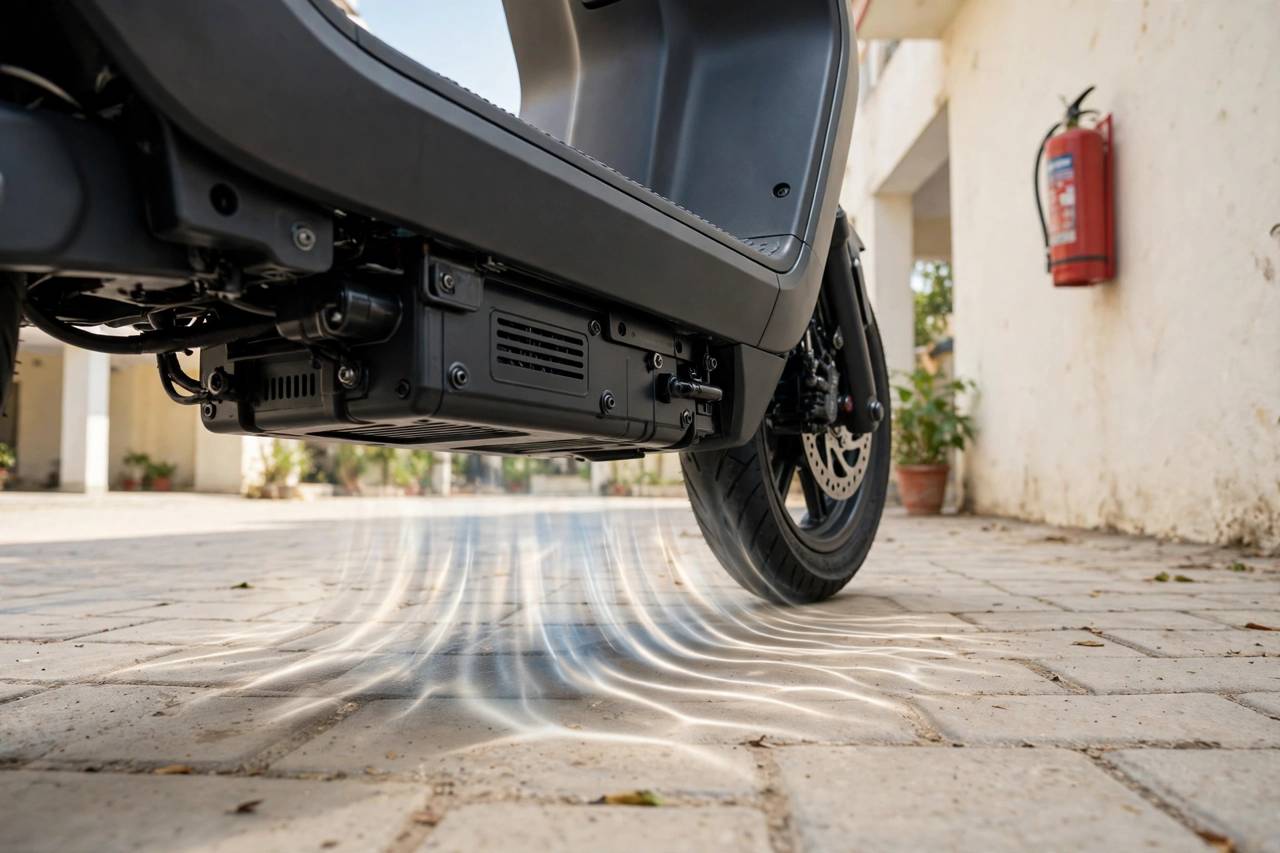
Editorial illustration: the battery area under an electric scooter in a residential parking space, with a fire extinguisher on the wall nearby.
Key Takeaways
Electric scooter fires start in the lithium-ion battery, when a defect, damage, a wrong charger or extreme heat pushes one cell into thermal runaway — a chain reaction that spreads heat from cell to cell.
India has no complete, centralised data on battery-fire incidents — the Ministry of Heavy Industries said so in February 2026 — so claims about how common scooter fires are should be treated with caution.
AIS-156 is India's mandatory battery safety standard for electric two-wheelers, tightened after the 2022 fires in two phases (December 2022 and March 2023), with certified cells, a microprocessor-based BMS and a thermal propagation test.
Under AIS-156 Phase 2, if a cell fails, the rider must get at least five minutes of warning to get away from the vehicle before any fire reaches them.
Prevention is mostly habits: use only the approved charger, let the battery cool 30 to 40 minutes before charging, charge in shade and ventilation, watch for heat, swelling, hissing or strange smells, and never try to fight a battery fire yourself — move away and call 112.
Electric scooters have become a common sight on Indian roads, but every few months a video of one catching fire goes viral and the same question comes back: why do electric scooters catch fire in India? The short answer is that the lithium-ion battery at the heart of every electric scooter stores a huge amount of energy in a small space, and when something goes wrong inside that battery — a manufacturing defect, physical damage, a faulty charger or extreme heat — the result can be a chain reaction called thermal runaway that ends in fire. Modern scooters are far safer than the ones that made headlines in 2022, thanks to stricter rules, but the risk has not disappeared entirely, and how you charge and care for your scooter still matters a lot.
It is worth putting the fear in perspective first. Petrol two-wheelers catch fire too, and they carry flammable fuel next to a hot engine. The difference with an electric scooter is that a battery fire burns hotter, spreads faster and is much harder to put out, because the battery releases oxygen as it burns. That is why battery safety gets so much attention, and why understanding the causes is the best protection a rider can have.
Why Do Electric Scooters Catch Fire in India?
The main cause of an electric scooter battery fire is thermal runaway. A lithium-ion battery pack is made of hundreds of individual cells packed tightly together. Each cell generates heat as it charges and discharges, and under normal conditions the battery management system, or BMS, keeps every cell inside a safe temperature and voltage range. But if one cell overheats — because of an internal short circuit, overcharging or damage — it starts a chemical reaction that produces even more heat. That heat spreads to the neighbouring cells, which overheat in turn, and the chain reaction can end in smoke, fire or even an explosion.
Several different triggers can start this chain reaction. A manufacturing defect is one: as a battery expands and contracts during use, a tiny metal protrusion inside a cell can bring the positive and negative electrodes into contact, causing an enormous current to flow. Poor quality cells and weak quality control were widely blamed for the string of electric scooter fires in India in 2022, when scooters from makers including Ola, Okinawa and Pure EV caught fire within days of each other. Physical damage is another trigger. A hard knock to the underbody in an accident, or riding over a sharp object, can dent or puncture the battery pack, and the damage may only show up as a fire after a few charging cycles.
Charging is the third big trigger, and the one riders can control most easily. Using a charger that is not approved for your scooter, overcharging, or relying heavily on fast charging can push cells beyond their designed limits. Faulty wiring and unauthorised electrical modifications — for example, fitting a bigger battery or tampering with the BMS — add further risk. Extreme heat matters too. Electric scooters are mostly air-cooled, unlike electric cars, which usually have liquid cooling, so in a hot Indian summer a battery pack parked in direct sunlight or charged immediately after a long ride in peak heat is already working closer to its limits.
One honest caveat is that India does not have complete, centralised data on battery-fire incidents. The Ministry of Heavy Industries said in February 2026 that there is no specific centralised tracking of such incidents, so claims about how common scooter fires are, or whether they are rising or falling, should be treated with caution. A detailed guide on [electric scooter fires in India, their causes and prevention](https://www.bikeleague.in/motorcycle-articles/motorcycle-safety-articles/electric-scooter-fires-in-india-causes-prevention/) makes the same point, and warns against presenting general EV accident figures as scooter fire statistics. What is certain is that the fires of 2022 forced the government to act, and that action changed the scooters sold in India today.
What Is the AIS-156 Battery Safety Standard?
AIS-156 is India's mandatory battery safety standard for electric two-wheelers, and it is the single most important reason new scooters are safer than the ones that caught fire in 2022. It applies to L-category electric vehicles — two-wheelers and three-wheelers — and every electric scooter sold in India must pass its tests and get type approval from agencies such as ARAI or ICAT before it can be sold legally. No type approval, no sale.
The standard was tightened sharply after the 2022 fires. The amended rules came in two phases: Phase 1 from 1 December 2022 and Phase 2 from 31 March 2023. Phase 1 brought in traceability of battery packs, an additional safety fuse, protection against faults from regenerative braking, minimum spacing between cells, and a microprocessor-based BMS with built-in protections. It also required cells to come from certified sources, cutting off the counterfeit-cell supply chain that was blamed for several of the 2022 incidents.
Phase 2 added the test that matters most to riders. In the thermal propagation test, one cell is deliberately forced into thermal runaway, and the pack must not catch fire or explode. The standard also requires an audio-visual warning of a thermal event, at least four temperature sensors in the BMS, and cells tested to the IS 16893 standard at accredited labs. A clear explainer of [the AIS-156 standard and its Phase 2 thermal runaway test](https://www.evpulse.co.in/blog/ais-156) sets out the same requirements. In practice, the rule means that if a cell fails, the rider must get at least five minutes of warning to get away from the vehicle before any fire reaches them. That five-minute window is the difference between a frightening incident and a tragedy.
For buyers, the practical lesson is simple: buy a scooter from a manufacturer that complies with the latest AIS-156 requirements, and be wary of very cheap, unbranded scooters or aftermarket battery swaps whose cells and BMS may never have been tested at all. A certified battery, a proper BMS and a reputable brand are the three things that stand between a rider and thermal runaway.
How to Prevent an Electric Scooter Fire: Charging and Daily Care
Most of the risk that remains after AIS-156 is in the rider's hands, and the habits that prevent fires are simple. The first rule is to use only the charger supplied with your scooter, or one approved by the manufacturer. A wrong charger can feed the wrong voltage or current into the pack and damage the BMS's ability to keep cells balanced. The second rule is about heat: do not charge the battery immediately after a ride. Let it cool down for at least 30 to 40 minutes first, and charge in a shaded, ventilated place rather than in direct sunlight or a closed, hot room. Avoid leaving the scooter plugged in overnight or for long periods after it is fully charged, and do not rely on fast charging for every charge.
Watch for warning signs, and treat them seriously. A battery that feels unusually hot, has swollen, leaks, makes hissing or cracking noises, or gives off a strange chemical smell should not be used or charged. Stop riding, move the scooter away from people and flammable material if it is safe to do so, and contact the manufacturer's authorised service centre. The same applies after any accident or hard impact to the underbody, even if the scooter looks fine — internal cell damage can take days to show up. Never attempt to open, repair or modify the battery pack yourself, and never use a battery that has been in a flood, since contaminated water can cause short circuits inside the pack.
Parking matters too. Park away from exits, stairwells and LPG cylinders, and never charge in a corridor or near the only escape route of a building. Keep a fire extinguisher handy if you charge at home, and make sure everyone in the family knows where the scooter is charged and what to do if it starts smoking.
What to Do If an Electric Scooter Catches Fire
If a scooter starts smoking or catches fire, the first priority is people, not property. Move away immediately, warn others, and call the fire services on 112. Do not try to put out a lithium-ion battery fire yourself — it burns extremely hot, releases toxic gases including hydrogen fluoride, and can reignite even after it appears to be out. Water from a bucket will not stop a battery fire, and standing close to a burning pack risks serious burns and toxic smoke inhalation. If the scooter is indoors, get everyone out and do not go back inside for belongings.
After the incident, report it to the manufacturer and, if the scooter is new, to the dealer. Manufacturers investigate such cases, and the findings feed back into battery design and safety recalls. If you are buying a used electric scooter, this is also why a battery health check matters — a pack with an unknown history, a replaced cell or a tampered BMS is a risk you cannot see from the outside. Our guide on [what to check before buying a second-hand electric scooter](https://indiaask.tech/question.php?slug=buying-second-hand-electric-scooter-checklist) covers the checks that matter, and our explainer on [electric scooter battery warranty claims](https://indiaask.tech/question.php?slug=ev-battery-warranty-claims-explained) explains what the warranty covers if a battery does fail.
Conclusion
So why do electric scooters catch fire in India? The fires start in the lithium-ion battery, when a defect, damage, a wrong charger or extreme heat pushes one cell into thermal runaway and the heat spreads from cell to cell. The 2022 fires showed how dangerous that chain reaction can be, but they also forced a real change: the AIS-156 standard now requires certified cells, a microprocessor-based BMS, and a thermal propagation test that gives riders at least five minutes to escape. A scooter bought from a reputable maker, charged with the right charger, allowed to cool before charging, and checked promptly when it shows warning signs is a safe machine. The risk has not vanished, but it is now largely a matter of standards, quality and simple habits — and all three are within a buyer's control.
Most electric scooter fires start in the lithium-ion battery, when a defect, physical damage, a wrong charger or extreme heat pushes one cell into thermal runaway — a chain reaction in which heat spreads from cell to cell until the pack catches fire. Poor quality cells and weak quality control were blamed for the string of fires in 2022, and the government has since tightened the AIS-156 safety standard for all electric two-wheelers.
What is the AIS-156 battery safety standard for electric scooters?
AIS-156 is India's mandatory battery safety standard for L-category electric vehicles, including electric two-wheelers. After the 2022 fires it was tightened in two phases — Phase 1 from 1 December 2022 and Phase 2 from 31 March 2023 — adding certified cells, a microprocessor-based battery management system, and a thermal propagation test. Under Phase 2, if a cell fails, the rider must get at least five minutes of warning to get away before any fire reaches them.
How can I prevent my electric scooter battery from catching fire?
Use only the charger supplied or approved by the manufacturer, let the battery cool for 30 to 40 minutes after a ride before charging, and charge in a shaded, ventilated place rather than in direct sunlight or a closed hot room. Do not leave the scooter plugged in long after it is fully charged, do not rely on fast charging for every charge, and never open, repair or modify the battery pack yourself.
What should I do if my electric scooter starts smoking or catches fire?
Move away immediately, warn others, and call the fire services on 112. Do not try to put out a lithium-ion battery fire yourself — it burns extremely hot, releases toxic gases and can reignite even after it appears to be out. If the scooter is indoors, get everyone out and do not go back inside for belongings. Afterwards, report the incident to the manufacturer and the dealer.
Read Next on IndiaAsk
If you are buying a used electric scooter, a battery health check matters — a pack with an unknown history or a tampered BMS is a risk you cannot see from the outside. Second-Hand Electric Scooter: Checklist Before You Buy