Home > E-Bikes & EV > How to Register an Electric Scooter in India? RTO Process, Green Number Plate, Documents and Road Tax Explained
How to Register an Electric Scooter in India? RTO Process, Green Number Plate, Documents and Road Tax Explained
By Vijay Pawar · 2026-11-10 · 11 min read · E-Bikes & EV
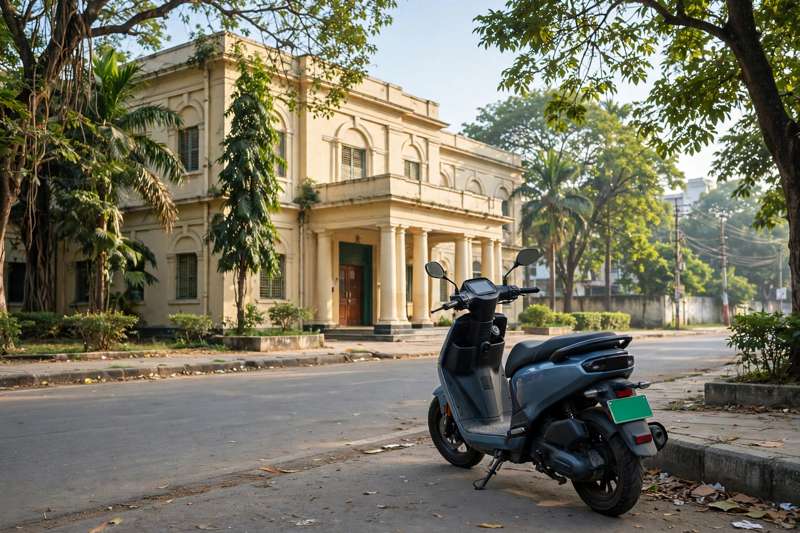
Editorial illustration: a modern electric scooter with a blank green number plate parked outside a government transport office building in India.
Key Takeaways
A scooter with a motor above 250W or a top speed above 25 km/h must be registered with the RTO; low-speed scooters within both limits need no registration, licence or plate.
Registration is usually dealer-led through the Vahan portal: Form 20, invoice, Forms 21 and 22, insurance and KYC documents, followed by RTO verification.
The registration certificate is valid for 15 years, and the green number plate is issued automatically — white lettering for private EVs, yellow for commercial ones.
The registration fee is waived for EVs nationwide under notification G.S.R. 525(E) of 2 August 2021; road tax is a state subject, with around 14 states and UTs offering a 100 per cent exemption as of 2026.
The process usually takes two to four weeks; a temporary number, generally valid for about a month, covers riding in the meantime.
Do You Need to Register Your Electric Scooter?
How to register an electric scooter in India is the first practical question most new buyers face — and the answer is not the same for every scooter. If you have just bought an electric scooter, or you are planning to buy one, registration decides whether you can legally ride it on public roads, whether you get the green number plate, and whether you can claim the subsidy and road tax benefits that come with an EV. The good news is that for most buyers the dealer handles almost everything. What you need to know is which scooters need registration at all, which documents to keep ready, and what to check so your registration certificate (RC) does not get delayed.
The short version is this: an electric scooter with a motor above 250W or a top speed above 25 km/h is legally a motor vehicle and must be registered with the RTO, insured, and ridden with a valid driving licence. A low-speed scooter that stays within both limits — 250W and 25 km/h — is not treated as a motor vehicle, so it needs no registration, no licence and no number plate. That one distinction shapes everything else in this guide.
First, Check Whether Your Scooter Needs Registration
The Central Motor Vehicles Rules draw a clear line between low-speed and high-speed electric two-wheelers, and the line is based on two numbers: motor power and top speed. If your scooter's motor is rated at 250W or less and its top speed is 25 km/h or less, it falls in the low-speed category. Such scooters are treated like bicycles in the eyes of the law — no RTO registration, no driving licence, no insurance and no number plate are required. Many of these are the small scooters used for short neighbourhood trips, and their makers usually advertise them as "no licence, no registration" models.
Cross either limit and the picture changes completely. A scooter with a motor above 250W, or a top speed above 25 km/h, is a motor vehicle under the Motor Vehicles Act, 1988. It must be registered with the Regional Transport Office before it is ridden on a public road, it must carry third-party insurance, and the rider must hold a valid driving licence. Riding an unregistered high-speed scooter can attract fines under the Motor Vehicles Act, and the vehicle can be impounded. Low-speed scooters also have a practical restriction worth knowing: they are meant for city roads and are not allowed on highways or expressways.
If you are unsure which side of the line your scooter falls on, check the sales invoice and the manufacturer's certificate — both mention the motor rating and the certified top speed. Do not go by what the showroom verbally promises; the invoice is the document the RTO will go by. Almost every popular electric scooter sold in India today — the ones with 2–4 kW motors and top speeds of 60–90 km/h — is a high-speed vehicle and needs full registration.
Documents You Need Before You Visit the RTO
Registration is mostly a paperwork exercise, and most delays happen because one document is missing or mismatched. Keep these ready before delivery day:
- **Sales invoice** from the dealer, showing the vehicle price, chassis and motor numbers, battery details, and fuel type recorded as battery or electric.
- **Form 20 (CMV20)**, the standard application for registration under the Central Motor Vehicles Rules. Your dealer normally fills and submits this for you.
- **Form 21 (sale certificate)** and **Form 22 (roadworthiness certificate)** from the dealer, confirming the transfer of ownership and that the vehicle meets the required standards.
- **Identity proof** — Aadhaar, PAN, passport or voter ID.
- **Address proof** — Aadhaar, passport, voter ID, utility bill or rental agreement.
- **Aadhaar-linked mobile number**, which is needed for e-KYC and for subsidy processing.
- **Valid motor insurance**, at least third-party cover, which is compulsory under Section 146 of the Motor Vehicles Act. New two-wheelers are typically sold with a five-year third-party policy, with the option of adding own-damage cover.
- **Passport-size photographs**, if your RTO still asks for them with offline applications.
One detail that trips up many buyers is the name and address on the documents. The name on the invoice, the insurance policy and your ID proof must match exactly — even a spelling difference between the invoice and the Aadhaar card can send the file back. Check the invoice the moment the dealer hands it to you, and get any error corrected before the registration file is submitted. If you are buying the scooter on a loan, the financier's name (hypothecation) is also entered in the RC, so keep the loan documents handy too.
How to Register an Electric Scooter in India: The Step-by-Step RTO Process
How to register an electric scooter in India is, in practice, a dealer-led process that runs through the government's Vahan portal. Here is how it works, step by step:
**Step 1: Buy from an authorised dealer and collect the invoice.** The dealer issues a sales invoice with the fuel type recorded as battery or electric, along with Forms 21 and 22. This is also the stage at which the dealer applies any subsidy you are eligible for, so ask for the subsidy to be shown separately on the invoice.
**Step 2: Arrange insurance.** You need at least third-party insurance before registration can go through. Most dealers bundle the policy with the sale. If you are arranging it yourself, compare covers — an own-damage add-on and a battery protection add-on are worth considering for an EV, since the battery is the most expensive part of the scooter. Our guide to electric scooter insurance explains the covers and the battery add-on in detail: https://indiaask.tech/question.php?slug=ev-insurance-cover-explained
**Step 3: Form 20 is filed on the Vahan portal.** The dealer fills in Form 20 (CMV20) with your details and the vehicle details, and submits it through the Vahan portal (https://parivahan.gov.in), the Ministry of Road Transport and Highways' official vehicle registration system. Your Aadhaar-linked mobile number is used for e-KYC at this stage. A step-by-step walkthrough of the registration process is also available here: https://www.vidaworld.com/blogs/electric-scooter-registration.html
**Step 4: RTO verification.** The RTO checks your documents and the vehicle details against the application. For a new scooter bought through an authorised dealer, this step is usually quick because the dealer has already pre-verified everything. In some cases the RTO may ask for a physical inspection of the vehicle to verify the battery and chassis details.
**Step 5: Temporary registration number.** In many cases you get a temporary registration number first, so you can ride the scooter while the permanent RC is processed. A temporary number is generally valid for about a month, which is usually enough time for the permanent registration to come through.
**Step 6: Permanent RC and green number plate.** Once approved, the RTO issues the registration certificate and the registration number. The RC for a new vehicle is valid for 15 years. The dealer or an authorised vendor then fits the High Security Registration Plate (HSRP) — the green plate for EVs — on the scooter.
The whole process usually takes two to four weeks from the date of purchase, though the exact time depends on your RTO's workload. If it stretches beyond a month, ask the dealer for the application number and check the status on the Vahan portal yourself instead of waiting for a call.
You can also do the process yourself at the RTO if your dealer does not offer registration, but for most buyers the dealer route is simpler: the dealer files the forms daily, knows the local RTO's requirements, and handles the HSRP booking. What you should never do is skip registration and ride on the temporary number after it expires — that leaves you uninsured and liable to fines.
The Green Number Plate: Which Colour Means What
Every registered electric vehicle in India carries a green number plate, introduced by the Ministry of Road Transport and Highways to identify battery-operated vehicles at a glance. The background is always green; the lettering changes with the type of use. A private electric scooter gets white lettering on the green background. A commercial EV, such as an e-taxi, gets yellow lettering, and a rent-a-cab EV gets black lettering. The plate is not something you apply for separately — it is issued automatically when the vehicle is registered and the fuel type is recorded as battery or electric.
The green plate does more than identify the vehicle. It is how toll operators, traffic police and parking systems recognise an EV, and in some states it is linked to benefits such as toll exemptions. Hybrid vehicles do not qualify — the green plate is reserved for pure battery-operated vehicles. A complete guide to the green plate rules is available here: https://www.evfy.in/blogs/ev-green-number-plate-rules-in-india-the-complete-rto-registration-guide
Registration Fees and Road Tax: What You Actually Pay
This is the part of the process where electric scooters are genuinely cheaper than petrol scooters. Under central notification G.S.R. 525(E), dated 2 August 2021, battery-operated vehicles are exempt from the fee for issuing a registration certificate anywhere in India. You still pay for the physical HSRP plate, but the core registration fee itself is waived.
Road tax is a different story because it is a state subject — each state sets its own rate under its own EV policy, and policies are revised from time to time. As of 2026, around 14 states and Union Territories offer a 100 per cent road tax exemption on electric scooters, including Delhi, Maharashtra and Tamil Nadu. Some states offer a partial exemption, and a few charge the normal rate. Because exemption windows have expiry dates that states keep changing, check your state's latest EV policy with your dealer or on the state transport department's website before you finalise the purchase — do not rely on a list you read months ago.
Two other costs are worth factoring in. First, GST on electric vehicles is a flat 5 per cent with no additional cess, which is lower than the GST on petrol two-wheelers. Second, if you are buying with a subsidy, the central PM E-DRIVE scheme offers an upfront incentive at the time of purchase, and several states add their own benefits on top. The subsidy is usually adjusted in the invoice itself, so confirm the final on-road price after the incentive rather than before it. Our guide explains how to claim the electric scooter subsidy, including the PM E-DRIVE amount, state benefits and the documents needed: https://indiaask.tech/question.php?slug=how-to-claim-electric-scooter-subsidy-india-explained
Mistakes That Delay Your Registration
Most registration delays are avoidable. The common ones are: a name or address mismatch between the invoice and the Aadhaar card; an insurance policy that starts after the registration filing date, which the RTO will not accept; a dealer who files the application late, leaving the temporary number to expire; and buying a scooter whose motor rating on the invoice is close to the 250W boundary without confirming whether it counts as low-speed or high-speed. A related mistake is buying first and checking the test ride later — a short test ride tells you whether the scooter suits your daily route before you commit to the paperwork. Our test ride checklist covers what to verify: https://indiaask.tech/question.php?slug=electric-scooter-test-ride-checklist-india-explained
Another avoidable problem is the HSRP appointment. The plate is fitted by an authorised vendor, not by the dealer or the RTO, and the appointment has to be booked separately in many cities. Ask the dealer at the time of delivery who books the HSRP and when, so the scooter is not left waiting without a plate after the RC arrives.
The Bottom Line
Registering an electric scooter in India is a straightforward process once you know which side of the 250W/25 km/h line your scooter falls on. For a high-speed scooter, the dealer files Form 20 on the Vahan portal with your invoice, insurance and KYC documents, the RTO verifies the file, and you receive a 15-year RC with a green number plate — with the registration fee waived under the 2021 central notification and road tax exempt in many states. Keep your documents consistent, confirm the subsidy and road tax position for your state before paying, and check the registration status on the Vahan portal if the RC takes longer than a few weeks. Do that, and the only thing left to think about is where to charge it.
Is registration mandatory for all electric scooters in India?
No. Only high-speed electric scooters need registration — those with a motor above 250W or a top speed above 25 km/h. Low-speed scooters that stay within both limits (250W and 25 km/h) are not treated as motor vehicles, so they need no RTO registration, no driving licence and no number plate. Almost every popular electric scooter sold today is a high-speed model and must be registered.
How long does electric scooter registration take in India?
Usually two to four weeks from the date of purchase. The dealer files Form 20 on the Vahan portal, the RTO verifies the documents, and the permanent registration certificate (RC) is then issued. You often get a temporary registration number first, generally valid for about a month, so you can ride while the permanent RC is processed. If it takes longer than a month, ask the dealer for the application number and check the status on the Vahan portal.
What is the cost of registering an electric scooter in India?
The registration certificate issuance fee is waived for battery-operated vehicles across India under central notification G.S.R. 525(E) of 2 August 2021. You still pay for the physical High Security Registration Plate (HSRP). Road tax depends on your state — around 14 states and Union Territories offer a 100 per cent exemption as of 2026, while others charge a partial or full rate, so check your state's latest EV policy before buying.
Can I register my electric scooter myself, or does the dealer have to do it?
The dealer usually handles it — dealers file Form 20 on the Vahan portal daily and know the local RTO's requirements. You can also apply yourself at the RTO with Form 20, the sales invoice, Forms 21 and 22, insurance, and your ID and address proof. For most buyers the dealer route is simpler, but do confirm who books the HSRP fitting, since that appointment is often separate.
Do I need a driving licence to ride an electric scooter?
Yes, for a high-speed electric scooter — one with a motor above 250W or a top speed above 25 km/h — a valid driving licence is mandatory, and the minimum age is generally 18. Low-speed scooters (250W and 25 km/h or below) need no licence at all, but they are meant for city roads and are not allowed on highways or expressways.