Home > E-Bikes & EV > How to Start an EV Charging Station Business in India? Investment, Profit and Step-by-Step Setup Explained
How to Start an EV Charging Station Business in India? Investment, Profit and Step-by-Step Setup Explained
By Vijay Pawar · 2026-11-23 · 11 min read · E-Bikes & EV
Starting an EV charging station business in India: a small AC setup can begin at Rs 2-4 lakh, while a DC fast-charging station typically needs Rs 15-25 lakh. Location and daily usage decide the profit.
Key Takeaways
Setting up a public EV charging station is a de-licensed activity — no separate electricity distribution licence is needed.
A basic AC setup costs roughly Rs 2-4 lakh; a commercial DC fast-charging station typically needs Rs 15-25 lakh.
PM E-DRIVE's Rs 2,000 crore for charging goes to government entities, so private franchisees should not budget for a direct central subsidy.
Profit depends on utilisation: the service charge for DC fast charging is capped at Rs 11-13 per unit before GST and land cost.
Get the DISCOM load sanction and grid-connection quote before ordering chargers — grid work can cost more than the charger itself.
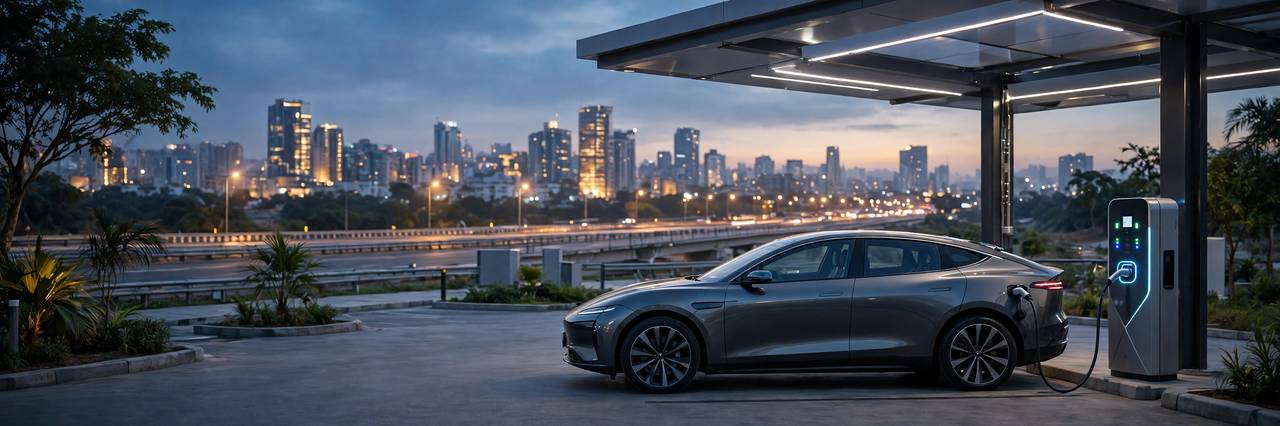
If you own a parking space, a petrol pump, a shop on a busy road or even a small plot near a highway, you may be sitting on a business that did not exist five years ago. Learning how to start an EV charging station business in India is now a serious option for small investors, because electric vehicles are no longer a niche: India had more than 50,000 public charging stations by mid-2026, and the government plans to take that number far higher before 2030. The demand is real, the rules are clearer than they were, and the entry cost can be as low as a few lakh rupees if you start small. This guide explains the investment, the business models, the step-by-step setup, the profit math and the mistakes to avoid.
Why this business makes sense now
Three things have come together at the same time. First, EV sales keep growing: electric two-wheelers, three-wheelers and cars are now a common sight in Indian cities, and every one of them needs charging away from home sooner or later. Second, the government has made setting up a public charging station a de-licensed activity, which means you do not need a separate electricity distribution licence to sell charging. Third, the PM E-DRIVE scheme has set aside Rs 2,000 crore for public charging infrastructure and plans 72,300 public fast chargers, which keeps the whole ecosystem moving.
The opportunity is biggest where cars park and wait: malls, office complexes, hotels, hospitals, highway dhabas and petrol pumps. A driver who stops for 30 to 45 minutes will happily pay for a fast charge while they eat or shop. That is the core insight of this business: you are not selling electricity, you are selling a convenient stop.
How much does it cost to start an EV charging station in India?
The honest answer is that it depends entirely on the charger you install. A slow AC charger and a DC fast charger are different businesses with different price tags. The figures below are indicative planning ranges from 2026 market guides, not fixed quotations; always take itemised quotes before you commit.
| What you pay for | Indicative cost |
|---|---|
| 7.4 kW AC charger | Rs 50,000 to Rs 1.5 lakh |
| 30 kW DC fast charger | Rs 8 to 12 lakh |
| 60 kW DC fast charger | Rs 15 to 20 lakh |
| Grid connection and transformer | Rs 2 to 15 lakh, depending on load and distance |
| Civil work, canopy, signage and lighting | Rs 2 to 5 lakh |
| Software, payment app and CMS | Usually bundled by the charger brand or franchise |
Put together, a basic setup with two AC chargers can be done for roughly Rs 2 to 4 lakh, a commercial setup with one DC fast charger and one AC charger costs around Rs 15 to 25 lakh, and a multi-charger highway station with two DC fast chargers can run to Rs 30 to 50 lakh. Franchise packages advertised in 2026 start from about Rs 9.99 lakh and go up to Rs 30 lakh and beyond, depending on the brand and the charger size. The grid connection is the cost most beginners underestimate: if your site needs a transformer or a long cable run, that one line item can cost more than the charger itself.
Choose your business model: franchise or independent?
There are three practical ways to enter this business, and the right one depends on how much money you have and how hands-on you want to be.
In the franchise-owned, franchise-operated (FOFO) model, you invest in the equipment, land setup and electricity connection, while a charge point operator (CPO) gives you branding, software and technical support. You run the station and keep most of the revenue after paying a royalty or software fee. This suits someone who wants to operate the business themselves.
In the franchise-owned, company-operated (FOCO) model, you invest in the hardware and setup, but the CPO manages daily operations, maintenance and billing, and pays you a revenue share. This is the passive-income route, and it suits investors who own a good location but do not want to run a station day to day.
In the independent model, you buy chargers from any vendor, set up your own station and run it under your own name. You keep all the revenue, but you also arrange everything yourself: software, payment collection, maintenance and marketing. This works best for experienced operators at high-traffic locations.
If you already own a petrol pump, a restaurant or a parking lot, the FOFO model is usually the best starting point: you bring the location, the brand brings the system.
How to start an EV charging station business in India: step by step
Step 1 is the location survey. Walk your site at different times of the day and count the EVs passing by. Good locations have three things: vehicles that stop for at least 20 minutes, easy entry and exit, and enough electrical load nearby. A mall parking bay, a highway dhaba and a fleet parking yard are all better than a quiet residential lane.
Step 2 is choosing the charger mix. For two-wheelers and three-wheelers, AC chargers are enough. For cars on a highway, at least one DC fast charger is what brings customers in. Most successful small stations start with one DC fast charger and one or two AC chargers, then add more as usage grows.
Step 3 is the electricity connection. Apply to your local DISCOM for an EV tariff connection with the sanctioned load your chargers need. Under the Ministry of Power guidelines, the DISCOM must give the connection within set timelines, which range from 3 to 90 days depending on the area. Get the load sanction in writing before you order chargers.
Step 4 is buying the chargers and the software. Buy only chargers that meet the technical standards in the Ministry of Power's 2024 charging guidelines, and make sure they support the connectors your customers actually use — for a deeper look at what those are, read our guide to [public charging connectors in India](https://indiaask.tech/question.php?slug=ev-public-charging-connectors-explained). The software, called a CMS, handles billing, remote monitoring and payments; without it you cannot run a public station properly.
Step 5 is civil work and safety. You need a concrete pad, a weather canopy, clear signage, lighting, earthing and fire safety equipment. Get a licensed electrical contractor for the installation, and keep all test certificates.
Step 6 is going live on charging apps. Register your station on the major charging apps and on the national database maintained by the Bureau of Energy Efficiency (BEE), the central nodal agency for charging infrastructure. Drivers find stations through apps, so a station that is not listed is almost invisible — our guide to [EV charging apps and payment networks](https://indiaask.tech/question.php?slug=ev-charging-apps-payment-networks-explained) explains how drivers choose where to charge.
Step 7 is pricing and operations. Set your per-unit price, keep the station clean and working, and respond quickly when a charger goes down. In this business, one broken charger with no one to fix it loses more money than any pricing mistake.
How much can you earn? The profit math
Your earning per unit of electricity is the service charge you add on top of your electricity cost. The Ministry of Power's 2024 guidelines cap the service charge for DC fast charging at Rs 11 per unit from 9 am to 4 pm and Rs 13 per unit at other hours, before GST and land cost, until 31 March 2028. Charging is a taxable service at 18% GST, so a Rs 20 per unit price leaves you about Rs 16.95 after GST.
A simple example shows how the numbers work. Suppose your 60 kW DC fast charger sells 150 units a day at an average of Rs 18 per unit. That is Rs 2,700 a day in revenue, or about Rs 81,000 a month. If your electricity cost is around Rs 8 per unit, your gross margin is roughly Rs 1,500 a day before rent, staff, maintenance and loan repayments. The real variable is utilisation: a charger that sells 50 units a day and one that sells 200 units a day are the same machine with very different businesses attached.
Franchisors' own payback estimates range from about 1.7 years to more than 5 years, because each one assumes different daily usage. Treat every payback claim with caution, and do your own math with conservative usage numbers — assume half the vehicles the seller promises, and see if the business still works.
Licences, rules and subsidies you must know
The most important rule is the simplest one: setting up a public charging station is a de-licensed activity, so no separate licence is needed, as long as you meet the technical, safety and performance standards set by the Ministry of Power, BEE and the Central Electricity Authority. You will still need the usual local permissions: a trade licence, fire safety clearance where required, and the DISCOM connection.
On subsidies, be careful about what you read online. The PM E-DRIVE scheme's Rs 2,000 crore for charging stations is routed through government ministries, central public sector enterprises, states and their PSUs, which are the entities eligible to submit proposals — a private franchisee should not budget for a direct subsidy from this scheme. Some states run their own capital subsidies for public chargers, so check your state EV policy before investing. The official scheme guidelines and the list of operational guidelines are published on the [PM E-DRIVE portal](https://pmedrive.heavyindustries.gov.in/policy_procedure), and the government's own explanation of who can apply is in this [PIB release on EV charging infrastructure under PM E-DRIVE](https://www.pib.gov.in/PressReleasePage.aspx?PRID=2200851®=3&lang=1).
Mistakes that kill new charging stations
The first mistake is picking a location by gut feeling instead of by traffic. A station on a road with few EVs will stay empty no matter how good the charger is. The second mistake is buying the cheapest charger available: unreliable hardware means downtime, and downtime means angry customers and bad reviews on charging apps. The third mistake is ignoring the grid cost — get the DISCOM quote before you sign any franchise agreement, not after. The fourth is forgetting working capital: you pay the electricity bill every month, but your revenue builds slowly. And the fifth is treating this as a fully passive investment: even in the FOCO model, someone has to watch uptime, cleanliness and customer complaints, or the station quietly dies.
Frequently asked questions
**How much money do I need to start an EV charging station in India?**
A small AC-only setup can start at roughly Rs 2 to 4 lakh, a commercial DC fast-charging station typically needs Rs 15 to 25 lakh, and a highway hub can cost Rs 30 to 50 lakh or more. The biggest variable is the grid connection, which can add Rs 2 to 15 lakh depending on the site.
**Do I need a licence to open an EV charging station?**
No. Setting up a public charging station is a de-licensed activity under the Ministry of Power's 2024 guidelines. You still need a DISCOM electricity connection, local trade permissions and fire safety clearance where applicable, and your chargers must meet the prescribed technical standards.
**Can I get a subsidy for an EV charging station?**
The PM E-DRIVE scheme's charging funds go to government ministries, CPSEs, states and their PSUs, not directly to private franchisees, so do not count on a central subsidy. Some states offer their own capital subsidies for public chargers — check your state EV policy for the current rules.
**How profitable is an EV charging station?**
It depends almost entirely on utilisation. A well-placed DC fast charger can pay back in roughly 2 to 4 years at good usage, but a poorly placed one may never recover its cost. Do the math with conservative daily sales before investing, and remember that electricity, GST, rent and maintenance all come out of the per-unit price.
Conclusion
Starting an EV charging station business in India is a genuine opportunity in 2026, but it rewards location and patience more than money alone. Start small with one DC fast charger and one or two AC chargers at a site where vehicles already stop, get your DISCOM load sanction before you spend on hardware, and choose a business model that matches how involved you want to be. Do not budget for a central subsidy that is meant for government entities, and do not believe any payback promise that assumes your chargers will run full all day. If the numbers work at half the promised usage, you have a business worth building — and as India's EV fleet keeps growing, the station you build today will only get busier.
How much money do I need to start an EV charging station in India?
A small AC-only setup can start at roughly Rs 2 to 4 lakh, a commercial DC fast-charging station typically needs Rs 15 to 25 lakh, and a highway hub can cost Rs 30 to 50 lakh or more. The biggest variable is the grid connection, which can add Rs 2 to 15 lakh depending on the site.
Do I need a licence to open an EV charging station?
No. Setting up a public charging station is a de-licensed activity under the Ministry of Power's 2024 guidelines. You still need a DISCOM electricity connection, local trade permissions and fire safety clearance where applicable, and your chargers must meet the prescribed technical standards.
Can I get a subsidy for an EV charging station?
The PM E-DRIVE scheme's charging funds go to government ministries, CPSEs, states and their PSUs, not directly to private franchisees, so do not count on a central subsidy. Some states offer their own capital subsidies for public chargers — check your state EV policy for the current rules.
How profitable is an EV charging station?
It depends almost entirely on utilisation. A well-placed DC fast charger can pay back in roughly 2 to 4 years at good usage, but a poorly placed one may never recover its cost. Do the math with conservative daily sales before investing, and remember that electricity, GST, rent and maintenance all come out of the per-unit price.