What to Check Before Buying an Electric Scooter in India? Test Ride Checklist Explained
Key Takeaways
- Match range to your real commute with a buffer: a 30 km daily trip needs about 50 km of real-world range
- Test ride the exact variant for at least twenty minutes on real roads, mostly in the everyday riding mode
- Test brakes from around 40 km/h, suspension over a speed breaker, and low-speed handling in a U-turn
- Get the battery warranty in writing: duration, kilometre limit, and whether degradation is covered
- Confirm the complete on-road price, incentive position, insurance and licence category before paying, and inspect the delivered scooter at the showroom
What to check before buying an electric scooter is the question that matters most after you have shortlisted two or three models. Brochures and showroom lights make every scooter look perfect, but a scooter is something you will ride every day through traffic, speed breakers, rain and bad patches of road. A short, careless test ride hides exactly the problems that will annoy you for years: a seat that hurts after twenty minutes, brakes that feel vague at speed, a throttle that jerks in slow traffic, or a charging setup that does not fit your home. This checklist walks through what to check before you sign anything, in the order a real buyer should check it: first your own daily ride, then the scooter on the road, then the battery and warranty, and finally the paperwork and price.
Before You Leave Home: Match the Scooter to Your Daily Ride
The most useful preparation costs nothing and takes ten minutes. Write down your real daily route: the round-trip distance, the longest single trip you make in a normal week, how often you carry a pillion, and whether your route has steep slopes, flyovers or long stretches of bad road. Then add a buffer. If your daily round trip is 30 km, a scooter that delivers about 50 km in real conditions is a comfortable choice, because range always falls with pillion weight, faster riding, headwinds and older batteries. A scooter whose claimed range only just covers your commute will leave you anxious within a year.
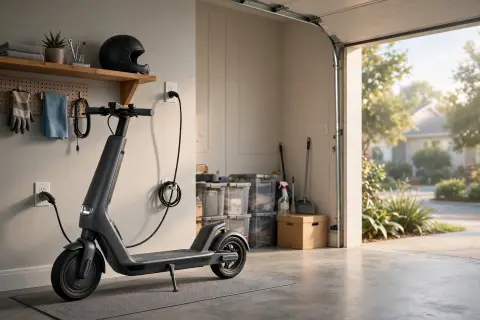
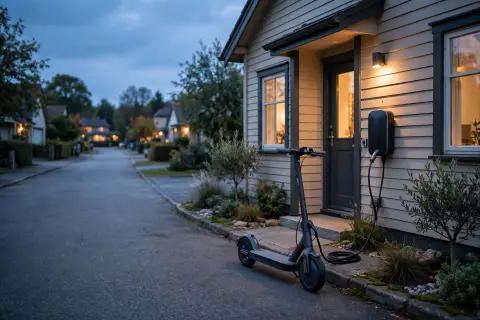
Charging access decides more purchases than top speed does. Ask yourself where the scooter will actually charge every night. If you live in an independent house with a parking spot near a socket, most fixed-battery scooters work fine. If you live in an apartment, a rented house or a building without fixed parking, a removable battery or a confirmed society charging arrangement matters far more than a bigger battery. Our guide to [home charging for electric scooters](https://indiaask.tech/question.php?slug=home-charging-evs-explained-india) explains sockets, charging time and apartment safety in detail, and it is worth reading before you visit a showroom. Also check the service network before falling in love with a model: find out where the nearest service centre is, not just the showroom, and whether spare parts are stocked locally. A beautiful scooter with a service centre two districts away becomes a burden the first time something breaks.
What to Check Before Buying an Electric Scooter on the Test Ride
Book a test ride on the exact variant you plan to buy, not just a similar model from the same brand, because seat height, suspension tuning and even throttle feel can differ between variants. Tell the dealer you want at least twenty minutes and a route that includes your kind of roads: a U-turn in a tight lane, a speed breaker, a slope if one is nearby, and a stretch where you can reach normal city speed. A five-minute loop around the showroom block tells you almost nothing.
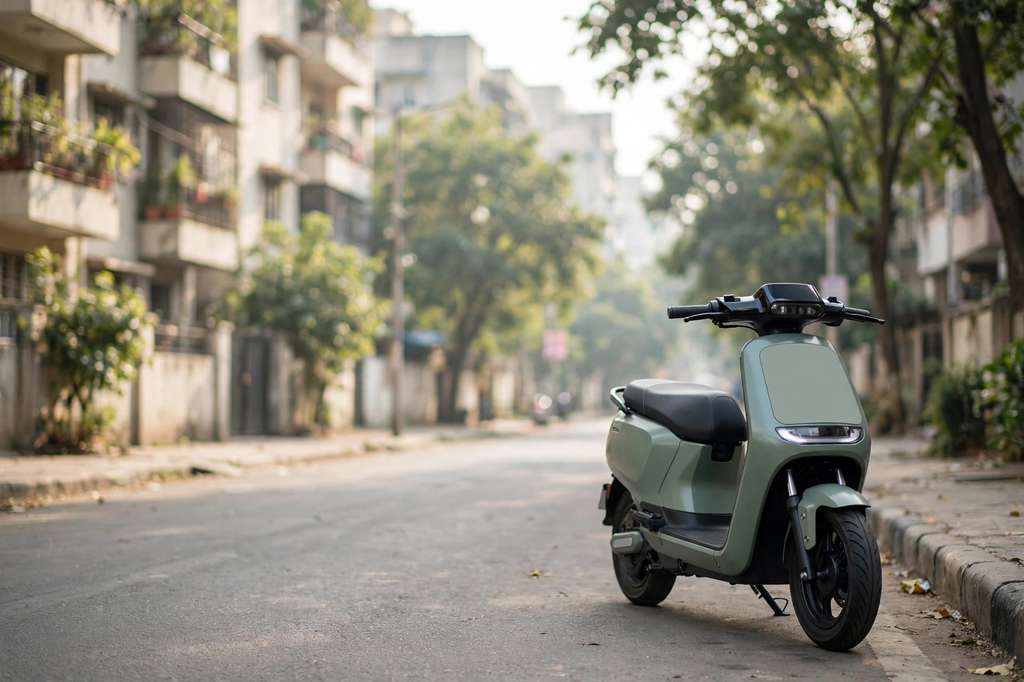
Start before you move. Sit on the scooter and check whether both feet reach the ground comfortably, whether the handlebar reach feels natural, and whether the seat supports you without pushing you forward. If a pillion rides with you regularly, bring them along: check the footboard space, the grab rail position and whether the seat is wide enough for two. Then check the everyday practicalities that brochures skip: can you fit your helmet under the seat, is the floorboard wide enough for a grocery bag, and can you read the display clearly in bright sunlight? A display that washes out in the sun forces you to guess your speed and remaining range, which is a daily irritation.
Now ride in the mode you will actually use. Most scooters offer Eco, Ride or Normal, and Sport modes. Spend most of the test ride in the everyday mode, not Sport, because that is where you will spend most of your riding life. Check whether Eco mode has enough punch to merge into traffic and climb a small slope without feeling strained. Then try the other modes briefly so you know what the scooter does when you need extra power. Pay attention to the throttle: electric acceleration is instant, and on some scooters the first twist feels jerky in slow traffic. A smooth, predictable throttle matters far more in daily traffic than a fast 0 to 40 km/h figure. If the scooter has regenerative braking, notice whether slowing down feels gentle and natural or abrupt; it should feel like engine braking, not like someone pulling a brake lever.
Brakes, Suspension and Handling: The Five-Minute Road Test
Brakes deserve a deliberate test, not a casual squeeze. On a safe, empty stretch, brake from around 40 km/h using both brakes together and notice whether the stop feels controlled and straight, or whether the scooter pulls to one side or the wheels lock too easily. Ask which braking setup the variant has: some scooters use combined braking, others use disc brakes at one or both ends, and the difference shows up in wet conditions. While you are at it, ride over a speed breaker at normal speed and notice whether the suspension absorbs it or sends a sharp thud through the handlebar and seat. Indian roads punish stiff suspension daily, so comfort over bad patches is a real buying reason, not a luxury.
Handling at low speed matters as much as stability at speed. Try a slow U-turn and a tight parking manoeuvre, and notice the scooter's weight and balance. Electric scooters carry their battery low, which usually helps stability, but a heavy scooter with a high seat can still feel awkward for a shorter rider. If the scooter has a reverse mode, test it in the parking area: backing a heavy scooter out of a tight spot by hand gets old quickly. Also listen. An electric scooter should be nearly silent, so any rattles, squeaks or grinding sounds on a new demo vehicle are worth asking about rather than ignoring.
Battery, Charging and Warranty Questions to Ask the Dealer
The battery is the most expensive part of the scooter, so this conversation deserves more time than the feature list. Ask three things in writing: the warranty duration, the kilometre limit, and whether battery health degradation is covered, meaning whether the warranty promises a minimum usable capacity after a certain age. A long warranty is far less useful if it only covers complete failure and not a battery that has faded to half its range. Also ask the replacement cost of the battery pack outside warranty, even if the number is only approximate, because it shapes the scooter's long-term cost. Our earlier guide to [real-world versus claimed range](https://indiaask.tech/question.php?slug=ev-range-explained-real-world-vs-claimed) explains why claimed figures and daily figures differ, and what to expect once the battery ages.
On charging, get specifics for your variant: the battery size in kilowatt-hours, the full-charge time on a normal household socket, and whether a fast charger is included or sold separately. Ask whether the battery is fixed or removable, and if removable, lift it yourself to judge the weight: a battery you cannot comfortably carry upstairs defeats the purpose of a removable pack. Ask about the charger too: is it portable, does it need a 15-ampere socket, and is the charging cable long enough for your parking spot? Finally, ask about software: whether the scooter receives over-the-air updates, what the connected app actually controls, and whether any connected features need a paid subscription after the first year. A feature that quietly becomes a subscription is a cost, not a freebie.
Paperwork, On-Road Price and Delivery Checklist
Before paying, get the complete on-road price in writing, broken into ex-showroom price, registration, insurance and accessories, and check whether any central or state incentive has already been applied to the quoted figure. Incentive schemes and their amounts change from time to time, so ask the dealer to show the current position rather than relying on an old advertisement. Compare insurance quotes separately, because the dealer quote is not always the cheapest, and check whether battery cover is included or needs an add-on. If you are financing the scooter, compare the total interest over the full loan period, not just the monthly EMI, and check for foreclosure charges.
Two legal points are worth knowing. A low-speed electric two-wheeler with a motor up to 250 watts and a top speed up to 25 km/h is generally exempt from licence and registration, but every mainstream scooter with a larger motor and higher speed is treated as a motor vehicle: it needs a valid driving licence, registration with a green number plate, and insurance. Confirm which category your model falls into with the dealer and your local transport office, and do not accept a verbal assurance on this. At delivery, inspect the actual scooter, not the demo vehicle: check the paint and panels, the tyre condition, that the charger and both keys are present, that the display shows a healthy battery, and that the warranty card and invoice mention the correct variant, chassis number and battery serial number. Take a photo of the odometer reading at delivery, and test-ride the delivered scooter briefly before leaving the showroom.
Conclusion
A good electric scooter purchase is decided on the test ride and in the warranty fine print, not in the brochure. Match the range to your real commute with a buffer, confirm charging at your actual parking spot, ride the exact variant on real roads for at least twenty minutes, test the brakes and suspension deliberately, and get the battery warranty and on-road price in writing. If a dealer rushes any of these steps, that itself is information: a scooter you cannot test properly is a scooter you should not buy yet. Spend one careful morning on this checklist, and the scooter you bring home will still feel like the right choice a year later, when the novelty has worn off and only the daily ride remains.
For a broader comparison of models before you shortlist, see BikeWale's [five checks before buying an electric scooter](https://www.bikewale.com/news/electric-scooters-five-checks-before-buying/), and for a structured buying framework, Vida's [electric scooter buying guide for India](https://www.vidaworld.com/blogs/electric-scooter-buying-guide-for-india.html).
Frequently Asked Questions (FAQ)
How long should an electric scooter test ride be?
At least twenty minutes on the exact variant you plan to buy, on a route that includes a tight U-turn, a speed breaker, a slope if one is nearby, and a stretch at normal city speed. A five-minute loop around the showroom block will not reveal seat discomfort, vague brakes or a jerky throttle in slow traffic. Spend most of the ride in the everyday riding mode, not Sport, and bring your regular pillion along if one rides with you.
What should I check during an electric scooter test ride?
Check that both feet reach the ground, the handlebar reach feels natural, and the seat supports you without pushing you forward. Then check practical things: helmet storage under the seat, floorboard space, and whether the display is readable in bright sunlight. On the road, test the throttle smoothness in slow traffic, braking from around 40 km/h with both brakes, suspension over a speed breaker, and low-speed handling in a U-turn.
What should I ask about the electric scooter battery warranty?
Ask for three things in writing: the warranty duration, the kilometre limit, and whether battery health degradation is covered, meaning a promised minimum usable capacity after a certain age. A warranty that only covers complete failure is far less useful than one that covers a battery faded to half its range. Also ask the approximate replacement cost of the battery pack outside warranty.
How much range do I really need in an electric scooter?
If your daily round trip is 30 km, choose a scooter that delivers about 50 km in real conditions, because range falls with pillion weight, faster riding and battery age. Also check charging access first: a fixed-battery scooter suits a house with a socket near parking, while an apartment or rented house may need a removable battery or a confirmed society charging arrangement.
Do I need a driving licence for an electric scooter in India?
A low-speed electric two-wheeler with a motor up to 250 watts and a top speed up to 25 km/h is generally exempt from licence and registration. Every mainstream scooter above those limits is treated as a motor vehicle and needs a valid driving licence, registration with a green number plate, and insurance. Confirm your model's category with the dealer and your local transport office before buying.
Read Next on IndiaAsk
- Shortlisted models but not sure which one fits you? Start with our first-scooter choosing guide. Best First Electric Scooter in India: How to Choose Right
- Before you buy, confirm charging at your actual parking spot with our home charging guide. EV Home Charging: Sockets, Charging Time, Safety, Apartments
Related Articles
Answers
No approved answers yet — you can give the first answer.
Give Your Answer
Discussion
No approved comments yet.