Home > E-Bikes & EV > Home Charging for EVs Explained: Sockets, Charging Time, Safety and Apartment Options
Home Charging for EVs Explained: Sockets, Charging Time, Safety and Apartment Options
By IndiaAsk Editorial Team · 2026-10-26 · 6 min read · E-Bikes & EV
Overnight home charging suits most two-wheeler owners, provided the socket, wiring and parking arrangement are checked first.
Key Takeaways
Most two-wheelers charge from an ordinary earthed household socket overnight.
Charging time depends on battery size, starting charge, charger power and temperature.
Avoid extension boards for regular charging and have old or doubtful wiring checked.
Apartment owners should agree a metered parking-bay connection before buying.
A removable battery is a practical fallback where a parking-point socket is not possible.
For most electric two-wheeler owners, home charging is the whole point. You plug in at night, wake up to a full battery, and rarely think about public chargers at all. Yet home charging is also where new buyers have the most questions: which socket do I need, how long will it really take, is it safe, and what if I live in an apartment? This guide answers those questions in practical terms, without assuming any electrical knowledge.
The key idea is simple. Home charging is slow compared with a petrol fill-up, but it happens while you sleep, so for daily city use it is usually more convenient, not less. Problems arise only when the parking spot, the wiring, or the building rules have not been checked in advance.
The three kinds of charging you will hear about
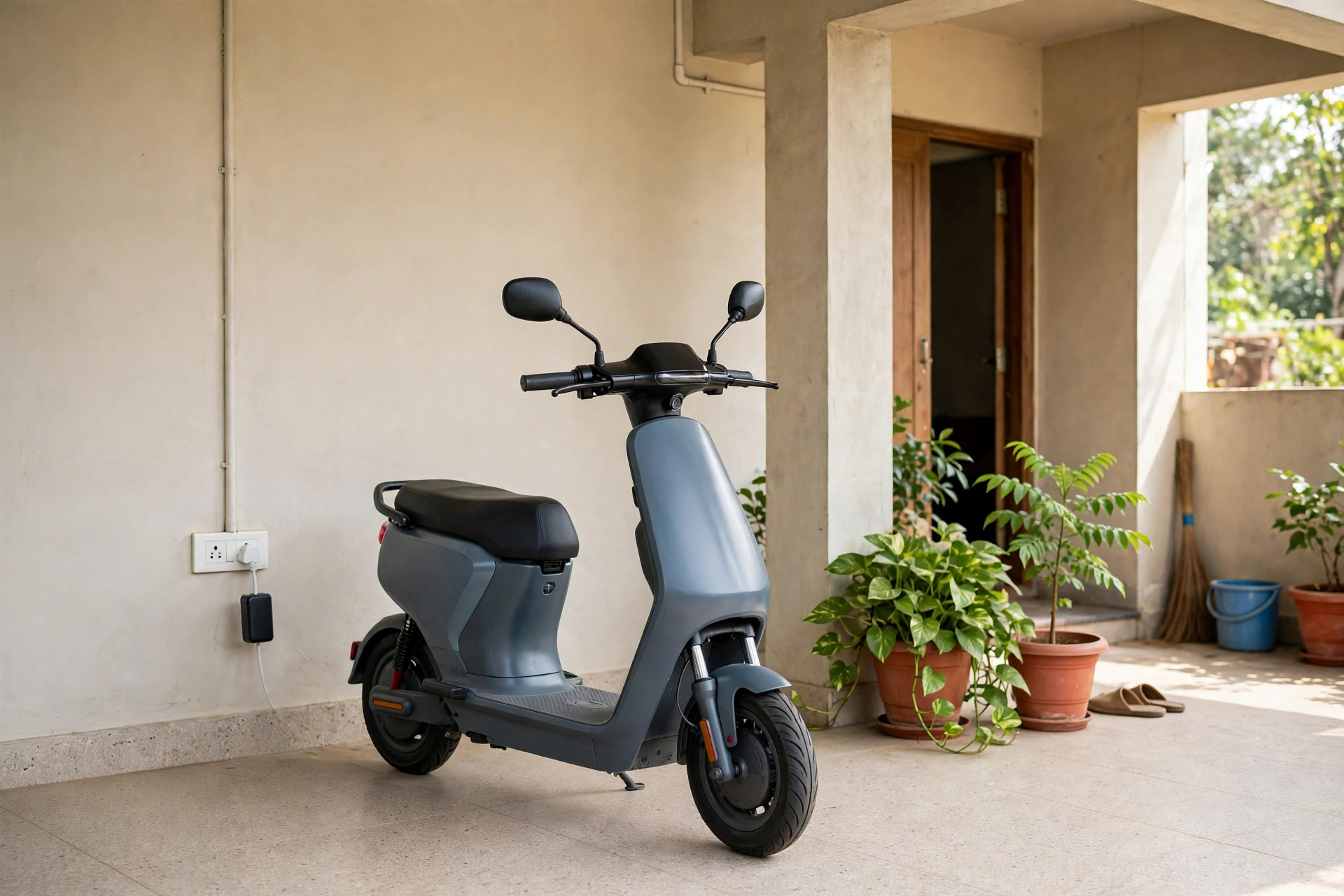
At home, almost all electric scooters and bikes charge from an ordinary wall socket, often called slow or AC charging. The bike's own charger converts the household supply into the form the battery needs. This is the cheapest and simplest setup, and it suits overnight charging.
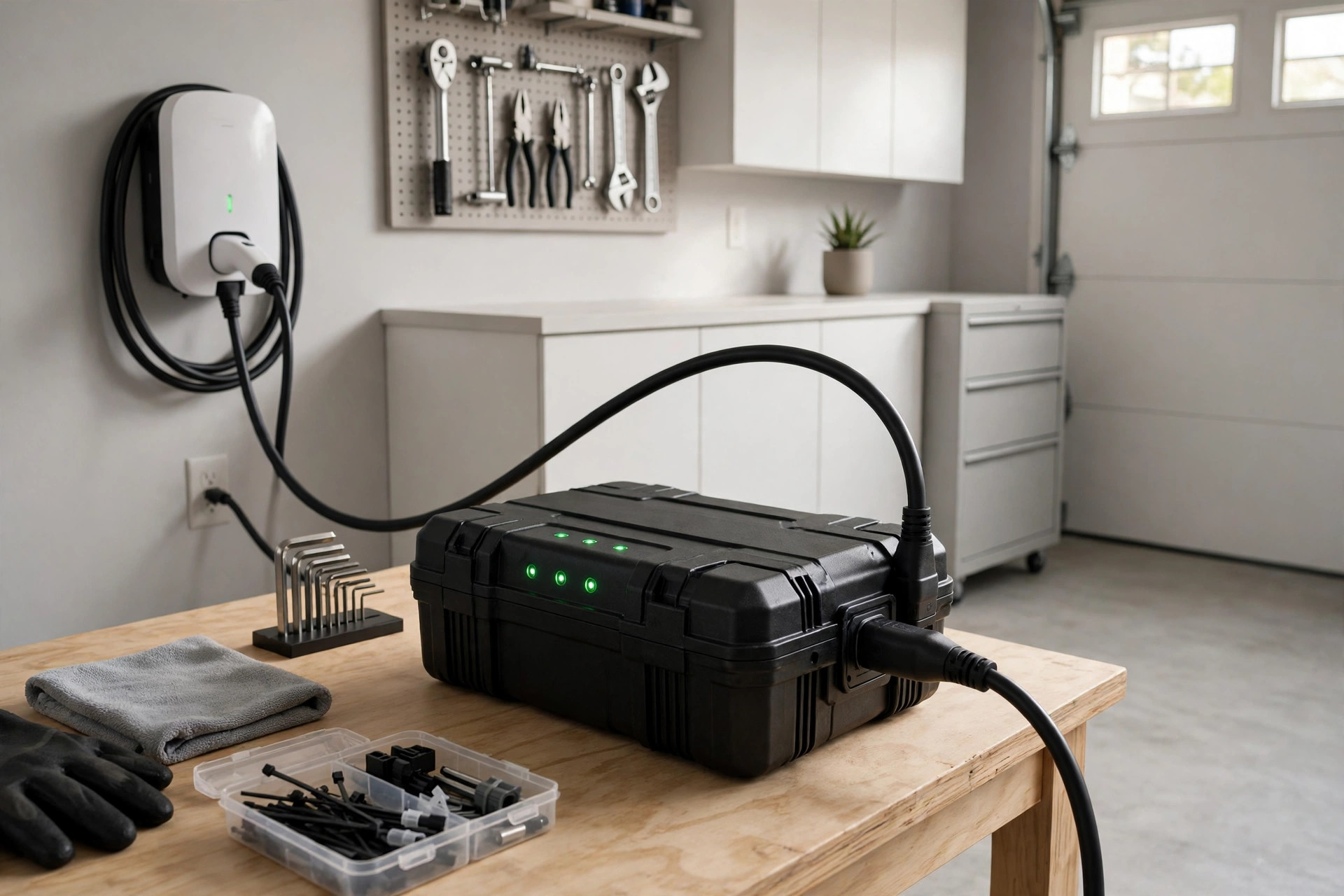
The next level is a dedicated home charger, sometimes called a wall box. It is wired into your home's electrical system by an electrician and can deliver power faster than a standard socket. It is more common for electric cars than for two-wheelers, but some two-wheeler owners install one for convenience and safety, especially if they charge daily.
Public fast charging is the third kind. Public chargers deliver much higher power and can add a useful amount of range in under an hour, depending on the vehicle. They are handy on long trips, but they are not a substitute for home charging in daily life, and not every two-wheeler supports every public connector type. Before relying on a public charger, check that your bike's connector and charging system are compatible with it.
What actually decides how long charging takes
Charging time is not a single fixed number. It depends on four factors. First, battery size: a bigger battery holds more energy and takes longer to fill. Second, how empty the battery is: charging from 20 percent to 80 percent is faster than charging from zero to full, because charging usually slows down near the top to protect the battery. Third, charger power: a higher-power charger fills the battery faster, up to the limit the bike itself allows. Fourth, temperature: very hot or cold batteries may charge more slowly as the battery management system protects the cells.
That is why manufacturers quote charging times as a range or for a specific condition, such as zero to 80 percent. For planning, assume an overnight window. If you arrive home at 8 pm with a half-empty battery and leave at 8 am, a standard home socket will usually be more than enough for a two-wheeler. If you regularly arrive late and leave early with a nearly empty large battery, talk to the dealer about a higher-power home option.
Safety checks before you plug in every day
Home charging is safe when the basics are right, and most problems come from overloaded or damaged wiring rather than from the bike itself. Start with the socket: it should be a properly earthed, good-quality socket, not a loose or burnt-looking one, and it should be protected from rain. Avoid long extension boards and multi-plug adaptors for regular charging, because they can overheat under a sustained load over many hours.
Have an electrician check the circuit if your home wiring is old, if the breaker trips when you charge, or if the socket or plug feels hot. The charging cable should not be stretched across a walkway where it can be tripped over or damaged, and it should not be coiled tightly while charging, because coiled cables can trap heat. Use only the charger supplied or approved for your vehicle, keep the charging area ventilated, and never charge a battery that looks swollen, cracked or damaged — contact the dealer instead.
A simple monthly habit helps: feel the plug and socket after charging has been running for a while (without touching exposed metal). Warm is normal for some chargers, but noticeably hot, discoloured or smelling of burning is a sign to stop charging and call an electrician.
Apartment charging: the options that actually work
Apartment living adds one extra layer: you need permission and a fair way to pay for electricity. The most common solutions, in order of simplicity, are: a socket at your own parking bay connected to your home meter; a shared charging point managed by the housing society with usage billed per unit; and, where neither is possible, a removable battery that you charge inside your flat.
Start by talking to your housing society or building manager, ideally before buying. Ask whether other residents already charge EVs, what arrangement they use, and whether the society has a policy or a designated area. Offer a practical plan: a metered connection so you pay for what you use, a proper cable route that does not create a trip hazard, and an electrician's certificate for the work. Societies are usually more comfortable when the proposal is specific and the cost is yours, not shared.
In some buildings, a common charging point in the basement with a simple booking or billing system works better than many individual sockets, especially where parking bays are shared.
FAQ
Q: Do I need a special socket to charge an electric scooter at home?
A: Most electric scooters charge from an ordinary earthed household socket. A dedicated wall charger is an optional upgrade, more common for cars, but check your model's requirements with the dealer.
Q: How long does home charging take?
A: It depends on battery size, starting charge, charger power and temperature. For most two-wheelers, an overnight charge from a standard socket is enough for daily use; charging from empty to full typically takes several hours.
Q: Is it safe to charge an EV overnight while I sleep?
A: Yes, when the socket is properly earthed, the wiring is in good condition, and you use the approved charger in a ventilated, weather-protected spot. Avoid extension boards for regular charging and stop using any hot, damaged or discoloured socket.
Q: What if my apartment society does not allow a charging point?
A: Ask what arrangement other EV owners use, propose a metered connection at your parking bay so you pay for your own usage, or consider a model with a removable battery you can charge indoors. Getting the arrangement agreed before buying avoids the most common apartment problem.
Conclusion
Home charging works best when it is boring: the same socket, the same routine, every night. Understand the three charging levels, plan around an overnight window rather than a race to full, check the wiring and safety basics once, and settle the apartment question before delivery. Do that, and charging stops being a daily calculation and becomes what it should be — something you barely think about, while the bike is simply ready each morning.
Frequently Asked Questions (FAQ)
Do I need a special socket to charge an electric scooter at home?
Most electric scooters charge from an ordinary earthed household socket. A dedicated wall charger is an optional upgrade, more common for cars, but check your model's requirements with the dealer.
How long does home charging take?
It depends on battery size, starting charge, charger power and temperature. For most two-wheelers, an overnight charge from a standard socket is enough for daily use; charging from empty to full typically takes several hours.
Is it safe to charge an EV overnight while I sleep?
Yes, when the socket is properly earthed, the wiring is in good condition, and you use the approved charger in a ventilated, weather-protected spot. Avoid extension boards for regular charging and stop using any hot, damaged or discoloured socket.
What if my apartment society does not allow a charging point?
Ask what arrangement other EV owners use, propose a metered connection at your parking bay so you pay for your own usage, or consider a model with a removable battery you can charge indoors.