Buying a Second-Hand Electric Scooter in India: A Checklist Before You Pay
Key Takeaways
- Check documents and ownership transfer before falling for a shiny scooter.
- Clarify battery ownership: original, replaced, owned outright, or subscription.
- Take a longer, varied test ride and watch charge drop over a known distance.
- Inspect tyres, brakes, lights, seals and the charging port, not just the bodywork.
- A professional battery health check is small compared with the cost of replacing a battery.
Buying a Second-Hand Electric Scooter in India: A Checklist Before You Pay
A second-hand electric scooter can be a smart way into electric riding. You skip the highest cost of a new vehicle, you get a practical city scooter, and if you choose well, you get years of cheap running. It can also be an expensive mistake. Unlike a petrol scooter, where most problems announce themselves through noise, smoke or poor starting, an electric scooter's most expensive part hides its health. A battery can look perfectly fine and still be well past its best, and that single fact changes how you should inspect, test and negotiate.
The goal of this checklist is not to turn you into a mechanic. It is to help you slow down, check the right things in the right order, and walk away when something does not add up. A good seller will welcome careful questions. A seller who rushes you, refuses a proper test ride, or cannot show basic documents is giving you information too, even if it is not the kind they intended.
Start with paper, not paint
Before you fall for a shiny scooter, ask for its documents and check them properly. You want to see the registration certificate, insurance details, and any record of service or battery-related work the seller can provide. Check that the names, numbers and details match each other and match the vehicle in front of you. Ask whether the scooter has any pending loan, challan or legal issue, and how the transfer of ownership will be handled. In India, a proper transfer is not a formality. It protects both buyer and seller if anything happens after the sale, and it affects insurance and future resale.
Also ask directly about the battery. Is it the original battery that came with the scooter, or has it been replaced? Is the battery owned outright, or is it part of a subscription or swapping arrangement that you would need to take over? This question matters more than almost any other, because a subscription you did not expect can change the monthly cost completely. If the seller is vague about battery ownership, do not guess. Ask to see the relevant paperwork, or contact the manufacturer or service centre with the vehicle details to clarify before paying.
A quick look at service history helps too. Regular service does not guarantee a perfect scooter, but a complete absence of records for a vehicle that is several years old is a warning sign. Ask what work has been done, especially anything involving the battery, motor, controller or display. If major parts have been replaced, ask why and whether genuine parts were used. A scooter that has been honestly maintained is usually a better buy than one that looks untouched but has no history at all.
The test ride that actually tells you something
A short spin around the block tells you very little. A useful test ride is longer, varied and done with attention. Start by checking the scooter at rest: does it power on cleanly, does the display show sensible information, and are there any warning lights or error messages? Then ride on a mix of roads if you can, including a slope, a rough patch and a stretch where you can ride at normal city speed. Notice how it accelerates, how it brakes, and whether there are any unusual noises, vibrations or sudden losses of power.
Range is the hardest thing to judge in one ride, and also the most important. A seller may claim a certain range, but what matters is what the scooter does on your kind of ride. If possible, ride long enough to see how much charge drops over a known distance, and compare that with what you would expect for that model and age. A sharp drop in charge, a display that jumps around, or a scooter that suddenly goes into a low-power mode early in the ride all deserve questions. You do not need to drain the battery to learn something useful. Even a moderate ride, done carefully, reveals far more than a quick loop.
Charging is part of the test too. If the seller allows it, watch the scooter charge for a while. Does it start charging normally? Does the charger feel excessively hot, or does the charging stop unexpectedly? Ask to see the charger itself and check it for damage, fraying or signs of repair. A missing or damaged charger is not a small detail. Replacing one can cost time and money, and using a poor-quality substitute can damage the battery.
Look closely at the parts that wear out
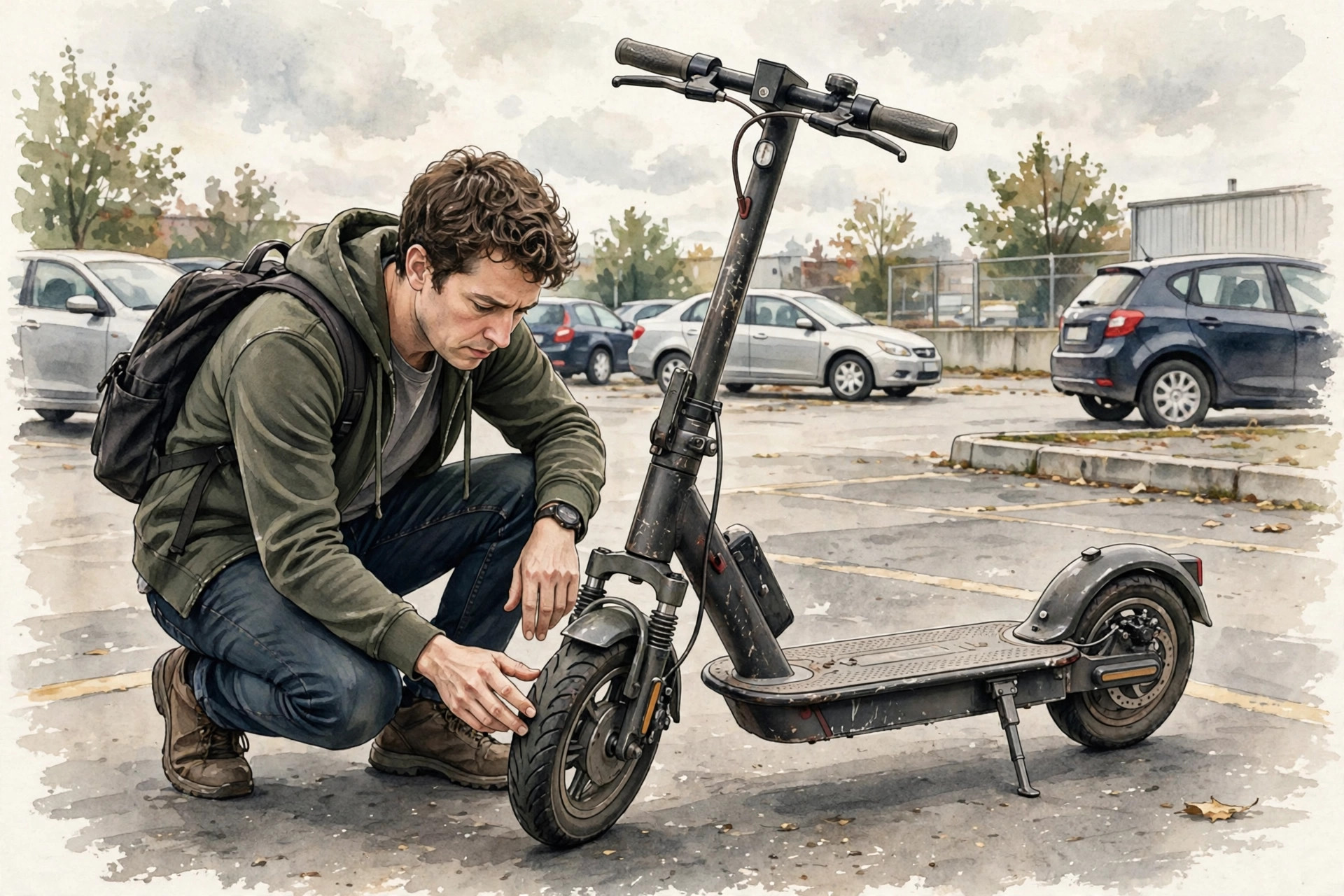
Once the ride is done, inspect the scooter as if you were buying it for daily use, because you are. Check the tyres for tread depth, cracks and uneven wear. Worn tyres are a safety issue, not a cosmetic one, and they are one of the first things you may need to replace. Test the brakes carefully. They should feel firm and consistent, not soft, gritty or grabby. Check the lights, indicators, horn and mirrors, and make sure the handlebar, seat and footboard feel solid rather than loose or wobbly.
Look at the body with fresh eyes. Scratches and small dents from city use are normal and not a reason to walk away. What should concern you is damage that suggests a serious accident, such as a bent frame, misaligned panels, or repairs that look rushed or mismatched. Check underneath, as far as you can without tools, for signs of water damage, rust or impact. Check seals around the battery area and the charging port for wear or damage, and make sure the charging port cover closes properly. Small signs of neglect in these areas often predict larger problems later.
Do not forget the everyday parts. Does the seat open and close properly? Does the storage space work as it should? Are the keys, and any remote or app access, handed over properly? If the scooter connects to an app, ask how that account will be transferred to you and whether the previous owner's access will be removed. A scooter you cannot fully control after purchase is not fully yours.
The battery question, in plain language
You cannot see inside a battery, but you can ask smart questions about it. How old is the battery, and how has the scooter mainly been used? A scooter used gently for short daily trips may have a healthier battery than one of the same age used heavily every day, even if both show similar mileage. Ask about charging habits if the seller knows them, and about any episodes where the scooter stopped suddenly, lost power unexpectedly, or needed battery-related service.
If the manufacturer or an authorised service centre offers a battery health check, take it seriously. A professional check can reveal far more than a visual inspection, and the cost of that check is small compared with the cost of replacing a battery. If the seller refuses to allow a check, or pressures you to decide before one can be done, treat that as a reason to pause. A genuine seller with nothing to hide usually has no objection to an independent inspection, especially when you offer to arrange it promptly.
Also think about what a weak battery means for your own use. If you ride short distances in the city, a battery that no longer delivers its original range may still be perfectly usable. If you need the full range every day, the same battery could be a deal-breaker. Match the battery to your real daily distance, with some margin for traffic, slopes and weather, rather than to the best-case figure in a brochure.
Price, negotiation and the walk-away test
Price should come last, after you know what you are buying. A scooter that looks cheap but needs new tyres, brake work and a battery check is not cheap at all once you add those costs. Before negotiating, list everything you noticed that will need attention soon, and estimate what each item might cost to fix properly. That list gives you a fair basis for discussion and stops you from being swayed by a low headline price.
Be wary of deals that seem too good to be true, sellers who cannot explain the scooter's history, or pressure to pay in full before documents are checked or transfer is arranged. Use a safe payment method, get a written receipt that records the vehicle details, the agreed price and what is included, and complete the ownership transfer properly. If anything feels rushed or unclear, walking away is not a failure. It is the most powerful tool a buyer has, and there will be other scooters.
A final habit is worth building before you hand over money: imagine owning this exact scooter for the next year. Picture your daily commute, your parking spot, your charging routine and your service options. If that picture feels easy and honest, and the documents, test ride and inspection all support it, you have probably found a good buy. If the picture depends on hoping the battery is fine, hoping the transfer works out, or hoping the seller is telling the full story, you have not yet found the right scooter.
Conclusion
Buying a second-hand electric scooter rewards patience. Check the documents first, take a proper test ride, inspect the wearing parts, ask hard questions about the battery, and only then talk price. The battery deserves the most attention because it is the most expensive surprise, but the documents, the brakes, the tyres and the transfer matter too. A careful buyer who is willing to walk away will almost always find a better scooter than a hurried buyer who falls for the first shiny option. Take your time, use this checklist, and let the scooter prove itself before you pay.