Electric Scooter Battery Warranty Claims Explained: Degradation, Terms and How to Claim
Key Takeaways
- A battery warranty covers manufacturing defects and abnormal failure, not normal gradual capacity loss.
- Degradation only qualifies as a claim when it passes the threshold defined in your warranty document.
- Service centres measure battery health through the BMS diagnostic, and you should get that report in writing.
- Unauthorised repairs, water damage, incompatible chargers and expired warranties are the most common rejection reasons.
- A denied claim can be challenged with a written rejection, a re-test and escalation through the manufacturer's customer-care channel.
Electric Scooter Battery Warranty Claims Explained: Degradation, Terms and How to Claim
The battery is the most expensive part of an electric scooter, and it is also the part owners worry about most. When range starts dropping or a scooter stops charging properly, the first question is usually the same: will the warranty cover this? The answer depends less on how you feel about the problem and more on what your warranty document actually says. Battery warranties are written with specific conditions, thresholds and exclusions, and understanding them before you need them can save you a rejected claim, a long argument and an unexpected bill.
A warranty is not a promise that your battery will stay like new. It is a promise that the battery will not fail prematurely or degrade faster than a defined limit within a defined period. Knowing the difference is the key to a successful claim.
What a Battery Warranty Actually Covers
Most electric scooter battery warranties cover manufacturing defects and abnormal failure. A manufacturing defect means something was wrong with the battery from the start: a faulty cell, a bad weld inside the pack, or a battery management system (BMS) that misreads charge levels. Abnormal failure means the battery stops working far earlier than it should, for example if it refuses to charge at all after a year of normal use.
What warranties usually do not cover is normal wear. Every lithium battery loses some capacity with each charge cycle, just like a phone battery slowly holds less charge over the years. Manufacturers treat this gradual loss as expected, not as a defect. That is why the fine print matters so much: it defines how much loss counts as normal and how much counts as a warranty case.
Warranty terms vary widely between manufacturers and models: some cover a set number of years, some add a distance limit, and some define coverage in charge cycles. Always check your own warranty card or owner's manual, because only your scooter's terms apply to your claim.
Degradation: The Part Everyone Misunderstands
Degradation is the gradual loss of a battery's ability to hold charge. A scooter that once travelled a certain distance on a full charge will slowly travel less. This is chemistry, not a fault, and it happens to every battery. The question for a warranty claim is whether your battery has degraded beyond the threshold the manufacturer set.
Manufacturers typically express this threshold as a percentage of original capacity. For example, a warranty might state that the battery is covered if its usable capacity falls below a certain percentage within the warranty period. If your battery is still above that threshold, the claim will usually be rejected even if you can feel the range drop. That feels unfair, but it is how the contract is written.
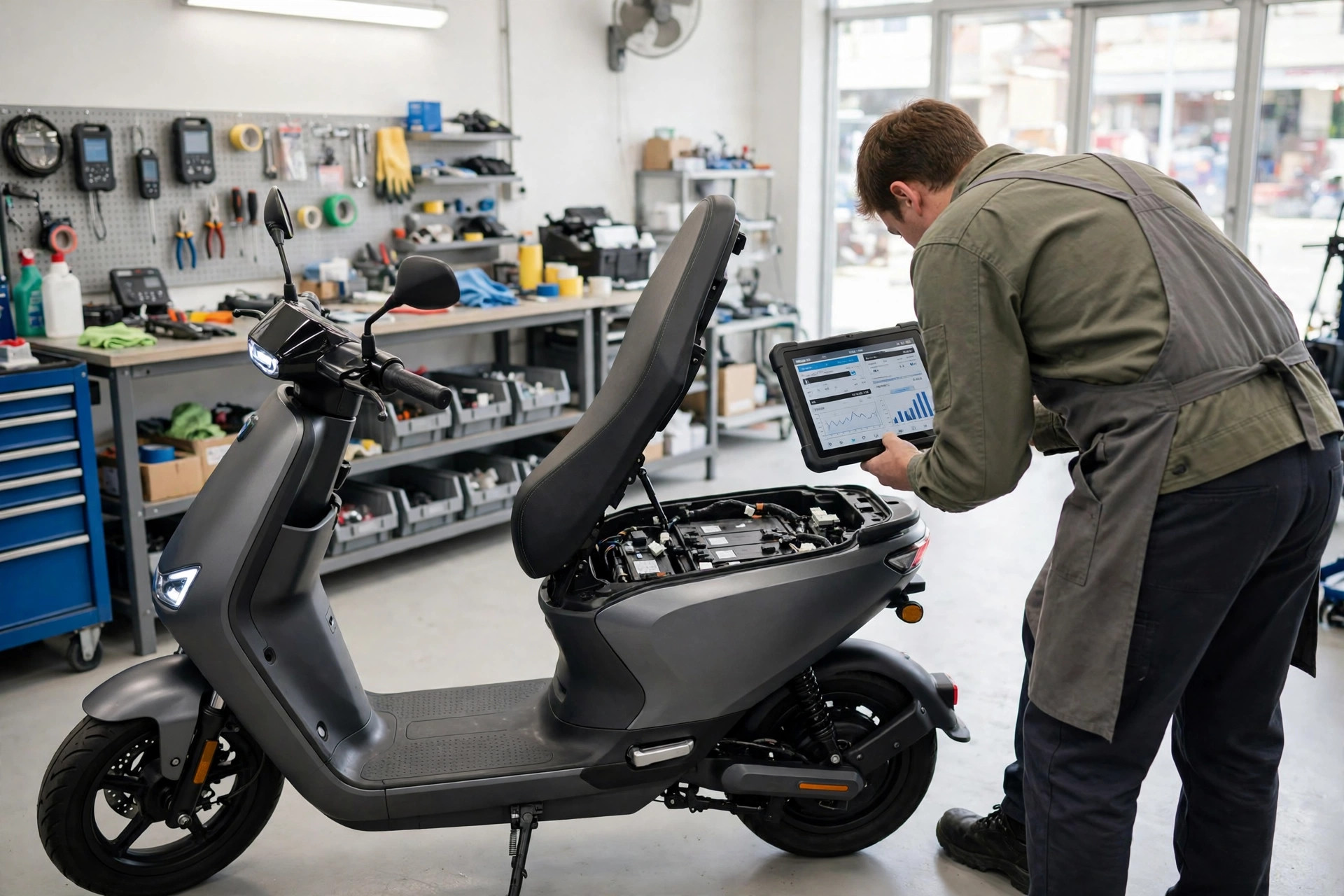
Service centres usually measure degradation with a diagnostic through the scooter's BMS, which reports the battery's state of health; some also accept a controlled range test. Ask which method is used and get the report in writing — a verbal "it is fine" is hard to argue with later, while a printed report gives you something concrete.
A few habits accelerate degradation and can weaken a claim: regularly draining the battery to zero, leaving it unused for months at full charge or fully empty, and using an unapproved charger. None of these automatically voids a warranty, but service centres can check charging history through the BMS, so a pattern of misuse may be cited in a rejection.
Common Reasons Claims Get Rejected
Understanding rejections in advance helps you avoid them. The most common reasons include:
- **Unauthorised repairs or modifications.** Opening the battery pack yourself, or having a local shop replace cells, usually voids the warranty immediately. Battery packs are sealed units, and manufacturers treat tampering as a clear exclusion.
- **Water damage.** Riding through deep water or pressure-washing the scooter can push water into the pack or its connectors. Most warranties exclude water damage, so monsoon riding needs care.
- **Use of an incompatible charger.** A charger with the wrong voltage or a cheap unbranded replacement can damage cells. Use only the charger supplied with the scooter or one approved by the manufacturer.
- **Physical damage.** A cracked pack casing from an accident or a drop is generally not a warranty matter; it falls under insurance instead.
- **Claim filed after expiry.** Warranty periods are strict. Even a week past the end date can mean rejection, so track your warranty end date from the day of purchase.
- **Missing service records.** Some manufacturers require periodic check-ups at authorised centres. Skipping them can complicate a claim, even if the battery fault is unrelated.
Even if one of these applies, it is still worth asking about goodwill repairs or a discounted replacement pack.
How to File a Claim, Step by Step
A calm, documented approach works better than an argument. Follow these steps:
1. **Gather your documents.** You will need the purchase invoice, the warranty card, and any service history. Photograph them so you have digital copies.
2. **Note the symptoms precisely.** Write down what is happening: how far the scooter goes on a full charge now versus when it was new, whether charging stops early, whether the display shows errors, and when the problem started.
3. **Visit an authorised service centre.** Do not go to an unauthorised shop first, because any work they do on the pack can void the claim. Explain the symptoms and ask for a battery health diagnostic.
4. **Get the diagnostic report.** Ask for the state-of-health reading and the test method in writing. If the reading is close to the warranty threshold, ask whether a re-test is possible after a full charge-discharge cycle.
5. **Submit the claim through the proper channel.** Some manufacturers process claims at the dealer, others through a customer-care helpline or app. Follow the channel stated in your warranty document and keep a reference number.
6. **Follow up in writing.** If the claim is approved, confirm the timeline for repair or replacement. If it is delayed, follow up by email so there is a record, and note the dates of every conversation.
Keep every receipt until the claim is resolved, and if the battery is replaced, get written confirmation of whether the replacement carries a fresh warranty or continues the original one.
What to Do If Your Claim Is Denied
A rejection is not necessarily the end. First, ask for the rejection in writing with the specific reason and the diagnostic reading it is based on. Vague rejections are easier to challenge than specific ones. If you believe the reading is wrong, ask for a re-test or a second opinion at another authorised centre.
If the service centre will not budge, escalate through the manufacturer's customer-care channel with your documents attached. Consumer complaint platforms and consumer forums exist for cases where a genuine defect is denied, but these take time, so use them only when the evidence is clearly on your side.
Meanwhile, get a quote for a replacement battery from the authorised channel so you know the real cost of paying yourself, and ask explicitly about any discounted or refurbished pack offered as a goodwill gesture.
Conclusion
Claims succeed when the problem is a genuine defect or abnormal degradation, the scooter has been used and serviced as required, and the claim is backed by documents and a diagnostic report. Read your warranty terms before you need them and keep your service records safe, so that when something truly goes wrong, you can claim with confidence rather than hope.