Dairy Farming for Small Holders Explained: Cows, Buffaloes, Feed Costs and a Realistic Income Plan
Key Takeaways
- Milk provides daily income, unlike crops that pay once or twice a year, but animals eat and need care every day.
- Cow versus buffalo choice should follow local climate, fodder and how the milk buyer pays.
- Feed is the largest cost; home-grown green fodder at the centre of the ration protects the margin.
- Preventive health, clean milking and careful breeding protect future lactations.
- Judge income on annual average yield and margin per litre, not on peak-month milk.
Dairy Farming for Small Holders Explained: Cows, Buffaloes, Feed Costs and a Realistic Income Plan
For millions of small farming households, milk is the steadiest income in an otherwise seasonal life. Crops pay once or twice a year, and a bad monsoon can wipe out a season. Milk, by contrast, pays daily or weekly, in small amounts that cover groceries, school fees and fodder costs through the year. That is why dairy remains the backbone of small-holder livelihoods, and why it deserves a clear-eyed plan rather than a hopeful guess.
The promise and the trap are the same: an animal produces every day, but it also eats every day, needs care every day, and can fall sick at the worst moment. A small holder who understands feed cost, breed choice, milk marketing and the true margin per litre can build a durable supplementary income. One who counts only the milk price, and ignores feed, veterinary costs, labour and dry periods, will wonder where the money went.
Cows, Buffaloes, or Both: Choosing the Animal
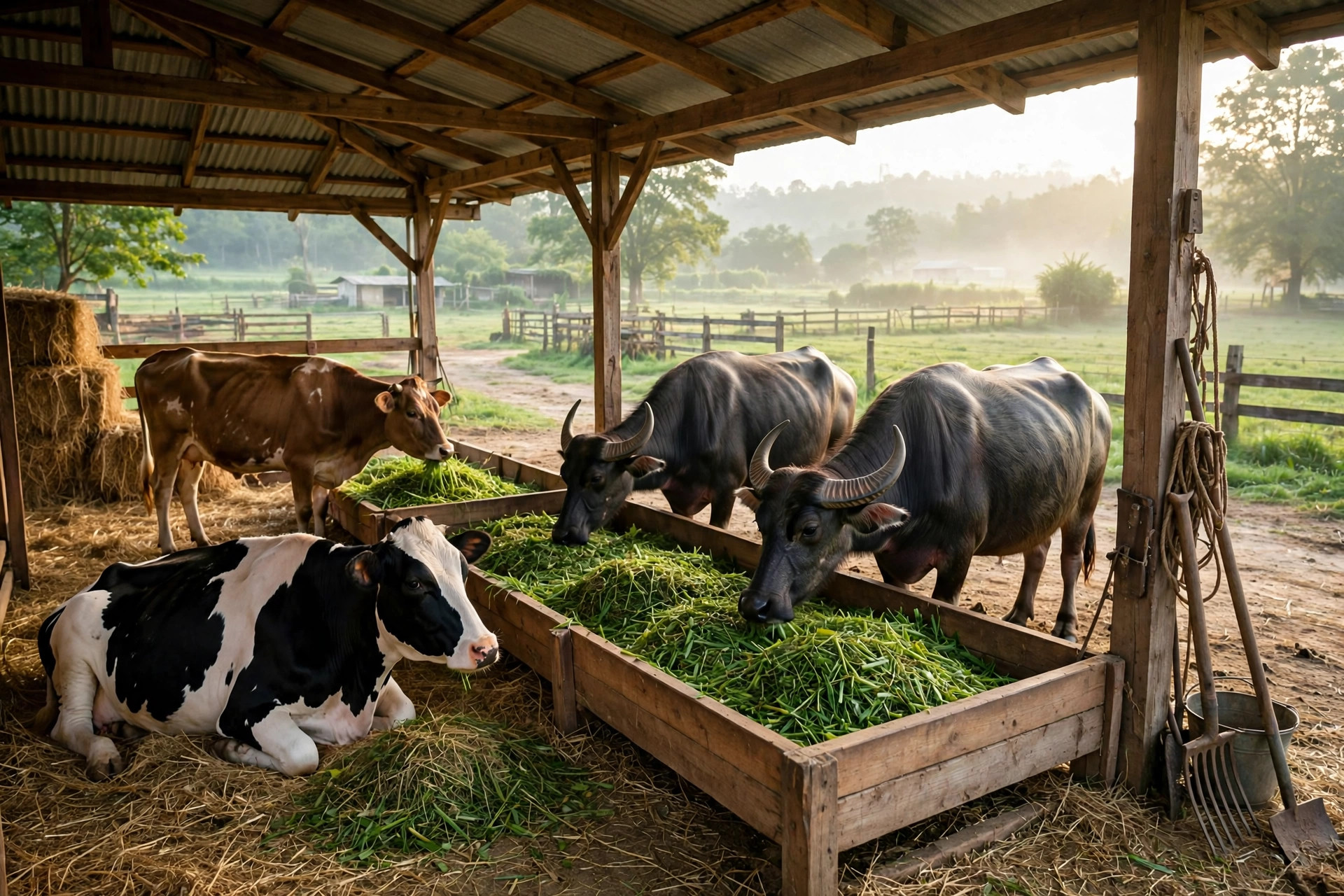
The first choice is the animal itself, and there is no universally right answer. Crossbred cows generally give more milk per day, and their milk is usually lower in fat than buffalo milk. Buffaloes generally give less milk but with higher fat, which often earns a higher price per litre where payment is fat-based, and they tend to be hardier in heat and on coarse fodder. Indigenous cows give less milk but are hardier, need less intensive feed, and suit low-input systems.
The right choice depends on local conditions: climate, fodder availability, milk buyer and payment system, veterinary support, and the family's labour. A village where the cooperative pays on fat and solid-not-fat content may reward buffaloes. A village where a private dairy pays mainly on volume may reward a high-yielding crossbred cow. Talk to the local milk collection centre before buying: ask how payment is calculated, what the average rate has been across seasons, and whether there are deductions or bonuses.
Buy from a reliable source, have the animal checked by a veterinarian before purchase, and check its age, lactation stage, previous milk record if available, health and temperament. For a beginner, starting with one or two animals, learning the routine, and expanding only after a full lactation cycle is far wiser than starting with five animals and discovering the feed bill all at once.
Feed: Where Most of the Money Goes
Feed is the largest cost in dairy farming, often accounting for the majority of daily expenses. It is also the cost most under the farmer's control. Green fodder, dry fodder, concentrates and mineral mixture each play a role, and the balance between them determines both milk yield and cost per litre.
Green fodder — grown on the farm where possible, or cut from common lands and field bunds where permitted — is the cheapest source of nutrition and should form the base of the ration. Dry fodder such as straw provides bulk but little nutrition on its own, and needs supplementation. Concentrates, whether home-mixed or purchased, supply energy and protein, but they are the most expensive component, and overfeeding them does not produce a proportional increase in milk. It simply raises cost.
A practical approach is to grow fodder as a crop, not as an afterthought. A small plot of a perennial or seasonal fodder crop, harvested in stages, reduces dependence on purchased feed and smooths supply across seasons. Clean drinking water, available at all times, is equally important: a milking animal that drinks too little will milk less, whatever else it is fed.
Mineral mixture and salt, in the recommended quantity, prevent deficiencies that show up as poor fertility, low yield or disease. They cost little compared with the losses they prevent. Any change in feed should be gradual, over several days, because a sudden change can upset digestion and drop milk yield.
Health, Breeding and the Daily Routine
Healthy animals milk steadily; sick animals cost money twice, in treatment and in lost milk. The daily routine is the real management system: observe each animal at milking, note appetite, dung, rumination and any swelling, lameness or drop in yield, and act early. Vaccination against locally prevalent diseases, regular deworming, and tick control, on veterinary advice, prevent many common losses. Mastitis, the infection of the udder, is one of the costliest diseases for small holders, and it is largely preventable through clean milking, clean hands and utensils, and prompt attention to any hot, swollen quarter.
Breeding determines future income. Use artificial insemination or a proven bull through a reliable service, keep breeding records, and aim for a calving interval that keeps the animal productive without exhausting it. A long gap between calvings means months of feeding an animal that gives no milk, which quietly erodes annual profit. Female calves are future milkers; raising them well is an investment, not a cost to be minimised at the expense of growth.
Labour must be counted honestly. Family labour feels free, but it has an opportunity cost, and a dairy unit that only works if someone is available every morning and evening without fail needs a backup plan for illness, festivals and harvest peaks.
A Realistic Income Plan: Counting Per Litre, Per Month, Per Year
A realistic plan starts with the margin per litre, not the milk price. Take the price received per litre, subtract feed cost per litre, veterinary and breeding costs, and other cash costs such as transport or collection charges, and what remains is the cash margin before family labour and capital costs. Many small holders are surprised to find this margin is thin, especially when purchased concentrates dominate the ration. That thinness is information, not failure: it points to where improvement is possible, usually in home-grown fodder, in reducing concentrate waste, or in negotiating a better milk price through a cooperative.
Next, count the year, not the month. A cow or buffalo does not milk at peak every day. Yield rises after calving, peaks, then declines, and the animal has a dry period before the next calving. Annual milk production, divided by twelve, gives the true monthly average, which is always lower than peak-month production.
A simple monthly record makes this visible: milk sold each day, price received, feed purchased, veterinary expenses, and any other cash outgo. At month end, total income minus total cash cost is the cash surplus. Over a year, that surplus, minus the cost of replacing animals and maintaining the shed, is the real return. Keep a reserve from good months for veterinary emergencies, fodder scarcity and dry periods. Do not expand the herd from one good month's surplus; expand when the annual record shows a sustained surplus after all cash costs.
Marketing choice matters as much as production. A cooperative, a private dairy, a local vendor and direct sale to consumers each offer different prices, payment timing and reliability. Direct sale often pays most per litre but needs time, transport and consistent quality, and a single lost customer hurts. A cooperative may pay less but pays regularly and provides veterinary and feed services.
Conclusion
Dairy farming rewards the small holder who treats it as a business with a daily rhythm: the right animal for the local market, home-grown fodder at the centre of feeding, preventive health care, careful breeding, and an income plan built on annual averages and margin per litre, not on peak milk or headline price. Done that way, two or three well-managed animals can provide the steadiest income a small farming household has — not a fortune, but a reliable floor under a life that otherwise depends on the season. That reliability, earned day by day, is the true value of dairy.