How to Start Poultry Farming for Beginners in India? Cost, Breeds and First Steps Explained
Key Takeaways
- Choose one type first: broilers for fast turnover, layers for steady daily egg income, backyard desi birds for the lowest-cost start
- Feed is around 60 to 70 percent of total cost, so feed quality and the feed conversion ratio decide most of the profit
- A dry, ventilated shed with clean water daily prevents more disease than any medicine
- Follow a vet's vaccination schedule for Marek's, Ranikhet and Gumboro, and practise basic biosecurity every day
- Start with a flock you can manage, track every cost and sale, and expand only after two or three successful batches
How to Start Poultry Farming for Beginners in India? Cost, Breeds and First Steps Explained
Poultry farming for beginners in India usually starts with the same hopeful question: can a small flock of chickens really become a steady income? The honest answer is yes, but only when the farm is treated as a business from day one, not as a side activity that runs on leftover time and attention. India is among the world's largest producers of eggs and chicken meat, and demand for both stays strong through the year, which gives a new farmer a real market to sell into. At the same time, poultry is a business where small mistakes compound quickly: one week of poor feed, dirty water or a missed vaccination can wipe out the margin of an entire batch. This guide walks through the decisions a beginner actually has to make, in the order they come up, so that the first flock starts on solid ground.
The first decision is not about birds at all. It is about which kind of poultry farming suits your land, money and daily routine. There are three common starting points, and each one behaves like a different business. Broiler farming raises chickens for meat, with birds reaching market weight in roughly five to seven weeks, so money comes back quickly but the cycle must be repeated again and again. Layer farming raises hens for eggs, which means a longer wait before income starts, usually around five to six months, but then a steadier daily cash flow for a year or more. Backyard or desi poultry farming uses hardy native birds, needs far less money to start, and fits a small plot or a home compound, but the income per bird is lower and growth is slower. A beginner with limited capital and no experience is usually better off starting small in one of these, learning the daily routine on a few hundred birds, and expanding only after two or three successful batches.
Poultry Farming for Beginners: Which Type Should You Start With?
Broiler farming suits someone who wants fast turnover and can arrange a buyer before the birds are ready. The cycle is short, which means mistakes are also corrected quickly: if a batch goes badly, the next one starts within weeks. The catch is that broilers need careful feeding, steady temperature control in the first weeks, and a reliable buyer, because a finished bird cannot wait: every extra day on the farm eats feed and shrinks profit. A guide to starting a poultry farm business, covering planning and investment, is available from [Godrej Capital's poultry farm business guide](https://www.godrejcapital.com/media-blog/knowledge-centre/starting-your-poultry-farm-business-plan-and-investment-tips).
Layer farming suits someone who can wait for returns and wants daily income once laying begins. A layer hen in a well-managed farm can lay around 300 eggs in a laying year, though the exact number depends on breed, feed and management, and no figure should be taken as a promise. The longer cycle also means a longer commitment: feed, vaccination and lighting must stay consistent for months before the first egg is sold. For a beginner, the risk is cash flow: money goes out for five months before it starts coming back, so the feed budget for the whole growing period must be arranged in advance, not month by month.
Backyard poultry suits a farmer who wants to start with very little money, perhaps 20 to 100 desi birds, and learn the basics while keeping risk low. Desi birds forage partly for themselves, tolerate heat better than commercial breeds, and sell at a premium in many local markets because buyers value their meat and eggs. The trade-off is slower growth and lower egg numbers, so this path builds skill and supplementary income rather than a large commercial operation. Many successful commercial farmers started exactly this way, and the experience of managing a small flock is worth more than any training video. The same start-small logic applies to other livestock: our [goat farming guide for beginners](https://indiaask.tech/question.php?slug=goat-farming-beginners-income-explained) follows the same pattern of breed choice, shed, feed and income planning.
Whichever type you choose, the same rule applies: start with a number you can manage alone or with family help, and buy chicks only from a known hatchery or supplier. Cheap chicks of unknown health are the most expensive mistake a beginner can make, because a weak batch never catches up, however good the feed.
Shed, Space and Equipment: What a Small Farm Actually Needs
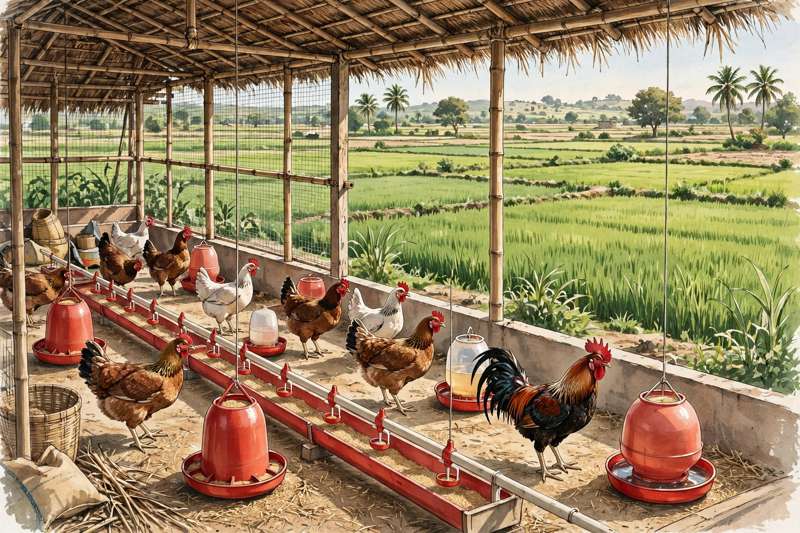
A poultry shed does not need to be expensive, but it does need to be dry, ventilated and safe from predators and rain. Birds suffer quickly in damp, ammonia-filled air, and a shed that traps heat in summer or lets in driving rain in monsoon will cost you birds. A simple open-sided shed with a raised roof, wire mesh on the sides and a dry floor of earth, brick or concrete works well in most Indian climates. The roof should overhang enough to keep rain out, and the sides should allow breeze while stopping dogs, cats and rats.
Space planning is straightforward and worth doing on paper before buying chicks. As a commonly used rule of thumb, broilers need roughly one square foot per bird in a deep-litter shed, while layers in a similar system need a little more, around one and a half to two square feet. Overcrowding is a false economy: crowded birds grow slower, fall sick more easily and peck each other. It is better to stock fewer birds well than to squeeze in extra birds and lose the batch to disease or stress.
The equipment list for a small farm is short: feeders, drinkers, a brooder heat source for day-old chicks, lighting, and litter material such as paddy husk or sawdust on the floor. Chicks need warmth in their first two to three weeks, and a simple brooder with bulbs or a gas brooder does the job, provided the temperature is checked rather than guessed: chicks huddled tightly under the heat source are cold, while chicks spread far away from it and panting are too hot. Clean water matters as much as feed. Drinkers should be washed daily, and water should never sit dirty or warm in the sun, because contaminated water spreads disease faster than almost anything else on a farm.
Feed: The 70 Percent Cost You Must Control
Feed is the single largest cost in poultry farming, commonly accounting for around 60 to 70 percent of total production cost. That one fact explains most of the difference between a profitable farm and a struggling one. A beginner should buy feed from a reputed supplier, store it in a dry place off the floor, and never use damp or mouldy feed, which can poison birds. Broilers need starter feed in the first weeks and finisher feed later, while layers need grower feed followed by layer feed once laying begins. Switching feed types at the right stage matters, and your feed supplier or veterinarian can confirm the schedule for your breed.
The feed conversion ratio, or FCR, is the number every broiler farmer should learn. It measures how many kilograms of feed produce one kilogram of live bird weight, and a lower number means better efficiency: a commonly cited good range for broilers is around 1.6 to 1.8. If your FCR is much higher, something is wrong, and the causes are usually poor feed quality, disease, heat stress or wasted feed in badly designed feeders. Weighing a sample of birds weekly and tracking feed use in a notebook turns guesswork into management. The same habit applies to layers: track daily egg numbers against feed use, and a sudden drop usually signals a problem worth investigating the same day, whether it is heat, disease, water shortage or a feed change.
Beginners often ask whether home-mixed feed saves money. It can, but only if the mix is balanced for protein, energy, minerals and vitamins, which is harder than it looks. A poorly balanced home mix that saves a few rupees per bag but slows growth or cuts egg production costs far more than it saves. Until you understand ration formulation, commercial feed from a known brand is the safer choice.
Health, Vaccination and Biosecurity Basics
Disease is the risk that keeps poultry farmers awake, and prevention is far cheaper than treatment. The most important diseases for a beginner to know by name are Newcastle disease, known as Ranikhet, and Infectious Bursal Disease, known as Gumboro, along with Marek's disease, which is usually controlled by vaccination at the hatchery on day one. Your veterinarian will give you a vaccination schedule suited to your area and bird type, and the schedule should be written down and followed exactly, with vaccine stored cold and used the same day it is mixed. A missed or mishandled vaccination leaves the whole flock exposed.
Biosecurity sounds technical, but in practice it is a set of simple habits. Keep visitors, especially people who keep birds themselves, out of the shed. Change footwear or use a footbath before entering. Keep new birds separate from the old flock for at least two weeks before mixing them. Dispose of dead birds promptly and safely, away from the shed and water sources. Control rats and flies, which carry disease between farms. And never bring sick birds from a market into a healthy flock, however cheap they look. Most disease outbreaks on small farms can be traced to one of these habits being skipped.
Watch the flock daily, and learn what normal looks like: birds that eat and drink eagerly, move actively and produce normal droppings. The warning signs are dullness, huddling, reduced feed intake, unusual droppings, coughing or sudden deaths. One or two sick birds can be isolated, but a pattern across the flock needs a veterinarian quickly, not a medicine bought on a shopkeeper's advice. Antibiotics should be used only on veterinary advice, at the right dose and for the full course, because misuse leaves residues and builds resistance.
Cost, Income and the Honest Maths
Every guide quotes different figures for poultry farm cost, because costs genuinely vary by state, shed type and feed price, and any article that promises a fixed profit should be read with suspicion. As a rough, commonly cited range, a small 1,000-bird broiler unit in India is often described as needing around Rs 3 to 6 lakh to set up, including shed, equipment, chicks and first-cycle feed, while a micro unit of 500 birds can start lower. Layers cost more before income begins, because the birds must be fed for months before laying. These are planning ranges from published guides, not quotations: get local prices for chicks, feed and shed material before committing money, and add a contingency of at least 10 percent.
On income, the honest way to think is per bird, per cycle. For broilers, the margin per bird in a stable market is often described as roughly Rs 8 to Rs 20 in open-market sales after feed, chick and medicine costs, though contract farming usually pays a lower fixed growing charge per bird with less market risk. That margin swings with feed price and the live-bird rate on sale day, which is why a written buyer arrangement, or a contract farming tie-up, matters more than optimism. For layers, income depends on the daily egg rate and the laying percentage, and a farm that tracks both numbers weekly will spot trouble a month before a farm that only counts money at the end. A step-by-step starting guide, including farm types and investment planning, is also available from [Modern Kisaan's poultry farm guide](https://modernkisaan.com/how-to-start-a-poulty-farm/).
Two support routes are worth checking early. The National Livestock Mission and NABARD-backed schemes have, at various times, offered capital subsidy for poultry units, and MUDRA loans are commonly used by small entrepreneurs; the exact subsidy percentage, eligibility and application route change over time, so confirm the current position with your district animal husbandry office or bank rather than relying on an old article. Registering the enterprise, keeping basic accounts, and maintaining the vaccination and mortality records also make any loan or subsidy application far easier. For a comparison with a longer-cycle livestock business, see our [dairy farming business plan](https://indiaask.tech/question.php?slug=dairy-farming-small-holders-income-explained), where feed cost and daily routine matter just as much.
Common Beginner Mistakes
The same mistakes appear on beginner farms again and again, and all of them are avoidable. The first is starting too big: a 5,000-bird shed on the first attempt multiplies every beginner error by 5,000. The second is buying chicks without arranging feed, medicine and a buyer in advance. The third is ignoring ventilation: a shed that smells of ammonia is already harming birds, and the fix is airflow and dry litter, not medicine. The fourth is mixing ages and sources in one shed, which lets disease from one group spread to all. The fifth is skipping records: without a notebook tracking feed, deaths, vaccinations and sales, a farmer cannot tell whether the farm is actually profitable or merely busy.
Seasonal care deserves a special note. Summer heat kills more birds than many diseases, and the remedies are simple: extra ventilation, cool drinking water, electrolytes on veterinary advice during heat waves, and feeding in the cooler hours. In winter, the risk reverses: cold drafts and damp litter cause respiratory problems, so side curtains and dry litter matter most. In both seasons, the daily walk through the shed, looking and listening, is the cheapest insurance a farmer has.
Conclusion
Poultry farming for beginners in India works best as a staged plan: choose one type of bird, start with a flock you can manage well, build a dry ventilated shed, buy quality chicks and feed, follow a vet's vaccination schedule, and write down every cost and sale. The first batch teaches you the daily rhythm; the second teaches you the costs; by the third, you will know whether to expand, switch type, or stay small. Farmers who succeed in this business are rarely the ones who started biggest. They are the ones who started carefully, kept records, and learned from each batch before scaling up. If you are thinking of starting, visit two or three working farms near you first, ask about their feed cost per bird and their mortality rate, and compare those honest numbers with your own budget. That single afternoon of visits will teach you more than a month of reading, and it costs nothing.
Frequently Asked Questions (FAQ)
How much money do I need to start poultry farming in India?
It depends on scale and type, but published guides commonly cite around Rs 3 to 6 lakh for a small 1,000-bird broiler unit including shed, equipment, chicks and first-cycle feed. A backyard unit of 20 to 100 desi birds can start for far less. Always get local prices for chicks, feed and shed material before committing money, and keep a contingency of at least 10 percent.
Which is better for beginners: broiler, layer or backyard poultry?
Broilers give the fastest return, in about five to seven weeks, but need a ready buyer and tight management. Layers give steadier daily income but only after about five to six months of feeding before laying starts. Backyard desi poultry needs the least money and is the safest way to learn, though income per bird is lower. Most beginners should start small in one type and expand after two or three successful batches.
How many eggs does a layer hen lay in a year?
A well-managed commercial layer hen can lay around 300 eggs in a laying year, but the exact number depends on breed, feed quality, lighting, health and management. Treat this as a planning figure, not a promise, and track your own flock's daily laying percentage to spot problems early.
What vaccinations do poultry birds need?
The key ones for beginners to know are Marek's disease, usually vaccinated at the hatchery on day one, Newcastle disease (Ranikhet) and Infectious Bursal Disease (Gumboro). Your veterinarian will give a schedule suited to your area and bird type. Store vaccine cold, use it the same day it is mixed, and never skip a scheduled vaccination.
Is poultry farming profitable for a small farmer?
It can be, but profit is not guaranteed. Feed is around 60 to 70 percent of cost, so feed efficiency, mortality and the sale-day bird or egg rate decide the result. Broiler margins per bird are often described as roughly Rs 8 to Rs 20 in stable open markets, while contract farming pays a lower fixed growing charge with less risk. Keeping daily records of feed, deaths and sales is what turns a busy farm into a profitable one.
Read Next on IndiaAsk
- The same start-small, track-every-cost approach in this guide works for goat farming too. Goat Farming in India for Beginners: Breeds, Shed, Feed, Income
- Compare poultry with dairy farming, where feed cost and daily routine matter just as much. Dairy Farming Business Plan: Cows, Buffaloes, Feed and Income
Related Articles

Answers
No approved answers yet — you can give the first answer.
Give Your Answer
Discussion
No approved comments yet.