How Can You Start Mushroom Farming in a Small Space? Oyster and Button Mushrooms Explained
Key Takeaways
- Mushroom farming needs no fertile field and grows vertically in a small indoor room
- Oyster mushroom is the best first choice for beginners because it tolerates ordinary room temperatures
- Buy spawn only from a reliable source such as a Krishi Vigyan Kendra or agricultural university
- A ten-by-ten-foot room can hold a hundred or more bags on racks or hanging lines
- Arrange buyers before the first harvest because mushrooms are perishable
How Can You Start Mushroom Farming in a Small Space? Oyster and Button Mushrooms Explained
Mushroom farming is unusual among farm businesses: it needs no fertile field, no large plot and no long wait before the first harvest. A clean, shaded room, a few growing bags, spawn and straw are enough to begin, and the first crop can be ready within weeks. That combination of small space, low starting cost and quick cycles is why mushrooms attract small farmers, unemployed youth and even urban growers with only a spare room or a backyard shed.
This guide explains how to start small, which mushroom to choose first, how to set up a growing room, the step-by-step process for oyster mushrooms, and how to sell the harvest. It describes typical yields and prices reported by farming guides as illustrations, not guarantees: your results depend on hygiene, temperature, spawn quality and your local market.
Why Mushrooms Suit a Small Space
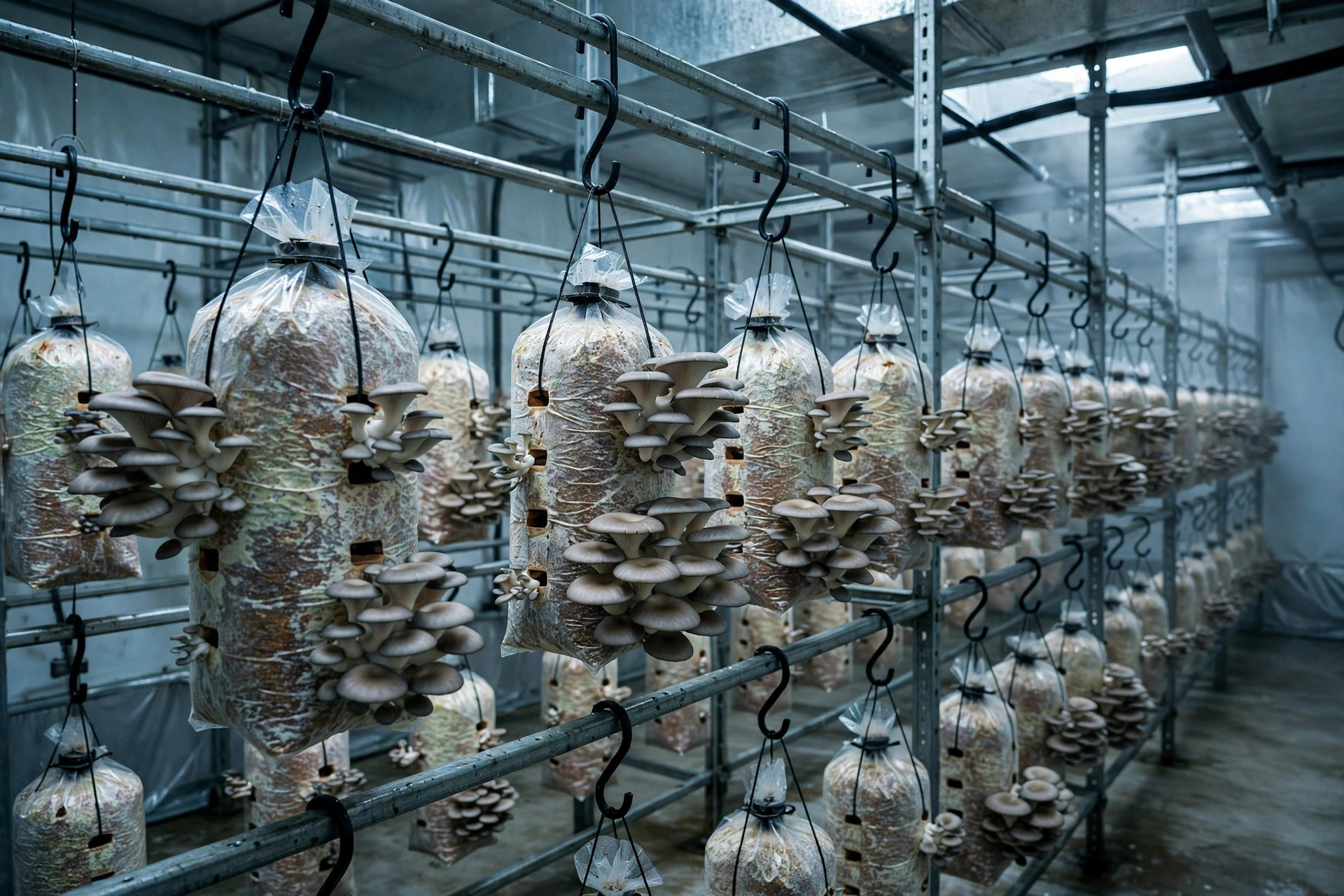
Unlike field crops, mushrooms grow indoors on substrate, the prepared material such as straw on which the fungus feeds, rather than on soil. A room of about ten by ten feet can hold a hundred or more growing bags on racks or hanging lines, because production goes vertical. Mushrooms also use agricultural waste as input: paddy straw, wheat straw and similar materials that are cheap and widely available. The crop cycle is short. Oyster mushrooms can be harvested within about three to four weeks of spawning, and a single bag can give multiple flushes, or harvests, over its productive life.
There is a second reason small growers like mushrooms: the market is growing. Hotels, restaurants, caterers, vegetable vendors and health-conscious urban buyers all buy mushrooms regularly, and supply in many towns still comes from distant producers. A local grower who delivers fresh mushrooms on the day of harvest has a quality advantage over mushrooms that travelled for a day or two. That advantage is real, but it only works if you can sell consistently, so read the selling section before you scale up.
Choosing Your First Mushroom: Oyster for Beginners
Three mushrooms dominate small-scale cultivation in India: oyster, button and milky. For a beginner, oyster mushroom is the clear first choice. It grows at ordinary room temperatures in most parts of India, tolerates a wider temperature range than button mushroom, needs simpler infrastructure, and fruits quickly. Button mushroom, the most popular commercial variety overall, gives good prices but needs controlled cool temperatures and a more complex composting process, which makes it a second step rather than a starting point. Milky mushroom suits warm climates and is a reasonable later option.
Within oyster mushrooms, buy spawn, the mushroom seed material, only from a reliable source: a Krishi Vigyan Kendra, an agricultural university, the ICAR Directorate of Mushroom Research at Solan, or a licensed supplier. Poor-quality or contaminated spawn is the most common reason a beginner's first batch fails, and no amount of care later can rescue it. Check the spawn on arrival: it should smell fresh and earthy, not sour, and the grain should be well covered with white mycelium. If it smells bad or shows coloured mould, do not use it.
Setting Up a Small Growing Room
The growing room is the heart of the business, and hygiene matters more than size. Choose a clean room, shed or garage that can be kept shaded, ventilated and humid, away from direct sunlight. Whitewash the walls, clean the floor, and seal gaps where insects enter. Install racks or hanging lines for the bags, a thermometer and a hygrometer to track temperature and humidity, and a simple misting arrangement, such as a hand sprayer for a small unit or a fogger for a larger one. An exhaust fan helps air circulation, and a wet gunny cloth hung near the entrance can raise humidity on dry days.
Oyster mushrooms prefer temperatures roughly in the twenties Celsius and high humidity, and they need indirect light and fresh air once fruiting begins. Keep the room clean between cycles: remove spent substrate promptly, wash racks, and do not store old bags near new ones, because contamination spreads from old material. For a first trial, ten to twenty bags are enough to learn the process without risking much money. Scale up only after one full successful cycle.
Step by Step: Growing Oyster Mushrooms in Bags
The process has five stages. First, prepare the substrate: chop paddy or wheat straw into short pieces, soak it, and pasteurise it, usually by dipping the straw in hot water or by chemical treatment as taught in training programmes, to kill competing moulds. Drain the straw well: it should be moist but not dripping. Second, spawn the bags: mix the spawn evenly through the cooled straw in clean polythene bags, layer by layer, and tie the bags loosely. Third, incubate: keep the bags in a dark, warm place for about two weeks while the white mycelium spreads through the straw. Do not disturb the bags during this stage.
Fourth, fruiting: once the bags are fully white, make small slits or holes in the bags, move them to the growing room, and maintain humidity by misting the room and the bags lightly. Pinheads, the tiny first mushrooms, appear within days, and they grow rapidly. Fifth, harvest: pick mushrooms when the caps are well formed but before they flatten and release spores, twisting gently rather than pulling, so the bag is not damaged. After the first flush, rest the bag for a few days, maintain humidity, and a second and third flush will follow. A well-managed bag can yield roughly one to two kilograms of mushrooms over its productive life, though results vary with substrate, spawn and climate.
Costs, Selling and Common Mistakes
A small oyster unit can be started with a modest investment covering straw, spawn, bags, racks and a sprayer, with farming guides commonly describing starter costs in the low thousands to tens of thousands of rupees depending on scale. Prices for fresh mushrooms vary by city and season, with oyster mushrooms commonly selling in a range that makes small units viable when sales are regular. The honest warning is this: the cost of production is only half the business. Before your first harvest, line up at least one buyer: a local vegetable vendor, a restaurant, a hotel kitchen, a farmers' market stall, or a housing society group. Mushrooms are perishable, and a harvest with no buyer is a loss, however good the crop.
The common beginner mistakes are all avoidable. Using poor spawn, skipping pasteurisation, letting the room dry out during fruiting, and harvesting too late, when caps flatten and quality drops, are the four that ruin most first batches. Another mistake is scaling up before learning: a hundred bags of a failed batch cost ten times more than ten bags of the same failure. Finally, keep records from the first bag: spawn source, substrate quantity, dates of each stage, yield per flush, expenses and sales. These records turn a hobby into a business, because they tell you your real cost per kilogram and your real profit per cycle.
Training is available and worth taking. Krishi Vigyan Kendras across India run short mushroom cultivation courses, and the ICAR mushroom research centre provides technical guidance. A two or three-day course, costing little, can prevent the errors that destroy a first crop. State horticulture departments and some banks also offer support for small mushroom units; your district horticulture office can explain the current options.
Conclusion
Mushroom farming lets a beginner start a farm business in a single room, with a short cycle, low land requirement and a product that local buyers want fresh. Start with oyster mushrooms, buy good spawn, keep the growing room clean and humid, learn from a small first batch, and arrange buyers before the harvest. If the first cycle succeeds, expand gradually, and consider button mushrooms only when you can control temperature reliably. Grown carefully, a small mushroom room can become a steady, repeatable income, harvest after harvest.