Home > Elections & Governance > Delhi to Guwahati Bullet Train: What Is the New North Corridor, Its Route and Travel Time?
Delhi to Guwahati Bullet Train: What Is the New North Corridor, Its Route and Travel Time?
By Vijay Pawar · 2026-11-02 · 9 min read · Elections & Governance
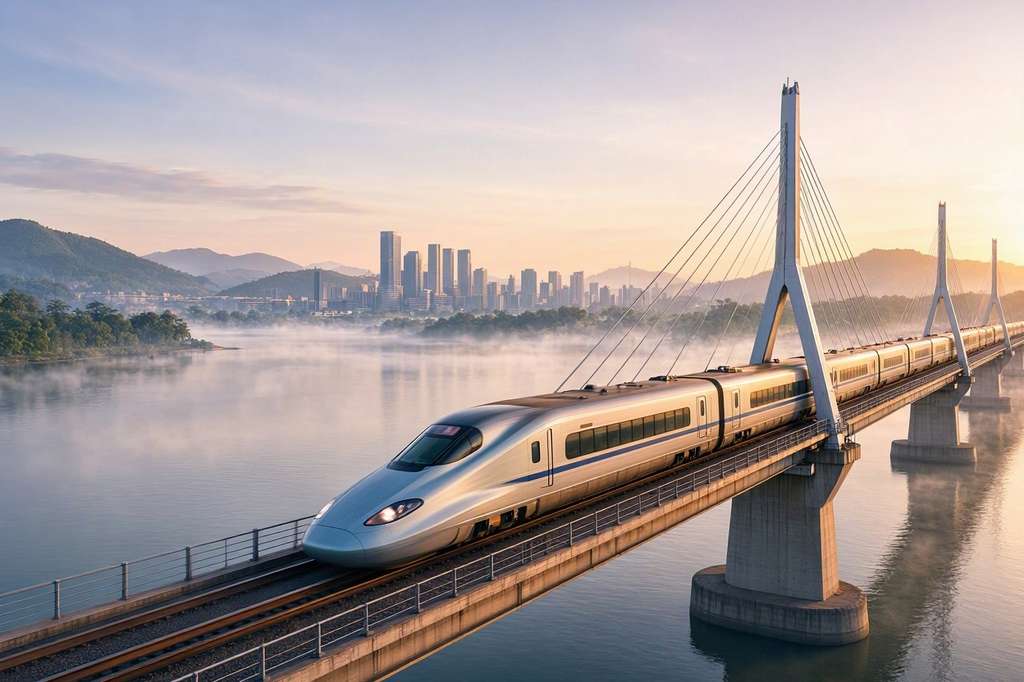
Editorial illustration: a sleek high-speed train crossing a river bridge at dawn, with a city skyline and green hills in the distance — no text, no logos, no real person.
Key Takeaways
Prime Minister Narendra Modi has approved the north corridor of the bullet train network, Railway Minister Ashwini Vaishnaw announced in Varanasi on 1 November 2026.
The route runs Delhi-Agra-Kanpur-Lucknow-Ayodhya-Varanasi-Prayagraj-Patna-Siliguri-Guwahati; Guwahati was added after the corridor was initially planned to end at Siliguri.
Quoted journey times: Delhi-Agra 59 minutes, Delhi-Kanpur 1 hour 45 minutes, Delhi-Lucknow 2 hours 12 minutes, Delhi-Varanasi 3 hours 33 minutes; Delhi-Guwahati under eight hours, per the Assam chief minister.
Construction from pillar to girder will be made in India, and the minister said fares will be very economical and less than flight tickets — but no fare chart exists yet.
No timeline, alignment, cost or completion date has been published; the corridor is approved in principle, with detailed planning still ahead.
A Delhi Guwahati bullet train moved from a long-discussed idea to an approved corridor on 1 November 2026, when Railway Minister Ashwini Vaishnaw announced that Prime Minister Narendra Modi has approved the north corridor of India's bullet train network, with Guwahati as its eastern end. The announcement was made in Varanasi, before the flagging off of new Vande Bharat Sleeper services between Varanasi and New Delhi, and it immediately raised the obvious questions: which cities will the line serve, how fast will the journeys actually be, and what is still not decided?
This article explains what was announced, the route and travel times quoted by the minister, why Guwahati's inclusion matters, and what remains at the approval stage rather than the construction stage.
What was announced on 1 November?
Speaking in Varanasi on Saturday, 1 November 2026, Vaishnaw said the Prime Minister has approved the north corridor of the bullet train project. He described it as a project that "will change the lives of many", and said construction work for the bullet train, from pillar to girder, will be made in India. The emphasis on domestic construction was a central part of his remarks: the corridor is presented not only as a transport project but as a manufacturing project, built by Indian workers and engineers.
The announcement was reported by The Hindu BusinessLine, India Today NE, The NewsMill and the Assam Tribune, all carrying the same core facts: an approved north corridor, a route running from Delhi through Uttar Pradesh, Bihar and West Bengal to Guwahati, and sharply reduced journey times on the sections the minister named.
It is important to be precise about what "approved" means here. The reports describe approval of the corridor itself. They do not carry a construction start date, a completion date, a final alignment, or a fare chart. Assam Chief Minister Himanta Biswa Sarma's own welcome message and the news reports both note that implementation details are still awaited. Readers should therefore treat the corridor as approved in principle, with the detailed project work still to come.
Delhi Guwahati bullet train route: which cities are on the corridor?
According to the minister, the proposed north corridor will connect Delhi, Agra, Kanpur, Lucknow, Ayodhya, Varanasi, Prayagraj, Patna and Siliguri, before extending to Guwahati. That is a long eastward sweep across northern and eastern India, linking some of the country's most populous cities and, at its far end, the largest city of the Northeast.
The Guwahati extension is the newest part of the story. The corridor was initially planned to terminate at Siliguri in West Bengal. Sarma said that after his written request and a meeting with Vaishnaw in July, the proposal was examined on merit and the extension into the Northeast was approved. On 1 November, Sarma publicly thanked the Prime Minister and the Railway Minister, describing the extension as "a pivotal moment for East India" and saying Guwahati to Delhi could take under eight hours.
The route matters because it does not just connect two endpoints. Agra, Kanpur, Lucknow, Ayodhya, Varanasi, Prayagraj and Patna are major centres in their own right, and Siliguri is the gateway to the Northeast. A high-speed line through them would, if built as described, change travel between many pairs of cities, not only between Delhi and Guwahati.
How long will the journeys take?
Vaishnaw quoted specific journey times for the western sections of the corridor:
- Delhi to Agra: 59 minutes
- Delhi to Kanpur: 1 hour and 45 minutes
- Delhi to Lucknow: 2 hours and 12 minutes
- Delhi to Varanasi: 3 hours and 33 minutes
For the full Delhi to Guwahati journey, Sarma said the trip could take under eight hours. For comparison, reports citing Akashvani put the current Delhi-Guwahati rail journey at roughly 30 to 35 hours. That contrast is the headline appeal of the project: a journey that today takes more than a day could, in the minister's and the Assam chief minister's framing, take less than a working day.
Two cautions apply. First, the under-eight-hours figure for Guwahati is the chief minister's statement about what the corridor would make possible, and the reports note that a specific journey-time estimate for the Guwahati-Delhi section was not provided in the announcement itself. Second, the section times quoted by Vaishnaw are estimates for a completed corridor, not a timetable for trains running today. No train is running on this corridor yet.
What did the minister say about fares?
Vaishnaw addressed a common criticism of bullet trains directly, saying that many people spread the misconception that the bullet train is only for the rich. He said the fare will be very economical and much less than flight tickets. That is a political assurance about affordability rather than a published fare table: no ticket prices for the north corridor have been announced, and fares will depend on decisions taken much later, when the line is closer to operation.
The "Make in India" point is related. Vaishnaw said construction, from pillar to girder, will be made in India, and that the project will be built by Indian youth and welders. If that holds, the corridor's economic effect would extend beyond passengers to the factories, suppliers and workers involved in building it — though, again, the scale of that effect will depend on the final alignment and construction programme, neither of which has been published yet.
Why does Guwahati's inclusion matter?
For Assam and the wider Northeast, the significance is connectivity. The region's links to the rest of India have long depended on a small number of rail and air routes, and Siliguri's narrow corridor is a well-known bottleneck. Extending a high-speed line to Guwahati would put the Northeast on the same high-speed map as the rest of the corridor, rather than leaving it one interchange short of it.
The practical effects, if the line is built, would be felt in business travel, tourism, education and medical travel, all of which currently involve long journeys to Delhi and other northern cities. A sub-eight-hour Delhi-Guwahati journey would make same-week return trips routine in a way that a 30-hour journey does not. It would also strengthen Guwahati's position as the Northeast's main transport and commercial hub.
For Uttar Pradesh and Bihar, the corridor runs through cities that are already major rail junctions. Faster links between Delhi, Lucknow, Varanasi and Patna would compress business and family travel across the Gangetic plain, and would connect pilgrimage and tourism centres — Ayodhya, Varanasi and Prayagraj — to Delhi in a few hours.
What is still not decided?
A surprising amount, and readers should not mistake the announcement for a finished plan:
- **Timeline:** No construction start or completion date has been announced for the north corridor, and reports explicitly note that the timeline and construction schedule are yet to be announced.
- **Alignment:** The cities on the route have been named, but the exact alignment, station locations and land requirements have not been published.
- **Cost and funding:** No project cost or funding structure was given in the announcement reports.
- **Fares:** Only the minister's assurance that fares will be economical and below flight ticket prices; no fare chart exists yet.
- **Guwahati journey time:** The under-eight-hours figure is the Assam chief minister's statement, not a confirmed timetable.
None of this makes the announcement unimportant — corridor approval is the step that allows detailed planning to proceed — but it does mean that the most concrete numbers available today are the section journey times quoted by the minister, and even those describe a completed line, not a service running now.
How does this fit with the Varanasi announcement event?
The bullet train announcement did not come alone. It was made at the same Varanasi event at which new Vande Bharat Sleeper services between Varanasi and New Delhi were flagged off, alongside other new rail services. That pairing is telling: the government used a day of tangible, running trains to announce a longer-term project. The Vande Bharat Sleeper is a service passengers can use now; the north bullet train corridor is a project whose trains are years away. Keeping that distinction clear is the best way to read the announcement.
For passengers today, the practical news remains the new sleeper services and the other services flagged off at Varanasi. For the longer term, the bullet train corridor is the project to watch — through the publication of its alignment, its cost, and its construction schedule, which will show whether the approved corridor becomes a built railway.
Conclusion
The Delhi Guwahati bullet train corridor is now an approved project, with a named route from Delhi through Agra, Kanpur, Lucknow, Ayodhya, Varanasi, Prayagraj, Patna and Siliguri to Guwahati, and with striking journey-time estimates — Delhi to Agra in 59 minutes, Delhi to Lucknow in 2 hours and 12 minutes, and Delhi to Guwahati in under eight hours, according to the Assam chief minister. Its Guwahati extension, won after the Assam chief minister's pitch to the Railway Minister, brings the Northeast onto the proposed high-speed map.
What is missing is equally important: no timeline, no alignment, no cost and no fares have been published. The corridor has cleared its first major hurdle, approval. The tests that will decide whether it changes how India travels — detailed planning, land, funding and construction — are still ahead. Readers in the cities on the route should watch for those next announcements, and should treat any date or price quoted before they appear as speculation, not news.
Sources: The Hindu BusinessLine's report of the minister's announcement, India Today NE's report on Guwahati's inclusion, The NewsMill and Assam Tribune reports of the route and journey times, and the Assam chief minister's public statement of 1 November 2026. Key external reporting is linked below: the [BusinessLine report on the north corridor approval](https://www.thehindubusinessline.com/economy/logistics/delhi-to-agra-in-59-minutes-pm-modi-approves-north-corridor-of-bullet-train-project/article71651891.ece) and the [India Today NE report on Guwahati's place on the corridor](https://www.indiatodayne.in/assam/story/guwahati-bullet-train-north-corridor-approved-pm-modi-1470012-2026-11-01).
Related reading on IndiaAsk: the [Vande Bharat Sleeper services flagged off at the same Varanasi event](https://indiaask.tech/question.php?slug=varanasi-new-delhi-vande-bharat-sleeper-explained) and the [new concessional highway pass for local travellers](https://indiaask.tech/question.php?slug=national-highway-concessional-local-pass-november-2026-explained).
Has the Delhi to Guwahati bullet train been approved?
Railway Minister Ashwini Vaishnaw announced on 1 November 2026 that Prime Minister Narendra Modi has approved the north corridor of the bullet train network, with the route extending from Delhi to Guwahati. The announcement was made in Varanasi, before the flagging off of new Vande Bharat Sleeper services between Varanasi and New Delhi.
Which cities are on the Delhi Guwahati bullet train route?
The minister named Delhi, Agra, Kanpur, Lucknow, Ayodhya, Varanasi, Prayagraj, Patna and Siliguri, before the extension to Guwahati. The corridor was initially planned to end at Siliguri; it was extended to Guwahati after Assam Chief Minister Himanta Biswa Sarma's written request and meeting with the Railway Minister.
How long will the Delhi to Guwahati bullet train take?
Vaishnaw quoted Delhi to Agra in 59 minutes, Delhi to Kanpur in 1 hour and 45 minutes, Delhi to Lucknow in 2 hours and 12 minutes, and Delhi to Varanasi in 3 hours and 33 minutes. Assam Chief Minister Himanta Biswa Sarma said Delhi to Guwahati could take under eight hours, against a current rail journey of roughly 30 to 35 hours. No confirmed timetable exists yet, as the line is not built.
When will the Delhi Guwahati bullet train start running, and what will tickets cost?
No. Reports of the announcement explicitly note that the timeline, alignment, construction schedule, project cost and fares are yet to be announced. The minister said fares will be very economical and less than flight tickets, but no fare chart has been published. The corridor is approved in principle; detailed planning still lies ahead.