Home > Government Schemes > National Highway Concessional Local Pass Explained: Rs 1,500 or Rs 3,000 a Year From 1 November 2026, Who Qualifies and What It Does Not Cover
National Highway Concessional Local Pass Explained: Rs 1,500 or Rs 3,000 a Year From 1 November 2026, Who Qualifies and What It Does Not Cover
By IndiaAsk Editorial Team · 2026-10-28 · 9 min read · Government Schemes
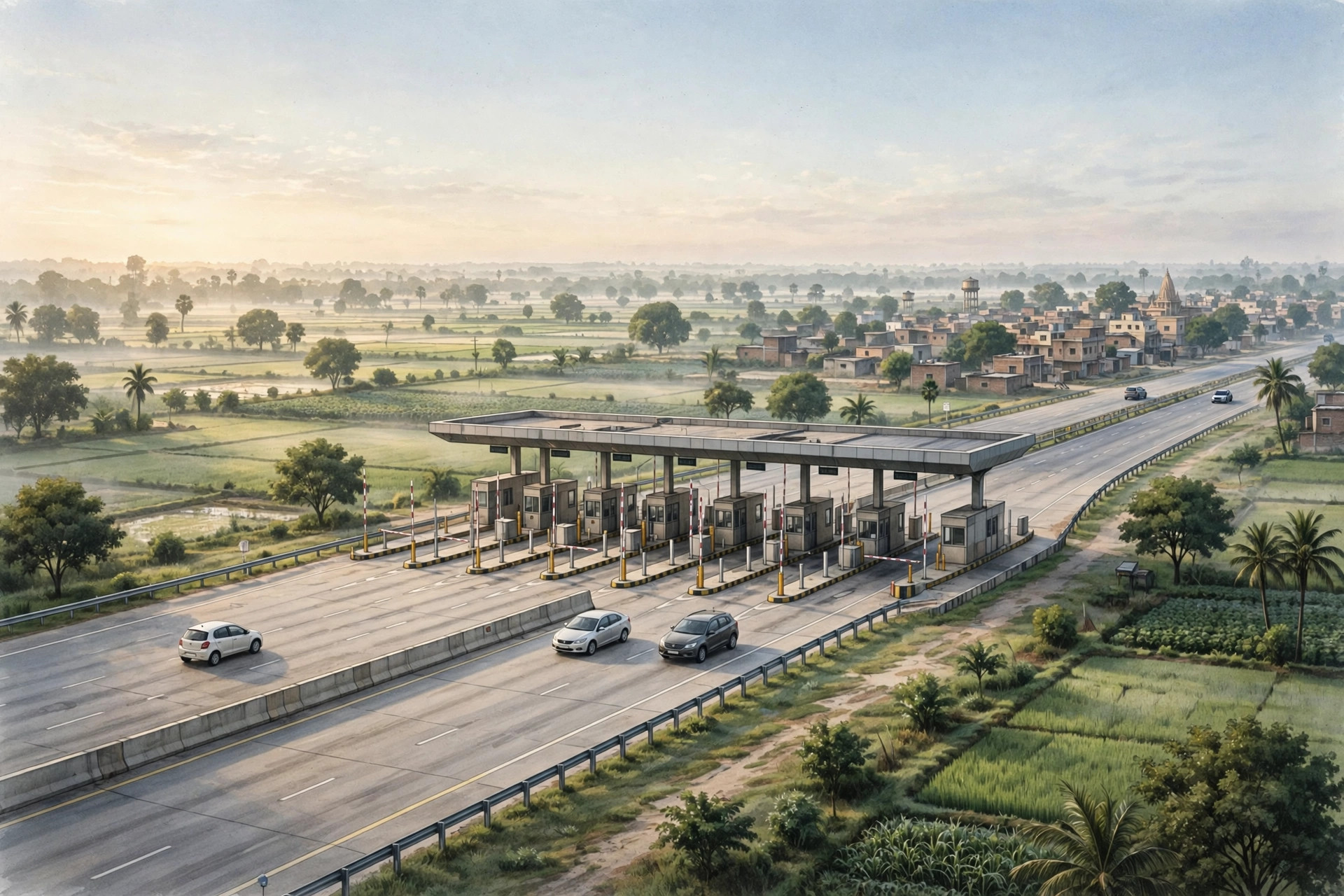
Original editorial illustration: a national highway toll plaza at dawn with private cars passing through toll lanes, green fields and a small town beside the highway.
Key Takeaways
From 1 November 2026, eligible non-commercial vehicle owners living within 20 km of a National Highway fee plaza can buy an annual Concessional Local Pass.
The annual fee is Rs 1,500 at plazas outside municipal or local town limits and Rs 3,000 at plazas within those limits.
Compared with the Rs 360 monthly pass (Rs 4,320 a year), the annual pass saves Rs 2,820 or Rs 1,320 a year for a regular user.
The pass is valid only at the specific plaza for which it is issued and cannot be transferred to another plaza.
It does not apply where toll is collected through a closed user-fee system or where a service road or alternative road is available.
What has changed
From 1 November 2026, eligible owners of non-commercial vehicles who live within 20 kilometres of a National Highway fee plaza will be able to buy an annual Concessional Local Pass instead of renewing a monthly pass every month. The Ministry of Road Transport and Highways announced the new option on 27 October 2026, and the National Highways Authority of India (NHAI) confirmed the same day that the pass will be available at eligible toll plazas from 1 November, including through the Rajmargyatra app.
The annual fee depends on where the toll plaza is located. It will be Rs 1,500 a year for a fee plaza located outside municipal or local town limits, and Rs 3,000 a year for a plaza situated within those limits. The distinction is based on the location of the plaza, not on whether the vehicle owner lives in a town or a village. The pass will be valid only for the specific fee plaza for which it is issued, and it cannot be transferred to any other plaza.
The change has been notified through the National Highways Fee (Determination of Rates and Collection) (Fifth Amendment) Rules, 2026, under the powers conferred by the National Highways Act, 1956. The notification was issued as G.S.R. 917(E). The Central Government may revise the annual rates each year, with revisions taking effect on 1 April.
Who can get the pass
The pass is not for every driver, and it is not a general exemption from toll charges. It is a targeted concession for local residents who use one nearby plaza regularly. According to the ministry, three conditions matter most. First, the vehicle must be registered for non-commercial use, which means private vehicles rather than commercial transport. Second, the owner must reside within 20 kilometres of the fee plaza. Third, the vehicle must have a valid and functional FASTag registered for non-commercial purposes.
Eligible owners will have a choice: they can continue with the existing monthly pass, or they can opt for the new annual Concessional Local Pass. That choice matters because the two options suit different patterns of use. A household that crosses its local plaza only occasionally may still prefer paying as it goes or using the monthly option, while a household that crosses the same plaza almost daily for work, school, college, medical visits or farming and business errands is more likely to benefit from paying once a year.
The ministry has said that with over 13 crore FASTags issued across the country, the new provision aims to make travel more economical for eligible residents living near toll plazas and to improve ease of commuting. In practice, the saving comes from replacing twelve monthly renewals with a single annual payment at a lower total cost.
How much can a local commuter save
The comparison that matters is with the existing monthly local pass, which costs Rs 360 a month, or Rs 4,320 over twelve months. Against that benchmark, the new annual pass saves Rs 2,820 a year at plazas outside municipal or local town limits, where the fee is Rs 1,500. At plazas within municipal or local town limits, where the fee is Rs 3,000, the saving is Rs 1,320 a year.
Those figures assume the commuter would otherwise have bought the monthly pass for all twelve months. They are therefore best read as the maximum saving for a regular user, not as a saving every nearby resident will automatically get. A resident who crosses the plaza only a few times a month may spend less by paying the ordinary toll each time than by buying any pass at all. The sensible step before 1 November is to compare your own crossing pattern: how often you use that one plaza, what you currently pay per month, and whether the annual fee is lower than your actual yearly spend.
It is also worth being clear about what the pass does not do. It does not cover other toll plazas, it does not cover travel across the wider National Highway network, and it does not remove toll charges for anyone else. A driver who regularly uses several different plazas will still need to pay separately at each of them, because the pass is tied to one plaza alone.
Where the pass will not apply
Two important exclusions are built into the new rules. The Concessional Local Pass will not be available on National Highways or Expressways where toll fee collection is based on a closed user-fee collection system, in which the charge depends on the distance travelled between entry and exit points rather than a single plaza crossing. It will also not be issued where a service road or alternative road is available for use by commuters.
Those exclusions mean that some residents living within 20 kilometres of a plaza may still not qualify, even if they meet the residence and FASTag conditions. The reason, in the ministry's framing, is that the concession is meant for places where local residents have no reasonable alternative but to cross that particular plaza. Where a free service road exists, or where the tolling system works differently, the annual local pass does not fit the same logic.
This is also why residents should check the status of their own plaza before assuming they can buy the pass on 1 November. The ministry has said the pass will be available at eligible toll plazas from that date and through the Rajmargyatra app, but eligibility is plaza-specific. The official notification and the NHAI's plaza-level information are the authoritative sources for whether a particular plaza is covered.
Background: why local toll has been a long-running issue
Local toll concessions are not new. The National Highways Fee Rules of 2008 already provided for a monthly pass for eligible non-commercial vehicle owners residing within 20 kilometres of a fee plaza, subject to prescribed conditions. The Rs 360 monthly pass was the existing form of that concession, and demands for cheaper and simpler local toll arrangements have been raised by residents' groups and public representatives for years, particularly in areas where a highway cuts through a town or village and daily life requires crossing the same plaza repeatedly.
The November 2026 change therefore does not invent the idea of a local concession. What it adds is an annual payment option at a lower total cost than twelve monthly passes, with a single renewal instead of twelve. That is a meaningful administrative simplification as well as a financial one: fewer renewals, fewer chances of a lapsed pass, and a predictable yearly cost for households that budget around school, work and farming seasons.
At the same time, the structure of the change shows the limits of what it tries to do. It does not revisit toll rates in general, it does not change how tolls are set for long-distance or commercial traffic, and it does not create a right to free passage. It is a narrow, local measure, aimed at a specific and recurring grievance: people who live next to a toll plaza and must cross it to go about ordinary life.
What it means for households, plazas and the highway system
For households, the main effect is on the monthly budget of regular local commuters. A saving of Rs 1,320 to Rs 2,820 a year is modest in absolute terms, but for a household that crosses the same plaza daily, it removes a recurring cost and a recurring chore. The annual structure also helps planning: one payment, one validity period, and no monthly deadline to remember.
For toll plazas and the highway system, the effect is likely to be administrative rather than dramatic. Annual passes reduce the volume of monthly renewals and give operators a clearer picture of how many local users are on annual terms. Because the pass is restricted to one plaza and to non-commercial vehicles, it should not change traffic patterns on the highway as a whole. Long-distance traffic, freight and commercial vehicles are outside its scope.
There is also a broader context worth noting. The change arrives alongside other 1 November measures, including GST changes and seasonal city plans, which means households and businesses are facing several new rules at the same time. The local pass is the smallest of these in national terms, but for the families who live beside a plaza, it may be the one they notice most directly, because it touches a payment they make almost every day.
What to do before 1 November
First, confirm that your plaza is eligible and that your vehicle qualifies: non-commercial registration, residence within 20 kilometres, and a valid, functional FASTag. Second, work out whether the annual fee beats what you actually spend now, using the Rs 1,500 or Rs 3,000 figure that applies to your plaza's location, not the other one. Third, use the official channels the ministry has named — the eligible toll plaza itself and the Rajmargyatra app — rather than relying on forwarded messages or unofficial agents, and check the official notification for the full conditions before paying.
If your plaza is not eligible, or if you use several plazas, the new pass will not solve your toll costs, and that is not a mistake in your application — it is how the rule is written. In that case, the existing monthly pass for a single plaza, or ordinary FASTag payment, remains the relevant option.
Conclusion
The Concessional Local Pass is a focused, practical change: from 1 November 2026, eligible local residents can pay Rs 1,500 or Rs 3,000 once a year for their one nearby plaza instead of Rs 360 every month. It will help regular local commuters most, it will not help everyone who lives near a highway, and its value depends entirely on checking your plaza, your vehicle and your actual usage. Used with those checks, it is a small but real reduction in both cost and hassle for the households it is designed for.
Frequently Asked Questions (FAQ)
What is the Concessional Local Pass for National Highway toll plazas?
It is a new annual pass, effective from 1 November 2026, for eligible owners of non-commercial vehicles who live within 20 kilometres of a National Highway fee plaza. It costs Rs 1,500 a year at plazas outside municipal or local town limits and Rs 3,000 a year at plazas within those limits, and it is valid only at the specific plaza for which it is issued.
Who is eligible for the Rs 1,500 or Rs 3,000 annual local pass?
Owners of vehicles registered for non-commercial use who reside within 20 kilometres of the fee plaza and have a valid, functional FASTag registered for non-commercial purposes. Eligible owners can choose between the existing monthly pass and the new annual pass.
How much does the new pass save compared with the monthly pass?
The existing monthly local pass costs Rs 360, or Rs 4,320 over twelve months. The Rs 1,500 annual pass therefore saves Rs 2,820 a year, and the Rs 3,000 annual pass saves Rs 1,320 a year, for a commuter who would otherwise buy the monthly pass every month.
Where will the Concessional Local Pass not be available?
It will not be available on highways or expressways where toll is collected through a closed user-fee collection system, and it will not be issued where a service road or alternative road is available for commuters. It is also valid only at one specific plaza and cannot be transferred to another plaza.