Arabian Black Electric Ray Explained: India's New Deep-Sea Species From the Arabian Sea, and Why Its Discovery Matters
Key Takeaways
- The Arabian Black Electric Ray (Tetronarce ramanamurthyi) is a newly described electric ray from the deep southeastern Arabian Sea, announced by the Zoological Survey of India on 27 October 2026.
- It is the first confirmed record of the genus Tetronarce in the northern Indian Ocean, and its findings were published in the taxonomy journal Zootaxa.
- Specimens were caught as bycatch by deep-sea trawlers targeting red shrimps at 400 to 700 metres, and collected during fish-landing surveys at Sakthikulangara Fishing Harbour in Kerala.
- It is distinguished by its dark upper body and whitish belly, a disc wider than it is long, no papillae around its spiracles, and smaller kidney-shaped electric organs, with mitochondrial DNA confirming a separate lineage.
- The species is named after Dr M. V. Ramana Murthy, Mission Director of India's Deep Ocean Mission, and its discovery underlines how much of India's deep sea remains unexplored.
Scientists in India have described a new species of electric ray from the deep waters of the southeastern Arabian Sea, a discovery that adds a previously unknown animal to the northern Indian Ocean and underlines how much of India's deep sea remains unexplored. The animal, commonly called the Arabian Black Electric Ray, has been given the scientific name Tetronarce ramanamurthyi. The Zoological Survey of India (ZSI) announced the discovery in a statement on 27 October 2026, and the findings have been published in the international taxonomy journal Zootaxa.
The announcement is notable for a simple reason: this is the first confirmed record of the genus Tetronarce in the northern Indian Ocean. In other words, scientists had not previously confirmed that a ray of this particular genus lived in these waters. The new species was not found on a dedicated deep-sea expedition with a submersible. It came to light through the far more ordinary route of fish-landing surveys, when specimens caught accidentally as bycatch were examined closely enough to show that they did not match any known species.
What was discovered, and where
The specimens were collected off India's southwestern coast, in the southeastern Arabian Sea, from deep-sea trawl fisheries targeting deep-sea red shrimps. The rays were caught at depths of 400 to 700 metres, far below the sunlit surface waters where most fishing and swimming take place. Researchers obtained the specimens during fish-landing surveys at Sakthikulangara Fishing Harbour in Kerala.
The discovery was led by Dr K. K. Bineesh, a scientist, and Anil Kasinath, a junior research fellow, from the Marine Biology Regional Centre of ZSI in Chennai, in collaboration with Dr David A. Ebert of the Pacific Shark Research Center at Moss Landing Marine Laboratories, San Jose State University in the United States. Research Matters, reporting the description, also lists the South African Institute for Aquatic Biodiversity and the California Academy of Sciences among the collaborating institutions. The research was carried out under the Ministry of Earth Sciences' Deep Ocean Mission project, which focuses on the taxonomy, distribution, biology and status of deep-sea chondrichthyans — the group of cartilaginous fishes that includes sharks, rays and skates — in Indian waters.
The species is named in honour of Dr M. V. Ramana Murthy, Mission Director of the Deep Ocean Mission and Director of the National Centre for Coastal Research under the Ministry of Earth Sciences, in recognition of his contributions to marine science, ocean engineering and marine hazard mitigation in India. Naming a species after a scientist is a long-standing taxonomic tradition, and in this case it also ties the discovery directly to the national programme that supported the underlying research.
How scientists knew it was a new species
Describing a new species is not a matter of spotting an unfamiliar-looking fish and giving it a name. Taxonomists must show, with evidence, that the animal differs consistently from every previously described species in its group. In this case, the team used two independent lines of evidence: body structure and genetics.
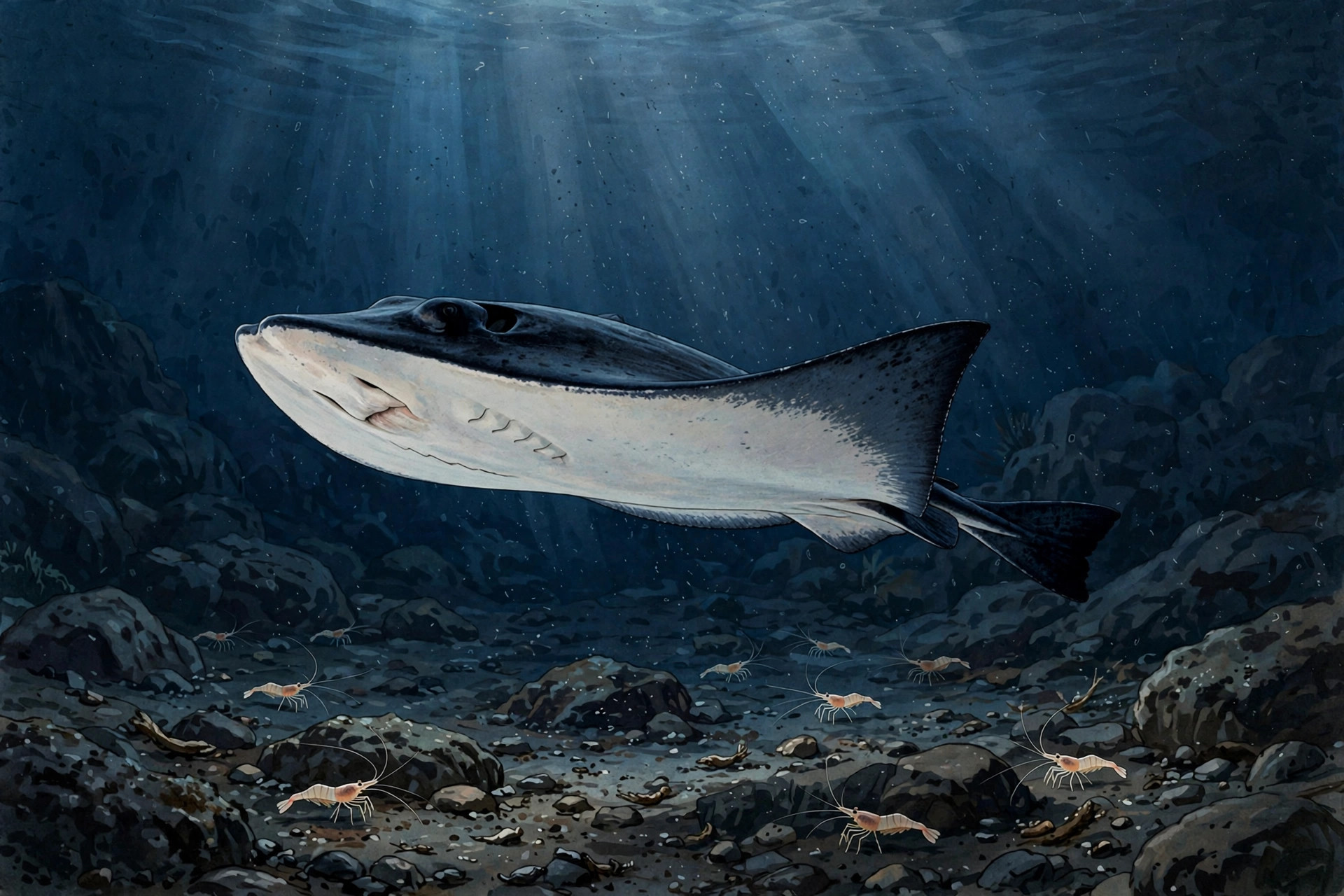
On appearance, the Arabian Black Electric Ray has a uniform dark bluish-black to dark brown upper body surface and a whitish belly. Unlike some of its relatives, it lacks skin bumps, called papillae, around its breathing holes, known as spiracles. Closer measurement revealed a set of distinguishing proportions: a disc that is wider than it is long, relatively large spiracles and endolymphatic pores, a distinctive ratio between the mouth and the nostrils, and smaller, kidney-shaped electric organs. Any one of these features alone might not be decisive, but together they form a pattern that does not match other known members of the genus.
The genetic evidence points the same way. Testing of mitochondrial DNA, using the COI and ND2 genes that are standard markers for distinguishing animal species, confirmed that the specimens form an independent evolutionary lineage, well separated from all other known electric ray species worldwide. Morphology and molecules agreeing is the standard that modern taxonomy expects, and it is what allows researchers to describe the ray as a new species rather than a regional variant of an existing one.
Electric rays belong to the family Torpedinidae. Like other cartilaginous fishes, their skeletons are made of cartilage rather than bone, and their flattened bodies have enlarged pectoral fins fused to the head. Their best-known feature is the pair of electric organs, which can generate an electric shock used for defence and to stun prey. The reports on this discovery describe the new species' electric organs as smaller and kidney-shaped, but they do not give a shock strength for this species, and none should be assumed. Deep-sea electric rays are not animals that beachgoers are likely to meet: this species was found hundreds of metres down, not in shallow coastal water.
Why a single new ray matters
A new species description can look like a small event — one more name on a very long list. Its importance lies in what it reveals about the place it came from. Deep-sea habitats are among the most difficult ecosystems on Earth to study. They are dark, cold, under high pressure and expensive to reach, so large areas of the Indian Ocean's deep waters have been sampled only sparsely. Every confirmed new species from those depths is evidence that the baseline inventory of Indian marine life is still incomplete.
That baseline matters for practical reasons. Conservation and fisheries management both depend on knowing what lives where. If a species has never been described, it cannot be monitored, its range cannot be mapped, and its vulnerability to fishing pressure cannot be assessed. The researchers themselves make this point: by combining classical morphological taxonomy with modern molecular tools, they argue, scientists can uncover hidden marine life, clarify evolutionary relationships and establish critical baselines for ocean conservation.
The discovery also highlights the role of bycatch monitoring. The rays were not the target of the fishery that caught them; they were hauled up accidentally by trawlers chasing deep-sea red shrimps. Fish-landing surveys — the routine checking of what boats actually bring in — turned an accidental catch into a scientific record. Without that monitoring step, the specimens might have been discarded unexamined, and the species would have remained unknown. For deep-sea animals, which are rarely seen alive by scientists, bycatch records and landing surveys are often the only window into what is really down there.
There is a wider context, too. India is a party to global biodiversity agreements and has set national biodiversity targets, and the health of marine ecosystems is part of that agenda. A new deep-sea species does not by itself change any target, but it strengthens the case for systematic deep-sea exploration under programmes such as the Deep Ocean Mission, which is designed to study exactly this kind of poorly known environment, including its biology, resources and hazards.
What this discovery does not mean
It is worth being clear about the limits of what has been announced. The reports do not give a population estimate for the Arabian Black Electric Ray, and they do not assign it a conservation status. Finding a new species is the first step, not a full ecological assessment. Scientists do not yet know how widespread it is beyond the area where the specimens were caught, how abundant it is, or how much it is affected by deep-sea trawling. Those questions will need further surveys and, ideally, records from more locations and depths.
Nor does the discovery create a new fishery or a new food source. Electric rays are not a targeted commercial catch, and the specimens here were bycatch. The value of the find is scientific: a clearer picture of the diversity of the Arabian Sea's deep waters, a new reference point for future surveys, and another reminder that India's deep ocean still holds undescribed life.
Finally, the name itself deserves a small note for readers who see it spelled in more than one way. Some reports render the species name as Tetronarce ramanamurthyi, while the ZSI statement's English rendering appears as Tetronarce Ramanamurthy. Both refer to the same animal, named for the same person; the difference is a matter of transliteration and capitalisation in news reports, not a second species. The scientific convention is to write the species epithet in lower case, as ramanamurthyi.
Conclusion
The Arabian Black Electric Ray is a modest animal with a useful story. Found by accident at 400 to 700 metres in the Arabian Sea, examined through both anatomy and DNA, and named for the scientist who leads India's Deep Ocean Mission, it becomes the first confirmed Tetronarce record in the northern Indian Ocean. Its description, published in Zootaxa and announced by ZSI on 27 October 2026, adds one more species to India's marine inventory and one more reason to keep surveying the deep sea systematically — because the next unknown animal may already be coming up in a trawl net, waiting for someone at a fishing harbour to look closely enough to notice it.