Why Did Thousands March in Imphal on 31 October 2026? Manipur Rally, SoO Agreement and CM Resignation Demand Explained
Key Takeaways
- Thousands marched in Imphal on 31 October 2026 in a COCOMI-organised rally demanding Chief Minister Y Khemchand Singh's resignation, protection for indigenous people, and abrogation of the SoO agreement.
- The march began at Tiddim Ground towards THAU Ground in Imphal West and was stopped by police barricades at Keisampat junction, near Lok Bhavan, the Chief Minister's Office and the BJP state office.
- The SoO agreement, signed in August 2008 by the Centre, the Manipur government and Kuki-Zo groups, expired on 4 September 2026 without renewal; the Manipur Assembly had already sought its abrogation in February 2024.
- The rally followed an ambush days earlier in which 14 Meitei men were attacked and three killed, and a camp takeover in which only one of 159 registered cadres was found present; an audit of all 14 designated camps is planned.
- Naga organisations endorsed the rally and held parallel marches in Senapati and Chandel, also demanding the SoO pact's abrogation and Deputy Chief Minister Nemcha Kipgen's resignation.
Thousands of people marched through Imphal on Saturday, 31 October 2026, in a protest that has put Manipur back at the centre of national attention. The Manipur Imphal rally SoO agreement protest was organised by the Coordinating Committee on Manipur Integrity (COCOMI), an umbrella body of Meitei groups, and it carried three clear demands: the resignation of Chief Minister Yumnam Khemchand Singh, protection for indigenous people, and the abrogation of the Suspension of Operations (SoO) agreement with Kuki-Zo militant groups. Reports described the turnout in the thousands, though no official crowd figure has been released, and the march was stopped by police barricades before it could reach its planned destination.
The rally matters because it was not a single-community event in isolation. Naga organisations endorsed the Imphal march and held parallel rallies of their own, and the protest came only days after a deadly ambush that killed three Meitei men. At the same time, the SoO agreement itself — a truce arrangement dating back to 2008 — lapsed in September 2026 without renewal, and security forces have since taken control of at least one designated militant camp after finding almost none of its registered cadres present. Together, these developments have turned an old ceasefire arrangement into the most contested question in Manipur today.
The Manipur Imphal rally and the SoO agreement demand: what happened on 31 October
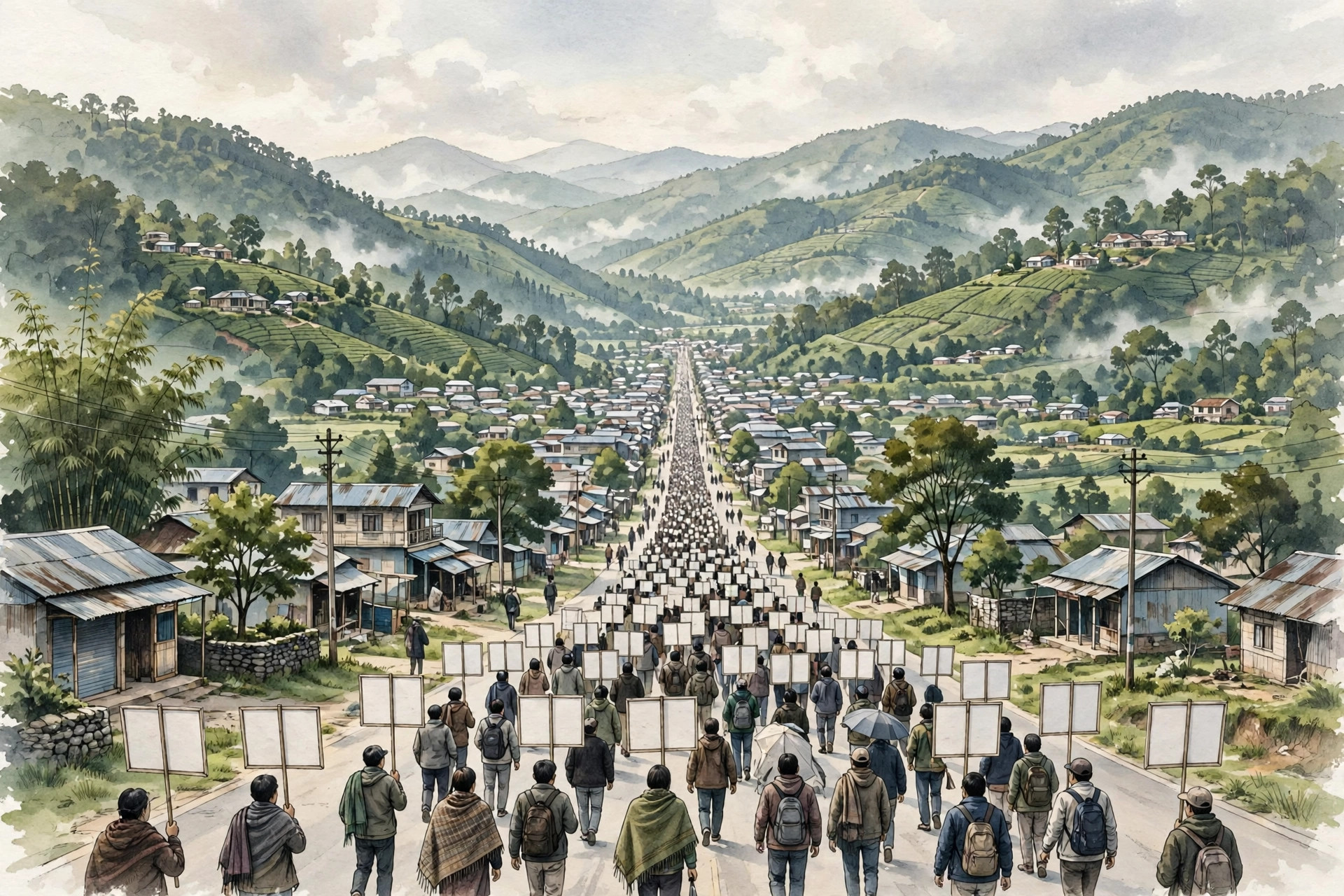
According to reports based on the PTI news agency, thousands of people began their march from Tiddim Ground towards THAU Ground in Imphal West district on Saturday morning. Participants carried placards reading "save Manipur", "we want peace and justice" and "abrogate SoO pact". The procession moved along Tiddim Road in Kwakeithel, Imphal West, before police put up barricades at Keisampat junction, only a few hundred metres from Lok Bhavan, the Chief Minister's Office and the BJP state office, and prevented the rally from moving further.
There is a small discrepancy in the reporting about how far the march got: one account said the procession reached THAU Ground for a public meeting, while the PTI-based reports said the barricades stopped it at Keisampat. That difference is worth noting, because it shows why crowd and route details in fast-moving protest coverage should be treated as reported, not confirmed, until an official account is available. What is consistent across the major reports is the scale — thousands of marchers — the organiser, the route's starting point, and the demands.
COCOMI convenor Y Dhiren put the protesters' case in blunt terms. "We seek the resignation of the present government for its failure to protect the lives and properties of the indigenous people of the state. This is a historic rally. People are raising their voice against policies and programmes which are against the indigenous people," he said. The resignation demand was aimed at Chief Minister Y Khemchand Singh and his government, which the protesters accuse of failing to protect indigenous communities.
What is the SoO agreement in Manipur?
The Suspension of Operations (SoO) agreement was signed in August 2008 by three parties: the central government, the Manipur government, and Kuki-Zo militant groups. Its purpose was to suspend hostilities and create conditions for a negotiated political settlement. Under the arrangement, armed cadres covered by the pact were to remain in designated camps and refrain from violence, while security operations against them were suspended.
The agreement was a tripartite arrangement, which is why ending it is not a decision the state government can take alone — the Centre is also a party. Over the years, the pact has been extended repeatedly, but it expired on 4 September 2026 without renewal. That expiry did not by itself end the debate; if anything, it sharpened it, because the camps, the cadres and the rules governing them are now in a grey zone.
In February 2024, the Manipur Assembly had already passed a resolution seeking the abrogation of the SoO agreement. The demand therefore predates the current protests by more than two years. What has changed in recent weeks is the enforcement picture on the ground, which critics of the pact say supports their case and which supporters of a negotiated settlement say makes careful handling more important, not less.
Why are protesters demanding the abrogation of the SoO agreement now?
The immediate trigger, according to the reports, was an ambush days before the rally in which militants attacked 14 Meitei men and killed three of them. That attack sparked protests across the state and became the rally's proximate cause. But the deeper grievance, as stated by the organisers, is the continuing violence in Manipur and what they see as the failure of the existing security framework to prevent it.
A second trigger is the camp controversy. Security forces have, for the first time since the current phase of violence began, taken control of a camp meant to house Kuki-Zo militants under the truce, and now plan to audit all 14 such camps in the state. The takeover followed the discovery that only one of the 159 registered cadres was present at the camp in question. Critics of the SoO agreement argue that this raises serious questions about compliance with one of the pact's central conditions — that cadres remain in designated camps. It is important to be precise here: the finding concerns one camp, and an audit of the remaining camps has been announced, not completed. The protesters treat the episode as evidence that the system is not working; others may argue that the audit itself is the system responding.
Protesters also raised two further demands that go beyond the SoO pact itself: the withdrawal of the Assam Rifles from Manipur and the resettlement of all internally displaced persons (IDPs). Some rally participants described the Centre's approach as a "proxy war" — that is the protesters' characterisation, not an established fact — and demanded an end to it. These demands show that the rally was not only about one agreement, but about the wider handling of Manipur's conflict.
Who joined the rally, and what did Naga groups demand?
One of the most notable features of Saturday's protest was the breadth of support it drew. The United Naga Council (UNC), the apex body of Naga organisations in the state, endorsed the rally. Naga civil society organisations joined the mobilisation, including the Joint Tribe Council Manipur, the Foothills Naga Coordination Committee, the Naga Humanitarian Aids Committee Manipur, the Naga People's Union, Imphal, and the Inpui Naga Union.
Naga organisations also held parallel demonstrations. In Senapati district, a rally organised by the Naga People's Organisation, the Senapati District Students' Association and the Senapati District Women's Association demanded the immediate abrogation of the SoO agreement and the resignation of Deputy Chief Minister Nemcha Kipgen. A similar rally was held in Chandel district, also demanding Kipgen's resignation and the pact's abrogation. Naga organisations have accused Kuki-Zo militant groups of involvement in the violence — again, an allegation made by the protesters, which the groups concerned would dispute.
The Meitei-Naga convergence is significant because Manipur's politics are often described in terms of competing community interests. A joint mobilisation does not erase those differences, but it does make the demand harder for governments in Imphal and New Delhi to dismiss as a single community's agitation. At the same time, it also raises the stakes of the response: any decision on the SoO agreement will now be read by multiple communities at once.
The background: Manipur's conflict since May 2023
Manipur has been affected by ethnic conflict between the valley-based Meitei community and the hill-based Kuki community since May 2023. The violence has displaced thousands of people, many of whom remain in relief camps, which is why the demand for IDP resettlement featured so prominently in Saturday's rally. The conflict has also repeatedly drawn in questions about land, identity, political representation and the role of armed groups — all of which feed into the debate over the SoO agreement.
Understanding that background matters for reading the rally correctly. The protesters are not only reacting to one ambush or one camp inspection. They are arguing that the framework put in place in 2008, and the way it has been operated since 2023, has not delivered safety for indigenous people. The counter-argument, made by those who favour keeping a negotiated channel open, is that scrapping a ceasefire framework without a replacement risks more violence, not less. Saturday's rally did not settle that argument; it put public pressure behind one side of it.
What happens next in Manipur?
In the short term, three things are worth watching. First, whether the state or central government responds formally to the resignation demand and to the call for abrogation. So far, the reports of the rally do not record an official response to these specific demands, and a resignation demand from a protest does not by itself change a government. Second, the camp audit: security forces have said they plan to audit all 14 designated camps, and the results of that audit will shape the factual basis of the SoO debate far more than any single camp's figures. Third, the IDP question: resettlement is a long-term administrative and security challenge, and protesters are likely to judge the government on visible progress, not announcements.
There is also a wider political context. Manipur's situation is being watched alongside other state-level political developments, and a large, peaceful, multi-community rally is the kind of event that tends to force a response even when governments would prefer to wait. Whether that response is a statement, a review of the SoO arrangement, or concrete steps on camps and resettlement remains to be seen. What can be said now is that the issue will not fade with the rally itself, because the agreement's expiry, the audit and the displacement crisis all remain unresolved.
Why this rally matters beyond Manipur
The Imphal rally matters for three reasons that go beyond one state's politics. First, it tests how the Centre handles a tripartite ceasefire agreement that has lapsed: renew it, replace it, or formally end it, each option carries risks. Second, it shows how local security incidents — an ambush, a camp inspection — can rapidly become state-wide political movements when they connect to a longer grievance. Third, it is a reminder that in a conflict-affected state, the demands of displaced people and of communities that feel unprotected cannot be treated as background noise; they are the central political fact.
For readers following Manipur, the honest position is this: the rally's scale and demands are well reported, the history of the SoO agreement is a matter of public record, and the camp figures come from official action reported in the press. But the underlying claims about who is responsible for continuing violence are contested, and the future of the agreement itself is still undecided. Any account that presents one side's allegations as proven fact would be misleading.
Conclusion
The 31 October 2026 Imphal rally was a large, organised and multi-community protest with a clear message: its organisers want the Manipur government to go, the SoO agreement to be scrapped, indigenous people to be protected, displaced people to be resettled, and the Assam Rifles to be withdrawn. It was triggered by a deadly ambush, fuelled by the lapse of the 2008 truce agreement in September 2026, and sharpened by the discovery that only one of 159 registered cadres was present at one designated camp. Police stopped the march at Keisampat junction, but the demands it carried have already travelled well beyond Imphal. The next steps — a government response, the camp audit, and progress on resettlement — will determine whether this rally becomes a turning point in Manipur's long-running crisis or another protest that the system absorbs without answering.