Varanasi-New Delhi Vande Bharat Sleeper Explained: Train Numbers, Timings, Stops, Coaches and What Changes for Overnight Travellers
Key Takeaways
- The Railway Board has approved the Varanasi-New Delhi Vande Bharat Sleeper Express, numbered 27421 and 27422, with inauguration reported for 31 October 2026.
- Train 27421 leaves Varanasi at 8:50 pm and reaches New Delhi at 6:10 am, except Fridays; train 27422 leaves New Delhi at 9:40 pm and reaches Varanasi at 7:10 am, except Saturdays.
- The train stops at only four stations between the terminals: Prayagraj, Kanpur Central, Aligarh and Ghaziabad, over a route of about 760 kilometres.
- It has 16 air-conditioned sleeper coaches with 823 berths: 24 First AC, 188 AC Two-Tier and 611 AC Three-Tier.
- The regular commercial start date was yet to be announced in the approval coverage, so passengers should verify the official timetable before booking.
Overnight travel between Varanasi and New Delhi is about to get a new option. The Railway Board has approved a Vande Bharat Sleeper Express on the route, numbered 27421 and 27422, and reports say the service is expected to be inaugurated on 31 October 2026. For passengers, the important point is simple: this is a sleeper version of the Vande Bharat idea, designed for a night journey rather than a daytime chair-car trip, with air-conditioned berths in three classes and only four stops between the two terminal stations.
This article explains what has actually been approved, the train numbers and timings reported so far, the stops and coach layout, the features that matter on an overnight journey, and what is still not confirmed. Where reports differ on smaller details, this article says so, because passengers should check the final booking timetable before making plans.
What has been approved
The Railway Board approved the introduction of the Vande Bharat Sleeper Express between Varanasi and New Delhi, according to reporting on the Railway Board letter by The Indian Express and Zee Business. The train will run as 27421 from Varanasi to New Delhi and as 27422 in the return direction. It will be maintained and operated by Northern Railway.
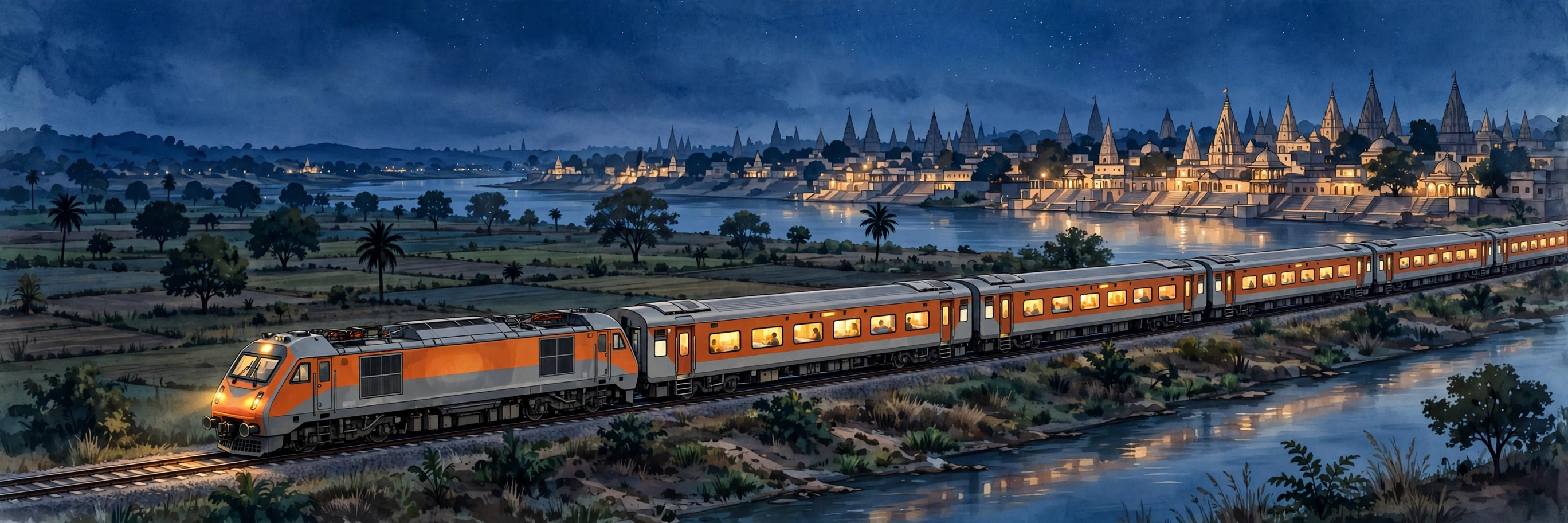
The train has been developed by BEML using technology from Chennai's Integral Coach Factory, and it is described as a semi-high-speed, self-propelled train. That matters because a self-propelled train does not need a separate locomotive to pull it, and the design is built for long-distance overnight running rather than short daytime hops. The orange-and-grey train is the sleeper counterpart to the Vande Bharat chair-car services that already run on this corridor.
Reports say Railway Minister Ashwini Vaishnaw and Uttar Pradesh Chief Minister Yogi Adityanath are expected to be associated with the inauguration on 31 October 2026. At the same time, The Indian Express notes that the start date for regular service is yet to be announced, and other reporting says the date for regular operations has not yet been finalised. The safest way to read this is that approval and an expected inauguration are reported, but passengers should not treat any single date as the first bookable commercial run until Indian Railways publishes it in its booking system.
Route, distance and stops
The train will cover around 760 kilometres between Varanasi and New Delhi, via Kanpur Central. The journey is reported at about nine and a half hours: nine hours and twenty minutes from Varanasi to New Delhi, and nine hours and thirty minutes in the return direction.
Between the two ends, the train will stop at only four stations. In route order, they are Prayagraj, Kanpur Central, Aligarh and Ghaziabad. A limited-stop pattern is a deliberate choice. It keeps the overnight journey reasonably fast, while still serving four large cities in Uttar Pradesh that send many passengers to and from Delhi. Prayagraj and Kanpur Central are major junctions in their own right, so the train also becomes useful for passengers connecting onward, even though its main market is end-to-end travel between Varanasi and the national capital.
The limited stops also explain why this train is different from many older overnight trains on the same corridor, which stop far more often and therefore take longer. Here, the promise is not the fastest possible train in India, but a predictable overnight schedule: leave in the evening, sleep on board, and arrive in the morning.
Timings and days of running
According to the timetable reported by The Indian Express from the Railway Board, train 27421 will leave Varanasi at 8:50 pm and reach New Delhi at 6:10 am the next morning. It will run six days a week, except on Fridays.
In the return direction, train 27422 will leave New Delhi at 9:40 pm and reach Varanasi at 7:10 am the following morning. It will run six days a week, except on Saturdays.
That pattern gives passengers a useful overnight window in both directions. A traveller can finish a working day or a day of sightseeing, board in the evening, and arrive early enough the next morning for onward travel, a meeting, or a hotel check-in. It also saves a night's hotel cost for many passengers, which is one of the main reasons sleeper trains remain popular even as daytime semi-high-speed trains get faster.
One caution is worth repeating. News reports on this train have not all carried identical intermediate timings, and the detailed station-by-station table in some coverage contains inconsistencies. The departure and arrival times above, the train numbers, the four stops and the weekly pattern are consistent across the main reports, but passengers should verify the exact stop timings in the official timetable at the time of booking.
Coaches, berths and classes
The train will have 16 coaches, all air-conditioned sleeper coaches, with a total capacity of 823 berths. The composition reported is one First AC coach, four AC Two-Tier coaches and eleven AC Three-Tier coaches. The berth split is 24 in First AC, 188 in AC Two-Tier and 611 in AC Three-Tier.
That mix is important. Most of the capacity is in AC Three-Tier, which keeps the train accessible to a large number of ordinary passengers, while AC Two-Tier and First AC give travellers who want more space and privacy a higher-priced option on the same train. Unlike a chair-car Vande Bharat, where passengers sit upright for the whole journey, every passenger here gets a berth for the night.
The train is designed for a speed of up to 180 kilometres per hour in testing, with regular service up to 160 kilometres per hour. In practice, the average speed over the whole 760-kilometre route will be much lower, because of stops, speed restrictions and traffic on the line. The top speed is therefore best understood as a design capability, not a promise that the train will run at that speed throughout the journey.
What the sleeper train offers on board
For an overnight train, comfort and safety features matter more than headline speed. The reported features include ergonomically designed berths with improved cushioning, automatic doors with vestibules for smooth movement between coaches, better suspension and noise reduction for a steadier ride, and sealed gangways connecting the coaches.
On safety, the train is reported to carry KAVACH, India's indigenous train protection system, along with CCTV cameras, fire-suppression systems and an emergency talk-back system. Zee Business also reports that the train meets European standards for crashworthiness and fire safety. Other reported fittings include vacuum toilets, mini-pantries for serving food on board, and regenerative braking, which recovers energy when the train slows down.
Taken together, these features point to the same goal: a quieter, cleaner and safer night journey than the older sleeper trains many passengers are used to, without changing the basic idea of an overnight berth. The train is also part of a wider modernisation push. Zee Business notes that Indian Railways is already working on a next version, Vande Bharat 4.0, expected in 2027, with further upgrades to comfort and safety systems.
Why this route, and why now
Varanasi and New Delhi are already connected by two pairs of Vande Bharat chair-car trains, and The Indian Express reports that both have been running at full capacity since they began. That is a strong signal of demand. A sleeper version does not simply duplicate those daytime trains. It serves a different kind of trip: the traveller who wants to travel overnight, sleep, and arrive in the morning, rather than spend daytime hours in a seat.
Varanasi is also a major pilgrimage and tourism centre, and a large education and business hub for eastern Uttar Pradesh. Pilgrims, families, students and business travellers all benefit from an overnight option that does not eat into a full day. The intermediate stops extend that benefit to Prayagraj, Kanpur, Aligarh and Ghaziabad, each of which has its own large flow of passengers to Delhi.
There is a broader context too. Indian Railways has been trying to replace ageing overnight stock with modern, safer and more comfortable trains, while keeping fares within reach of a wide range of passengers. A sleeper Vande Bharat fits that strategy: it uses Indian manufacturing, it brings modern safety systems such as KAVACH to a busy corridor, and it adds capacity where existing premium trains are already full. Whether it succeeds will depend less on the launch ceremony and more on reliability, cleanliness, punctuality and berth availability once regular service begins.
What to check before you book
First, confirm the first date of regular commercial service. Approval and an expected inauguration on 31 October are not the same as a bookable daily timetable, and reports differ on when regular operations will start.
Second, check the weekly pattern for your direction of travel. The Varanasi-bound and Delhi-bound services do not skip the same day: the Varanasi to New Delhi train does not run on Fridays, while the New Delhi to Varanasi train does not run on Saturdays.
Third, check the fare for your class before comparing it with other trains. Fares had not been prominently reported in the approval coverage at the time of writing, and they will determine whether this train competes mainly with other AC sleeper trains, with flights, or with the daytime chair-car services.
Fourth, if you are travelling from an intermediate station, verify the arrival and departure time at that station in the official timetable, rather than relying on a single news table. The terminal times and the stop list are consistent, but intermediate timings in early coverage should be treated with care.
Conclusion
The Varanasi-New Delhi Vande Bharat Sleeper Express is a clear and useful addition to a busy corridor: a 16-coach, 823-berth overnight train, numbered 27421 and 27422, running six days a week with stops at Prayagraj, Kanpur Central, Aligarh and Ghaziabad. It leaves in the evening and arrives the next morning in both directions, it offers First AC, AC Two-Tier and AC Three-Tier berths, and it brings modern features such as KAVACH, automatic doors and improved berths to overnight travel.
Its success will not be decided by the approval letter or the inauguration. It will be decided by whether passengers can actually book a berth, board on time, sleep comfortably, and arrive punctually, night after night. If it does that, it will quickly become one of the most useful trains on the Delhi-Varanasi route, especially for travellers who would rather sleep through the journey than spend a day in a seat.