Home > Agriculture & Mandi Bhav > Why Is Punjab Stubble Burning Rising Again in 2026? 1,152 Farm Fires on Diwali Explained
Why Is Punjab Stubble Burning Rising Again in 2026? 1,152 Farm Fires on Diwali Explained
By Vijay Pawar · 2026-11-10 · 8 min read · Agriculture & Mandi Bhav
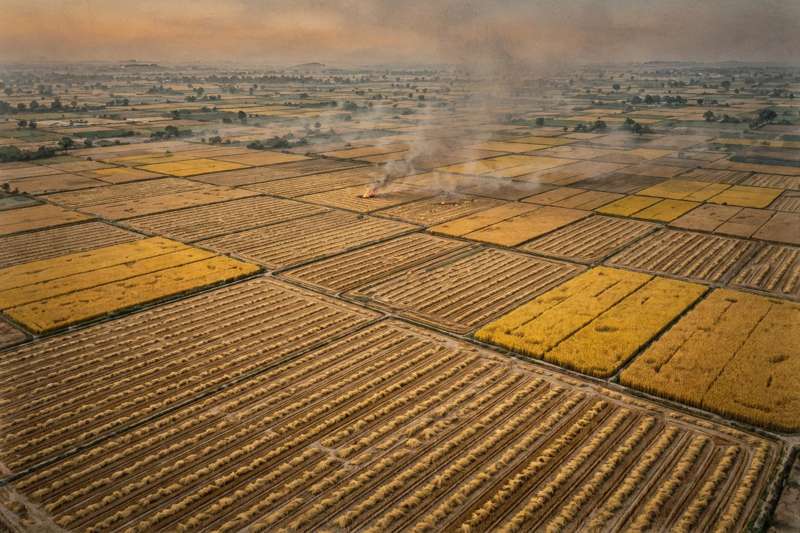
Editorial illustration: golden paddy fields in Punjab at dusk with thin smoke rising from a distant stubble fire under a hazy sky.
Key Takeaways
Punjab recorded 1,152 farm fires on Diwali day, 8 November 2026 — the highest single-day count of the season and the worst Diwali-day figure in three years.
The season total jumped from 3,307 to 4,459 in 24 hours, a 34.8 per cent rise that reversed Punjab's small year-on-year improvement.
Tarn Taran leads the season with 654 fires; on Diwali day itself, Sangrur reported the most at 194.
Authorities have registered 884 FIRs, made 1,017 red entries in land records and imposed Rs 62.55 lakh in environmental compensation.
Delhi's AQI touched 483 the morning after Diwali, and the capital recorded its most polluted Diwali in five years.
Punjab Stubble Burning in 2026: What Happened on Diwali
Punjab stubble burning in 2026 surged sharply on Diwali, with satellites detecting 1,152 farm fires across the state on 8 November alone — the highest single-day count of the ongoing paddy season and the highest Diwali-day figure in three years. The one-day spike pushed Punjab's cumulative farm fire count from 3,307 on 7 November to 4,459, a jump of 34.8 per cent in just 24 hours. The day before Diwali, only 163 fires had been recorded, which means the Diwali-day figure was nearly seven times higher. The surge matters because it wiped out, in a single day, the small year-on-year improvement Punjab had held until then — and it came on the same night Delhi recorded its most polluted Diwali in five years.
The figures come from satellite monitoring by the Punjab Remote Sensing Centre, compiled under the Indian Space Research Organisation protocol, and reported by the Punjab Pollution Control Board and the Commission for Air Quality Management. Multiple major news outlets — The Hindu, The Times of India, The Indian Express and News18 — reported the same numbers on 9 November 2026, and they agree on the core facts: 1,152 fires on Diwali day, 4,459 for the season so far, and a sharp reversal of the trend.
The Season So Far in Numbers
The farm fire monitoring season began on 15 September 2026, about two weeks before paddy procurement started on 1 October. By 8 November, 91.40 per cent of Punjab's total paddy area — spread across 32.87 lakh hectares — had already been harvested. That is why the Diwali spike is so striking: with the harvest nearly complete, the fires were concentrated in the final stretch of the season.
The district picture shows how widespread the burning was. Tarn Taran has recorded the highest season total so far with 654 fires, followed by Ferozepur with 592, Sangrur with 488, Bathinda with 406 and Patiala with 288. On Diwali day itself, Sangrur reported the most fires at 194, followed by Ferozepur with 157, Bathinda with 132, Patiala with 92 and Barnala with 91. Six districts of Punjab figured among the ten most affected districts across the seven states that report farm fires.
The comparison with last year is what makes the Diwali spike significant. Until 7 November, Punjab had recorded 3,307 fires against 3,384 in the corresponding period last year — 77 fewer, or a 2.3 per cent decline. After Diwali, the tally stood at 4,459 against 3,622 on the corresponding date in 2025 — 837 more, or 23.1 per cent higher. In one day, the state went from slightly ahead of last year's pace to well behind it.
The longer view, however, puts the numbers in perspective. Punjab recorded 5,114 farm fires in the full 2025 paddy season, 10,909 in 2024 and 36,663 in 2023. Even at 4,459, the 2026 season remains far below the worst years, which suggests the long decline in stubble burning has not been erased — but the Diwali spike shows how fragile that progress is. Across seven states, 8,106 farm fires had been reported till 8 November, and Punjab alone accounted for about 55 per cent of them. Madhya Pradesh reported 1,530, Rajasthan 1,221, Uttar Pradesh 523, Uttarakhand 196, Haryana 175 and Delhi just 2.
Why Do Farmers Burn Stubble?
The reason farmers set fire to paddy stubble is not carelessness but a tight calendar. After paddy is harvested, farmers have only a short window — roughly two to three weeks — to clear the field and sow wheat, the next crop in the cycle. Combine harvesters leave behind short stalks and loose straw spread across the field, and clearing it by hand or machine takes time and money that many small farmers say they do not have. Burning is the cheapest and fastest way to clear a field, even though it is illegal and harms the soil.
Alternatives do exist. Machines such as the Happy Seeder and Super Seeder can sow wheat directly into the stubble without burning, and balers can collect the straw for use as fodder or biomass fuel. The Punjab government and the Centre have subsidised these machines for years. But at the peak of the harvest, machines are in short supply, hiring them costs money, and many farmers say the machines do not work well on every field. The result is that when the sowing window tightens — as it does around Diwali, when the harvest is nearly done and wheat sowing is due — some farmers fall back on fire.
It is worth noting a caveat reported by The Indian Express: satellite data records active fire events, but it does not establish the motive or the exact timing of individual burnings. The count is therefore a measure of fires detected, not a court-ready finding against any individual farmer. That distinction matters because the enforcement that follows is based on field verification, not on satellite pixels alone.
What Action Has Been Taken Against Burning?
Enforcement this season has been heavy. By 8 November, authorities had registered 884 FIRs under Section 223 of the Bharatiya Nyaya Sanhita, which deals with disobedience of an order issued by a public servant. They had made 1,017 red entries in land revenue records against farmers found burning stubble — an entry that can affect a farmer's ability to sell or mortgage land and to access some benefits. Environmental compensation of Rs 62.55 lakh has been imposed in 1,228 cases, with more than Rs 32 lakh already recovered.
Field teams inspected 2,998 of the reported locations and physically verified stubble burning at 1,310 of them. The gap between reported fires and verified cases is normal: satellites can pick up heat signatures that turn out to be something else, or fires that are over before a team arrives. The verification numbers show that enforcement is following up on the ground rather than acting on satellite data alone.
Whether fines and FIRs are the right tool is debated every year. Supporters say penalties are the only deterrent that works at scale; critics argue that fines punish small farmers for a problem created by the paddy-wheat cycle itself, and that lasting change needs cheaper machines, assured markets for straw, and a shift away from water-hungry paddy. Both arguments are part of the public debate, and neither side disputes the basic facts of the season's numbers.
What It Means for Delhi's Air
The timing of the spike could hardly have been worse for Delhi. On the morning after Diwali, the capital's air quality index touched 483 at 8.10 am, placing it in the 'severe' category, according to Central Pollution Control Board data. Delhi recorded its most polluted Diwali in five years, with an average AQI of 376 on the day itself. Stubble smoke drifting from Punjab and Haryana is one of the contributors to Delhi's winter pollution, alongside local sources such as vehicles, dust, construction and firecrackers.
That is also why the reliability of Delhi's own pollution data became a separate controversy this Diwali. Several of the capital's monitoring stations went offline on Diwali night, raising questions about whether the official figures captured the full extent of the pollution. [Read the full story: Why Is Delhi's AQI Data Under Question After Diwali 2026? 36 of 59 Monitoring Stations Went Offline Explained](https://indiaask.tech/question.php?slug=delhi-aqi-data-gap-diwali-night-2026-explained)
The courts have been involved in this issue for years. Ahead of Diwali, the Supreme Court heard matters relating to green crackers and stubble burning in Delhi-NCR, and its directions shape what the authorities can and cannot allow during the festival season. [Read the background: Delhi Pollution Supreme Court Hearing: Green Crackers, Stubble](https://indiaask.tech/question.php?slug=delhi-ncr-pollution-supreme-court-green-crackers-hearing-october-2026-explained)
What Happens Next
With 91.40 per cent of the paddy area already harvested, the window for further large-scale burning is narrowing — most of the straw that could be burnt already has been. The season's final tally will depend on how the remaining fields are cleared and how strictly enforcement continues in the coming days. The larger question is whether the Diwali spike is a one-day blip or a sign that the long decline in stubble burning is stalling. The answer will come from the next few weeks of data, and from whether the machines and incentives meant to replace burning reach farmers in time next year.
For the full official figures behind this story, see the reporting in [The Hindu](https://www.thehindu.com/news/national/punjab/punjab-records-seasons-biggest-single-day-jump-in-farm-fires-on-deepavali/article71681771.ece) and [The Indian Express](https://indianexpress.com/article/cities/chandigarh/punjab-diwali-stubble-burning-1152-farm-fires-sangrur-paddy-season-10956265/), both of which published district-wise data from the Punjab Pollution Control Board and the Commission for Air Quality Management on 9 November 2026.
Conclusion
Punjab's 1,152 farm fires on Diwali 2026 were the highest single-day count of the season and the worst Diwali-day figure in three years. They pushed the season total to 4,459, reversing a small year-on-year improvement in a single day, and they coincided with Delhi's most polluted Diwali in five years. Enforcement — 884 FIRs, 1,017 red entries and Rs 62.55 lakh in fines — is proceeding, but the spike is a reminder that the problem is structural: a tight sowing window, costly alternatives and a cropping pattern that leaves millions of tonnes of straw with nowhere cheap to go. Until those pressures ease, one festival night can undo weeks of progress.
How many farm fires were recorded in Punjab on Diwali 2026?
Satellites detected 1,152 farm fires across Punjab on 8 November 2026, Diwali day. It was the highest single-day count of the ongoing paddy season and the highest Diwali-day figure in three years — nearly seven times the 163 fires recorded the day before.
What is Punjab's total stubble-burning count this season?
Punjab's cumulative farm fire count reached 4,459 by 8 November 2026, up from 3,307 a day earlier — a 34.8 per cent jump in 24 hours. In the corresponding period last year the count was 3,622, so the 2026 figure is 23.1 per cent higher than last year at the same stage.
Why do Punjab farmers burn paddy stubble?
Farmers have only a short window of two to three weeks between the paddy harvest and wheat sowing. Combine harvesters leave stalks behind, and clearing them by hand or machine costs time and money. Burning is the cheapest and fastest way to clear a field, even though it is illegal. Machines like the Happy Seeder exist, but they are in short supply at peak harvest and do not suit every field.
What action is taken against farmers who burn stubble?
By 8 November 2026, authorities had registered 884 FIRs under Section 223 of the Bharatiya Nyaya Sanhita, made 1,017 red entries in land revenue records, and imposed environmental compensation of Rs 62.55 lakh in 1,228 cases, with over Rs 32 lakh recovered. Field teams inspected 2,998 locations and physically verified burning at 1,310 of them.
Does stubble burning affect Delhi's air quality?
Yes, smoke from stubble burning in Punjab and Haryana is one of the contributors to Delhi's winter pollution, along with vehicles, dust, construction and firecrackers. On the morning after Diwali 2026, Delhi's AQI touched 483, in the 'severe' category, and the capital recorded its most polluted Diwali in five years.