Home > Agriculture & Mandi Bhav > How to Get Kisan Drone Subsidy in India? Agriculture Drone Price, Training and Rules Explained
How to Get Kisan Drone Subsidy in India? Agriculture Drone Price, Training and Rules Explained
By Vijay Pawar · 2026-11-06 · 11 min read · Agriculture & Mandi Bhav
A Kisan drone can spray an acre in minutes — and the government pays up to half its cost for small farmers, 80% for women Self-Help Groups. Here is how to get Kisan drone subsidy in India.
Key Takeaways
How to get Kisan drone subsidy in India: apply through your state agriculture department or Agrimachinery portal with Aadhaar, land records and a dealer quotation, for a DGCA type-certified drone
Small and marginal, SC/ST, women and North-Eastern farmers get 50% up to Rs 5 lakh, other farmers 40% up to Rs 4 lakh, FPOs 75% for demonstrations, and women SHGs 80% up to Rs 8 lakh under Namo Drone Didi
A spray drone covers about an acre in 7 to 10 minutes using far less water than manual spraying, and keeps the operator away from pesticide mist
Flying a spray drone legally needs a Remote Pilot Certificate from a DGCA-authorised institute, a 15-day course, and registration on the Digital Sky platform
Only CIB&RC-approved chemicals may be sprayed, with advance notice to neighbours and buffer zones — and hiring a spraying service is the low-risk first step for small farms
A farmer in Punjab once needed a full day and four labourers to spray pesticide over ten acres of paddy. Today the same job can be finished in about an hour by a single machine flying a few metres above the crop. That machine is the Kisan drone, and the question most farmers now ask is simple: how to get Kisan drone subsidy in India, and is it worth buying one? This guide answers that in plain language — what the subsidy covers, who gets how much, what training is needed, and the rules you must follow before flying.
What Is a Kisan Drone and What Does It Do?
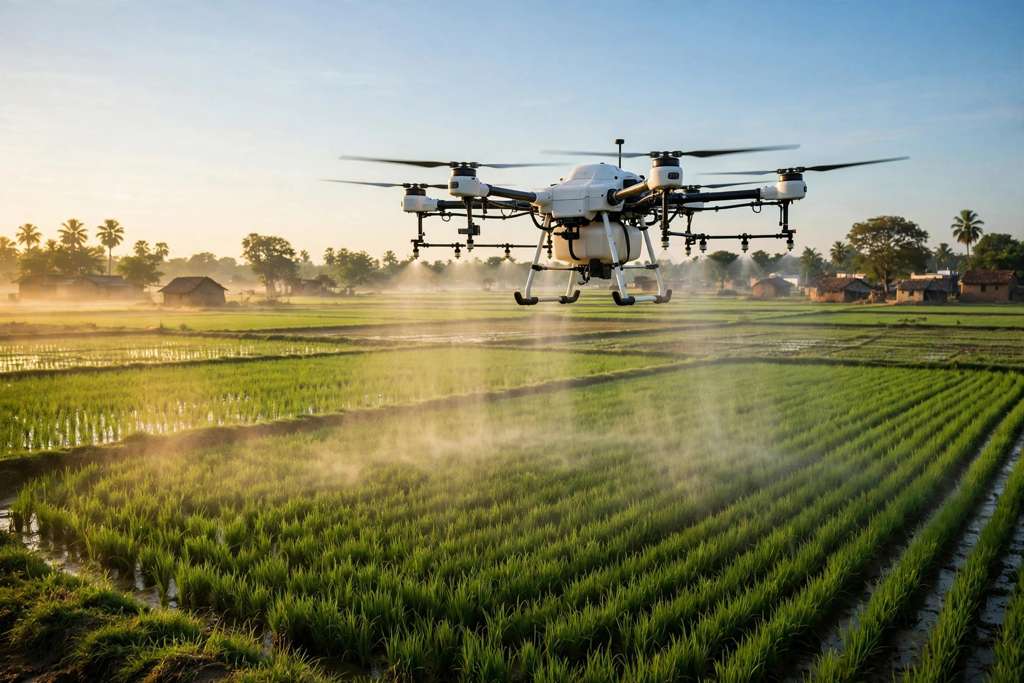
A Kisan drone is an agriculture drone built mainly for spraying pesticides, fungicides and liquid fertiliser over crops. Most models used in India carry a 10 to 40 litre tank, fly on a pre-set GPS route, and spray in a fine, even mist. Because the spray comes from above, it reaches the underside of leaves that a hand sprayer often misses, and the operator stays far away from the chemicals.
In practice, farmers use drones for three jobs. The first is spraying — the most common use, especially in paddy, cotton, soybean and sugarcane, where walking through a tall, wet crop is slow and tiring. The second is crop health monitoring: drones fitted with multispectral cameras can show which patches of a field are stressed, so fertiliser and water go only where they are needed. The third is spreading granular fertiliser and seeds on small plots, though this is still less common than spraying.
The time saving is the biggest reason farmers try it. A spray drone typically covers about an acre in 7 to 10 minutes, and uses far less water than a manual sprayer because it works on ultra-low volume spraying. For a farmer with 10 to 20 acres, that can turn a two-day spraying job into a morning's work — and remove the health risk of walking through pesticide mist all day.
How to Get Kisan Drone Subsidy in India?
This is the part that confuses most people, because the subsidy is not one flat rate — it depends on who you are and what you are buying it for. The support comes mainly through the Sub-Mission on Agricultural Mechanization (SMAM) of the Ministry of Agriculture and Farmers Welfare, and through the Namo Drone Didi scheme for women Self-Help Groups. The figures below are the published slabs [under these SMAM guidelines](https://www.technologyforyou.org/guidelines-for-use-of-drone-technology/); exact amounts and cut-off dates are notified by each state, so always confirm on your state agriculture portal before applying.
| Who applies | Subsidy | Maximum limit |
|---|---|---|
| ICAR institutes, Krishi Vigyan Kendras, State Agriculture Universities and government agriculture institutions | 100% of cost | Rs 10 lakh per drone |
| Farmer Producer Organisations, for demonstrations on farmers' fields | 75% of cost | As per project cost |
| Women Self-Help Groups under Namo Drone Didi | 80% of cost | Rs 8 lakh |
| Small and marginal farmers, SC/ST farmers, women farmers and farmers in North-Eastern states | 50% of cost | Rs 5 lakh |
| Other individual farmers, Custom Hiring Centres, cooperatives and rural entrepreneurs | 40% of cost | Rs 4 lakh |
The Namo Drone Didi package is the most generous for its target group: apart from the 80% subsidy, it covers a 15-day pilot training course, one year of comprehensive insurance and two years of annual maintenance. The scheme aims to put 15,000 drones in the hands of women Self-Help Groups, who can then earn by offering spraying services to other farmers in their village.
To apply, the usual route is through your state agriculture department or the central Agrimachinery portal, often with help from the nearest Common Service Centre or Krishi Vigyan Kendra. Keep these documents ready: Aadhaar card, land records such as Khasra or Khatauni, bank passbook, and a quotation from an authorised dealer. One condition applies in every category — the drone must be a DGCA type-certified model bought from an authorised dealer with a proper GST invoice. A cheaper uncertified drone from an unknown seller will not qualify for subsidy, and it cannot legally be flown for spraying either.
Agriculture Drone Price in India: What Decides the Cost?
There is no single fixed price for an agriculture drone in India, because the price depends on the tank size, the brand, and whether it is an Indian-made or imported model. A small 10-litre spray drone costs far less than a 40-litre heavy-lift model, and prices also move with the dollar rate and with GST — agricultural drones currently attract only 5% GST.
What matters more than the sticker price is the total cost of owning one. A realistic budget includes the drone itself, two or three spare batteries (each battery gives roughly 10 to 15 minutes of flying time, so spraying without spares means long waits), a charger, a generator or charging setup for field use, and the pilot training. Batteries wear out after a few hundred charge cycles and are a recurring cost. When you compare models, ask the dealer for the per-acre spraying cost including battery replacement, not just the purchase price — that is the number that decides whether the drone actually saves you money.
If the full purchase looks too big, remember that you do not have to own a drone to use one. Many [Custom Hiring Centres](https://indiaask.tech/question.php?slug=farm-machinery-rental-custom-hiring-centres) and [Farmer Producer Organisations](https://indiaask.tech/question.php?slug=farmer-producer-organisations-explained) now rent out drone spraying by the acre, and some rural entrepreneurs run spraying as a service business. Hiring is often the smarter first step: you see the results on your own field before spending lakhs on a machine.
Kisan Drone Training: Remote Pilot Certificate in 15 Days
You cannot simply buy a drone and start flying it over your fields. Under the Drone Rules 2021, the pilot of a spray drone needs a Remote Pilot Certificate from a DGCA-authorised training organisation. The good news is that the course is short — about 15 days — and covers flying practice, airspace rules, safety procedures and the basics of chemical handling. There are now hundreds of DGCA-approved training institutes across India, including many agriculture universities and Krishi Vigyan Kendras.
The training matters for a practical reason, not just a legal one. A trained pilot knows how high to fly (too high and the spray drifts away, too low and it damages the crop), how to plan a route so no patch is sprayed twice, and what to do if the drone loses signal or a battery runs low mid-flight. The certificate is also required if you want to earn money by spraying for other farmers, which is how many owners recover the cost of the drone.
Rules You Must Follow Before Flying a Spray Drone
Drones are regulated by the Directorate General of Civil Aviation, and spraying drones have extra rules on top of that because chemicals are involved. These are the essentials:
- **Buy a type-certified drone and register it.** The model must hold a DGCA type certificate, and the drone must be registered on the Digital Sky platform with a Unique Identification Number.
- **Check the airspace map first.** India is divided into green, yellow and red zones. Green zones need no prior permission, yellow zones need permission, and red zones — near airports, military areas and borders — are strictly no-fly.
- **Spray only approved chemicals.** Only pesticides and fertilisers approved by the Central Insecticides Board and Registration Committee for drone application may be sprayed, at the approved dose and height. The Agriculture Ministry has published crop-wise standard operating procedures for this.
- **Inform people nearby.** Aerial spraying operations should be notified to the public in advance, and a buffer zone must be kept from houses, water bodies, animals and crops that are not meant to be sprayed.
- **Mind the weather.** Do not spray in strong wind or when rain is expected within a few hours — the chemical drifts or washes off, wasting money and risking damage to neighbouring fields.
Breaking these rules can attract fines of up to Rs 1 lakh under the Drone Rules, and a wrongly sprayed chemical can damage a neighbour's crop and your own reputation in the village. The rules are not paperwork for its own sake; they are what keep a useful technology safe. A practical summary of the drone rules, with links to the official DGCA and ministry sources, is available in the [Kisan Drone guide](https://www.kisandrone.co.in/).
Should You Buy a Drone or Hire Spraying on Rent?
The honest answer depends on how much land you farm and whether you can earn from spraying for others. A farmer with 5 acres who sprays four times a year will rarely recover the cost of owning a drone. A farmer with 30 acres, or a group of farmers who buy together through an FPO, can recover it much faster — and faster still if the drone also earns by spraying neighbours' fields at a per-acre charge.
Hiring a spraying service is the low-risk way to start. You pay per acre, you need no training or certificate, and you learn what a good spray job looks like on your own crop. Many farmers who start by hiring later buy a drone once they are sure of the demand in their village. If you do decide to buy, use the subsidy route, buy only a DGCA-certified model from an authorised dealer, and complete the pilot training before the first flight.
The technology is still new, and prices, models and subsidy slabs change from season to season. What does not change is the basic calculation: a drone is worth it when it saves you labour, protects your health, and sprays more evenly than manual work — and the subsidy exists precisely to make that calculation work for small farmers, not just big ones.
Frequently Asked Questions
### How much subsidy can a small farmer get on a Kisan drone?
Under the SMAM guidelines, small and marginal farmers, SC/ST farmers, women farmers and farmers in North-Eastern states can get 50% financial assistance, up to a maximum of Rs 5 lakh per drone. Other individual farmers generally get 40%, up to Rs 4 lakh. Confirm the current slab on your state agriculture portal before applying, as states notify their own cut-off dates and procedures.
### What is the Namo Drone Didi scheme?
Namo Drone Didi is a government scheme that provides drones to women Self-Help Groups with 80% subsidy, up to Rs 8 lakh per drone. The package also includes 15 days of pilot training, one year of insurance and two years of maintenance. The target is to equip 15,000 women SHGs, who can then earn income by providing drone spraying services to farmers in their area.
### Do I need a licence to fly an agriculture drone in India?
Yes, for spraying drones you need a Remote Pilot Certificate from a DGCA-authorised training organisation. The course takes about 15 days. Nano drones used for non-commercial purposes are exempt, but spray drones are heavier and commercial in nature, so the certificate applies. The drone itself must also be a DGCA type-certified model registered on the Digital Sky platform.
### How much does drone spraying cost per acre?
The per-acre charge for hired drone spraying varies by crop, area and season, because it depends on the chemical, the dose and local competition. Get quotes from two or three local service providers or your nearest Custom Hiring Centre before the season starts. If you own a drone, work out the cost per acre including battery replacement and maintenance — that is the fair comparison with manual spraying.
### Can any pesticide be sprayed by drone?
No. Only pesticides and fertiliser formulations that the Central Insecticides Board and Registration Committee has approved for drone application may be sprayed, and only at the approved dose, height and weather conditions. Using an unapproved chemical, or spraying in high wind, can damage your crop and your neighbour's crop, and can attract penalties under the Drone Rules.
Conclusion
The Kisan drone is no longer a demonstration gadget — it is a working farm tool with real subsidy support behind it. The subsidy slabs are generous, especially for small farmers, women farmers and women Self-Help Groups under Namo Drone Didi, and the 15-day pilot training is short enough for any interested farmer or rural youth. But the subsidy is only the beginning: buy a DGCA-certified model, complete the training, follow the spraying rules, and consider hiring a service first if your land is small. Used the right way, a drone saves labour, protects the person spraying, and puts the chemical exactly where the crop needs it — which is the whole point of the technology.
How much subsidy can a small farmer get on a Kisan drone?
Under the SMAM guidelines, small and marginal farmers, SC/ST farmers, women farmers and farmers in North-Eastern states can get 50% financial assistance, up to a maximum of Rs 5 lakh per drone. Other individual farmers generally get 40%, up to Rs 4 lakh. Confirm the current slab on your state agriculture portal before applying, as states notify their own cut-off dates and procedures.
What is the Namo Drone Didi scheme?
Namo Drone Didi is a government scheme that provides drones to women Self-Help Groups with 80% subsidy, up to Rs 8 lakh per drone. The package also includes 15 days of pilot training, one year of insurance and two years of maintenance. The target is to equip 15,000 women SHGs, who can then earn income by providing drone spraying services to farmers in their area.
Do I need a licence to fly an agriculture drone in India?
Yes, for spraying drones you need a Remote Pilot Certificate from a DGCA-authorised training organisation. The course takes about 15 days. Nano drones used for non-commercial purposes are exempt, but spray drones are heavier and commercial in nature, so the certificate applies. The drone itself must also be a DGCA type-certified model registered on the Digital Sky platform.
How much does drone spraying cost per acre?
The per-acre charge for hired drone spraying varies by crop, area and season, because it depends on the chemical, the dose and local competition. Get quotes from two or three local service providers or your nearest Custom Hiring Centre before the season starts. If you own a drone, work out the cost per acre including battery replacement and maintenance - that is the fair comparison with manual spraying.
Can any pesticide be sprayed by drone?
No. Only pesticides and fertiliser formulations that the Central Insecticides Board and Registration Committee has approved for drone application may be sprayed, and only at the approved dose, height and weather conditions. Using an unapproved chemical, or spraying in high wind, can damage your crop and your neighbour's crop, and can attract penalties under the Drone Rules.