Drip Irrigation vs Flood Irrigation in India: Water Saving, Cost, and Which Crops Suit Each Method
Key Takeaways
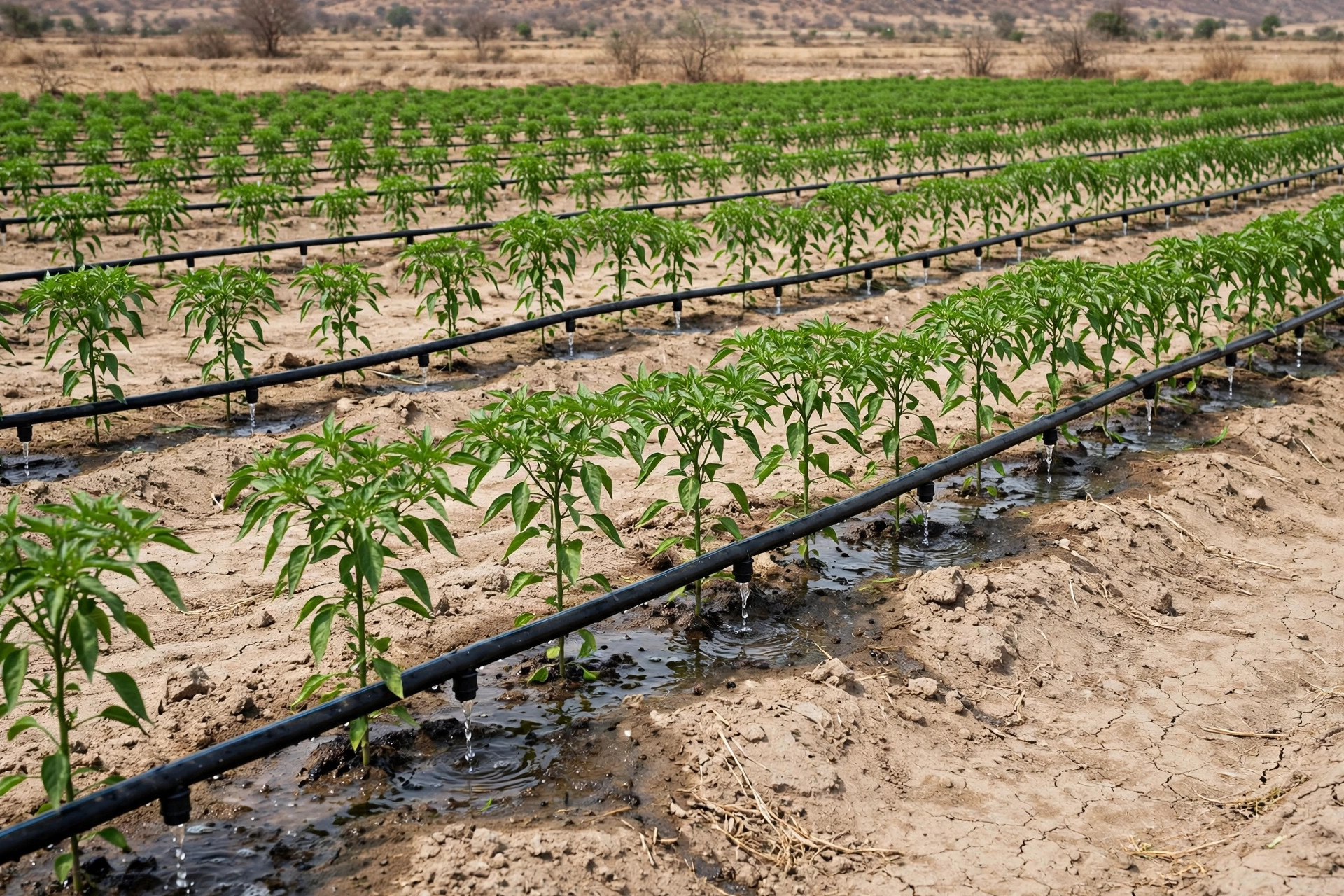
- Drip delivers water drop by drop to the root zone, wetting only part of the surface and reducing evaporation and weed growth.
- Flood irrigation suits dense crops such as paddy and wheat on levelled fields with a reliable large-volume water supply.
- Drip suits widely spaced row crops — orchards, vegetables, cotton and row sugarcane — where fertigation and uniformity pay back fastest.
- Upfront drip cost is high, but pumping and labour savings matter; compare total cost including subsidy, maintenance and system life.
- Drip needs filtration and regular emitter checks, since clogging and damage can fail silently across part of a field.
Drip Irrigation vs Flood Irrigation in India: Water Saving, Cost, and Which Crops Suit Each Method
Water is the most contested input on Indian farms, and how it is applied matters as much as how much is available. Two methods dominate the discussion: flood irrigation, the traditional practice of letting water flow across the field, and drip irrigation, which delivers water slowly and directly to the root zone through pipes and emitters. Both can grow good crops, and both can fail if used badly. The right choice depends on the crop, the soil, the water source, labour, and how much the farmer can invest upfront. This article compares them honestly, without claiming that one method suits every farm.
Flood irrigation is familiar because it is simple. Water from a canal, tank or pump is released into the field, often through channels and bunds, and it spreads by gravity. It needs little equipment, works for many field crops, and also helps leach salts in some soils. Drip irrigation is more engineered. A pump, filter, main and lateral pipes and emitters form a system that must be designed for the field shape, crop spacing and water quality. That complexity is its strength and its barrier: it saves water and fertiliser when it works, but it needs maintenance and care to keep working.
How Each Method Actually Works in the Field
In flood irrigation, the whole field surface gets wet. That is both an advantage and a waste. Crops with dense, close planting, such as paddy, wheat and many fodder crops, benefit from a uniform wet field, and flood is well suited to levelled fields with a reliable, large-volume water supply. But much of the water evaporates from the open surface, runs off at the edges, or percolates below the root zone before roots can use it. Weeds also benefit, because the entire surface is wet and invites weed growth between crop rows.
In drip irrigation, water is released drop by drop near each plant. Only a portion of the soil surface is wetted, which reduces evaporation and weed growth between rows. Fertilisers can be dissolved and delivered through the same system, a practice called fertigation, which places nutrients near roots and reduces waste. Because flow rates are low, drip can work with a smaller water source and on undulating land where flood water would pool in low spots and miss high spots. It also allows irrigation in short, frequent doses, which suits crops that prefer steady moisture rather than alternate flooding and drying.
The trade-off is sensitivity. Drip emitters clog if water carries silt, algae or dissolved salts and is not filtered properly. Rodents, accidental damage during interculture, and poor maintenance can put parts of the system out of action without the farmer noticing immediately, because the rest of the field still looks irrigated. Flood irrigation, by contrast, fails visibly: if water does not reach a corner, it is obvious. Drip failures can be silent, which is why regular checking of emitters is part of the method, not an optional extra.
Water Saving, Yield and Soil Effects
Drip irrigation generally uses considerably less water than flood irrigation for the same crop, because it avoids much of the evaporation, runoff and deep percolation loss. The exact saving varies with crop, soil, climate and management, so a single percentage for all farms would be misleading. Sandy soils, where flood water drains quickly past roots, tend to show larger savings than heavy clay soils that hold water longer. Hot, windy conditions, where open water evaporates fast, also favour drip. What matters for the farmer is not a brochure figure but water saved on their own field, measured against their own pumping hours and electricity or diesel cost.
Yield effects follow a similar pattern. Crops that respond to steady moisture and precise fertigation — many vegetables, fruits, cotton, sugarcane in row planting, and orchards — often show better uniformity and sometimes higher yield under drip. Crops grown in dense stands, where laying laterals between every row is impractical or uneconomic, gain less. Paddy is the clearest example: it is grown in standing water by design in many systems, and drip is not a like-for-like replacement. Trying to force drip onto a crop and layout it does not suit will disappoint, however good the technology is in principle.
Soil effects also differ. Flood irrigation can cause waterlogging and, over time, salinity problems if drainage is poor and water is applied in excess. It can also help wash salts down in well-drained soils when managed deliberately. Drip keeps the root zone moist without saturating the whole profile, which can reduce waterlogging, but it can concentrate salts at the edge of the wetted zone if water quality is saline and leaching is inadequate. Neither method removes the need to watch soil health; both change which soil problem to watch for.
Cost, Subsidy and Maintenance: The Full Picture
The biggest barrier to drip is upfront cost. Pipes, filters, fittings and installation cost far more per acre than opening a field channel for flood irrigation. Government subsidy schemes for micro-irrigation exist in many states and can reduce that burden, but eligibility, documentation and the choice of approved vendors vary, and farmers should confirm current rules with the local agriculture or horticulture department rather than assuming a subsidy rate from an old pamphlet. Even with subsidy, the farmer pays for maintenance, replacement parts and the time to manage the system.
Running costs tell a different story. Drip usually needs less pumping time and less labour to move water across the field, which saves electricity, diesel and hours, especially on larger or scattered plots. It also reduces weeding labour, because dry inter-row spaces grow fewer weeds. Flood irrigation looks cheap at installation but can be expensive in labour, especially where water must be watched, channels maintained, and bunds repaired. A fair comparison therefore adds up installation, subsidy received, pumping cost, labour, maintenance and expected system life, not just the price of pipes on day one.
Maintenance is where many drip systems succeed or fail. Filters must be cleaned on schedule, laterals flushed, emitters checked, and damaged sections replaced. Water with high silt or biological load needs better filtration and more frequent cleaning. Farmers who treat drip as a fit-and-forget system often find yields dropping in the second or third year, not because drip stopped working in principle, but because parts of the field quietly stopped receiving water. A simple routine — walking the laterals during irrigation, noting dry emitters, and keeping spare fittings — protects the investment.
Which Crops Suit Each Method
A practical rule is to match the method to plant spacing and water need. Drip suits widely spaced, high-value row crops: fruit orchards such as mango, pomegranate, banana and grapes, vegetables such as tomato, chilli, brinjal, capsicum and onion in row planting, cotton, and sugarcane planted in rows. In these crops, the cost per plant is justified by water saving, fertigation benefit and better uniformity, and laterals can run along rows without interfering with every operation.
Flood suits dense, close-spaced field crops and situations where water is plentiful and cheap: paddy, wheat, many millets and pulses grown as field crops, and fodder crops where the whole field is the crop. It also suits very small, irregular plots where laying a drip system would be fiddly and where the farmer already has a reliable canal turn. In such cases, improving flood efficiency — levelling the field, shortening run lengths, using border or furrow methods instead of uncontrolled flooding, and avoiding over-irrigation — can save a surprising amount of water without any new technology.
Mixed farms can use both. A farmer might keep flood for wheat on a levelled field and install drip for a vegetable or orchard block where water saving and fertigation pay back faster. That mixed approach is often more realistic than converting the whole farm at once, and it lets the farmer learn drip management on a smaller area before expanding. Starting small also limits risk if water quality or maintenance proves harder than expected.
Making the Decision for Your Farm
Start with four questions. First, how much water do you reliably have, and what does pumping it cost? If water is scarce or pumping is expensive, drip's saving matters more. Second, what crops do you actually grow, and are they row crops or dense field crops? Third, is your land level or undulating, and is your water clean or silty? Drip handles undulation well but hates dirty water without filtration. Fourth, can you commit to maintenance and to learning the system, or do you need a method that works with minimal attention during peak labour periods?
Visit a nearby farm using drip for a similar crop before deciding, and ask about real costs: installation after subsidy, filter cleaning frequency, emitter problems, and what happens during power cuts or canal rotation. Ask also about the service network: can parts be bought locally, and is there someone to repair the system quickly during a critical growth stage? A system that cannot be repaired in time is worse than a simpler method that keeps working.
Conclusion
Drip irrigation saves water, reduces weeds and allows precise fertigation, but it costs more upfront, needs filtration and maintenance, and suits row crops far better than dense field crops. Flood irrigation is simple, cheap to start and well suited to paddy, wheat and other field crops on levelled land, but it wastes more water through evaporation, runoff and deep percolation and demands more labour to manage. The best choice is not a slogan but a farm-specific calculation: crop layout, water scarcity, pumping cost, soil, water quality and willingness to maintain the system. For many farmers, the sensible path is to improve flood efficiency where it already works, and to adopt drip on the high-value row-crop block where its savings pay back fastest — and to check, season by season, whether the water, labour and yield on their own field confirm the choice.