Home > Science & Environment > Why Is Delhi's AQI Data Under Question After Diwali 2026? 36 of 59 Monitoring Stations Went Offline Explained
Why Is Delhi's AQI Data Under Question After Diwali 2026? 36 of 59 Monitoring Stations Went Offline Explained
By Vijay Pawar · 2026-11-10 · 9 min read · Science & Environment
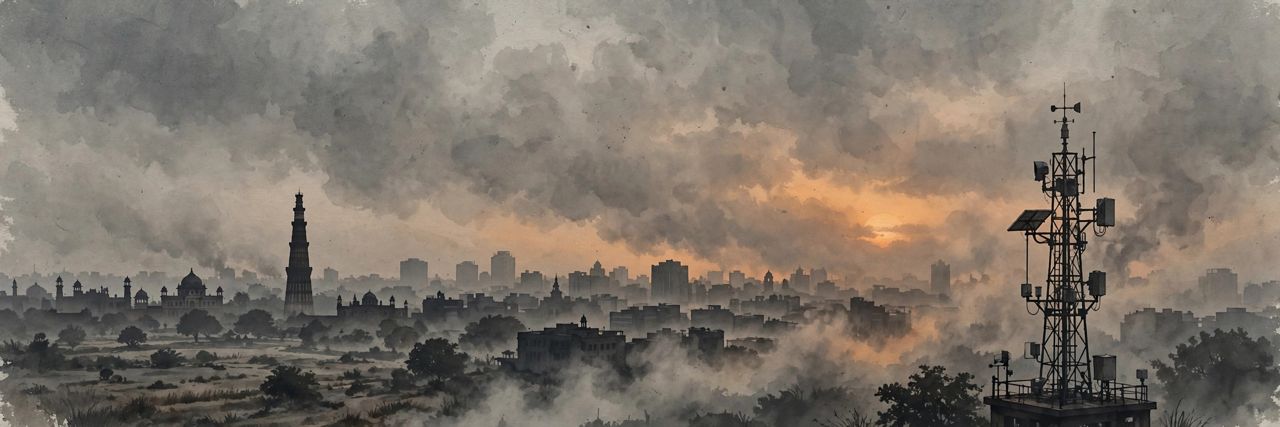
Editorial illustration: New Delhi's skyline shrouded in thick grey smog at dawn after Diwali, with an air quality monitoring tower in the foreground.
Key Takeaways
Delhi recorded its most polluted Diwali in five years in 2026, with an average AQI of 376 — but 36 of the city's 59 monitoring stations were offline at 1 am, so the real pollution may have been worse.
The data gap grew hour by hour: 1 station missing at 7 pm, 7 by 10 pm, 23 by 11 pm, 29 at midnight and 36 at 1 am, leaving only 23 stations reporting at the peak hour.
The morning after Diwali, Delhi's AQI was 371 at 10 am — the worst post-Diwali reading since 2021 — and Bawana recorded the worst station reading at 396.
Private platforms reported much worse air than official figures: IQAir recorded PM2.5 at 170 micrograms per cubic metre, around 34 times the WHO annual guideline.
CSE's Anumita Roychowdhury called the failure a 'data eclipse' and said it was inexplicable given the public investment in the country's densest monitoring network.
What Happened: Delhi AQI After Diwali 2026
Delhi recorded its most polluted Diwali in five years in 2026, with the city's average Air Quality Index (AQI) reaching 376 on Diwali day, according to official data. But the number that has sparked a bigger debate is not 376 — it is 36. At 1 am on Monday, the morning after Diwali, 36 of Delhi's 59 air quality monitoring stations had stopped reporting data, leaving only 23 stations to measure the air the city's residents were breathing at the worst possible hour. That gap, which experts have called a "data eclipse", has put the reliability of Delhi's AQI data after Diwali 2026 under serious question — because if the monitors were silent when pollution peaked, the official figures may have understated just how bad the air really was.
The morning after was barely better. At 10 am on Monday, Delhi's average AQI stood at 371, the worst reading for a post-Diwali day since 2021. By 4 pm it had eased to 344, compared with 376 at the same time on Diwali day — but even then, only 47 of the 59 stations were reporting. In short, Delhi's worst Diwali in five years may have been worse than the official record shows, and nobody can now say by how much.
The Data Gap Hour by Hour
The picture comes from an analysis by the Centre for Research on Energy and Clean Air (CREA), based on data from Delhi's 59 monitoring stations. The timeline shows the network failing exactly as pollution was climbing:
- **7 pm, Sunday (Diwali evening):** only 1 station had missing data.
- **10 pm:** 7 stations were not reporting.
- **11 pm:** 23 stations had gone silent.
- **Midnight:** 29 stations were not reporting data.
- **1 am, Monday:** 36 stations — more than 60% of the network — had stopped reporting, leaving just 23 stations providing readings.
- **2 am:** 35 stations were still offline. The number then fell gradually — 30 at 3 am, 20 at 4 am, 19 at 5 am and 16 at 6 am.
More than 20 stations were without data between midnight and 2 am, the peak smog hours, when firecracker smoke was at its thickest. The stations are operated by four agencies — the Central Pollution Control Board (CPCB), the Delhi Pollution Control Committee (DPCC), the India Meteorological Department (IMD) and the Indian Institute of Tropical Meteorology (IITM).
The gaps matter because Delhi's AQI is an average built from these stations. When the stations that go dark are spread across the city, the average is calculated from a thinner, possibly unrepresentative sample. The worst-hit areas illustrate the point: at 4 pm on Monday, Bawana recorded the worst AQI at 396, followed by Burari at 393 — both in the "very poor" category, close to "severe". Of the 47 stations reporting at that hour, 40 were in the very poor category and seven in the poor category.
Why Experts Are Calling It a "Data Eclipse"
Anumita Roychowdhury, executive director of the Centre for Science and Environment (CSE), criticised the monitoring network's failure to provide real-time data during a public health emergency. "When substantial public funds have been invested in establishing Delhi-NCR's air quality monitoring network — the densest in the country — backed by active operation and maintenance contracts, a data eclipse precisely during peak Diwali pollution is inexplicable," she said.
Her point is about timing as much as technology. Monitoring stations are supposed to be most reliable exactly when pollution is worst, because that is when the data guides emergency action — school closures, construction bans, vehicle restrictions and health advisories. A network that goes quiet on the most polluted night of the year fails at the one moment it is needed most. Experts tracking the numbers in real time also flagged the silence as it happened, noting that key stations stopped reporting during the night when pollution levels surged.
The failure is especially awkward because Delhi had prepared for a bad winter. The city had already put graded emergency measures in place before Diwali — [GRAP Stage 3 restrictions were in force in Delhi-NCR from 7 November 2026](https://indiaask.tech/question.php?slug=grap-stage-3-delhi-ncr-rules-vehicle-ban-explained), with vehicle bans and other curbs — and the Supreme Court had laid down rules for the festival itself, including timings for bursting crackers. Read how the court regulated the festival in our explainer on [the green cracker rules for Diwali 2026 in Delhi-NCR](https://indiaask.tech/question.php?slug=diwali-2026-green-crackers-delhi-ncr-supreme-court-rules-explained). Reports from the night say the Supreme Court-mandated time restrictions on fireworks were widely flouted, which is one reason pollution shot up so sharply. But while the cracker violations were visible in the sky, the scale of the pollution they caused was partly invisible in the data — because the monitors were off.
Official Figures vs Private Readings
The second reason Delhi's AQI data is under question is the wide gap between official readings and those reported by private monitoring platforms. While official data showed Delhi's AQI at 370 at 8 am on Monday, private agencies painted a much worse picture, with most parts of Delhi-NCR reporting extremely hazardous air pollution levels.
Swiss air quality monitoring platform IQAir, for example, recorded an AQI of 245 on the US scale — in the "very unhealthy" category — at 8.30 am, with PM2.5 concentration at 170 micrograms per cubic metre, around 34 times the World Health Organisation's annual guideline value. The two scales are not directly comparable, but the direction of the difference is what experts flagged: private readings suggested the air was considerably worse than the government's figures indicated.
This is not a new tension. Government and private monitors have differed before, partly because they use different methods, different locations and different averaging. What made this Diwali different was that the disagreement coincided with the official network itself going partly dark. When more than half the stations are silent, even the official average becomes hard to defend — and the private readings, however imperfect, become the only alternative picture available.
The Political Row Over the Missing Data
The missing data quickly became a political issue. The Aam Aadmi Party (AAP) alleged that dozens of monitoring stations had gone offline as pollution levels rose on Diwali night and resumed functioning the following morning. Senior AAP leader Saurabh Bharadwaj accused the Delhi government of manipulating pollution figures and described the alleged practice as "data fraud".
The Delhi government has not accepted that charge. Responding to a query at a press conference, Delhi cabinet minister Kapil Mishra asked reporters to share details of the AQI monitoring stations reported to be non-functional, saying he would seek action on the matter. The allegation is also not new: after Diwali last year, the AAP had accused the then BJP-led Delhi government of deliberately switching off air quality monitoring stations to conceal the rise in pollution levels.
It is important to separate what is proven from what is alleged. What the data shows is that 36 of 59 stations stopped reporting at the peak hour — that is a fact established by the CREA analysis. Why they stopped — technical failure, power or connectivity problems, maintenance lapses, or something deliberate — has not been established by any official inquiry so far. No agency has yet published a station-by-station explanation for the outage.
What This Means for Delhi's Air Quality Fight
The controversy goes beyond one night. Delhi's entire winter pollution response runs on this data. The Graded Response Action Plan (GRAP) stages — which trigger measures like stopping construction, restricting vehicles and closing schools — are invoked on the basis of AQI readings. If the readings are incomplete at the worst moments, emergency measures may be triggered late, or not at all, or based on an average that understates the danger.
There is also a credibility cost. Air quality data is one of the few tools ordinary residents have to decide whether to send children to school, wear a mask, or keep elderly family members indoors. If people stop trusting the official number, they will turn to private apps — which use different scales and can confuse as much as they inform — or stop checking altogether. Either way, public health suffers.
The episode also raises a practical question that the authorities will have to answer: why did a network described as the densest in the country, with active operation and maintenance contracts, fail on the most predictable high-pollution night of the year? Diwali's date is known months in advance, and the pollution spike it brings is expected every year. A monitoring network should be stress-tested before the festival, not found wanting during it.
What Happens Next
Three things are worth watching. First, whether the CPCB, DPCC, IMD or IITM publish a station-wise account of why each monitoring station went offline and when it came back — transparency here is the fastest way to restore trust. Second, whether the Delhi government orders an audit of the monitoring network's maintenance contracts and backup power and connectivity arrangements before the next pollution peak. Third, whether the courts or the Commission for Air Quality Management take note of the gap, given that GRAP decisions depend on this very data.
For residents, the immediate advice from health experts remains unchanged: the air in Delhi stays in the very poor category for days after Diwali, so limiting outdoor exposure, avoiding morning walks on high-pollution days and using masks outdoors are sensible precautions, especially for children, the elderly and people with asthma or heart conditions.
For more on the official response, read the detailed reporting in the [Deccan Herald](https://www.deccanherald.com/india/delhi/questions-over-delhi-aqi-data-as-several-monitoring-stations-go-offline-on-diwali-night-4212731) and the [Times of India](https://timesofindia.indiatimes.com/city/delhi/data-eclipse-experts-flag-delhi-aqi-data-gap-on-diwali-night-after-36-of-59-pollution-monitoring-stations-go-offline/articleshow/135681086.cms), which first reported the hour-by-hour station data.
Conclusion
Delhi's Diwali of 2026 was officially its most polluted in five years, with an average AQI of 376. But the real story of the night is the silence of the monitors: 36 of 59 stations offline at 1 am, more than 20 dark through the peak smog hours, and a morning-after reading of 371 that was itself the worst since 2021. The official numbers tell us the air was very poor; the missing data suggests it may have been worse than the numbers say — and we may never know by how much. Until the agencies explain why the network failed at the exact hour it was needed most, the question over Delhi's AQI data will remain open, and so will the doubt over every reading that follows it.
Why is Delhi's AQI data after Diwali 2026 under question?
Delhi recorded its most polluted Diwali in five years in 2026, with an average AQI of 376 on Diwali day. But at 1 am on the morning after Diwali, 36 of the city's 59 air quality monitoring stations had stopped reporting data, leaving only 23 stations measuring the air during the peak pollution hours. Experts say the official figures may therefore have understated how bad the air really was.
How many Delhi AQI monitoring stations went offline on Diwali night?
According to an analysis by the Centre for Research on Energy and Clean Air (CREA), only 1 of Delhi's 59 stations had missing data at 7 pm on Diwali evening. The number rose to 7 by 10 pm, 23 by 11 pm, 29 by midnight and 36 by 1 am on Monday. More than 20 stations were without data between midnight and 2 am, the peak smog hours.
What was Delhi's AQI the morning after Diwali 2026?
At 10 am on the morning after Diwali, Delhi's average AQI stood at 371, the worst reading for a post-Diwali day since 2021. By 4 pm it had eased to 344, but only 47 of the 59 stations were reporting then. Bawana recorded the worst AQI at 396, followed by Burari at 393.
Did private agencies report worse air quality than the official Delhi AQI?
Private monitoring platforms reported considerably worse air than the official figures. Swiss platform IQAir recorded an AQI of 245 on the US scale ('very unhealthy') at 8.30 am on Monday, with PM2.5 at 170 micrograms per cubic metre — around 34 times the World Health Organisation's annual guideline value — while official data showed Delhi's AQI at 370 at 8 am. The scales differ, but experts flagged the gap alongside the official network going partly dark.