Home > Constitution & Law > What Are the Green Cracker Rules for Diwali 2026 in Delhi-NCR? Timings, Sale Dates and No-Cracker Zones Explained
What Are the Green Cracker Rules for Diwali 2026 in Delhi-NCR? Timings, Sale Dates and No-Cracker Zones Explained
By Vijay Pawar · 2026-11-03 · 8 min read · Constitution & Law
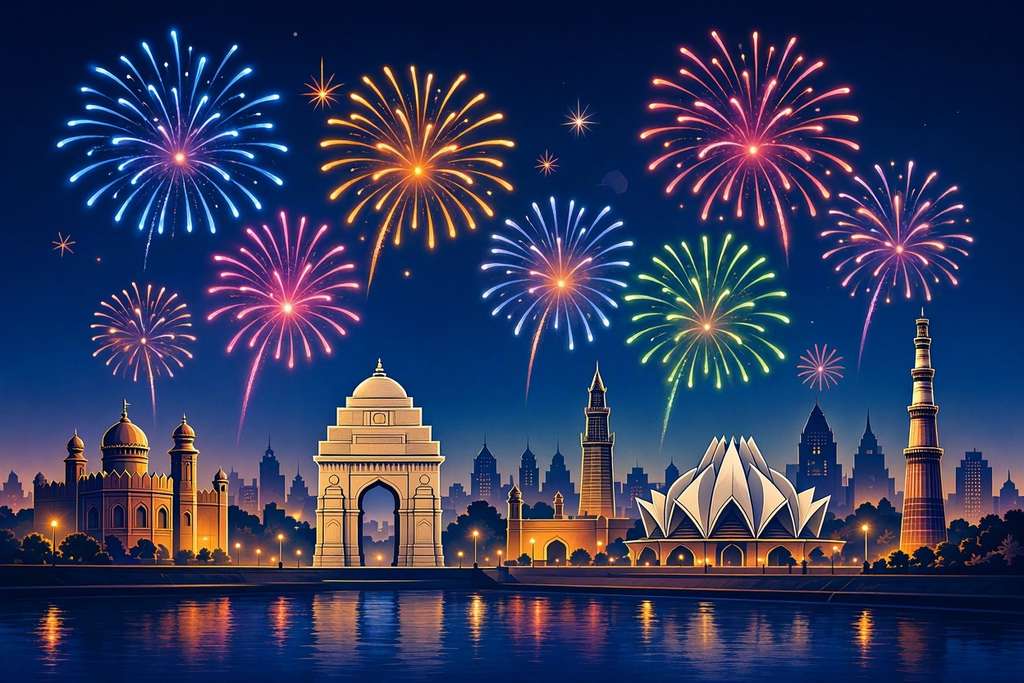
Editorial illustration: colourful fireworks bursting over a Delhi skyline at night — no text, no logos, no real person.
Key Takeaways
The Supreme Court allows only CSIR-NEERI-approved green crackers in Delhi-NCR, burst between 6-7 am and 8-10 pm on 7 and 8 November 2026.
Sale is limited to 4-6 November at designated points, with cancelled traders' licences temporarily restored; online sales are banned.
Only sealed boxes with a product-specific QR code qualify, and ladis, barium crackers and non-approved crackers are banned.
No bursting is allowed within 300 metres of hospitals, schools, old-age homes and notified silence zones.
The complete ban resumes from 9 November 2026, with daily AQI reports and compliance affidavits due by 14 December.
The green crackers Delhi NCR Diwali 2026 timings are now fixed by the Supreme Court: certified green firecrackers may be burst in Delhi and the National Capital Region only between 6 am and 7 am and between 8 pm and 10 pm on 7 and 8 November 2026, with a complete ban returning from 9 November. The order, passed by a Bench of Justices M. M. Sundresh and Prasanna B. Varale on 29 October and made available on 2 November, allows only firecrackers approved by the Council of Scientific and Industrial Research–National Environmental Engineering Research Institute (CSIR-NEERI), sold under strict conditions, and banned entirely near hospitals, schools and other sensitive places. Diwali itself falls on 8 November this year, so the two-day window covers the eve of the festival and the festival day.
This article explains what the Supreme Court actually allowed, when green crackers can be sold and burst, what counts as a green cracker, where bursting is banned, and what happens after Diwali — based on the court's order as reported by Bar and Bench, The Hindu, The Statesman and Business Standard.
What did the Supreme Court allow for Diwali 2026?
The court permitted the manufacture, sale and bursting of only CSIR-NEERI-approved green firecrackers in Delhi-NCR for a limited period around Diwali, subject to enforcement and monitoring safeguards. The case, Arjun Gopal and Others v. Union of India and Others, is a petition filed in 2015 in which the court has passed a series of orders restricting firecrackers in Delhi and other parts of north India because of their effect on air quality and public health.
The Bench described the bursting of firecrackers during Deepavali as a religious practice, but one that, if left unregulated, takes a heavy toll on the environment and on public health. Children, disabled people and the elderly are among the most vulnerable groups, the court observed, and firecrackers cause severe air and noise pollution as well as solid waste. The order therefore takes a regulated approach rather than a blanket ban for these two days: the court reasoned that the earlier prohibition had neither significantly improved air quality nor stopped the illegal sale and use of conventional firecrackers, so a tightly controlled window for approved green crackers, with monitoring, was preferable to a ban that was widely flouted.
The relaxation is temporary. The court made it clear that the complete ban on all firecrackers, including green variants, will resume from 9 November 2026. The directions also come with a compliance test: authorities must file reports supported by affidavits by 14 December 2026, and the matter will next be heard on 16 December. Officials who fail to comply face the prospect of contempt action, the court warned.
When can green crackers be burst and sold?
Bursting is allowed for three hours on each of the two days: between 6 am and 7 am and between 8 pm and 10 pm on both 7 and 8 November 2026. Bursting outside those hours remains banned, even for green crackers.
Sale follows a shorter calendar. Traders whose licences had been cancelled will have them temporarily restored from 4 to 6 November, solely to enable the sale of approved green crackers. Manufacturing is restricted to the period from 2 to 6 November, and only for products uploaded on the CSIR-NEERI website in that window by manufacturers holding valid green-cracker certification and licences from the Petroleum and Explosives Safety Organisation (PESO). Online sales are banned outright, and sales may take place only at designated locations.
In practical terms, that means a buyer in Delhi-NCR this Diwali should check three things before buying: that the product is a CSIR-NEERI-approved green cracker, that the box is sealed and carries a product-specific QR code for verification, and that it is bought from a licensed trader at a designated sale point between 4 and 6 November — not online, and not from an unlicensed seller.
What counts as a green cracker, and what is banned?
A green cracker is not simply a quieter firecracker. Under the CSIR-NEERI framework, green crackers are designed to emit less particulate matter and fewer toxic gases than conventional crackers, by using different chemical formulations and reduced quantities of polluting ingredients. Only products that carry CSIR-NEERI certification and appear on the institute's list qualify under the court's order.
Several categories are expressly prohibited. Firecrackers joined in series — commonly known as ladis — and garlands are banned. Crackers containing barium, and any cracker not approved by CSIR-NEERI, are also banned. The court also prohibited the manufacture and sale of crackers that do not carry the required product-specific QR code, which is meant to let buyers and enforcement officers verify that a box is genuinely an approved green product rather than a conventional cracker relabelled as green.
This distinction matters because relabelling has been one of the main enforcement problems in past years. The QR code, the sealed box, the designated sale points and the short sale window are all designed to make it harder for conventional crackers to enter the market under a green label.
Where are no-cracker zones, and who enforces the rules?
No firecrackers may be burst within a 300-metre radius of hospitals, nursing homes, primary and district health centres, old-age homes, educational institutions and notified silence zones. These areas are to be declared as no-cracker zones, marked on the ground and publicised, so that residents and enforcement officers can identify them.
Enforcement rests with the Delhi and NCR authorities, with air-quality monitoring by the Central Pollution Control Board (CPCB) in coordination with State Pollution Control Boards. The CPCB must prepare daily air-quality reports for three periods: the pre-Diwali period from 2 to 6 November, Diwali itself on 7 and 8 November, and the post-Diwali period from 9 to 30 November. Authorities must also explain on affidavit how they implemented the safeguards, including security deposits, sales arrangements, vehicle checks, patrolling, prosecutions, AQI trends and post-Diwali hospital admissions.
The court also called on members of the Bar, celebrities, sportspersons and other prominent personalities to voluntarily lead awareness campaigns, underlining that enforcement alone will not change how Diwali is celebrated. The order's message is that the shift has to be in public perception — towards celebrations that protect public health and air quality — rather than reactive measures taken only after pollution peaks.
How does this order fit with Delhi's other November pollution rules?
The green-cracker window does not exist in isolation. Delhi entered November with a fresh set of pollution controls, and the two measures will be judged together when the post-Diwali air-quality reports arrive. Readers tracking the wider picture can read our explainer on [Delhi's new pollution rules from 1 November 2026, including vehicle restrictions, parking fees and work-from-home measures](https://indiaask.tech/question.php?slug=delhi-new-pollution-rules-november-1-2026-explained). The court's own earlier firecracker orders, and the enforcement problems that led to this regulated approach, are covered in our explainer on [the Supreme Court's earlier firecracker orders and why enforcement, not a complete ban, became the issue](https://indiaask.tech/question.php?slug=supreme-court-firecracker-orders-enforcement-october-2026-explained).
The key question after Diwali will be whether the regulated window actually kept pollution lower than in years when a blanket ban was widely ignored. The daily AQI reports for 2–6, 7–8 and 9–30 November, and the compliance affidavits due by 14 December, are designed to answer exactly that question with data rather than claims.
What should residents of Delhi-NCR do this Diwali?
First, burst crackers only during the permitted hours — 6–7 am and 8–10 pm on 7 and 8 November — and never inside a no-cracker zone. Second, buy only sealed, QR-coded, CSIR-NEERI-approved green crackers from licensed traders at designated points between 4 and 6 November, and do not buy online. Third, remember that the window closes on 9 November, when the complete ban resumes, so leftover crackers cannot legally be burst later. Finally, residents near hospitals, schools and old-age homes should expect the no-cracker zone to be marked and publicised, and can report violations to local enforcement authorities.
The order gives Delhi-NCR a controlled Diwali rather than an unrestricted one. Whether it works will depend less on the courtroom and more on the market: whether only genuinely approved green crackers are sold, whether the hours and no-cracker zones are enforced, and whether the air-quality data after 8 November shows a real difference. The court's December hearing will be the first formal test of all three.
Conclusion
The Supreme Court's Diwali 2026 order for Delhi-NCR is a compromise between a religious practice and a public-health problem: certified green crackers only, for three hours a day on 7 and 8 November, sold only from 4 to 6 November at designated points, banned near hospitals and schools, and banned entirely again from 9 November. The rules are unusually specific — QR codes, sealed boxes, daily AQI reports and December compliance affidavits — because past bans failed on enforcement. For residents, the practical rule is simple: check the approval, check the QR code, respect the hours and the no-cracker zones, and treat 9 November as the end of the window, not the start of an extension.
Sources: the Supreme Court order of 29 October 2026 as reported by Bar and Bench ([Diwali 2026: Supreme Court allows bursting of green crackers in Delhi-NCR on November 7 and 8](https://www.barandbench.com/news/litigation/diwali-2026-supreme-court-allows-bursting-of-green-crackers-in-delhi-ncr-on-november-7-and-8)) and The Hindu ([Supreme Court calls Deepavali fireworks a 'religious practice', allows green crackers for two days in Delhi-NCR](https://www.thehindu.com/news/cities/Delhi/supreme-court-lifts-firecracker-ban-for-deepavali-in-delhi-ncr/article71656147.ece)), with supporting reporting from The Statesman and Business Standard on the sale window, the QR-code requirement and the December compliance deadline.
What are the green cracker timings for Diwali 2026 in Delhi-NCR?
Certified green firecrackers may be burst in Delhi-NCR only between 6 am and 7 am and between 8 pm and 10 pm on 7 and 8 November 2026. Bursting outside those hours is banned, even for green crackers.
When can green crackers be sold in Delhi-NCR for Diwali 2026?
Approved green crackers can be sold from 4 to 6 November 2026, when cancelled traders' licences are temporarily restored for that purpose. Sales must take place at designated locations; online sales are banned.
What is a green cracker, and how can buyers check it is genuine?
A green cracker is a CSIR-NEERI-certified firecracker designed to emit less particulate matter and fewer toxic gases than a conventional cracker. Only products on the CSIR-NEERI list, sold in sealed boxes with a product-specific QR code, qualify under the Supreme Court's order.
Where are no-cracker zones, and when does the complete ban return?
No firecrackers may be burst within 300 metres of hospitals, nursing homes, health centres, old-age homes, educational institutions and notified silence zones. These are declared as no-cracker zones and must be marked and publicised. The complete ban on all firecrackers, including green ones, resumes from 9 November 2026.