Home > Elections & Governance > Why Did the US Strike Iran's Qeshm Island, and What Does It Mean for Oil Prices and India?
Why Did the US Strike Iran's Qeshm Island, and What Does It Mean for Oil Prices and India?
By Vijay Pawar · 2026-11-03 · 9 min read · Elections & Governance
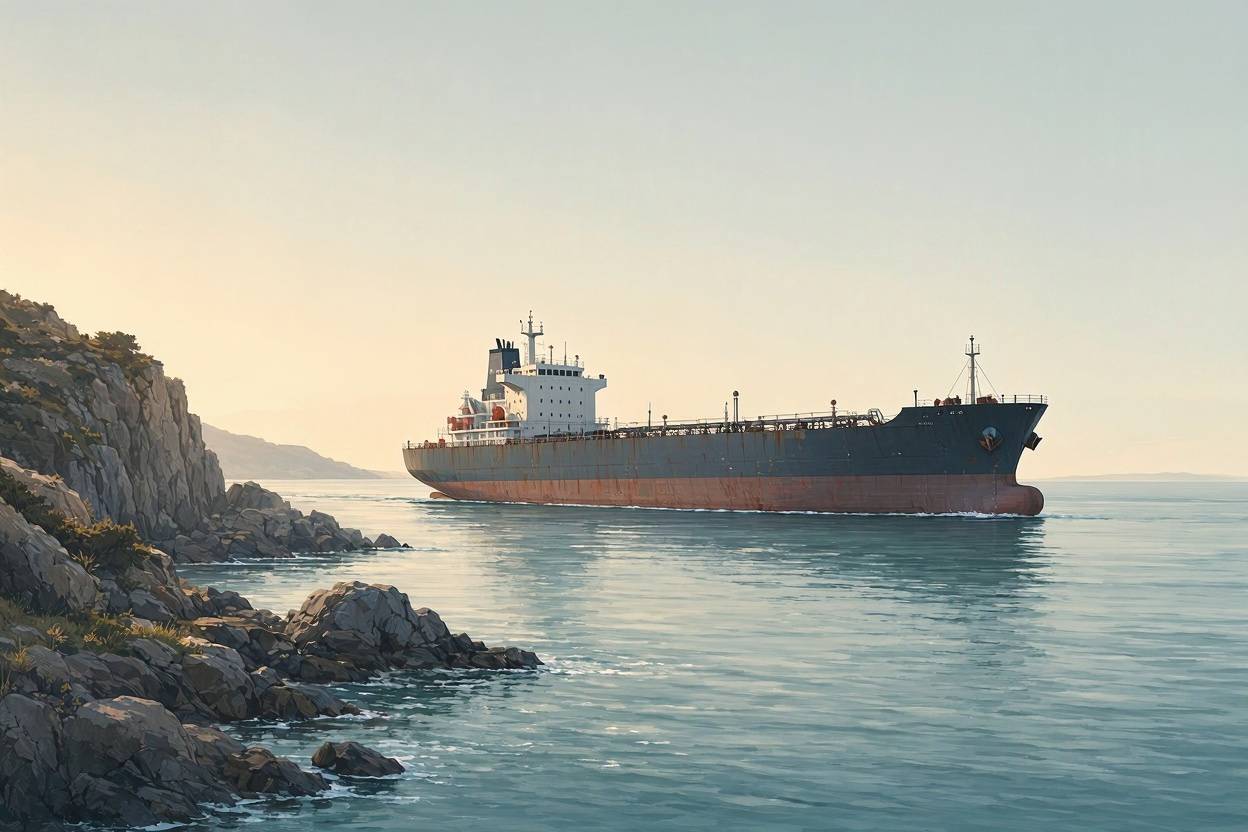
Editorial illustration: a large oil tanker sailing through a narrow sea strait at dawn beside a rocky island coastline — no text, no logos, no real person.
Key Takeaways
The US strike on Iran's Qeshm Island was reported by the Wall Street Journal citing US officials; Iranian state media IRNA reported five explosions on the island on Monday evening.
US officials described the strike as limited and defensive, aimed at stopping attacks on commercial shipping in the Strait of Hormuz and answering surface-to-air missile use against US assets.
The Strait of Hormuz carries about a fifth of the world's oil and gas, so fighting near it moves markets even when a strike is limited.
Brent crude rose about 0.58% to $105.38 a barrel in early Tuesday trading after falling 7.63% on Monday to $104.77 on hopes of a US-Iran deal.
India imports roughly 85% to 90% of its crude oil, so a prolonged Hormuz disruption would widen the import bill, pressure the rupee and raise inflation risks.
The US strike on Iran's Qeshm Island on Monday, 2 November 2026, has put the Strait of Hormuz back at the centre of world attention. According to a Wall Street Journal report citing unnamed United States officials, American forces struck targets on Qeshm, Iran's largest island, which sits at the mouth of the Strait of Hormuz — the narrow waterway through which about a fifth of the world's oil and liquefied natural gas travels. Iranian state media reported explosions on the island on Monday evening, and oil prices, which had fallen sharply that day, moved higher again on Tuesday morning as traders weighed the risk of escalation against hopes of a diplomatic deal.
This article explains what happened at Qeshm Island, why the United States says it acted, what the strike means for the eight-month-old US-Iran war, and why it matters for oil prices and for India, which imports most of the crude oil it uses.
What happened at Qeshm Island?
Iran's state news agency IRNA reported that five explosions were heard in rapid succession on Qeshm Island on Monday evening, and that some residents reported seeing two aircraft in the sky. The Fars news agency also reported explosions in the port city of Bandar Lengeh, west of the island and near the Strait of Hormuz. No casualty or damage figures had been officially confirmed at the time of writing, and local authorities had not issued a detailed statement.
The Wall Street Journal, citing US officials, reported that the United States had carried out the strike. A US official speaking on condition of anonymity told news agencies that the targets were Iranians who had used surface-to-air missiles against US assets, and that the operation was limited. Another account, reported by Fox News and cited in coverage of the strike, said the action followed Iran firing at a US aircraft. The Pentagon referred questions to US Central Command, which did not immediately comment on the reported strikes.
Qeshm is the largest island in the Persian Gulf. It runs parallel to Iran's southern coast, separated from the mainland by a narrow strait, and sits beside Bandar Abbas at the western mouth of the Strait of Hormuz, overlooking the shipping lanes that carry energy supplies from Saudi Arabia, Iraq, Kuwait, the United Arab Emirates and other Gulf producers to the rest of the world. That geography is precisely why a strike there, even a limited one, moves markets: any fighting near the strait raises questions about the safety of tankers and the cost of insuring and routing them.
Why does the US say the strike was defensive?
US officials quoted in the reporting described the Qeshm strike as defensive rather than the start of a new large-scale campaign. The stated purpose was to stop Iran from being able to attack commercial ships in the Strait of Hormuz, and to answer the use of surface-to-air missiles against US assets. The Journal also reported that the strike was the latest in a series of limited strikes Washington has carried out in secret in recent weeks, with the last previously known attacks in early September, and that the operations have deliberately not been publicly announced so as not to signal an intention to resume major combat operations.
That framing matters because of the timing. The strike came on the eve of the US midterm elections, held on Tuesday, 3 November 2026 — the same elections covered in our explainer on [what happens on 3 November and what is at stake](https://indiaask.tech/question.php?slug=us-midterm-elections-2026-3-november-explained). President Donald Trump had earlier said the US would not launch new strikes before the midterms, and on Monday he told reporters that a deal with Tehran was coming together, while also saying he was in no hurry to decide whether to resume a broader bombing campaign. The Journal's reporting suggests Washington is trying to do two things at once: keep military pressure limited and deniable, while keeping a diplomatic track alive.
Iran, for its part, has said intensive talks aimed at ending the war are under way through mediators, and according to the Indian Express, Tehran has said its plan to reopen the Strait of Hormuz could start within two days. No agreement has been announced, and the war, which began on 28 February 2026, is not over. Claims circulating alongside the strike — including an Iranian Revolutionary Guards claim that a US drone was downed near Qeshm — could not be independently verified, and US Central Command dismissed that claim as false, according to Gulf News coverage. Readers should therefore treat the Qeshm strike as confirmed in outline by multiple news organisations citing officials, but treat casualty claims, damage claims and drone claims as unverified until confirmed by independent evidence.
Why did oil prices move after the Qeshm strike?
Oil traders reacted in two opposite directions in less than a day, which tells the story of this conflict well. On Monday, Brent crude fell sharply — down $8.66, or 7.63%, to settle at $104.77 a barrel — as investors bet that a US-Iran deal might be close. After news of the Qeshm strike emerged, prices recovered part of that fall in early Tuesday trading: Brent rose 61 cents, or 0.58%, to $105.38 a barrel, while US West Texas Intermediate (WTI) crude gained 71 cents, or 0.73%, to $97.17 a barrel. Other reports put Brent near $104.80 to $105.25 in the same session; the exact level moved through the morning, but the direction was the same — a modest rise as traders added back a geopolitical risk premium.
The reason is straightforward. The Strait of Hormuz has been largely disrupted since the war began in late February, and shipping through it has fallen sharply. Brent had ended October at its highest point in six months on worries that Middle East instability could worsen after the US midterm elections. A strike at the strait's mouth revives the fear that the disruption could last longer or widen, even if the strike itself was limited. At the same time, the fact that Trump is publicly talking about a deal, and that Iran is talking about reopening the strait, limits how far prices rise: traders are weighing a peace agreement against the risk of further military action, and neither outcome is settled.
What does the Qeshm strike mean for India?
For India, the stakes are mainly economic, and they run through the oil price. India imports roughly 85% to 90% of its crude oil requirements, so sustained high crude prices widen the country's import bill, put pressure on the rupee, raise inflation risks and increase costs for fuel-dependent sectors such as aviation, logistics, paints, chemicals and manufacturing. One expert quoted by Times Now put the India crude oil basket at around $118.74 a barrel and warned that if that level rose significantly further, industrial growth as well as inflation would be hit. That is a market assessment, not an official forecast, and it underlines why New Delhi watches Hormuz so closely.
The good news, for now, is that a single limited strike and a single day's price move do not automatically mean petrol and diesel prices rise immediately in India. Retail fuel prices depend on sustained crude levels, exchange rates, taxes and the pricing decisions of oil marketing companies, and a diplomatic breakthrough — if one actually arrives — could reverse the pressure quickly, just as Monday's sharp fall showed. The risk to watch is duration: if the strait stays disrupted and crude stays above $105 a barrel for weeks, the import bill and inflation pressures build, and stock markets feel it too, as our explainer on [why the Sensex jumped over 1,000 points on 2 November](https://indiaask.tech/question.php?slug=sensex-jumps-1000-points-2-november-2026-reliance-rally-explained) showed how sensitive Indian markets are to global cues.
India also has a direct interest in the safety of shipping. Indian refiners buy crude from Gulf producers whose tankers use the strait, and Indian shipowners and exporters face higher insurance and freight costs whenever the route is seen as risky. A reopening of the strait, which Iran has said could begin within two days, would therefore be significant for India — but until ships actually move freely and safely, that remains a claim to verify, not a fact to assume.
What happens next?
Three things will decide whether the Qeshm strike is a footnote or a turning point. First, whether either side confirms more detail — the Pentagon and US Central Command have so far not commented publicly, and fuller Iranian statements may clarify what was actually hit. Second, whether the limited strikes continue in secret or stop, which will signal whether Washington genuinely wants to keep the war contained while talks proceed. Third, whether the diplomatic track produces something concrete: Trump has said a deal is taking shape, Iran says talks are intensive, and mediators including Qatar have been involved, but previous rounds have ended without a breakthrough, and no agreement has been announced.
For readers, the honest summary is this: the US strike on Iran's Qeshm Island is real and reported by multiple major news organisations, it was described by US officials as a limited defensive operation near the world's most important oil chokepoint, and it pushed oil prices modestly higher after a steep fall — but the wider war is unresolved, key details remain unconfirmed, and the next move depends on negotiations that have not yet produced a deal. This is a developing story, and the facts above should be read as the position on the morning of 3 November 2026, not as the final word.
Conclusion
The Qeshm strike shows how a single limited military action near the Strait of Hormuz can ripple across the world in hours — from explosions reported on an Iranian island, to oil benchmarks in London and New York, to the import bill and inflation outlook in India. The strike itself appears contained, and diplomacy is still being talked about on both sides, but containment is not peace. Until a deal is actually signed and shipping through Hormuz demonstrably returns to normal, India and the world will keep paying a risk premium for every barrel that passes through the strait — and every new report from Qeshm will be read first as a market signal, and only second as a military event.
Sources: the strike was first reported by the Wall Street Journal citing US officials and covered by [Reuters](https://www.reuters.com/world/middle-east/us-struck-irans-qeshm-island-wall-street-journal-reports-2026-11-03/) and the [Indian Express](https://indianexpress.com/article/world/us-iran-war-strikes-qeshm-island-trump-deal-hormuz-shipping-oil-prices-nuclear-threat-10948068/), with oil price movements reported by Times Now, HDFC Sky and Business Today on 3 November 2026.
The Wall Street Journal, citing US officials, reported that the United States struck targets on Qeshm Island, Iran's largest island at the mouth of the Strait of Hormuz. Iranian state media IRNA reported five explosions in rapid succession on the island on Monday evening. No casualty or damage figures had been officially confirmed at the time of writing.
Why does the US say the strike on Qeshm Island was defensive?
US officials quoted in the reporting said the strike was limited and defensive: it was meant to stop Iran from attacking commercial ships in the Strait of Hormuz and to answer the use of surface-to-air missiles against US assets. Officials said it was not a return to full-scale war.
How did oil prices react to the US strike on Iran's Qeshm Island?
After Brent crude fell 7.63% on Monday to $104.77 a barrel on hopes of a deal, it rose about 0.58% in early Tuesday trading to $105.38 a barrel, while US WTI crude gained 0.73% to $97.17. Traders added back a geopolitical risk premium because the Strait of Hormuz carries about a fifth of the world's oil and gas.
What does the Qeshm strike mean for India?
India imports roughly 85% to 90% of its crude oil, so sustained high prices would widen the import bill, pressure the rupee and raise inflation risks. A single limited strike does not automatically raise petrol and diesel prices immediately, but a prolonged disruption of the Strait of Hormuz would increase shipping, insurance and fuel costs for India.