Home > Constitution & Law > Theni Jailbreak Explained: How Did 17 Prisoners Escape, and What Action Has Tamil Nadu Taken?
Theni Jailbreak Explained: How Did 17 Prisoners Escape, and What Action Has Tamil Nadu Taken?
By IndiaAsk Editorial Team · 2026-10-31 · 8 min read · Constitution & Law
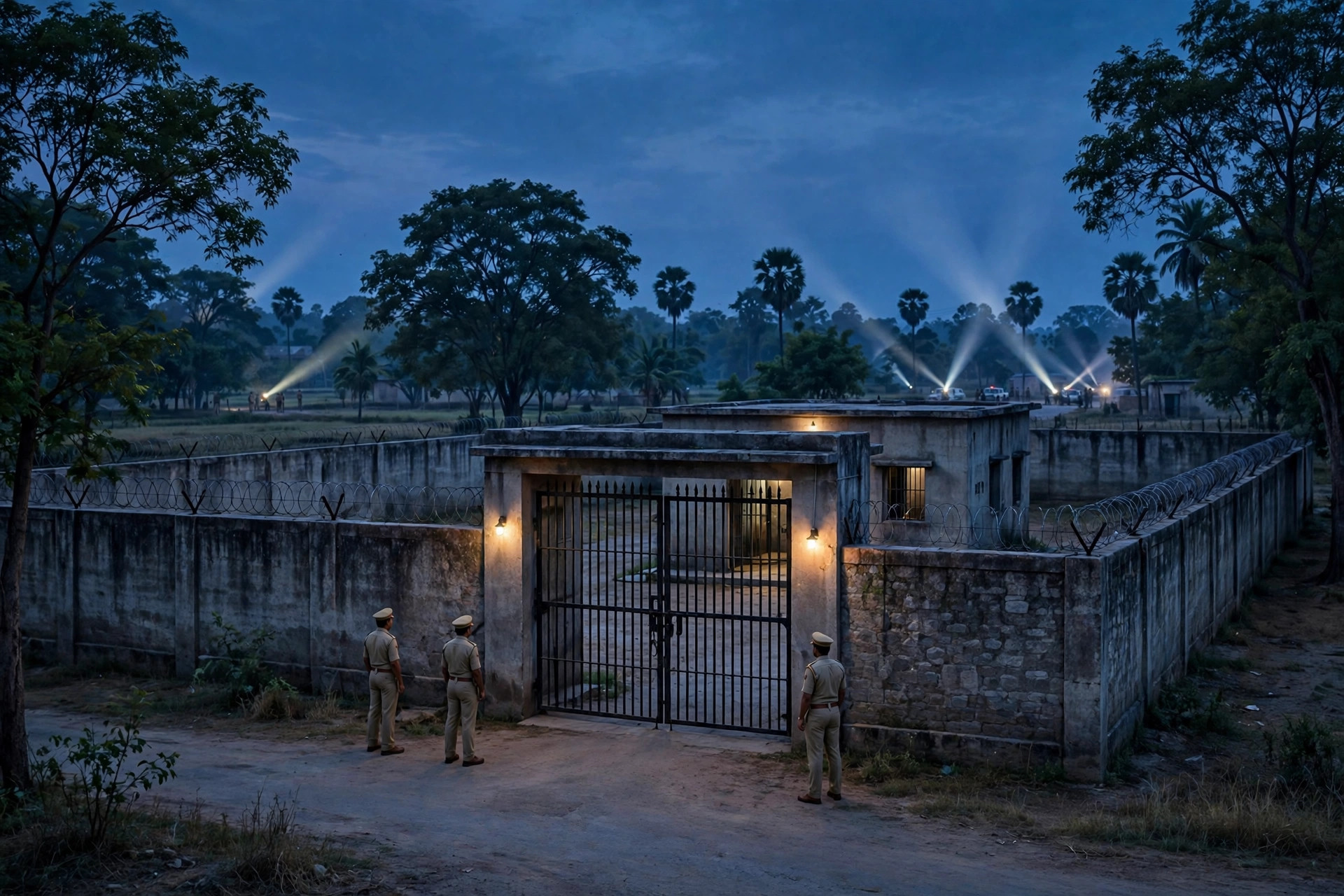
Editorial illustration: a small Indian district sub-jail with high walls and a barred main gate at dusk, guards standing by the gate and searchlights over tree-lined surroundings.
Key Takeaways
On the night of 26 October 2026, 17 undertrial prisoners escaped from the Thekkampatti sub-jail in Theni after staging a fake medical emergency and overpowering the guards.
All 17 were recaptured within about 48 hours through a manhunt involving special teams, STF units and thermal-imaging drones.
Tamil Nadu CM C. Joseph Vijay suspended Deputy Jail Superintendent (in-charge) N. Ramalingam for dereliction of duty, with a departmental inquiry ordered.
Senior prison officials were reshuffled, including the transfer of the DGP (Prisons) and the appointment of a new ADGP for Prisons and Correctional Services.
Reports point to overcrowding — about 334 inmates against a capacity of about 200 — and weak night supervision as key factors the inquiry must address.
The Theni jailbreak has put Tamil Nadu's prison system under sharp scrutiny. On the night of 26 October 2026, 17 undertrial prisoners escaped from the Thekkampatti sub-jail in Theni district after staging a fake medical emergency, overpowering the guards on duty and walking out through the main gate. All 17 were recaptured within about 48 hours, but the incident has now led to the suspension of the sub-jail's officer in charge and a wider reshuffle of senior prison officials across the state.
What happened in the Theni jailbreak?
According to reports based on police and prison department accounts, the escape took place between about 10:30 pm and 11 pm on Monday, 26 October, at the Thekkampatti sub-jail near Andipatti in Theni district. The 17 men were remand prisoners — undertrials, meaning they were awaiting trial and had not been convicted in the cases for which they were held — and were lodged in a single cell.
The prisoners raised an alarm claiming that one of their fellow inmates was unwell, with reports describing the claim as an epileptic seizure. When the duty guards opened the cell door to check on the supposedly ill prisoner, the inmates launched a coordinated attack, overpowered the staff, seized the keys to the main gate and fled into nearby forested areas around Aranjanaipudur. The plan worked because it exploited the one moment when a closed cell must be opened: a medical emergency.
A sub-jail is a small facility, usually meant for short-term custody of undertrials, and it does not have the layered security of a central prison — multiple gates, watchtowers, armed guards and perimeter patrols. That difference matters here. Once the cell door was open and the guards were overpowered, there was little left between the prisoners and the outside.
How were all 17 prisoners recaptured?
The escape triggered a large manhunt. Tamil Nadu Police deployed 17 special teams along with Special Task Force units and special police battalions, and used thermal-imaging drones to search dense forest cover around the jail. Thirteen of the escapees were recaptured by the evening of 27 October, and the remaining four were caught by 28 October, according to reports of the operation.
After recapture, the men were produced before judicial magistrates. Five were remanded to judicial custody until 10 November and eight others until 11 November, while the final two — reported to be Tirupathi and Meenakshisundaram — were to be produced in court after their capture. Once the legal formalities are complete, the authorities plan to move the escapees out of the local facility to central prisons in Salem, Vellore, Cuddalore and Puzhal, so that they are no longer held together in the same small sub-jail.
Escaping from lawful custody is itself a punishable offence, separate from the cases the men were already facing. The recaptured prisoners therefore face not only their original trials but also the legal consequences of the escape, along with departmental and police scrutiny of how it happened.
What action has Tamil Nadu taken against prison officials?
On Saturday, 31 October, Tamil Nadu Chief Minister C. Joseph Vijay ordered the suspension of Deputy Jail Superintendent (in-charge) N. Ramalingam, who was in charge of the Thekkampatti sub-jail when the prisoners escaped. The suspension order, issued under the Tamil Nadu Civil Services (Discipline and Appeal) Rules, cited dereliction of duty and lapses in supervision — specifically, a failure to ensure proper supervision, control and vigilance over both the inmates and the staff on duty. The suspension remains in force until further orders, and a departmental inquiry has been ordered.
Some early reports described the action against Ramalingam as a dismissal. The fuller accounts published on Saturday, based on the government's order, describe it as a suspension until further orders, which is the version this article follows. Nine prison personnel of various ranks had already been suspended earlier over alleged negligence and violations of security protocol, and further action against other staff has been ordered as part of the same crackdown.
The government has also ordered a wider reshuffle at the top of the prison administration. The Director General of Police (Prisons and Correctional Services), Sandeep Rai Rathore, was transferred to the post of Director General of Police and Chief Vigilance Officer at TANGEDCO, the state power utility. K. Shankar has been appointed the new Additional Director General of Police for Prisons and Correctional Services, and R. Krishnaraj, who was Superintendent of Madurai Central Prison, has been transferred to Salem Central Prison in the same role. The Chief Minister has also ordered a security review across Tamil Nadu's prisons.
Why did the escape succeed? Overcrowding, staffing and night protocols
Three weaknesses stand out from the reporting so far, and they are the ones the inquiry will have to answer.
First, overcrowding. The sub-jail reportedly housed around 334 inmates against a sanctioned capacity of about 200. Overcrowding strains everything: the guard-to-prisoner ratio, the ability to watch every cell, the speed of any response, and the general discipline of the facility. When a single cell holds 17 men, a coordinated rush becomes far harder to stop than an escape attempt by one or two prisoners.
Second, staffing and vigilance at night. The suspension order itself points to supervision failures. Night shifts in small jails are often thinly staffed, and the escape happened at the hour when staffing is lightest and attention is hardest to sustain. The inquiry will need to establish how many guards were actually on duty, whether the cell-opening procedure was followed, and whether there was a second layer of security — such as a locked grill between the cell block and the main gate — that should have stopped the men even after the first door was breached.
Third, the medical-emergency protocol. A genuine medical emergency in a cell cannot be ignored, and guards cannot simply refuse to open a door when a prisoner appears to be seriously ill. That is exactly why the ruse worked. Good prison procedure deals with this dilemma through small, practical safeguards: checking through a peephole or hatch first, calling a medical attendant before opening, opening with more than one guard present, and keeping the outer gate locked while the cell is open. Whether those safeguards existed at Thekkampatti, and whether they were followed, is now a central question.
What does this mean for Tamil Nadu's prisons?
Prisons are a State subject in India, which means the Tamil Nadu government runs its own prison department, sets its own staffing and infrastructure, and answers for its own failures. A mass escape from a sub-jail therefore reflects on the state system as a whole, not just on one facility — which is why the response has gone beyond one suspension to a reshuffle of senior officials and a statewide security review.
The episode also highlights a larger, quieter problem: undertrials. A large share of India's prison population consists of people awaiting trial, many of them held in small district and sub-jails rather than central prisons. Sub-jails are cheaper to run and closer to the courts that hear the prisoners' cases, but they are also the weakest link in the system — older buildings, fewer staff, less technology and less money for upgrades. Moving the recaptured men to central prisons recognises that reality, but it does not fix the sub-jails that remain.
For the public, the reassuring part of this story is the speed of the recapture: all 17 men were back in custody within about two days, and no report so far suggests that any member of the public was harmed during the escape or the manhunt. The worrying part is that the escape happened at all, through a method — a staged medical emergency — that prison systems everywhere know about and are supposed to guard against. The departmental inquiry, and whatever security changes follow it, will show whether the state treats this as a one-off lapse or as a warning about its sub-jails.
Conclusion
The Theni jailbreak was brief — an escape on the night of 26 October, a manhunt, and all 17 prisoners back in custody within about 48 hours — but its consequences are still unfolding. The suspension of the sub-jail's officer in charge, the transfer of the prisons chief and other senior officials, and a statewide security review show that the Tamil Nadu government is treating it as a systemic failure rather than a single mistake. The real test will be what changes inside the state's sub-jails: staffing at night, cell-opening procedures for medical emergencies, and relief from overcrowding. Until those answers come, the Theni escape will remain a reminder that the weakest parts of a prison system are usually its smallest jails.
Frequently Asked Questions (FAQ)
What happened in the Theni jailbreak?
On the night of 26 October 2026, 17 undertrial prisoners escaped from the Thekkampatti sub-jail in Theni district, Tamil Nadu. They staged a fake medical emergency, claiming one inmate was suffering an epileptic seizure. When guards opened the cell door to help, the prisoners overpowered them, seized the main gate keys and fled into nearby forested areas. All 17 were recaptured within about 48 hours.
Who was suspended after the Theni jailbreak?
Tamil Nadu Chief Minister C. Joseph Vijay ordered the suspension of Deputy Jail Superintendent (in-charge) N. Ramalingam, who was in charge of the Thekkampatti sub-jail at the time of the escape. The order cited dereliction of duty and lapses in supervision and vigilance, and the suspension remains in force until further orders, with a departmental inquiry ordered. Nine prison personnel had already been suspended earlier, and senior prison officials across the state were transferred as part of a wider reshuffle.
How were the escaped prisoners recaptured?
The police launched a large manhunt with 17 special teams, Special Task Force units, special police battalions and thermal-imaging drones. Thirteen escapees were recaptured by the evening of 27 October and the remaining four by 28 October. Five were remanded to judicial custody until 10 November and eight others until 11 November, and the authorities plan to move them to central prisons in Salem, Vellore, Cuddalore and Puzhal.
Why did the Theni jailbreak succeed, and what happens next?
Reports point to overcrowding — around 334 inmates in a facility with a sanctioned capacity of about 200 — thin night staffing, and a medical-emergency procedure that left the cell vulnerable once the door was opened. A genuine medical emergency cannot be ignored, so safeguards such as checking through a hatch first, calling a medical attendant before opening, and keeping the outer gate locked while the cell is open matter greatly. The departmental inquiry will establish which safeguards existed at Thekkampatti and whether they were followed.