Home > Economy > How Much Has Poverty Fallen in India? World Bank's 2026 Report, 49.6 Crore People and What Remains Explained
How Much Has Poverty Fallen in India? World Bank's 2026 Report, 49.6 Crore People and What Remains Explained
By IndiaAsk Editorial Team · 2026-10-31 · 7 min read · Economy
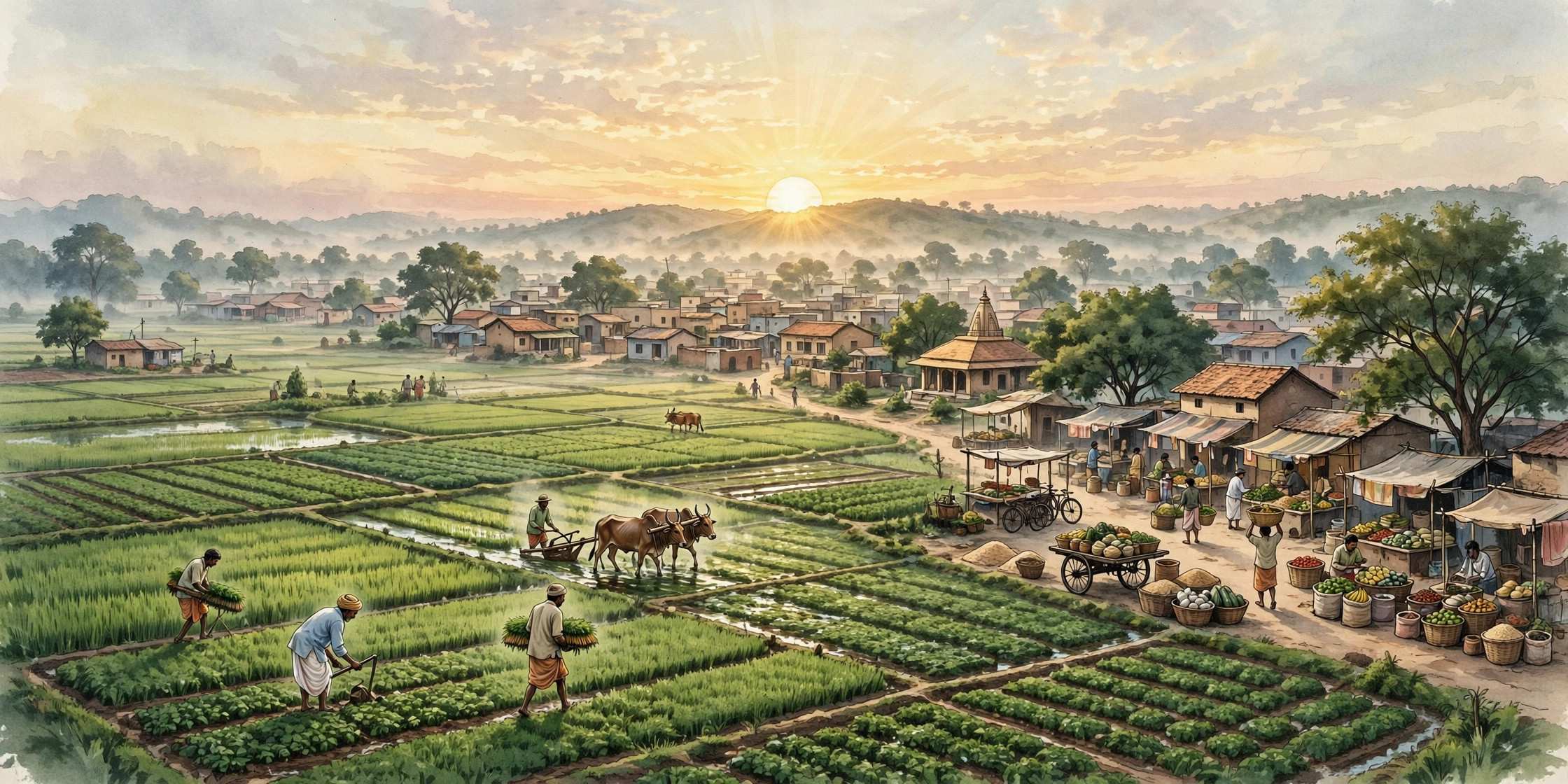
Editorial illustration: a rising sun over green fields and a small Indian town at dawn, with farmers and a marketplace in soft morning light, symbolising rising prosperity.
Key Takeaways
Between 2011 and 2023, an estimated 49.6 crore Indians moved above the $4.20-a-day poverty line, which fell from 57.7% to 16.1%.
Extreme poverty ($3.00 a day) fell from 27.1% to 2.6% over the same period, the World Bank's October 2026 brief says.
The decline was driven by strong consumption growth, rising employment especially among women, and expanded social transfers including food subsidies.
Poverty is projected to fall more slowly, from 14.2% in 2026 to 12.1% by 2028, on indicative microsimulation estimates.
Challenges remain: top earners make about 13 times the bottom 10%, youth unemployment rose to 15.9%, and 57% of the poor live in the Uttar Pradesh-to-West Bengal belt.
How much has poverty fallen in India? According to the World Bank's October 2026 Poverty and Equity Brief for India, released on Friday, 30 October 2026, the answer is: dramatically. Between 2011 and 2023, an estimated 496 million people — 49.6 crore — moved above the lower-middle-income poverty line, and extreme poverty fell from 27.1 per cent to just 2.6 per cent. The World Bank described India's progress as "one of the fastest poverty declines in the world", with improvements across both monetary and non-monetary measures of poverty.
What does the World Bank report actually say?
The headline numbers rest on two poverty lines, both measured in 2021 purchasing power parity (PPP) terms — that is, adjusted for what money can actually buy in India, rather than converted at market exchange rates. The first is the lower-middle-income country line of $4.20 per person per day. The share of Indians living below it fell from 57.7 per cent in 2011 to 16.1 per cent in 2023, a drop of 41.6 percentage points in twelve years. That is where the 49.6 crore figure comes from.
The second is the international extreme poverty line of $3.00 per day. Here the fall is even steeper in proportional terms: from 27.1 per cent of the population in 2011 to 2.6 per cent in 2023. In other words, extreme poverty — the condition of living on less than roughly Rs 285 a day in PPP terms — now affects only a small fraction of Indians, where it once affected more than one in four.
The report also looks beyond income. On the Oxford Poverty and Human Development Initiative's Multidimensional Poverty Index, which counts deprivations in health, education and living standards together, poverty fell from 53.8 per cent in 2005-06 to 16.4 per cent in 2019-21. The World Bank's own multidimensional measure put the rate at 15.5 per cent in 2022-23. The message is consistent across methods: the improvement is not an artefact of one particular poverty line.
Why did poverty fall so fast?
The World Bank attributes the decline mainly to three forces working together. The first is strong consumption growth: as the economy expanded, household spending rose, and consumption surveys — the data on which these estimates are built — captured real gains in living standards. The second is rising employment, particularly among women, which spread earnings more widely across households. The third is expanded social transfers, including food subsidies, which put a floor under the poorest households' consumption.
There is also a geographic story. The report describes India's poverty reduction as one of "both convergence and concentration". Households in both rural and urban areas saw substantial welfare gains, and faster progress in rural India significantly narrowed the rural-urban gap. In 2023, rural poverty stood at 19.3 per cent under the $4.20-a-day threshold, compared with 8.6 per cent in urban areas — a gap, but a much smaller one than in the past.
At the same time, poverty has become more concentrated geographically. Around 57 per cent of India's poor population now lives in a contiguous belt stretching from Uttar Pradesh to West Bengal. That concentration matters for policy: further poverty reduction will depend disproportionately on creating productive employment opportunities in those states.
What happens next, according to the projections?
The World Bank expects poverty to keep falling, but more slowly. Its projections put the poverty rate at the $4.20-a-day line at 14.2 per cent in 2026, declining to 12.1 per cent by 2028. The report is careful to flag that these are indicative estimates based on microsimulations, which will change as new labour market and macroeconomic data become available. They are a direction of travel, not a promise.
Finance Minister Nirmala Sitharaman welcomed the findings on Friday, describing them as evidence of the government's sustained policy efforts to improve household welfare and expand economic opportunities. The political reception is unsurprising — a 41.6 percentage point fall in poverty is the kind of number governments like to quote — but the report itself is more measured than any celebration, and its caveats deserve as much attention as its headlines.
What the report warns about
The most striking warning concerns inequality. Wage disparities remain pronounced: in 2023, median earnings among the top 10 per cent of workers were about 13 times those of the bottom 10 per cent. Poverty falling and inequality persisting are not contradictory — millions can cross a poverty line while the gap between the top and the bottom stays wide — but the combination shapes what further progress will look like. Lifting people just above $4.20 a day is not the same as giving them secure, well-paid work.
A second warning concerns young workers. Youth unemployment rose from 14.6 per cent to 15.9 per cent between the first quarter of FY2026 and the first quarter of FY2027, particularly among rural young women. That is a concern for a country whose poverty story has been driven in part by rising employment: if young people cannot find work, the next phase of poverty reduction becomes harder.
A third caveat is methodological, and the World Bank states it plainly. Poverty estimates are based on household consumption surveys, and some recent gains may reflect improvements in measurement alongside genuine welfare improvements. Survey methods, coverage and questionnaire design have all changed over the years, and separating better measurement from better lives is genuinely difficult. Readers should treat the precise figures — 2.6 per cent, 16.1 per cent — as estimates with uncertainty around them, even though the broad direction is clear across every measure the report uses.
Why does this matter for ordinary Indians?
For most people, poverty statistics feel abstract, but the underlying changes are concrete: more households able to spend on food, schooling and healthcare; more women in paid work; fewer families dependent on a single uncertain income. The multidimensional numbers capture this best — fewer deprivations in health, education and basic services, not just higher daily spending.
The concentration of remaining poverty also has practical implications. If nearly three-fifths of poor Indians live in the Uttar Pradesh-to-West Bengal belt, then national averages can improve while those regions lag, and policies that work nationally may need a regional focus. Similarly, the rural-urban gap — 19.3 per cent versus 8.6 per cent — means that "average" India still hides two quite different realities.
None of this diminishes the scale of what the report documents. Lifting nearly 50 crore people above a poverty line in twelve years is, by any standard, one of the largest welfare improvements in modern history. But the report's own framing — fast decline, slowing pace, persistent wage gaps, concentrated remaining poverty — is the honest version of the story, and the one worth remembering when the headline numbers are quoted.
Conclusion
The World Bank's October 2026 brief records a remarkable twelve years: extreme poverty down from 27.1 per cent to 2.6 per cent, the $4.20-a-day poverty rate down from 57.7 per cent to 16.1 per cent, and 49.6 crore people moving above the poverty line, driven by consumption growth, rising employment and expanded social transfers. The road ahead looks slower — 14.2 per cent in 2026 to a projected 12.1 per cent by 2028 — and it runs through the challenges the report flags: a 13-to-1 wage gap between top and bottom earners, rising youth unemployment, and poverty concentrated in the belt from Uttar Pradesh to West Bengal. The decline is real, and so is the work that remains.
Frequently Asked Questions (FAQ)
How much has poverty fallen in India according to the World Bank?
According to the World Bank's October 2026 Poverty and Equity Brief, the share of Indians living below the lower-middle-income poverty line of $4.20 per day fell from 57.7 per cent in 2011 to 16.1 per cent in 2023, lifting an estimated 496 million (49.6 crore) people out of poverty. Extreme poverty, measured at $3.00 per day, fell from 27.1 per cent to 2.6 per cent over the same period.
What is India's extreme poverty rate now?
Extreme poverty in India fell from 27.1 per cent in 2011 to 2.6 per cent in 2023, according to the World Bank's October 2026 brief. Extreme poverty here means living on less than $3.00 per person per day, measured in 2021 purchasing power parity (PPP) terms — that is, adjusted for what money can buy in India, not converted at market exchange rates.
Why did poverty fall so fast in India?
The World Bank attributes the decline mainly to strong consumption growth, rising employment — particularly among women — and expanded social transfers, including food subsidies. Faster progress in rural India also narrowed the rural-urban gap, though rural poverty (19.3 per cent) remained well above urban poverty (8.6 per cent) in 2023.
What challenges does the World Bank report flag despite the poverty decline?
The World Bank projects the $4.20-a-day poverty rate will fall from 14.2 per cent in 2026 to 12.1 per cent by 2028, but more slowly than before. These are indicative microsimulation-based estimates. The report also flags persistent challenges: median earnings of the top 10 per cent of workers were about 13 times those of the bottom 10 per cent in 2023, youth unemployment rose to 15.9 per cent, and about 57 per cent of India's poor live in the belt from Uttar Pradesh to West Bengal.