Home > General Knowledge > Why Is National Unity Day Celebrated? Sardar Patel's 151st Birth Anniversary, Run for Unity and Ekta Nagar Parade Explained
Why Is National Unity Day Celebrated? Sardar Patel's 151st Birth Anniversary, Run for Unity and Ekta Nagar Parade Explained
By IndiaAsk Editorial Team · 2026-10-31 · 9 min read · General Knowledge
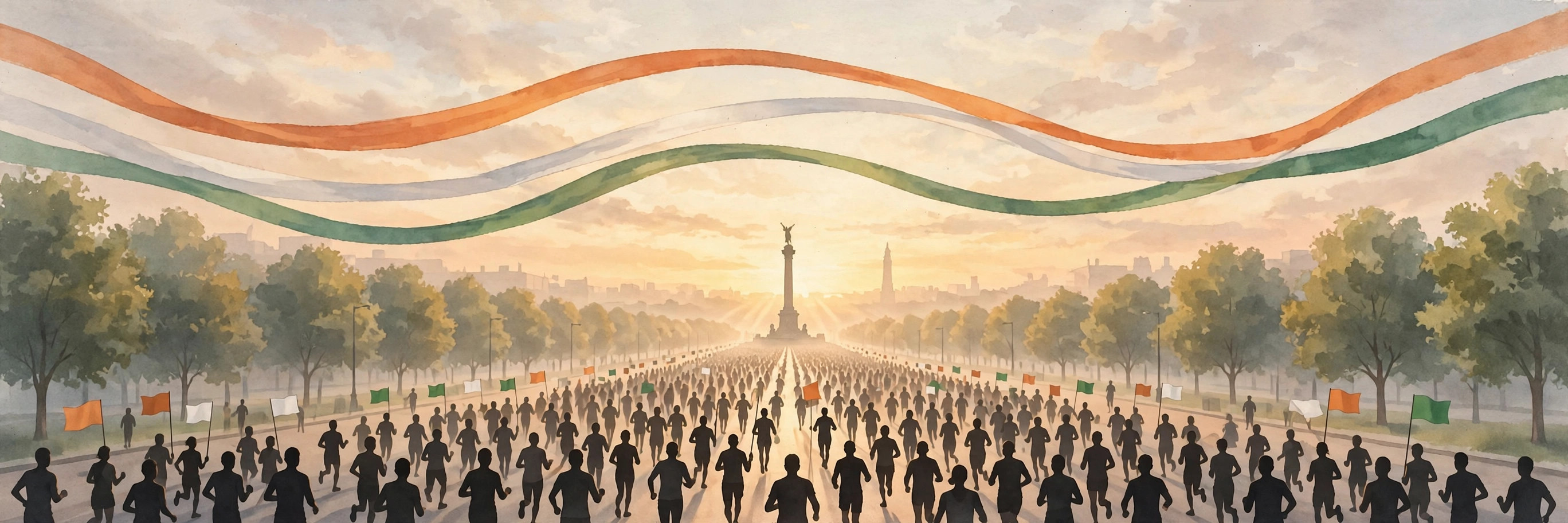
Editorial illustration: runners on a broad avenue at dawn under saffron, white and green ribbons, with a tall monument silhouette in the distance.
Key Takeaways
National Unity Day is celebrated on 31 October, Sardar Vallabhbhai Patel's birth anniversary, and has been observed as Rashtriya Ekta Diwas since 2014.
On 31 October 2026, India marked Patel's 151st birth anniversary, with Amit Shah flagging off the Run for Unity in Delhi and tributes at Patel Chowk.
Patel, India's first Deputy Prime Minister and Home Minister, led the integration of more than 560 princely states into the Indian Union after 1947.
At Ekta Nagar, PM Modi paid tribute at the Statue of Unity and launched 31 projects worth more than Rs 426 crore.
The 2026 evening Ekta Parade was themed on the end of armed Naxalism, with 15 citizen-designed tableaux and around 5,000 artists in the cultural programme.
Why is National Unity Day celebrated on 31 October? The answer begins with Sardar Vallabhbhai Patel, whose birth anniversary falls on this date. On Saturday, 31 October 2026, India marked the 151st birth anniversary of Patel — the country's first Deputy Prime Minister and Home Minister, and the leader remembered as the Iron Man of India — with the Run for Unity in Delhi, floral tributes at Patel Chowk, and the main evening celebrations at Ekta Nagar in Gujarat, home to the Statue of Unity. National Unity Day, or Rashtriya Ekta Diwas, has been observed every year since 2014 to honour Patel's role in bringing the country together after Independence and to remind citizens that national unity is something to be renewed, not taken for granted.
What happened on National Unity Day 2026
The day began in New Delhi with tributes and a run. President Droupadi Murmu, Vice-President C. P. Radhakrishnan, Union Home Minister Amit Shah, Delhi Lieutenant Governor Taranjit Singh Sandhu and Chief Minister Rekha Gupta paid floral tributes at Patel Chowk in central Delhi. Shah then flagged off the Run for Unity at the Major Dhyan Chand National Stadium, and similar runs were held across states, with chief ministers flagging off events in several states.
Addressing the gathering in Delhi, Shah said Patel's life remains an inspiration of sacrifice and patriotism for every young person, and that India achieved an undivided identity under Patel's leadership in just 1,218 days. He also used the occasion to appeal to citizens to help make India completely drug-free by 31 December 2029, linking the goal of a developed India to a drug-free society. Prime Minister Narendra Modi described Patel as the architect of Akhand Bharat and the Iron Man of India, recalling his contribution to nation-building.
The main celebrations were held in the evening at Ekta Nagar in Gujarat's Narmada district, where the 182-metre Statue of Unity — the world's tallest statue — stands. Modi paid tribute to Patel at the statue, inaugurated and laid foundation stones for 31 tourism and infrastructure projects worth more than Rs 426 crore, and attended the Ekta Parade in the evening. The projects include an IRCTC hotel built at a cost of Rs 50 crore, the new Ekta Cruise, a Rain Forest and a 2.62-km eco-trail, along with a sewage treatment plant, a water treatment plant and a parade track. Foundation stones were also laid for works including the Gora-Bhanadra Road, the Khalwani Bridge, an integrated cactus and butterfly garden, and a disaster control room for the Sardar Sarovar Dam.
Modi had arrived at Ekta Nagar on Friday evening, ahead of the celebrations, and watched Anandmath, a theatrical production based on Bankim Chandra Chattopadhyay's work featuring more than 300 artists, besides attending the Narmada aarti. The two-day programme also coincided with Bharat Parv 2026, the food and cultural festival at Ekta Nagar.
Why is National Unity Day celebrated?
National Unity Day is celebrated to recognise Sardar Patel's contribution to India's political integration and to encourage citizens to preserve the country's unity, integrity and security. According to the Ministry of Home Affairs, the day provides an opportunity to re-affirm the inherent strength and resilience of the nation to withstand threats — actual and potential — to its unity, integrity and security.
The date is not arbitrary. Patel was born on 31 October 1875 in Nadiad, in present-day Gujarat. The Government of India began observing his birth anniversary as Rashtriya Ekta Diwas in 2014, and the observance has since grown into a nationwide programme of pledges, runs, marches and cultural events. On the day, participants typically take a unity pledge, and events are organised by ministries, state governments, schools and public institutions across the country.
The idea behind the day goes beyond remembering one leader. India is home to many languages, religions and cultures, and the observance is meant to promote unity, integrity, peace and harmony among people from different backgrounds. In 2015, during the Rashtriya Ekta Diwas celebrations, the Prime Minister launched Ek Bharat Shreshtha Bharat, an initiative that pairs states and union territories for cultural exchange, so that citizens experience each other's language, cuisine, art and heritage.
Who was Sardar Patel, the Iron Man of India?
Sardar Vallabhbhai Patel was one of the foremost leaders of India's freedom movement and a trusted lieutenant of Mahatma Gandhi. After Independence on 15 August 1947, he became India's first Deputy Prime Minister and Home Minister, and was given the task that would define his legacy: integrating the princely states into the Indian Union.
At Independence, British India was not a single administrative unit. Alongside the provinces directly ruled by the British were more than 560 princely states, covering roughly 40 per cent of the subcontinent's land and population. Under the Indian Independence Act, these states were given the choice of joining India or Pakistan, or remaining independent. Without integration, the map of the new nation would have been a patchwork of separate territories.
Patel, working closely with his secretary V. P. Menon, led the States Department's effort to bring the rulers into the Union. The main legal instrument was the Instrument of Accession, through which a ruler agreed to accede to India. Patel combined negotiation and persuasion with firmness, and also offered the privy purse — an annual payment to rulers as compensation for merging their kingdoms — as an inducement. Most states had joined India by, or soon after, 15 August 1947.
A handful of cases needed longer negotiation or firmer action. Junagadh, where a ruler wanted to join Pakistan despite a largely Hindu population, acceded to India after a referendum. Hyderabad, ruled by the Nizam, who sought independence, was integrated through Operation Polo in September 1948. Jammu and Kashmir was another difficult case. Patel's determination through this process earned him the title of the Iron Man of India, and his work gave the new republic its territorial shape and a unified administrative framework.
What was special about the 2026 celebrations at Ekta Nagar?
The 2026 celebrations at Ekta Nagar carried several firsts and changes from past years, as set out by Union Home Secretary Govind Mohan in a briefing on 21 October. The most visible change was timing: all events were shifted to the evening, because daytime temperatures at Ekta Nagar are high. The annual event has been held in the presence of the Prime Minister at the Statue of Unity since 2019, but this was the first evening parade.
The parade's theme was the end of armed Naxalism. Contingents of state police forces and Central Armed Police Forces that led operations in the affected regions marched past the Prime Minister, and short films on each contingent's achievements were screened on large LED displays as it passed. The Home Ministry's message, echoed in Shah's Delhi speech, was that districts once affected by Left-Wing Extremism are now part of the mainstream, with people from those districts invited to participate in the celebrations.
The cultural programme was built around two themes: 150 years of Vande Mataram, the national song, and unity in diversity. Around 5,000 artists presented the cultural programme, and the National School of Drama staged a production titled "Naxal Mukt Bharat" featuring about 2,000 performers drawn from 126 districts that had experienced armed Naxal activity. About 5,000 people from those districts were also invited to attend the celebrations.
Another first was the tableaux. Instead of tableaux designed by ministries, departments and state governments, this year's parade featured 15 tableaux based on designs submitted by ordinary citizens through competitions on the MyGov platform and in Gujarat's districts. The idea was to make public participation, not just official ceremony, the centre of the celebration.
What does National Unity Day mean for ordinary citizens?
For most people, National Unity Day is not about the parade at Ekta Nagar, which few will ever attend. It is about the pledge and the run in their own city, town or school — and about the idea that unity in India is a daily practice rather than a single event.
The pledge taken on the day commits participants to preserving the unity, integrity and security of the nation and to spreading that message among fellow citizens. The Run for Unity, held in cities across the country, is deliberately open: it is not a competitive race but a mass participation event, meant to bring together people of different ages, backgrounds and regions in a single public act.
There is also a practical side. Ek Bharat Shreshtha Bharat, launched on the occasion in 2015, continues to pair states for youth camps, language learning and cultural exchanges. And Ekta Nagar itself has grown into a major tourist destination around the Statue of Unity, with new attractions — the Rain Forest, the eco-trail, river cruises and gardens — drawing visitors from across the country to a site dedicated to the idea of unity.
Critics sometimes ask whether a day of ceremony changes anything on the ground. The honest answer is that a pledge does not by itself solve regional, linguistic or communal tensions. What the observance does do is keep a particular story in public memory: that India was not born united in its present form, that unity had to be built state by state in 1947 and 1948, and that keeping it requires institutions, dialogue and a willingness to live with difference. That is the story Patel's birth anniversary is meant to retell each year.
Conclusion
National Unity Day 2026 marked Sardar Patel's 151st birth anniversary with the familiar symbols — tributes in Delhi, the Run for Unity across the country, and the evening Ekta Parade at Ekta Nagar — and with a new emphasis on the end of armed Naxalism and on citizen-designed celebrations. The day's meaning, however, rests on the older story: a leader who, in just over three years, helped turn more than 560 princely states into one nation, and a republic that has chosen to remember that achievement every 31 October since 2014. The run, the pledge and the parade are reminders of that work — and of the work that remains, in every generation, to keep India united.
Frequently Asked Questions (FAQ)
Why is National Unity Day celebrated on 31 October?
National Unity Day is celebrated on 31 October every year to mark the birth anniversary of Sardar Vallabhbhai Patel, India's first Deputy Prime Minister and Home Minister. The Government of India began observing the day as Rashtriya Ekta Diwas in 2014 to honour Patel's role in integrating more than 560 princely states into the Indian Union after Independence and to promote national unity, integrity and security.
What is the Run for Unity?
The Run for Unity is a mass-participation run held across India on National Unity Day. On 31 October 2026, Union Home Minister Amit Shah flagged off the Delhi run at the Major Dhyan Chand National Stadium, and similar runs were held in states across the country. It is not a competitive race; it is open to the public and meant to bring people together in a shared act honouring Patel's legacy.
Why is Sardar Patel called the Iron Man of India?
Sardar Vallabhbhai Patel is called the Iron Man of India for his determination in uniting India after Independence. As Home Minister, working with V. P. Menon, he led the integration of more than 560 princely states through the Instrument of Accession, negotiation and, where needed, firm action — including Junagadh's accession after a referendum and Hyderabad's integration through Operation Polo in September 1948.
What happened at Ekta Nagar on National Unity Day 2026?
The main 2026 celebrations were held in the evening at Ekta Nagar in Gujarat, home to the 182-metre Statue of Unity. Prime Minister Narendra Modi paid tribute to Patel, inaugurated and laid foundation stones for 31 projects worth more than Rs 426 crore, and attended the Ekta Parade, whose theme was the end of armed Naxalism, with 15 citizen-designed tableaux and cultural performances by around 5,000 artists.