Home > General Knowledge > What Does the Rafale Marine INS Vikrant Landing Mean? First Carrier Landing, Trials and What Comes Next Explained
What Does the Rafale Marine INS Vikrant Landing Mean? First Carrier Landing, Trials and What Comes Next Explained
By IndiaAsk Editorial Team · 2026-10-31 · 9 min read · General Knowledge
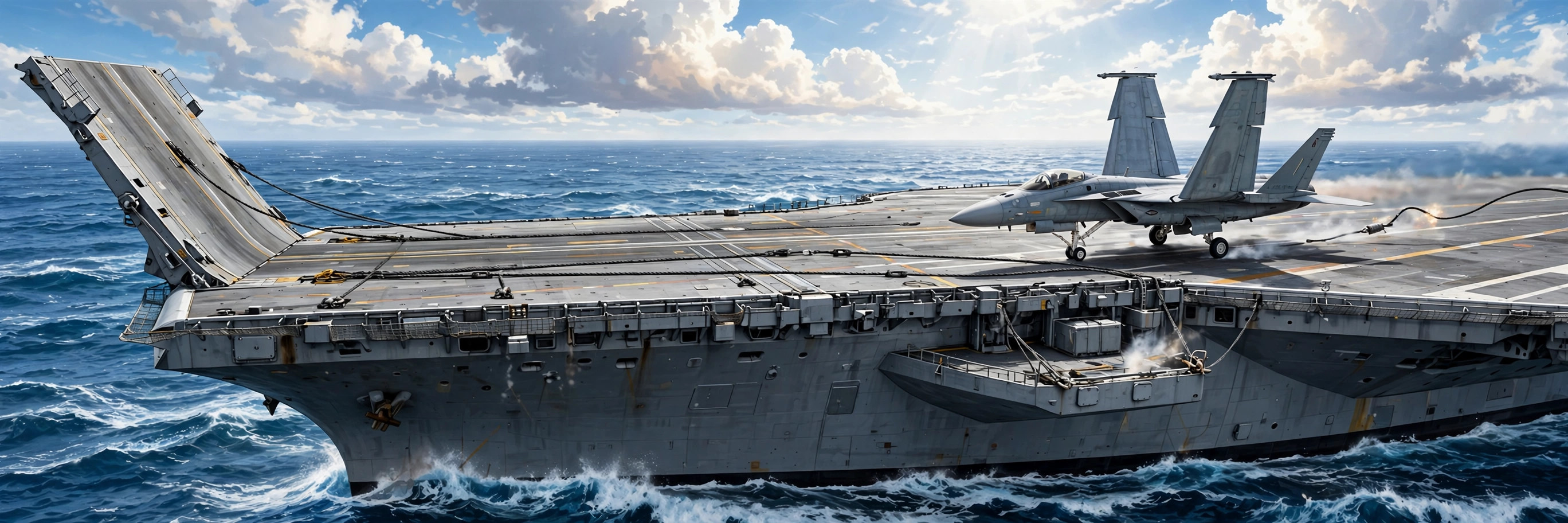
Editorial illustration: a naval fighter jet landing on an aircraft carrier deck with a ski-jump ramp at the bow, over open sea.
Key Takeaways
A Rafale Marine jet landed on INS Vikrant on its maiden attempt on 29 October 2026; the Navy announced it on 30 October as the first steps towards operationalisation.
The jet was built for France's catapult carrier Charles de Gaulle, while India's carriers use STOBAR — ski-jump take-off and arrested recovery — so compatibility had to be proven.
India signed a deal on 28 April 2025 for 26 Rafale Marine jets (22 fighters, 4 trainers) for about Rs 63,000 crore, with deliveries expected from late 2028.
A key challenge remains: the jet's 10.9-metre non-folding wingspan is wider than Vikrant's 10-metre lifts, which need modification.
The landing was a trial, reportedly by a French aircraft and pilot — Indian pilot qualification and full operational deployment still lie years ahead.
On 29 October 2026, a Rafale Marine fighter jet landed on India's indigenous aircraft carrier INS Vikrant on its very first attempt. The Indian Navy announced the milestone the next day, calling the ongoing trials "the first steps towards operationalisation of the aircraft in the Indian Navy". But what does the Rafale Marine INS Vikrant landing actually mean, and why is one landing such a big deal? In short, it is the first proof that a jet designed for a very different kind of carrier can work with India's ski-jump carriers — but it is the start of a long testing journey, not the end of it.
What Happened on 29 October?
According to the Indian Navy, a Rafale Marine aircraft successfully landed on board INS Vikrant on its maiden attempt on 29 October 2026. The Navy shared a video of the landing on its official X account on 30 October, and the event was witnessed by the Navy's Western Naval Command chief, Vice Admiral Sanjay Vatsayan.
Reports indicate that the landing was carried out by a French aircraft flown by a French pilot, as part of what is described as a first-flight campaign. That detail matters: this was a compatibility demonstration, not the delivery of an Indian-owned jet or the qualification of Indian naval pilots. Both of those steps still lie ahead.
The carrier landing did not happen in isolation. About two weeks earlier, the Navy began trials of the Rafale Marine at its Shore Based Test Facility (SBTF) at INS Hansa in Goa. That facility replicates a carrier's ski-jump ramp and arrestor wires on land, allowing engineers to assess what modifications the jet needs before it ever goes to sea. In fact, the Rafale Marine had already been tested at the same Goa facility back in January 2022, when it underwent 12 days of trials on a 283-metre mock-up ski-jump to prove it could take off from Indian-style carriers. The October 2026 landing took that work from the shore to a real, moving ship at sea.
What Is the Rafale Marine?
The Rafale Marine, also called the Rafale M, is the naval version of France's Rafale fighter jet, built by Dassault Aviation. It is designed to operate from aircraft carriers, with a strengthened airframe and landing gear for the hard impact of a carrier landing, and a tail hook that catches an arrestor wire to stop the aircraft in a very short distance.
There is, however, an important catch. The Rafale Marine was designed for the French Navy's nuclear-powered carrier Charles de Gaulle, which uses a CATOBAR system — Catapult-Assisted Take-Off But Arrested Recovery. On such a carrier, a steam or electromagnetic catapult accelerates the jet to flying speed on a flat deck, and arrestor wires stop it on landing.
India's carriers work differently. Both INS Vikrant and the older INS Vikramaditya use STOBAR — Short Take-Off But Arrested Recovery. There is no catapult. Instead, the jet accelerates under its own engine power and launches off an upward-curved ski-jump ramp at the bow of the ship, then lands by catching an arrestor wire. So the question the Navy has been working to answer is straightforward but technically demanding: can a jet built for catapults be adapted, safely and repeatedly, to ski-jump take-offs and arrested landings on Indian carriers?
How Does a STOBAR Carrier Landing Work?
A carrier landing is often described as a controlled crash, and the description is not far off. The pilot flies a precise approach to a moving deck, aims for a small landing area, and touches down at speed. A hook under the tail must catch one of several arrestor wires stretched across the deck; the wire then absorbs the jet's energy and brings it to a stop within about a hundred metres. Miss all the wires, and the pilot must immediately power up and go around for another attempt.
Take-off is equally demanding. On a STOBAR carrier, the jet lines up on the ski-jump ramp, runs up at full power, and leaves the ramp climbing into the air. The aircraft must have enough speed and lift at the moment it leaves the deck, which limits how much fuel and weapons it can carry compared with a catapult launch. That trade-off — payload versus safe launch — is one of the key things trials must measure for every new aircraft type.
This is why the Navy's shore facility in Goa matters so much. By replicating the ski-jump and arrestor wires on land, engineers can test launch and recovery profiles, measure stresses on the airframe, and work out the safe operating limits before risking a jet and pilot at sea. The move to INS Vikrant adds the one thing no shore facility can fully reproduce: a deck that moves with the sea, with real shipboard procedures, deck crews and weather.
Why the Rafale Marine INS Vikrant Landing Matters
The landing matters for three reasons. First, it is a compatibility milestone. Until a jet has actually landed on the ship it is meant to serve, integration is theory. A successful first-attempt landing on a moving carrier is concrete evidence that the Rafale Marine's approach profile, arrestor-hook geometry and handling qualities work with Vikrant's deck.
Second, it de-risks a very large purchase. India signed an agreement with France on 28 April 2025 to buy 26 Rafale Marine jets for about Rs 63,000 crore. The Navy needs to know, well before deliveries begin, that the aircraft can genuinely operate from its carriers — not just from a French catapult carrier or a Goan test ramp.
Third, it strengthens India's carrier aviation at a time when the Navy operates two carriers. The Rafale Marine will initially operate from INS Vikrant and later from INS Vikramaditya, where space is even tighter. A carrier without a capable, modern fighter is a floating airfield with limited reach; a carrier with one extends India's air power far out to sea, for fleet air defence, maritime strike and surveillance.
The Deal Behind the Jet: 26 Aircraft for About Rs 63,000 Crore
The April 2025 inter-governmental agreement covers 26 Rafale Marine aircraft: 22 single-seat fighters and four twin-seat trainers. Reports put deliveries starting in late 2028, with some accounts saying the end of 2028 or early 2029. The package also includes weapons, spares, simulators and support, as is normal for a deal of this size, though the exact breakdown of the headline price is not published in full.
For context, the Indian Air Force already flies the land-based Rafale, inducted from 2020 onwards. That commonality is part of the appeal: shared training, maintenance practices and weapons familiarity between the Air Force and Navy versions, even though the naval jet has its own carrier-specific modifications.
The current carrier fighter is the MiG-29K, flown from both Indian carriers. The Rafale Marine is the planned next-generation carrier fighter, offering more modern sensors, weapons and range. But it will not replace the MiG-29K overnight — deliveries, pilot conversion and carrier qualification will take years, and the two types are expected to overlap during the transition.
What Problems Still Need Solving?
A successful first landing is not the same as operational readiness, and several known challenges remain.
The most talked-about is physical size. The Rafale Marine has a wingspan of about 10.9 metres, and its wings do not fold. INS Vikrant's aircraft lifts are about 10 metres wide. That means the lifts will need modification, and reports suggest the jet's wingtip pylons may have to be removed during lift operations. Moving a large, non-folding-wing jet around a crowded flight deck and hangar, without blocking other aircraft, is a daily operational puzzle that trials must solve.
Then there is the full flight envelope. Landing is one half of carrier operations; ski-jump take-off at different weights, in different wind and sea conditions, with different weapon and fuel loads, is the other. Deck handling, maintenance at sea, weapons integration and night operations all need to be proven as well.
There is also the human side. Indian naval pilots must be trained and qualified on the type, deck crews must learn its handling characteristics, and maintenance teams must be able to support it aboard ship, far from a shore base. The French-flown demonstration flight is a starting point for that process, not its conclusion.
What Happens Next?
Expect the trial campaign to continue in stages. Shore trials at Goa and carrier trials aboard Vikrant will be used to validate modifications, define safe operating limits and build the procedures the Navy will use when its own jets arrive. As deliveries approach in late 2028, Indian pilots will convert to the type, and the first Indian Navy Rafale Marine carrier qualifications will follow.
The Navy's own language is deliberately careful — "first steps towards operationalisation" — and that caution is warranted. Carrier aviation punishes haste. Each milestone, from first landing to first ski-jump take-off to first fully loaded operational sortie, will be announced as it is achieved, and the gap between a demonstration and a deployable squadron is measured in years, not weeks.
Conclusion
The Rafale Marine's maiden landing on INS Vikrant on 29 October 2026 is a genuine milestone for Indian naval aviation: a French-designed, catapult-born fighter has now proven it can land on India's indigenous ski-jump carrier on its first attempt. It validates years of shore testing, de-risks a Rs 63,000 crore purchase, and points towards a more capable carrier air wing from the end of this decade.
But it is equally important to see what it is not. It is not an induction, not a squadron, and not proof that every carrier task is solved. The wingspan-and-lift puzzle, the ski-jump payload envelope, and the long work of qualifying Indian pilots and deck crews all remain. For now, the honest summary is the Navy's own: the first steps have been taken, and the road to a fully operational Rafale Marine force aboard INS Vikrant is now visibly under way.
Frequently Asked Questions (FAQ)
When did the Rafale Marine land on INS Vikrant for the first time?
On 29 October 2026, a Rafale Marine fighter jet landed on India's indigenous aircraft carrier INS Vikrant on its maiden attempt during ongoing trials. The Indian Navy announced the milestone on 30 October, describing the trials as the first steps towards operationalising the aircraft.
What is STOBAR, and how is it different from a catapult carrier?
STOBAR stands for Short Take-Off But Arrested Recovery. The jet takes off from an upward-curved ski-jump ramp under its own engine power, and lands by catching an arrestor wire on the deck. India's carriers INS Vikrant and INS Vikramaditya both use STOBAR, unlike France's Charles de Gaulle, which uses a catapult (CATOBAR) system.
How many Rafale Marine jets is India buying, and when will they arrive?
India signed an agreement with France on 28 April 2025 for 26 Rafale Marine jets — 22 single-seat fighters and four twin-seat trainers — for about Rs 63,000 crore. Deliveries are reported to begin in late 2028 or early 2029.
Does this landing mean the Rafale Marine is now operational on INS Vikrant?
No. The October 2026 landing was a compatibility trial, reportedly flown by a French aircraft and pilot. It proves the jet can land on Vikrant, but Indian pilot qualification, ski-jump take-off trials at various loads, deck handling and weapons integration still remain before the jet is operationally deployed.
What is the wingspan problem with the Rafale Marine on INS Vikrant?
The Rafale Marine's wings do not fold and span about 10.9 metres, while INS Vikrant's aircraft lifts are about 10 metres wide. The lifts need modification, and the jet's wingtip pylons may have to be removed during lift operations. Moving the jet around the deck and hangar without blocking other aircraft is another challenge trials must solve.