What Happened in Delhi's Mangolpuri Shoe Factory Fire? 4 Dead, 2 Injured, Owner Summoned — Explained
Key Takeaways
- Four people died and two were injured in the Delhi Mangolpuri shoe factory fire on the night of 30 October 2026.
- The fire was reported at around 9:30 pm at a footwear unit in Mangolpuri Industrial Area, Phase 1; about 20 fire tenders were sent.
- Six people were rescued unconscious from the smoke-filled building and taken to Sanjay Gandhi Memorial Hospital; four were declared dead on arrival.
- Fire officer ADO Paras Kumar said the blaze began in the basement and smoke spread upwards through the building.
- Delhi Police have summoned the factory owner for questioning; the cause of the fire is still under investigation and no finding on negligence has been announced.
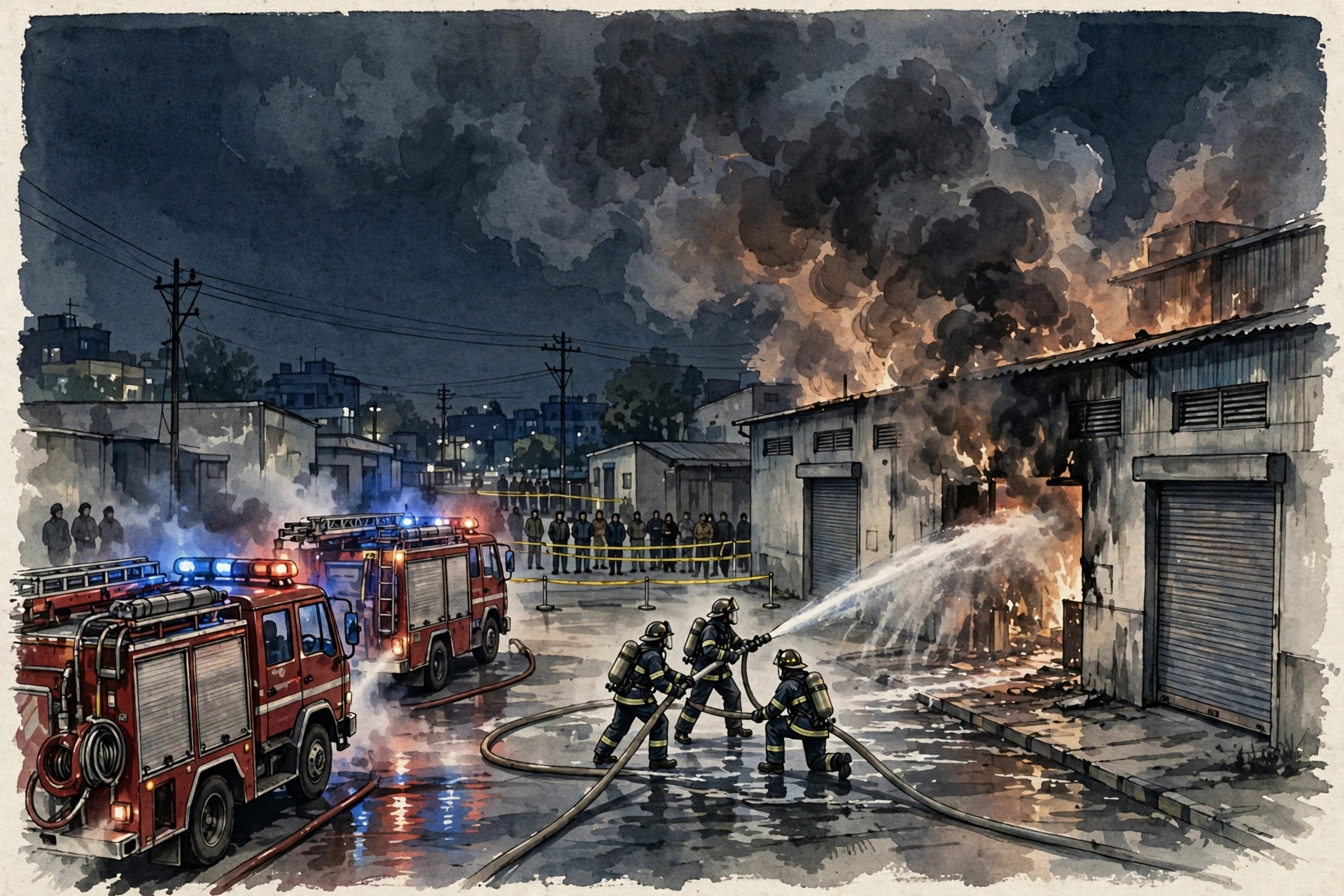
Four people died and two others were injured in the Delhi Mangolpuri shoe factory fire that broke out on the night of Friday, 30 October 2026, in Phase 1 of the Mangolpuri Industrial Area in north-west Delhi. The fire, reported at around 9:30 pm, turned a routine working night into a rescue operation in which six people were found unconscious inside the smoke-filled building and rushed to hospital. Four of them were declared dead on arrival, while the other two were admitted for treatment. Police have summoned the factory owner for questioning, and the cause of the fire is still under investigation.
This article explains what happened, what officials have confirmed so far, what the investigation will need to establish, and why factory fires raise the same safety questions again and again in Delhi's industrial areas. Nothing here goes beyond what has been reported: where accounts differ, or where facts are not yet known, that is stated plainly.
Delhi Mangolpuri shoe factory fire: what happened on 30 October
According to police and fire officials quoted by multiple news organisations, the Delhi Mangolpuri shoe factory fire was reported at around 9:30 pm on Friday, 30 October 2026, at a footwear manufacturing unit in Mangolpuri Industrial Area, Phase 1. The Hindu's morning digest places the unit at B-293/294 in the same industrial area. The Delhi Fire Service received the call at about 9:31 to 9:32 pm, and around 20 fire tenders were sent to the spot, according to The New Indian Express.
The unit manufactured and stored footwear, officials said. A fire officer, ADO Paras Kumar, said the blaze began in the basement of the building. From there, fire and smoke spread upwards through the building, filling it with a large amount of smoke. That detail matters, because in factory fires it is often smoke, rather than flames alone, that makes escape difficult and leaves people unconscious before rescuers can reach them.
Six people were rescued from inside the factory in an unconscious state. All six were taken to Sanjay Gandhi Memorial Hospital in Mangolpuri. Four were declared dead on arrival, and the remaining two were undergoing treatment, police said. Early reports during the night had suggested a larger number of injuries, but the confirmed account from police and hospital sources, as carried by NDTV, The New Indian Express, The Times of India and The Hindu, is four dead and two injured. Readers should treat any other casualty figure circulating on social media with caution unless it comes from the police or the hospital.
By late on Friday night, officials said the fire had been completely extinguished and a cooling-down operation was under way. That does not mean the work was over: cooling, searching the building, and preserving the scene for investigation continue after the flames are out.
Who was rescued, and what is known about the victims
So far, the public record gives the broad outline but not the personal details. Six people were found unconscious inside the factory and rescued. Four died, and two survived and were admitted to hospital. Officials have not, in the reports available at the time of writing, publicly released a confirmed list of names, ages, or roles of the victims, and this article does not guess at them.
That restraint is deliberate. In the first hours after a factory fire, families are still being informed, hospital records are still being checked, and the exact number of workers present in the building is still being established. Police said they were questioning the contractor and workers to determine how many labourers were present when the fire broke out. Until that headcount is settled, no report can safely say whether everyone inside has been accounted for.
The two survivors are undergoing treatment at Sanjay Gandhi Memorial Hospital. No update on their condition beyond that had been confirmed in the reports available when this article was written, and any claim about their condition should be checked against a fresh hospital or police statement.
Delhi Mangolpuri shoe factory fire: the investigation so far
The Delhi Police have begun an investigation, and the factory owner has been summoned for questioning. Police said they were also questioning the contractor and workers. A police statement quoted in the reports said appropriate legal action was being taken, and that the cause of the fire was being probed.
At this stage, no official conclusion has been announced about how the fire started, whether any safety rule was broken, or who, if anyone, was at fault. That is an important distinction. A summons for questioning is part of an investigation; it is not, by itself, a finding of guilt. Likewise, the fact that the fire began in the basement does not by itself explain what ignited it. Investigators will need to work through several questions before any conclusion is possible.
First, what was stored in the basement, and in what condition? Footwear units handle materials that can burn quickly and produce thick smoke, and storage arrangements matter a great deal in how fast a fire spreads. Second, how did smoke reach the upper floors, and were staircases, exits and ventilation able to do their job? Third, did the building have working fire-safety arrangements — alarms, extinguishers, clear escape routes and a fire no-objection certificate where one was required — and were workers trained in what to do when an alarm sounds? Fourth, how many people were inside, on which floors, and were any of them working or resting in areas that were not meant for occupancy? None of these questions has a confirmed public answer yet, and this article does not pre-judge them.
Investigators will also look at the building's layout and its approvals, and at whether the unit was operating within the terms of its licences. Those records take time to pull together, and they are often the difference between a quick, speculative explanation and a reliable one. Readers should expect the first confirmed findings to come from the police or the fire service, not from rumour.
Why factory fires in Delhi keep raising the same safety questions
Delhi's industrial areas contain a large number of small and medium manufacturing units, often in multi-storey buildings where production, storage and, in some cases, workers' rest areas sit close together. When a fire starts in such a building — especially in a basement or storage area — smoke can spread fast, stairwells can fill, and escape can become difficult within minutes. That pattern has been seen in earlier Delhi factory fires, and it is why fire officers repeatedly stress clear exits, unobstructed staircases, and storage kept away from ignition sources.
The Mangolpuri case, on the facts confirmed so far, fits the pattern that investigators will be testing: a basement origin, heavy smoke spreading upwards, people found unconscious inside, and a large fire-service response. But fitting a pattern is not the same as proving a cause. Each building is different, and the investigation must establish this building's facts rather than assume them from earlier incidents.
There is also a wider question that follows every such tragedy: how often are small industrial units inspected, and how quickly are shortcomings fixed? That question cannot be answered from the Mangolpuri reports alone, and it would be unfair to the victims, the owner and the workers to turn one night's tragedy into a general verdict before the inspection and licence records are examined. What can fairly be said is that the investigation's findings — on storage, exits, alarms and occupancy — will matter well beyond this one unit, because they will show whether the safeguards that are supposed to protect workers in such buildings were in place and working.
What happens next
In the immediate term, the police investigation continues, the two injured workers remain under treatment, and the families of the dead face the formal processes that follow a fatal fire, including identification and post-mortem procedures. The factory site will remain a scene of investigation while evidence is collected, and officials are likely to give further updates as the cause becomes clearer.
For workers and small factory owners elsewhere in Delhi, the practical lessons are already clear, even before the cause is known: know the escape routes in your building, keep staircases and exits clear, never block a basement or storage exit, and treat smoke — not just visible flame — as a reason to leave immediately and call the fire service. For the public, the lesson is simpler: rely on police, fire-service and hospital statements for casualty figures and causes, and be wary of forwarded messages that claim a cause before investigators have announced one.
This article will need updating as the investigation progresses. The confirmed facts at the time of writing are: four dead, two injured, a basement-origin fire reported at around 9:30 pm on 30 October 2026 at a shoe factory in Mangolpuri Industrial Area Phase 1, 20 fire tenders deployed, six people rescued unconscious, and the factory owner summoned for questioning, with the cause still under investigation.
Conclusion
The Delhi Mangolpuri shoe factory fire is a tragedy measured in four lives lost and two people in hospital, not in speculation about blame. What is confirmed is stark enough: a basement fire, thick smoke, six people found unconscious, and a rescue that came too late for four of them. What is not yet confirmed — the ignition source, the state of the building's fire safety, and whether any rule was broken — is now the investigation's job, and it should be allowed to do that job on evidence rather than rumour. The most useful response to this fire, for authorities and for other factory owners alike, is to make sure the findings, when they come, lead to checks that are actually carried out — on exits, storage, alarms and occupancy — before the next alarm sounds.