Home > Science & Environment > What Is India's First Indigenous H5N1 Bird Flu Vaccine? How It Protects Chickens, What It Costs, Explained
What Is India's First Indigenous H5N1 Bird Flu Vaccine? How It Protects Chickens, What It Costs, Explained
By Vijay Pawar · 2026-11-20 · 8 min read · Science & Environment
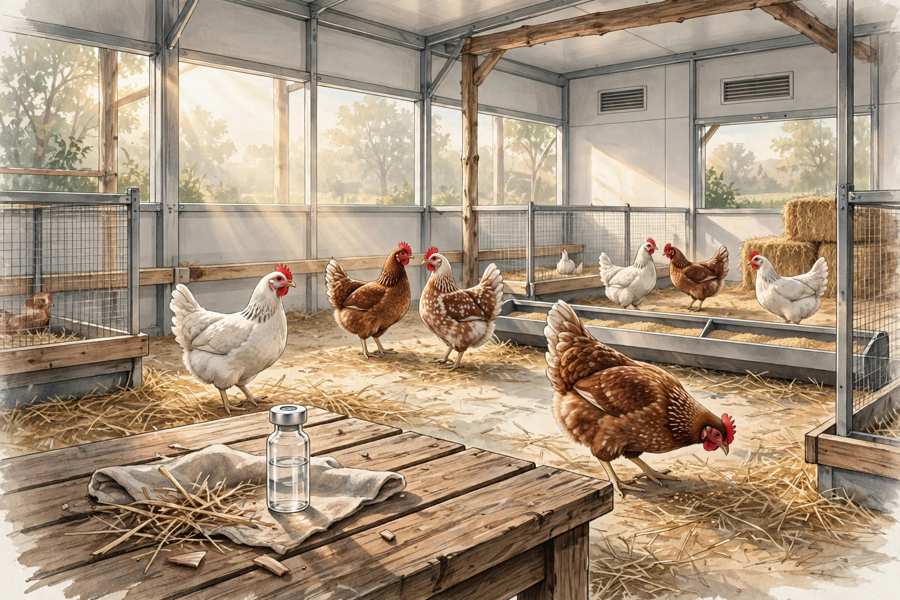
Editorial illustration: healthy chickens in a poultry shed with a vaccine vial and syringe, symbolising India's first indigenous H5N1 bird flu vaccine for chickens.
Key Takeaways
India's first indigenous H5N1 vaccine — an inactivated vaccine against clade 2.3.2.1a — was developed by ICAR-NIHSAD, Bhopal, and dedicated to the nation by Agriculture Minister Shivraj Singh Chouhan on 20 November 2026.
In trials the vaccine protected chickens for up to six months and prevented the virus spreading to unvaccinated birds kept in contact with vaccinated ones.
The vaccine costs just Rs 1 to Rs 2 per dose, so protecting a flock of 10,000 birds would cost roughly Rs 10,000 to Rs 20,000.
Clade 2.3.2.1a accounts for most H5N1 outbreaks in Indian poultry; the most recent major outbreak, in Navapur, Maharashtra in May 2026, led to nearly 400,000 birds being culled across 13 farms.
Commercial availability, distribution and the vaccination schedule are not yet announced — the dedication is a research milestone, not a rollout, so farmers must keep following existing biosecurity and reporting rules.
India's first indigenous H5N1 vaccine was dedicated to the nation on 20 November 2026, giving the country's poultry sector its first homegrown shield against bird flu. Developed by scientists at the ICAR-National Institute of High Security Animal Diseases (ICAR-NIHSAD) in Bhopal, the inactivated H5N1 vaccine targets the exact strain of the virus that causes most bird flu outbreaks in Indian poultry — and it costs just Rs 1 to Rs 2 per dose.
Until now, India had no indigenous vaccine against highly pathogenic avian influenza (HPAI). When bird flu struck a poultry farm, the standard response was culling — killing lakhs of birds to stop the virus from spreading. That protected public health, but it wiped out farmers' livelihoods overnight. The new vaccine changes that equation: for the first time, prevention, not just culling, is on the table.
What happened on 20 November 2026
Union Agriculture and Farmers Welfare Minister Shivraj Singh Chouhan dedicated India's first indigenous inactivated H5N1 (Clade 2.3.2.1a) Highly Pathogenic Avian Influenza vaccine for chickens to the nation at ICAR-NIHSAD, Bhopal, on Friday, 20 November 2026. The vaccine was developed entirely in India by scientists at the Bhopal institute, which is the country's nodal laboratory for exotic and emerging animal diseases.
"This vaccine is an example of India's self-reliance. Bird flu causes large-scale chicken deaths and huge economic losses for poultry farmers. The indigenous vaccine will strengthen bird flu control in India and protect chickens," Chouhan said at the ceremony, according to the Indian Express.
The research team behind the vaccine included Dr S. Nagarajan, Dr Manoj Kumar, Dr C. Tosh, Dr H. V. Murugkar, Dr Aniket Sanyal, Dr Senthil Kumar D, Dr Naveen Kumar and Dr Yogisharadhya R. At the same event, Chouhan announced a Rs 300-crore state-of-the-art animal disease research laboratory at Bhopal, and a BSL-4 high-containment facility at the institute.
What is H5N1 bird flu, and why is it so damaging?
H5N1 is a strain of highly pathogenic avian influenza — a flu virus that spreads among birds and can kill entire flocks within days. It is called "highly pathogenic" because, unlike low-pathogenic flu strains that cause mild illness, H5N1 kills a very high proportion of infected birds, often more than 90 per cent of a flock.
The virus spreads through direct contact with infected birds, their droppings, contaminated feed, water, equipment and even the clothes and shoes of farm workers. Wild migratory birds can carry it over long distances, which is why outbreaks often flare up along migratory routes and near water bodies.
For poultry farmers, an outbreak is financially devastating. India has no choice but to cull infected and exposed birds to stop the virus, which means a farmer can lose an entire flock — months of investment in chicks, feed and medicine — in a single week. The most recent major outbreak in India came in May 2026 in Navapur, in Maharashtra's Nandurbar district, where the H5N1 strain led to the culling of nearly 400,000 poultry birds across 13 farms.
The virus also matters for public health. A joint assessment published in May 2026 by the World Health Organization, the Food and Agriculture Organization and the World Organisation for Animal Health rated the risk to the general public as low, but noted a higher risk for people who are frequently exposed to infected animals at work — such as poultry farm workers and cullers. That is why controlling the virus in birds is the first line of defence for humans too.
What makes this vaccine different?
The new vaccine is an "inactivated" vaccine — it is made from H5N1 virus that has been killed, so it cannot cause disease, but it still trains a chicken's immune system to recognise and fight the live virus. It specifically targets H5N1 of clade 2.3.2.1a, a genetic group of the virus that NIHSAD says accounts for most H5N1 outbreaks in Indian poultry.
That targeting matters because influenza viruses keep evolving. A vaccine built against a strain that no longer circulates would offer little protection. By matching the vaccine to the clade actually circulating in India, the Bhopal scientists have aimed at the version of the virus that farmers are most likely to meet in the field.
According to the institute, experimental trials showed the vaccine protected chickens for up to six months, and — just as importantly — it prevented transmission to other chickens kept in contact with vaccinated birds. In a crowded poultry shed, where one infected bird can pass the virus to thousands, blocking transmission is what turns a vaccine from a useful tool into a genuine outbreak-breaker.
This is also the first vaccine of its kind developed in India against this clade of the H5N1 virus. Until now, the country depended on culling and biosecurity measures alone; there was no made-in-India preventive vaccine for poultry against bird flu.
How much does the H5N1 vaccine cost, and how well does it work?
The headline number is the price: Rs 1 to Rs 2 per dose, according to the Agriculture Minister. At that price, vaccinating even a large commercial flock costs a tiny fraction of what a farmer loses in a single outbreak — a flock of 10,000 birds could be covered for roughly Rs 10,000 to Rs 20,000 in vaccine cost.
In trials, the vaccine protected chickens for up to six months and stopped the virus from spreading to unvaccinated birds kept in the same space. Six months of protection covers a full production cycle for broiler chickens, which are typically raised for five to seven weeks, and a large part of a layer hen's cycle.
What is not yet clear is when the vaccine will actually reach poultry farms. The 20 November announcement was a dedication of the vaccine to the nation — a formal recognition of the research milestone — and it does not by itself establish when the vaccine will become commercially available, how it will be distributed across poultry farms, or what vaccination schedule farmers should follow. Those details — manufacturing scale-up, pricing in the market, and the vaccination protocol — are still to be announced.
What does it mean for poultry farmers?
For the lakhs of small and medium poultry farmers across India, the vaccine could mean the difference between losing everything and surviving an outbreak season. [Poultry farming](https://indiaask.tech/question.php?slug=poultry-farming-beginners-india-explained) is one of the fastest-growing sources of rural income in India, and bird flu is its single biggest biological risk. A single confirmed case on a farm can trigger culling not just on that farm but on neighbouring farms too, so even farmers whose birds are healthy can lose their stock.
A cheap, effective vaccine changes the economics of that risk. Instead of absorbing a total loss once an outbreak hits, a farmer could pay a few rupees per bird and keep the flock alive. It also reduces the need for mass culling, which is traumatic for farmers and expensive for the state, which must pay compensation and manage disposal of culled birds.
The benefit extends beyond poultry. [Dairy farming](https://indiaask.tech/question.php?slug=dairy-farming-small-holders-income-explained) and other livestock businesses face their own disease risks, and the Rs 300-crore research laboratory and BSL-4 facility announced alongside the vaccine signal a broader push to strengthen India's animal disease research capacity — the same science that protects chickens also underpins the safety of milk, meat and eggs.
How is bird flu controlled today?
Until the vaccine reaches farms, the existing system remains in place. When an outbreak is confirmed, the affected area is notified, infected and exposed birds are culled, and the movement of poultry, eggs and feed in and out of the area is restricted. Farms are disinfected, and surveillance is stepped up in surrounding districts.
Farmers are advised to follow strict biosecurity: keeping wild birds away from poultry sheds, disinfecting vehicles and equipment, changing clothes and footwear before entering sheds, and reporting unusual bird deaths to the local animal husbandry department immediately rather than trying to sell sick birds. Early reporting is critical — the faster an outbreak is confirmed, the smaller the area that must be culled.
The vaccine, once available, will sit on top of these measures, not replace them. Vaccination plus biosecurity plus rapid surveillance is the combination that has controlled bird flu in other countries that vaccinate poultry.
Conclusion
India's first indigenous H5N1 bird flu vaccine is a genuine scientific milestone: a made-in-India, inactivated vaccine matched to the virus clade behind most Indian outbreaks, shown in trials to protect chickens for up to six months and to block spread to other birds, at a cost of just Rs 1 to Rs 2 per dose. Dedicated to the nation on 20 November 2026 by Agriculture Minister Shivraj Singh Chouhan at ICAR-NIHSAD, Bhopal, it gives poultry farmers a preventive tool they have never had before — and with the May 2026 Navapur outbreak still fresh in memory, when nearly 400,000 birds were culled, the need for it is not theoretical.
The honest caveat is that a dedication is not a rollout. Until the government announces manufacturing, availability and the vaccination protocol, farmers should keep following existing biosecurity and reporting rules. But the direction of travel is clear: India is moving from reacting to bird flu with culling alone towards preventing it with a vaccine of its own. For more on the official announcement, see the [Press Information Bureau release](https://www.pib.gov.in/PressReleasePage.aspx?PRID=2337716®=48&lang=2), and for detailed reporting on the launch, the [Indian Express coverage](https://indianexpress.com/article/india/india-first-indigenous-h5n1-bird-flu-vaccine-icar-nihsad-bhopal-shivraj-singh-chouhan-10971805/).
It is an inactivated H5N1 (Clade 2.3.2.1a) Highly Pathogenic Avian Influenza vaccine for chickens, developed by ICAR-NIHSAD in Bhopal and dedicated to the nation by Agriculture Minister Shivraj Singh Chouhan on 20 November 2026. It is the first vaccine of its kind developed in India against this clade of the H5N1 virus.
How much does the H5N1 vaccine cost per dose?
The vaccine will cost between Rs 1 and Rs 2 per dose, according to Union Agriculture Minister Shivraj Singh Chouhan. At that price, vaccinating a flock of 10,000 birds would cost roughly Rs 10,000 to Rs 20,000 in vaccine cost.
How long does the H5N1 vaccine protect chickens?
Experimental trials showed the vaccine protected chickens for up to six months and prevented transmission of the virus to other chickens kept in contact with vaccinated birds.
When will the H5N1 vaccine be available to poultry farmers?
That is not yet announced. The 20 November 2026 event was a formal dedication of the vaccine to the nation; the government has not yet said when it will become commercially available, how it will be distributed, or what vaccination schedule farmers should follow. Until then, existing biosecurity and outbreak-reporting rules remain in force.
Dairy farming and other livestock businesses face their own disease risks, and the research capacity being built alongside the vaccine also underpins the safety of milk, meat and eggs. Dairy Farming Business Plan: Cows, Buffaloes, Feed and Income