Home > Science & Environment > Why Have TB Deaths Fallen 38% in India Since 2015? WHO Global TB Report 2026 Explained
Why Have TB Deaths Fallen 38% in India Since 2015? WHO Global TB Report 2026 Explained
By Vijay Pawar · 2026-11-14 · 7 min read · Science & Environment
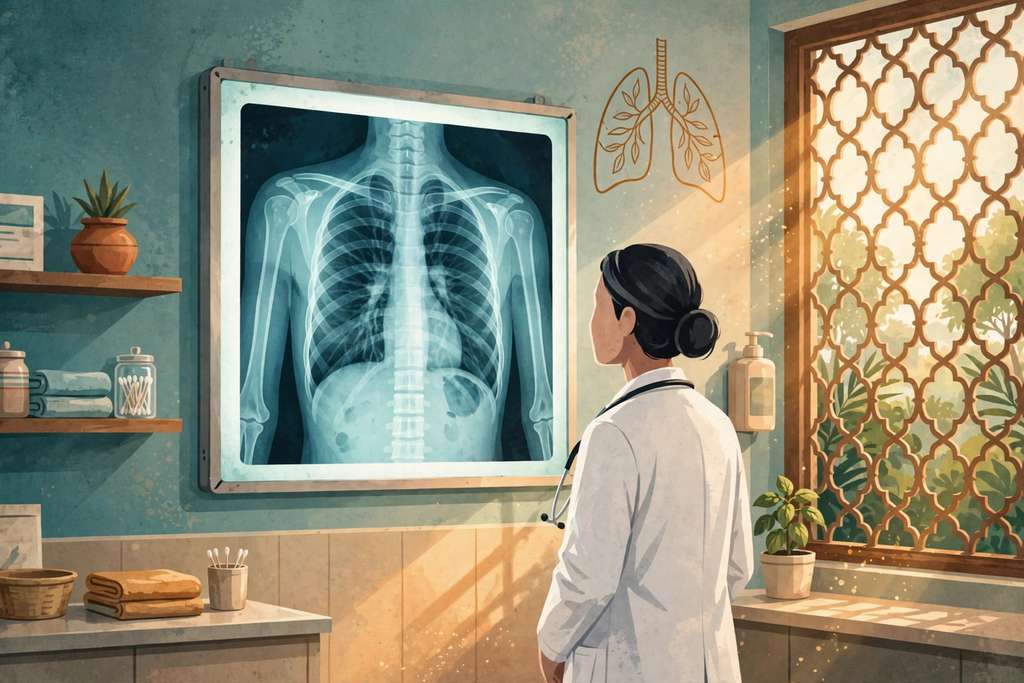
Editorial illustration: a doctor studying a chest X-ray on a lightbox in a bright Indian public health clinic, symbolising India's fight against tuberculosis.
Key Takeaways
India's TB deaths have fallen 38% since 2015 — mortality down from 28 to 18 per lakh population — beating the global decline of 35%, according to the WHO Global Tuberculosis Report 2026 released on 12 November 2026.
India recorded a 94% treatment success rate among patients with drug-susceptible TB, reflecting early detection, AI-enabled X-rays, rapid diagnostics and patient support under the National TB Elimination Programme.
The TB Mukt Bharat Abhiyaan screened over 250 million people between December 2024 and November 2026 and found 4.864 million cases, including 1.497 million people with no symptoms.
India still carries about 25% of the world's TB cases — 10.6 million people developed TB globally in 2025 and 1.13 million died — so cutting new infections remains the bigger challenge.
WHO estimates drew on the Registrar General of India's Sample Registration System, community verbal autopsy assessments and Ni-kshay portal data, with a 2025 ICMR-NIRT prevalence survey shared with the WHO.
India has recorded a 38% fall in tuberculosis (TB) deaths since 2015, beating the global decline of 35% over the same period, according to the World Health Organization's Global Tuberculosis Report 2026. The report, released on 12 November 2026, also puts India's treatment success rate at 94% among patients with drug-susceptible TB — a figure the Union Health Ministry says reflects a decade of early detection, faster diagnosis and sustained patient support. For a country that still carries the world's largest TB burden, the numbers mark the sharpest improvement India has ever reported — and they arrive just as the country measures itself against its own ambitious goal of eliminating the disease.
What the WHO report says about India
The headline finding is straightforward: India's estimated TB mortality rate has fallen from 28 deaths per lakh population in 2015 to 18 per lakh in 2025, a reduction of 38% that outpaces the 35% decline recorded globally. The World Health Organization's Global Tuberculosis Report 2026, released on Thursday, 12 November, describes this as India's highest-ever reduction in TB mortality. The Health Ministry said the progress reflects sustained work towards eliminating TB through early detection, timely treatment, technological innovation and comprehensive patient care.
The 94% treatment success rate applies to patients with drug-susceptible TB — people whose infection responds to standard medicines. It is a measure of how many patients who start treatment actually complete it and are cured, and it points to improvements not just in finding cases but in keeping patients on months of treatment until they recover. The ministry credited a patient-centred approach, stronger treatment delivery and sustained support for people affected by TB. Health Minister J P Nadda welcomed the findings, and the WHO's South-East Asia Regional Office publicly praised India's contribution to reducing TB mortality across the region.
How the numbers were worked out
One reason this report carries weight is the evidence behind it. The WHO's mortality estimates for India drew on several complementary sources rather than a single dataset: the Registrar General of India's Sample Registration System, community-based verbal autopsy assessments, and programme data from the government's Ni-kshay portal. The Indian Council of Medical Research–National Institute for Research in Tuberculosis (ICMR-NIRT) also conducted a nationally representative TB prevalence survey in 2025, whose findings have been shared with the WHO. That mix of official registration data, field-level death reporting and programme records is what allows the report to estimate mortality with more confidence than in earlier years.
The improvement has not come from one intervention alone. Under the National TB Elimination Programme (NTEP), India has pushed proactive case finding — going out to look for TB rather than waiting for patients to arrive at clinics — backed by AI-enabled chest X-rays that flag likely cases quickly, rapid molecular diagnostics that confirm TB in hours rather than weeks, prompt treatment initiation, and differentiated care for patients with more complex needs. Nutritional support through the Ni-kshay Poshan Yojana and community backing under the Ni-kshay Mitra initiative address a quieter problem: many TB patients are undernourished, and food support helps them complete treatment.
The TB Mukt Bharat Abhiyaan: screening at a scale never tried before
A large part of the recent progress comes from the TB Mukt Bharat Abhiyaan, the nationwide campaign to find hidden cases. Between 7 December 2024 and 8 November 2026, the campaign brought more than 250 million people into screening activities and identified 4.864 million TB cases — including 1.497 million people who had no symptoms at all and would probably never have walked into a clinic on their own. Finding symptom-free cases matters because a person with TB who does not know they have it can keep spreading the infection for months; catching those cases early breaks chains of transmission that would otherwise continue silently.
This is the logic behind India's approach: the disease cannot be beaten by treating only the patients who show up. It has to be hunted in communities, workplaces and villages, with X-rays, sputum tests and door-to-door screening. The campaign's scale — a quarter of a billion people screened — is unusual anywhere in the world, and it is one of the reasons the mortality curve has bent as sharply as the report shows.
The other side of the story: India still carries a quarter of the world's TB
The good news should not hide the scale of what remains. India still accounted for about 25% of all people who developed TB worldwide in 2025. Globally, the WHO estimates that 10.6 million people developed TB and 1.13 million died from it in 2025. In other words, even after a decade of progress, one in every four new TB patients in the world is Indian — a reflection of the country's population size, crowded cities, undernutrition and the sheer number of undetected cases still in circulation.
That is why the government is cautious about declaring victory. The treatment success rate of 94% covers drug-susceptible TB; drug-resistant TB, which needs longer, harsher and more expensive treatment, remains a harder problem. And while mortality has fallen, the number of new cases — incidence — has to fall much faster if India is to reach its goal of eliminating TB, which it set for 2025, five years ahead of the global 2030 target under the Sustainable Development Goals. The 2026 report is therefore best read as proof that the strategy works, not as a finish line.
What this means for patients and families
For ordinary families, the practical meaning of the report is that TB in India is increasingly a curable, survivable disease — provided it is found early and treatment is completed. Diagnosis and treatment for TB are free in the public health system, and patients registered on the Ni-kshay portal receive nutritional support during treatment. The message health officials repeat is simple: a cough lasting more than two weeks, fever, night sweats or unexplained weight loss should be checked, because TB caught early is far easier to cure and far less likely to spread to family members.
The wider health system matters here too. Hospitalisation for serious illness can still push families into debt, which is why the government's flagship health insurance scheme matters alongside disease-specific programmes — [Ayushman Bharat PM-JAY](https://indiaask.tech/question.php?slug=ayushman-bharat-pm-jay-explained) covers hospital treatment for eligible families, and TB patients who need inpatient care can benefit from it. Meanwhile, the push to manufacture more medical equipment at home, including diagnostic tools, is part of the same self-reliance story — the [medical devices PLI scheme](https://indiaask.tech/question.php?slug=pli-scheme-medical-devices-extended-2035-36-explained) extended to 2035-36 aims to strengthen the domestic industry that supplies the machines used to detect diseases like TB.
What happens next
The challenge now is to convert a mortality decline into an incidence decline. The government will need to sustain the screening intensity of the TB Mukt Bharat Abhiyaan, keep drug supplies uninterrupted, tackle drug-resistant TB, and address the social drivers — undernutrition, overcrowded housing, smoking and diabetes — that make people vulnerable to the disease in the first place. The 2026 report gives India something it has not had before: credible, multi-source evidence that deaths are falling faster here than in the rest of the world. The next report will show whether that momentum can be held.
The story was first reported by [Deccan Herald](https://www.deccanherald.com/amp/story/india/india-records-38-drop-in-tb-deaths-since-2015-outpaces-global-decline-who-report-4216812) and [The Hindu BusinessLine](https://www.thehindubusinessline.com/news/indias-tb-deaths-fall-38-since-2015-faster-than-global-decline-who-report/article71697146.ece), both citing the Health Ministry's statement on the WHO Global Tuberculosis Report 2026.
Conclusion
India's 38% reduction in TB deaths since 2015 — faster than the global 35% — is the strongest result the country has recorded in its fight against tuberculosis, backed by a 94% treatment success rate and one of the largest screening campaigns ever attempted. The WHO's Global Tuberculosis Report 2026 credits early detection, AI-enabled X-rays, rapid diagnostics and patient support under the National TB Elimination Programme. Yet with a quarter of the world's TB cases still in India, the work is far from over. The falling death toll proves the strategy works; the test ahead is whether India can cut new infections at the same pace and move from controlling TB to ending it.
Why have TB deaths fallen 38% in India since 2015?
India's estimated TB mortality rate fell from 28 deaths per lakh population in 2015 to 18 per lakh in 2025, a 38% reduction that beats the global decline of 35%, according to the WHO Global Tuberculosis Report 2026 released on 12 November 2026. The Health Ministry credits early detection, AI-enabled X-rays, rapid diagnostics, prompt treatment and patient support under the National TB Elimination Programme.
What is India's TB treatment success rate in 2026?
India recorded a 94% treatment success rate among patients with drug-susceptible TB — people whose infection responds to standard medicines. It reflects improvements in diagnosis, treatment delivery, patient follow-up and support such as nutritional assistance under the Ni-kshay Poshan Yojana.
What is the TB Mukt Bharat Abhiyaan and what did it find?
The TB Mukt Bharat Abhiyaan is India's nationwide campaign to find hidden TB cases. Between 7 December 2024 and 8 November 2026 it screened more than 250 million people and identified 4.864 million TB cases, including 1.497 million people who had no symptoms and would probably never have visited a clinic.
Does India still have the world's largest TB burden?
Yes. India still accounted for about 25% of all people who developed TB worldwide in 2025. Globally, the WHO estimates 10.6 million people developed TB and 1.13 million died from it in 2025. So while deaths are falling faster in India than globally, cutting new infections remains the bigger challenge.
Read Next on IndiaAsk
Hospitalisation for serious illness can still push families into debt, which is why the government's flagship health insurance scheme matters alongside disease-specific programmes — Ayushman Bharat PM-JAY covers hospital treatment for eligible families, and TB patients who need inpatient care can benefit from it. Ayushman Card: Eligibility, Benefits and How Hospital Treatment Works