Home > Government Schemes > What Is the Medical Devices PLI Scheme Extension to 2035-36? Rs 2,700 Crore, New Rules and Who Can Apply, Explained
What Is the Medical Devices PLI Scheme Extension to 2035-36? Rs 2,700 Crore, New Rules and Who Can Apply, Explained
By Vijay Pawar · 2026-11-11 · 6 min read · Government Schemes
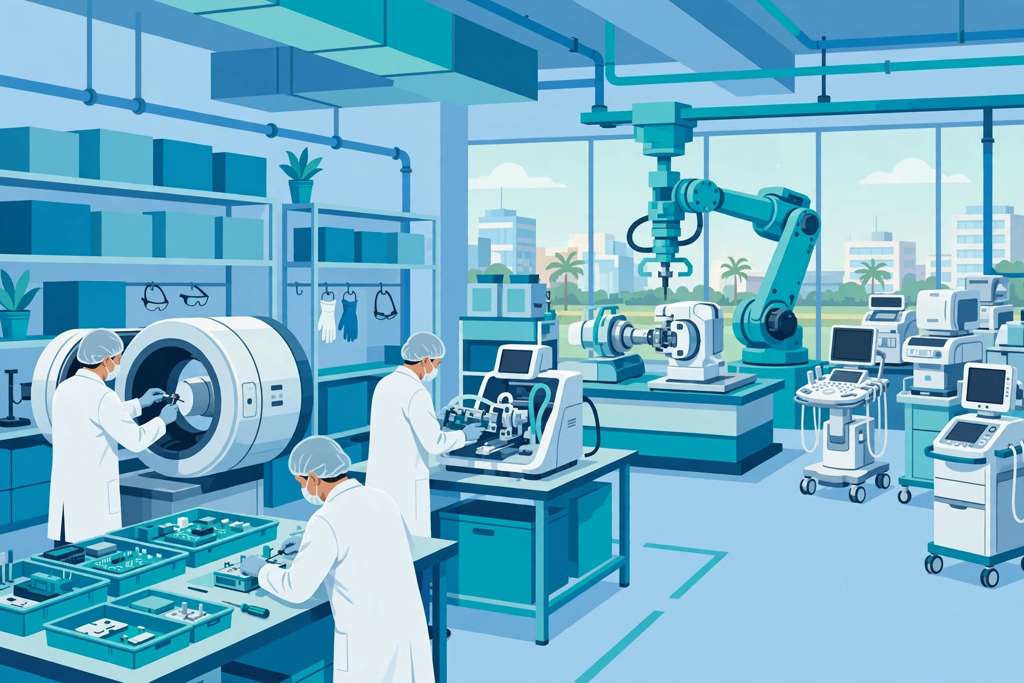
Illustration: engineers assembling medical scanning machines on a modern factory floor in India — no text, no real person, no logos.
Key Takeaways
The medical devices PLI scheme has been extended by eight years to 2035-36, with about Rs 2,700 crore of outlay available.
PLI-MD 2.0 scraps the minimum sales threshold and lowers the minimum investment requirement of Rs 180 crore.
Fresh applications open through an online portal within 10 days of the 10 November 2026 announcement.
Incentives are 5% for consumables and implants, 9% for critical components and nascent high-end devices, and 6% for devices only assembled in India.
The first phase enabled 60+ high-end devices and production worth over Rs 16,000 crore since 2020-21.
The Centre has extended the medical devices PLI scheme by eight years, to 2035-36, and invited fresh applications from manufacturers, the Department of Pharmaceuticals announced on 10 November 2026. About Rs 2,700 crore of the scheme's outlay is still available, and the revised version — called PLI-MD 2.0 — scraps the minimum sales threshold that companies earlier had to meet to claim incentives, and lowers the minimum investment requirement. An online application portal will go live within 10 days.
What is the medical devices PLI scheme?
The Production Linked Incentive (PLI) Scheme for Promoting Domestic Manufacturing of Medical Devices was launched in 2020-21 to reduce India's dependence on imported medical equipment. Under the scheme, the government pays manufacturers a cash incentive linked to the value of the medical devices they produce in India. The idea is simple: make it profitable to manufacture here rather than import, and the factories, jobs and technology will follow.
So far, the scheme has supported domestic manufacturing of more than 60 high-end medical devices and components, including X-ray tubes and detectors, 1.5 Tesla MRI systems, LINAC machines used in cancer treatment, CT scanners, mammography machines, cathlab equipment, orthopaedic and cardiac implants, and dialyzers. Production under the scheme has crossed Rs 16,000 crore. Even so, the scheme's original outlay of Rs 3,420 crore has been slow to reach companies — nearly 80 per cent of it remains unutilised, which is one reason the government has now rewritten the rules.
What changes under PLI-MD 2.0?
The revised scheme makes three big changes. First, the minimum sales threshold for claiming incentives has been discontinued. Earlier, a company had to cross a sales target before it could claim any money; now the incentive is linked to production itself, which helps smaller and newer manufacturers. Second, the minimum investment requirement — earlier Rs 180 crore — has been reduced, lowering the entry barrier for companies that want to set up plants. Third, the scheme's tenure has been extended from 2027-28 to 2035-36, giving manufacturers a long, predictable policy runway for what is a capital-intensive industry.
Applicants will get three years to set up their manufacturing facilities, followed by a five-year performance period during which incentives are paid. Applications will be accepted through an online portal that the Department of Pharmaceuticals says will be operational within 10 days, with an open-ended submission window. Companies that were approved before 31 October 2026 will continue under the previous set of guidelines.
The four segments and the incentive rates
The scheme covers four target segments. Segment 1 covers medical consumables, disposables and implants. Segment 2 covers critical components used to manufacture medical devices — the parts that India still largely imports. Segment 3 covers high-end medical devices whose domestic manufacturing is still at a nascent stage, and Segment 4 covers high-end devices that are currently only assembled in India, not fully made here.
The incentive rates taper over time and differ by segment: about 5 per cent for Segment 1, about 9 per cent for Segments 2 and 3, and about 6 per cent for Segment 4. The highest rates are deliberately reserved for critical components and complex diagnostic machinery — the areas where India is most import-dependent and where building domestic capability matters most for both health security and exports.
Why the government is pushing medical device manufacturing
India imports a large share of its medical devices, from imaging machines to implants. That dependence became a visible vulnerability during the pandemic, when supply chains broke down and equipment prices spiked. The National Medical Devices Policy 2023 set a target of growing India's medical devices market from about $11 billion in 2020 to $50 billion by 2030, and the PLI scheme is the main financial tool for getting there.
The extension fits a wider push to build domestic manufacturing capacity with government support. Large private investment plans are also flowing into manufacturing and infrastructure — for example, the [Adani Group's $120 billion investment plan](https://indiaask.tech/question.php?slug=adani-group-120-billion-investment-plan-explained) spans energy, ports and other sectors. For medical devices specifically, the government argues that local manufacturing will cut import bills, create skilled jobs, improve the quality and competitiveness of Indian-made devices, and integrate domestic producers into global supply chains.
Who can apply, and what should applicants watch?
The scheme is aimed at companies willing to manufacture medical devices or their critical components in India. With the investment threshold lowered and the sales threshold gone, mid-sized manufacturers and component makers — not just large corporates — can now realistically apply. The four segments mean a company should first identify which segment its product falls into, because the incentive rate and the expectations differ.
Applicants should also note the timelines: the portal opens within 10 days of the announcement, and once approved, a company has three years to set up its facility. The incentive is paid on production over the following five years, so the economics depend on actually manufacturing and selling, not merely on getting approved. Small businesses looking at government support of a different kind — subsidised loans rather than production incentives — can read our explainer on the [Prime Minister's Employment Generation Programme (PMEGP)](https://indiaask.tech/question.php?slug=pm-employment-generation-programme-pmegp-explained), which helps entrepreneurs start small manufacturing and service units.
What to watch next
The first test of PLI-MD 2.0 will be the response to the fresh applications: how many companies apply once the portal opens, and whether component makers — the Segment 2 firms the scheme most wants — come forward. The second test is utilisation. With about Rs 2,700 crore still available and the old rules blamed for slow uptake, the government will be judged on whether the money actually reaches manufacturers this time. The details in this article are drawn from the Department of Pharmaceuticals' announcement as reported by [Business Standard](https://www.business-standard.com/amp/industry/news/centre-extends-medical-devices-pli-scheme-by-8-yrs-eases-eligibility-norms-126111000905_1.html) and [The Economic Times](http://economictimes.indiatimes.com/industry/healthcare/biotech/pharmaceuticals/government-invites-fresh-applications-under-rs-2700-crore-medical-device-pli-scheme/articleshow/135713436.cms).
Conclusion
The medical devices PLI scheme has been extended to 2035-36 with about Rs 2,700 crore available, simpler rules and higher incentives for the components India needs most. The first phase proved Indian factories can make MRI machines, CT scanners and implants; the second phase will show whether easier rules can turn that proof into scale. For manufacturers, the window opens within days — and for patients, the payoff, if it works, is more affordable Indian-made medical equipment.
What is the medical devices PLI scheme extension announced in November 2026?
The Centre has extended the Production Linked Incentive (PLI) scheme for medical devices to 2035-36 and invited fresh applications. About Rs 2,700 crore of the scheme's outlay is available, and the revised PLI-MD 2.0 rules remove the minimum sales threshold and lower the minimum investment requirement.
How and when can companies apply under PLI-MD 2.0?
Companies can apply through an online portal that the Department of Pharmaceuticals says will be operational within 10 days of the 10 November 2026 announcement. The submission window is open-ended. Applicants approved before 31 October 2026 continue under the old guidelines.
Which products are covered, and what incentives do they get?
The scheme covers four segments: medical consumables, disposables and implants (5% incentive); critical components (9%); high-end devices at a nascent stage of domestic manufacturing (9%); and high-end devices currently only assembled in India (6%). Approved applicants get three years to set up facilities, then a five-year performance period.
What has the PLI scheme for medical devices achieved so far?
Launched in 2020-21, the scheme has enabled domestic manufacturing of over 60 high-end devices and components, including MRI and CT scanners, and production worth over Rs 16,000 crore. But nearly 80% of the Rs 3,420 crore outlay remained unutilised, which is why the rules were eased.
Small businesses looking for a different kind of government support — subsidised loans to start a unit — can read our PMEGP explainer on subsidy, eligibility and how to apply online. PMEGP Loan: Subsidy, Eligibility and How to Apply Online