Home > Agriculture & Mandi Bhav > How to Get a Solar Pump Subsidy Under PM-KUSUM? 60% Subsidy, Pump Sizes and Application Explained
How to Get a Solar Pump Subsidy Under PM-KUSUM? 60% Subsidy, Pump Sizes and Application Explained
By Vijay Pawar · 2026-11-22 · 11 min read · Agriculture & Mandi Bhav
How to get solar pump subsidy under PM-KUSUM: 60% subsidy, 30% loan and about 10% from the farmer — pick the right component, apply on the official portal, and buy only from an empanelled vendor.
Key Takeaways
For a solar pump under PM-KUSUM, the Centre pays 30% and the State pays 30% of the benchmark cost — 60% together — with a bank loan for up to 30% and about 10% from the farmer
Component B is a new standalone solar pump for farms with no grid connection; Component C solarises an existing grid-connected pump; Component A earns rent from solar plants on barren land
Apply on the national portal pmkusum.mnre.gov.in or your state's notified channel, and buy only from an empanelled vendor
Keep your Aadhaar card, land ownership document, Aadhaar-linked bank account and pump details ready before applying
A solar pump has almost no running cost but works only in sunlight, so plan daytime irrigation and water storage
Every season, a diesel pump eats into a farmer's profit — fuel, repairs, and the wait for grid power that comes at odd hours. A solar pump runs on sunlight instead, and the government pays most of its cost. Learning how to get solar pump subsidy under PM-KUSUM is the first step: the scheme covers up to 60% of the cost of a solar pump, with a bank loan for another 30%, so the farmer pays only about 10% out of pocket. This guide explains the subsidy, the three parts of the scheme, who can apply, and the online application step by step.
PM-KUSUM — the Pradhan Mantri Kisan Urja Suraksha evam Utthaan Mahabhiyan — was launched in March 2019 by the Ministry of New and Renewable Energy. Its aim is to free farming from diesel: replace diesel irrigation pumps with solar ones, solarise the pumps that already run on grid power, and let farmers earn extra income by selling surplus solar electricity. Everything about the scheme runs through the national portal at https://pmkusum.mnre.gov.in/, and the work on the ground is done by each state's nodal agency for renewable energy. The scheme's own portal describes it as the de-dieselisation of the farm sector, and its achievement dashboard is updated regularly — the portal was live and current when this guide was written.
How to Get a Solar Pump Subsidy Under PM-KUSUM: The 60-30-10 Formula
The money question comes first, because it decides whether the pump is affordable at all. For a standalone solar pump and for solarising an existing grid-connected pump, the cost is shared in a simple ratio in most states: the central government pays 30% of the benchmark cost, the state government pays another 30%, a bank loan covers up to 30%, and the farmer pays the remaining 10%. In some states the total government support is higher, so the farmer's share can be even smaller — your state nodal agency's notice for the season will carry the exact figures for your district.
Two things are worth noting. First, the subsidy is calculated on the benchmark cost fixed by the government for that pump size, not on whatever price a dealer quotes — so the farmer's share stays predictable. Second, the loan part is a normal bank loan against the asset, which is why keeping your bank record clean matters. The loan and the subsidy are usually handled through the empanelled vendor and the nodal agency, so you do not pay the full price and wait for a refund later; you pay your share, and the rest flows through the official channel. If money for the 10% share is tight, the [Kisan Credit Card](https://indiaask.tech/question.php?slug=kisan-credit-card-farm-loan-explained) is the usual way farmers arrange short-term farm credit — our guide explains its loan limit and interest.
The Three Parts of PM-KUSUM: Which Component Is Yours?
PM-KUSUM has three components, and most farmers will only ever deal with one of them — so it helps to know which is which before applying.
Component A is for farmers with barren or fallow land and a grid connection nearby. Small solar power plants of 0.5 to 2 MW are set up on that land, and the power is sold to the local DISCOM under a power purchase agreement. The farmer does not pay for the plant; the land is leased to a developer and the farmer earns rent from it. This is the component for earning income from land that grows little.
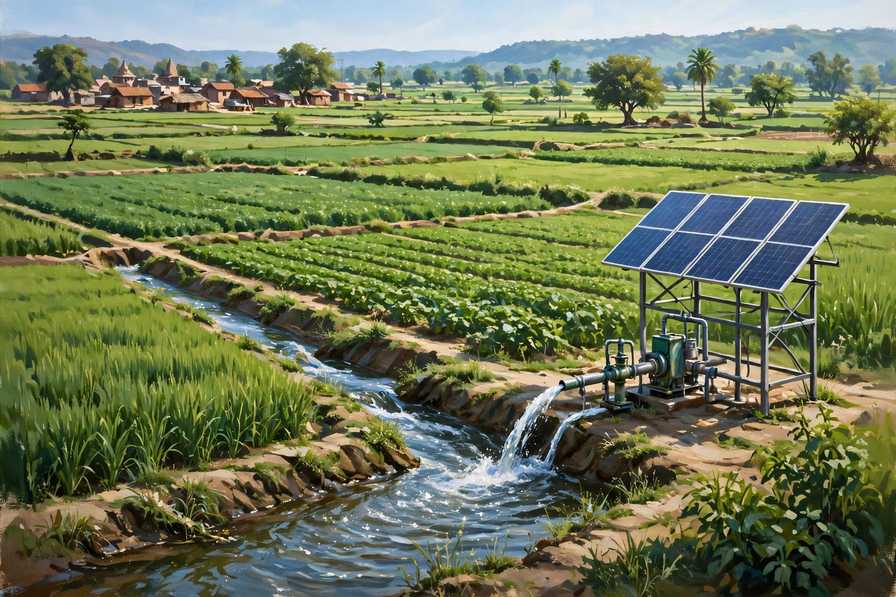
Component B is the one most farmers apply for: standalone solar pumps for farms without a grid connection. It replaces a diesel pump with a solar pump, generally up to 7.5 HP, though some states allow larger sizes up to 10 HP. If your field has no electricity connection and you run a diesel pump today, Component B is your component.
Component C is for farmers who already have a grid-connected electric pump. Under its individual-pump option, your existing pump is solarised — solar panels are installed to run it during the day, the grid stays as backup, and any surplus power you generate can be sold to the DISCOM. The feeder-level option solarises whole agricultural feeders at once. If you already pay electricity bills for a pump, Component C is the one to ask about.
A related idea worth knowing is agrivoltaics — growing crops and generating solar power on the same land — which the scheme also encourages in some states. It is a different use of the same idea, and it suits farmers with land to spare rather than farmers who only need water.
Who Can Apply for a PM-KUSUM Solar Pump?
The eligibility rules are straightforward. The applicant must be an Indian farmer who owns cultivable agricultural land, and should not be a defaulter on any bank loan. Tenant farmers can also apply if they hold a valid lease agreement or a land-use certificate that their state accepts. Farmer groups, cooperatives, panchayats and Farmer Producer Organisations can apply under Component A, where a group holds the land.
You will need a few documents ready before you start: your Aadhaar card, the land ownership document for the field where the pump will be installed, your bank account details with the passbook, a passport-size photograph, your mobile number, and your PAN card if the application asks for it. Keep the survey number of the plot and the details of your existing pump — diesel or electric — handy, because the form asks for them. Applications are usually invited in rounds by each state, so if your state's window is closed when you check, the nodal agency's notice board or the portal will show the next round.
How to Apply for PM-KUSUM Online, Step by Step
Applying online takes a little patience but no middleman. Start at the national portal, https://pmkusum.mnre.gov.in/, and look for the registration or apply section. Many states also run their own application pages through the state renewable energy department or the DISCOM, and the national portal points you to them — use whichever channel your state has notified, because that is where your application will actually be processed.
First, register on the portal with your name, mobile number and the OTP that arrives on your phone. Second, choose the component that fits you — A, B or C — and fill in the application form with your personal details, land details and pump details. Third, upload the documents listed above. Fourth, check every entry once before submitting, then submit and save the application ID or reference number you receive. That number is how you track everything afterwards.
After submission, the nodal agency verifies your land and eligibility, and officials may visit your field to check feasibility — water availability, sunlight, and whether the site suits a solar pump. Once approved, you are allocated an empanelled vendor from your district, and only vendors listed on the portal can supply the system. The vendor installs the pump and the panels, and the subsidy is settled through the official channel. You can check the status of your application on the portal by logging in with your application ID or registered mobile number. A detailed step-by-step walkthrough of the scheme is also available at https://www.bankbazaar.com/government-schemes/pm-kusum-yojana.html.
What Size Solar Pump Do You Need? HP, Water and Land
A solar pump is sized by three things: how deep your water is, how much land you need to irrigate, and how much water your crop needs. A small pump suits a shallow well and a small plot; a larger pump is needed for a deep borewell or a bigger field. Most farmers end up with a pump in the 3 HP to 7.5 HP range, with 5 HP the commonest choice for a typical small holding — but do not guess the size yourself. The feasibility visit and the empanelled vendor size the system from your borewell depth and the area you irrigate, and the benchmark cost in the subsidy is fixed per size, so an oversized pump only raises your share without helping your crop.
Think about water before you think about panels. A solar pump gives you water only while the sun shines, so it fits crops that can be irrigated during the day and fields with a storage tank or a pond to hold water for the evening. If your field needs water at night, plan storage alongside the pump. Also check the panel space: the panels need clear, unshaded ground near the pump, and they need cleaning every few weeks — dust on the panels is the commonest reason a solar pump underperforms.
Solar Pump vs Diesel Pump: What Changes on Your Farm
The change is mostly about running cost and reliability. A diesel pump needs fuel every time it runs, plus engine oil and repairs, and the price of diesel decides your irrigation cost each season. A solar pump has no fuel bill — sunlight is free — and its running cost is mainly cleaning the panels and the occasional repair. The system usually comes with several years of maintenance support through the vendor, which covers the early years when most teething problems appear.
The trade-off is timing. Diesel runs whenever you start it; solar runs when the sun is up, strongest around midday. For most crops that is fine, because daytime irrigation is the norm — but it changes the day's rhythm, and a storage tank smooths it out. The other change is independence: with a solar pump you stop waiting for the grid's schedule or the diesel dealer's price, and your irrigation cost becomes fixed at nearly zero for the life of the panels.
Common Reasons Applications Get Delayed or Rejected
Most delays are avoidable. The commonest is a land record that does not match the application — the survey number, the area or the name on the record differs from what was entered. The second is a bank account that is not linked to Aadhaar or not active, which stalls the loan and subsidy flow. The third is applying under the wrong component — for example, asking for a standalone pump when you already have a grid-connected pump, which belongs under Component C. The fourth is an incomplete document set, usually a missing land paper or a photograph that does not scan clearly. And the fifth is simply the state's round being closed — applications are taken in rounds, and applying outside a round means waiting for the next one.
If your application is stuck, check its status on the portal first, then contact your state nodal agency or the DISCOM office that handles your district, with your application ID in hand. The national helpline for the scheme is 1800-180-3333. Never pay anyone who offers to get your application approved faster — empanelment, approval and vendor allocation are all done by the nodal agency, not by agents.
Conclusion
A solar pump under PM-KUSUM is one of the few farm investments where the government pays most of the bill: 60% subsidy in most states, a 30% loan, and about 10% from the farmer's pocket. The steps are simple once you know your component — Component B if you run a diesel pump with no grid connection, Component C if you already have an electric pump, Component A if you have barren land and want rent from it. Apply on https://pmkusum.mnre.gov.in/ or your state's notified channel, keep your land record and Aadhaar-linked bank account ready, and buy only from an empanelled vendor. And remember that a pump protects your water supply, not your crop — for the crop itself, crop insurance under PMFBY is the matching safety net, and our guide explains [how to claim crop insurance under PMFBY](https://indiaask.tech/question.php?slug=how-to-claim-crop-insurance-pmfby-72-hour-rule-documents-explained) when the season turns bad.
Frequently Asked Questions
### How much subsidy do I get for a solar pump under PM-KUSUM?
In most states the central government pays 30% and the state government pays 30% of the benchmark cost — 60% together — with a bank loan for up to 30% and about 10% paid by the farmer. Some states give higher total support, so check your state nodal agency's notice for the exact figures.
### How do I apply for PM-KUSUM online?
Visit https://pmkusum.mnre.gov.in/, register with your mobile number and OTP, choose Component A, B or C, fill in your personal, land and pump details, upload your documents, and submit. Save the application ID to track your status. Some states take applications through their own renewable energy department or DISCOM portal instead.
### What is the difference between Component B and Component C of PM-KUSUM?
Component B gives you a new standalone solar pump for a farm with no grid connection, replacing a diesel pump. Component C solarises a pump you already have on grid power, so it runs on solar during the day with the grid as backup, and surplus power can be sold to the DISCOM.
### Can a tenant farmer apply for a PM-KUSUM solar pump?
Yes, if you hold a valid lease agreement or a land-use certificate that your state accepts. You will still need your Aadhaar card, bank account details and the land document for the field where the pump will be installed.
How much subsidy do I get for a solar pump under PM-KUSUM?
In most states the central government pays 30% and the state government pays 30% of the benchmark cost — 60% together — with a bank loan for up to 30% and about 10% paid by the farmer. Some states give higher total support, so check your state nodal agency's notice for the exact figures.
How do I apply for PM-KUSUM online?
Visit https://pmkusum.mnre.gov.in/, register with your mobile number and OTP, choose Component A, B or C, fill in your personal, land and pump details, upload your documents, and submit. Save the application ID to track your status. Some states take applications through their own renewable energy department or DISCOM portal instead.
What is the difference between Component B and Component C of PM-KUSUM?
Component B gives you a new standalone solar pump for a farm with no grid connection, replacing a diesel pump. Component C solarises a pump you already have on grid power, so it runs on solar during the day with the grid as backup, and surplus power can be sold to the DISCOM.
Can a tenant farmer apply for a PM-KUSUM solar pump?
Yes, if you hold a valid lease agreement or a land-use certificate that your state accepts. You will still need your Aadhaar card, bank account details and the land document for the field where the pump will be installed.