Home > Elections & Governance > When Does Pune Metro's Pink Line Open, and What Does the Rs 21,800 Crore Expansion Mean for Commuters?
When Does Pune Metro's Pink Line Open, and What Does the Rs 21,800 Crore Expansion Mean for Commuters?
By Vijay Pawar · 2026-11-03 · 6 min read · Elections & Governance
Pune Metro's Pink Line links Hinjawadi's IT hub with Shivajinagar; passenger services begin on 4 November 2026.
Key Takeaways
Pune Metro Pink Line passenger services begin on 4 November 2026, a day after PM Modi virtually inaugurated the corridor.
The 23.3 km elevated line runs from Maan to District Court, with 17 of its 23 stations opening on day one.
The Pink Line cost over Rs 8,300 crore; with Phase-II's four new corridors at Rs 13,500 crore, the total is around Rs 21,800 crore.
Fares go up to Rs 62 for journeys over 18 km, with trains every six minutes at peak hours.
Phase-II comprises Lines 2A, 2B, 4 and 4A, expanding metro connectivity across Pune.
Pune Metro Pink Line services begin for passengers on 4 November 2026, a day after Prime Minister Narendra Modi virtually inaugurated the corridor on 3 November 2026 and laid the foundation stone for four new corridors under Pune Metro Phase-II. Together, the inauguration and the foundation-stone projects are worth around Rs 21,800 crore, making this one of the largest single-day public transport announcements for Pune. For the thousands of IT professionals who travel daily between Hinjawadi and central Pune, the Pink Line is not just another metro route — it is the first direct rail link to the city's biggest employment hub.
What happened on 3 November 2026
Prime Minister Narendra Modi inaugurated Pune Metro Line 3, known as the Pink Line, through video conferencing on Tuesday, 3 November 2026, and laid the foundation stone for Phase-II of the Pune Metro network. Maharashtra Chief Minister Devendra Fadnavis also participated in the programme. The Pink Line itself was built at a cost of over Rs 8,300 crore, while Phase-II is estimated to cost around Rs 13,500 crore, taking the combined value of the projects to about Rs 21,800 crore.
The inauguration came after years of construction on the corridor, which was developed by the Pune Metropolitan Region Development Authority (PMRDA) in collaboration with the Tata Group under a public-private partnership (PPP) model. The Prime Minister had laid the foundation stone for the Hinjawadi–Shivajinagar corridor back in December 2018, so the opening marks the end of a long wait for commuters in western Pune.
Pune Metro Pink Line: route, stations and opening plan
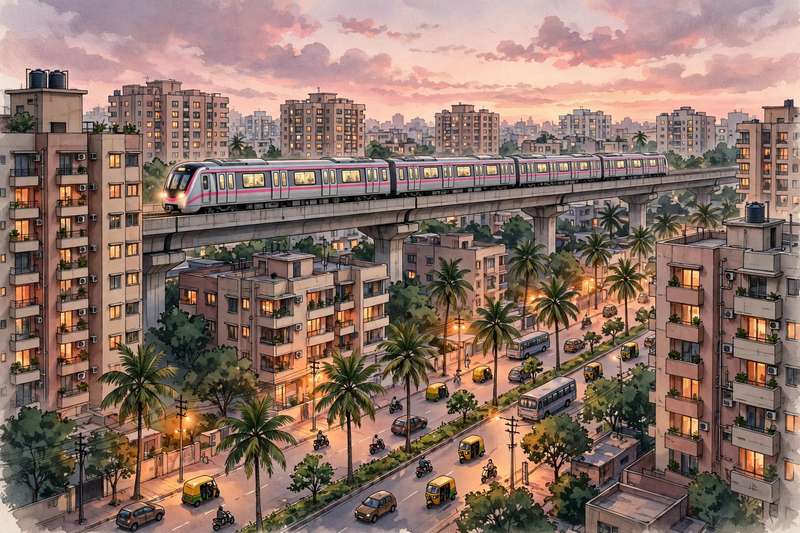
The Pune Metro Pink Line is a fully elevated corridor of about 23.3 km, running from Maan in the Hinjawadi area to District Court station in Shivajinagar, in central Pune. It passes through Wakad, Balewadi, Baner, Aundh and the Savitribai Phule Pune University area, covering the residential, commercial and office belt along which much of western Pune's daily traffic moves.
The corridor has 23 stations in total, but passenger services will not open at all of them on day one. Seventeen stations will be operational from 4 November 2026, with the first train departing from Maan at 6 am. The remaining six stations are scheduled to open in phases, with some expected by the end of November 2026 and the rest between January and March 2027. At District Court station, the Pink Line connects with MahaMetro's Line 1 (Pimpri-Chinchwad to Swargate) and Line 2 (Vanaz to Ramwadi), so passengers can change lines to reach other parts of the city.
In a first-of-its-kind initiative, the entire Pink Line will be operated by women train operators, according to the Press Information Bureau. The line is also expected to cut the Maan to District Court journey to around 45 minutes, compared with one-and-a-half hours or more by road during peak hours on the congested Baner–Balewadi–Hinjawadi stretch.
Pune Metro Pink Line fare and timings
Because the Pink Line is being developed under a PPP model, unlike the government-funded existing Pune Metro network, its fares have been fixed under the concession agreement and are higher than the existing network's fares. Passengers travelling more than 18 km will pay Rs 62, compared with the existing maximum fare of Rs 35 on Pune Metro. The fare structure is to be reviewed after six months, according to the operator's chief executive.
Trains will run at intervals of six minutes during peak hours and 12 minutes during non-peak hours. The last train from Maan towards District Court will depart at 10:30 pm, while the last train from District Court towards Maan will leave at 11:40 pm. Commuters should confirm timings on the official Pune Metro app or at their station before travelling, as opening-week schedules can change.
What is Pune Metro Phase-II?
Alongside the Pink Line opening, the Prime Minister laid the foundation stone for Phase-II of Pune Metro, estimated at around Rs 13,500 crore. Phase-II comprises four new corridors — Lines 2A, 2B, 4 and 4A — which will substantially expand the metro network and strengthen connectivity across important residential, commercial and IT hubs in the city.
Phase-II is about the next decade of Pune's growth, not just the next few stations. Pune's population and its IT and manufacturing employment have grown faster than its roads, and the city's planners have bet that only a larger metro network can keep daily commuting workable. The four new corridors are meant to link the older and newer parts of Pune, so that the Pink Line is the start of a network rather than a single line serving one corridor.
Why the Pink Line matters for Pune
Hinjawadi is Pune's largest IT hub, home to the Rajiv Gandhi Infotech Park and thousands of technology workers. Until now, reaching it from central Pune has meant depending on buses, company cabs and private vehicles on roads that clog badly at peak hours. A direct metro link changes that calculation in three ways.
First, it gives Hinjawadi's workforce a predictable commute. A 45-minute metro ride that runs every six minutes at peak hours is far easier to plan around than a road journey that can vary by an hour. Second, it takes pressure off the roads themselves: every commuter who shifts to the metro is one fewer car or two-wheeler on the Baner–Balewadi–Hinjawadi corridor. Third, it supports the areas along the route — Wakad, Balewadi, Baner and Aundh — whose housing and commercial growth has outpaced their transport links.
The line is expected to carry two to two-and-a-half lakh passengers a day once fully operational, according to local reporting. That figure will be the real test of the project: inauguration-day headlines fade, but daily ridership decides whether the Pink Line genuinely changes how Pune travels.
What commuters should watch next
The most important dates after the inauguration are the phased openings of the remaining six stations, expected in stages through early 2027, and the six-month fare review. Commuters should also watch how the interchange at District Court works in practice, since the Pink Line's value depends on smooth connections to MahaMetro's Lines 1 and 2.
It is also worth remembering that this is one part of a wider rail push. India has been expanding metro networks and announcing new rail corridors in the same week — the [Delhi to Guwahati bullet train corridor](https://indiaask.tech/question.php?slug=delhi-guwahati-bullet-train-north-corridor-explained) was approved days earlier, and cities such as Delhi are tightening [vehicle and pollution rules](https://indiaask.tech/question.php?slug=delhi-new-pollution-rules-november-1-2026-explained) to push commuters towards public transport. Pune's Pink Line fits that pattern: more rail capacity, offered as the alternative to cars.
For the full official picture, see the reporting by [NDTV on the inauguration](https://www.ndtv.com/india-news/pm-narendra-modi-inaugurates-pune-metros-pink-line-launches-rs-21-800-crore-projects-12275479/amp/1) and [The Economic Times on the Pink Line and Phase-II corridors](https://economictimes.indiatimes.com/industry/transportation/railways/pm-narendra-modi-inaugurates-pune-metros-23-km-pink-line-lays-foundation-for-four-new-corridors/articleshow/135487914.cms), and the route and station details in [The Financial Express](https://www.financialexpress.com/business/infrastructure-pune-metro-line-3-to-open-on-november-3-check-route-all-23-stations-and-key-benefits-4373860/).
Related reading on IndiaAsk: the [Delhi to Guwahati bullet train corridor](https://indiaask.tech/question.php?slug=delhi-guwahati-bullet-train-north-corridor-explained) and [Delhi's new pollution rules from November 1, 2026](https://indiaask.tech/question.php?slug=delhi-new-pollution-rules-november-1-2026-explained).
When does the Pune Metro Pink Line open for passengers?
Passenger services on the Pune Metro Pink Line begin on 4 November 2026, a day after its virtual inauguration by Prime Minister Narendra Modi on 3 November 2026. The first train departs from Maan at 6 am.
Which stations does the Pune Metro Pink Line cover?
The Pink Line runs about 23.3 km from Maan to District Court station, passing through Hinjawadi, Wakad, Balewadi, Baner, Aundh and Savitribai Phule Pune University. It has 23 stations in total, of which 17 open on day one and six follow in phases.
What is the fare on the Pune Metro Pink Line?
Passengers travelling more than 18 km will pay Rs 62, higher than the existing Pune Metro maximum of Rs 35, because the Pink Line is built under a public-private partnership model. Fares are due for review after six months.
What are the four new corridors in Pune Metro Phase-II?
Phase-II comprises Lines 2A, 2B, 4 and 4A, estimated to cost around Rs 13,500 crore. Together with the Pink Line, the projects announced on 3 November 2026 are worth around Rs 21,800 crore.