Home > Elections & Governance > Why Did Aga Ruhullah Resign From the National Conference and the Lok Sabha?
Why Did Aga Ruhullah Resign From the National Conference and the Lok Sabha?
By Vijay Pawar · 2026-11-04 · 11 min read · Elections & Governance
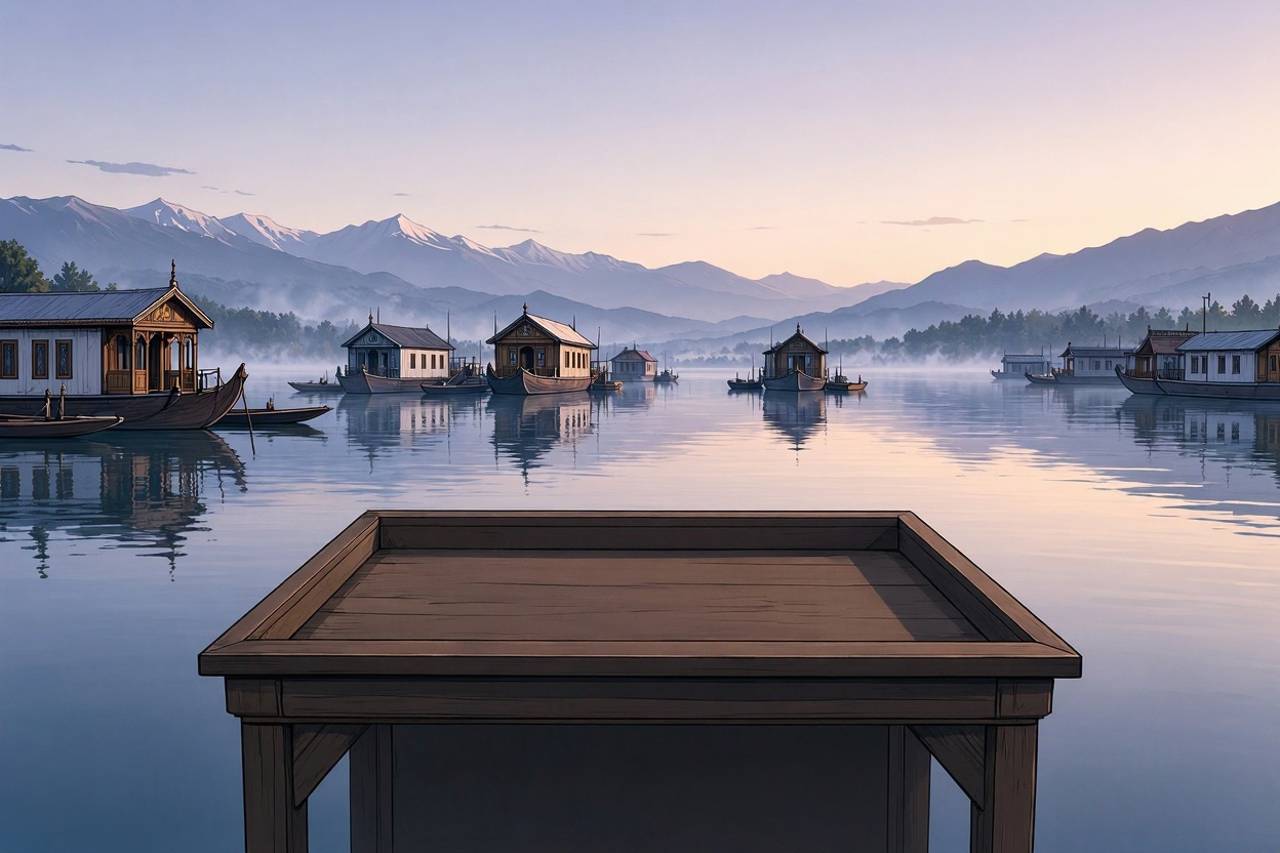
Editorial illustration: Srinagar's Dal Lake with houseboats and Himalayan mountains at dawn, an empty podium silhouette in the foreground — no text, no logos, no real person.
Key Takeaways
Srinagar MP Aga Syed Ruhullah Mehdi announced on 3 November 2026 that he was resigning from the National Conference and the Lok Sabha, ending a 24-year association.
His stated reason: the NC betrayed its 2024 mandate by abandoning the fight for Article 370 restoration, and failed on reservation, political prisoners and free electricity.
He signed the party resignation at a Budgam rally and gave it to Mohammad Ashraf Mattoo to forward to Farooq Abdullah, and emailed his Lok Sabha resignation to Speaker Om Birla.
The NC accused him of opportunism and said he resigned only after being told to by the party president — a version Ruhullah disputes.
Once the Speaker accepts the resignation, the Srinagar seat falls vacant and a by-election will test whether voters back Ruhullah or the party he left.
Why did Aga Ruhullah resign from the National Conference and the Lok Sabha? The Srinagar MP answered that question himself on 3 November 2026, when he announced his resignation from both the party and Parliament at a rally in Budgam, ending a 24-year association with the National Conference (NC). His stated reason was blunt: he accused the NC leadership of betraying the mandate voters gave the party in the 2024 Jammu and Kashmir Assembly elections, above all by abandoning the fight for the restoration of Article 370 and the constitutional guarantees that came with it.
The announcement, made on the 26th death anniversary of his father, Aga Syed Mehdi, immediately became one of the most searched political stories in India, with reported Google Trends data showing search interest in Ruhullah surging by more than 5,000 per cent over the preceding week. This explainer sets out what happened, why Ruhullah says he quit, how the National Conference has responded, and what happens next for the Srinagar Lok Sabha seat.
What happened: resignation announced at Budgam rally
Addressing supporters at Behisht-e-Zehra Park in Budgam on 3 November 2026, Aga Syed Ruhullah Mehdi signed a two-page resignation letter from the National Conference from the podium itself. He did not hand it directly to the party leadership. Instead, he gave it to Mohammad Ashraf Mattoo and asked him to forward it to NC president Farooq Abdullah. Mattoo's 17-year-old son, Tufail Ahmad Mattoo, was killed in 2010 after being hit by a tear gas shell during protests in Omar Abdullah's earlier tenure as chief minister — a symbolism Ruhullah deliberately invoked, calling his resignation a "decree of freedom" from what he described as a deceitful organisation.
Ruhullah also announced his resignation from the Lok Sabha, saying he would email his resignation letter to Speaker Om Birla. In that letter, as reported by The Telegraph, he said his resignation was "voluntary and genuine, and is tendered of my own free will". He was elected to the Lok Sabha from Srinagar on an NC ticket in 2024, so quitting the party alone would not have ended his parliamentary tenure — resigning the seat as well was a deliberate choice, framed by his office as surrendering a seat won on a promise to the people rather than continuing as, in its words, an accomplice to that promise's betrayal.
The speech lasted around 80 minutes, according to reports of the rally, and ended with Ruhullah hinting at a new political direction. He said he was more interested in launching a movement for the restoration of dignity and respect for the people of Jammu and Kashmir than in immediately forming a party, though he also spoke of finding honest, compassionate young people willing to lead that struggle. Some reports said he hinted at a new political outfit; his own emphasis, as carried in the coverage, was on a movement rather than a party launch.
Why did Aga Ruhullah resign? Article 370 at the centre
At the centre of Ruhullah's case is Article 370, the constitutional provision that gave Jammu and Kashmir special status within India until it was abrogated on 5 August 2019, along with Article 35-A, when the former state was also reorganised into two Union Territories. Ruhullah argued that the NC sought votes in the 2024 Assembly elections in the name of protecting Jammu and Kashmir's constitutional rights, won a massive mandate on that anger and emotion, and then failed to pursue those commitments after coming to power under Chief Minister Omar Abdullah.
In his telling, the party's goalposts shifted. He accused Omar Abdullah of repeatedly assuring him that the fight was not merely for the restoration of statehood but for Article 370 and constitutional guarantees, and then changing course in government. "All the posturing during elections about restoring Article 370, releasing prisoners, and providing free electricity were just lies. And I cannot continue to be a part of these lies anymore," he said, as reported by The Telegraph. He also attacked what he called the chief minister's approach to the Centre, criticising him for going to the Prime Minister and Home Minister with shawls after winning the election, and asking: "How would a BJP government in Jammu and Kashmir look any different from the one we have?"
Three other issues fed the break, and all of them had already spilled into public view before November:
- **Reservation policy:** Ruhullah had openly challenged his own party government's handling of reservation in Jammu and Kashmir, including after he accompanied students protesting over representation in the open merit category in education and jobs.
- **Political prisoners:** The release of political prisoners was one of the promises he listed as unfulfilled, alongside Article 370 and free electricity.
- **Everyday promises:** He cited the rationalisation of reservation and 200 units of free electricity as part of the manifesto fight that, in his words, the government had forgotten once in office.
Ruhullah also gave a personal account of how the rift developed. He said he began questioning the party leadership after the abrogation of Article 370, alleging that sections of the leadership were more concerned about restoring 4G internet services, holding elections and securing leaders' release than mounting a political challenge. He further claimed that Farooq Abdullah had asked him to resign, suggesting the party president was under family pressure — a claim reported by ETV Bharat before the rally and one the NC has disputed in its response. Readers should treat that particular claim as Ruhullah's account, not as an agreed fact, since the two sides tell this part of the story differently.
How the National Conference responded
The National Conference reacted sharply. In a statement reported by The Telegraph, the party accused Ruhullah of hypocrisy, political opportunism, self-obsession and betraying the party that shaped his political career. It questioned what concrete initiatives he had taken in Parliament for the restoration of special status, statehood and reservation rights, and asserted that the restoration of statehood would never come at the expense of special status, which it said remained the foundation of its over 90-year-old political legacy.
Crucially, the NC offered a different explanation for the timing. It said Ruhullah had only remembered to resign when he was told to by the party president — in other words, that this was not a principled exit freely chosen, but a resignation that followed the leadership's own direction. That directly contradicts Ruhullah's framing of a voluntary break, and the truth of that dispute may never be fully settled in public. What is not in dispute is the depth of the split: a sitting NC MP publicly accusing the party's father-son leadership of betrayal, and the party publicly questioning his contribution and motives, leaves little room for reconciliation.
The resignation also lands at a difficult moment for the NC government, which has faced reports of discontent among a section of its MLAs over a recent cabinet expansion. Ruhullah's exit gives that discontent a prominent public voice — and a potential rallying point outside the party.
Background: who is Aga Ruhullah, and why does his voice matter?
Ruhullah is not a marginal figure in Kashmir politics. He is an influential Shia leader from Budgam, a former minister, and a politician whose strong stand on Article 370 helped the NC score an emphatic win in the 2024 Assembly elections, according to The Telegraph's analysis. His father, Aga Syed Mehdi, was a Congress leader assassinated in an IED blast in his home constituency in 2000 — which is why Ruhullah chose his father's death anniversary for the announcement, and why the rally carried the banner line, in Urdu and English, "A promise is greater than the chair. Resignation in November."
His importance also lies in the constituency he represented. Srinagar-Budgam is the political heart of the Kashmir Valley, and Ruhullah's appeal cut across the usual party lines precisely because he spoke about dignity, rights and constitutional guarantees in moral rather than purely administrative terms. When such a figure says the party has "surrendered" to the Centre and reduced its politics to what he called "mere governmentality" — running a government rather than leading a struggle — the charge stings because it comes from inside the NC's own tent.
That is also why the story travelled so fast online. Search interest in Ruhullah surged by more than 5,000 per cent in the week before 4 November, according to Google Trends figures cited by Greater Kashmir and other outlets, with Jammu and Kashmir recording the highest interest, followed by Bihar, Delhi and Uttar Pradesh. Trends data measures relative interest, not the absolute number of searches, and it is not a measure of public support — but it does show how quickly a regional resignation became a national talking point.
What happens next: the Srinagar seat and Kashmir politics
The immediate procedural question is straightforward. Ruhullah has sent his resignation to the Lok Sabha Speaker; once the Speaker accepts it, the Srinagar seat falls vacant. A vacancy in the Lok Sabha is then filled through a by-election called by the Election Commission, and that contest will become the first electoral test of Ruhullah's break with the NC. Readers who want the basics of how Lok Sabha seats, voting and results work can read our explainer on [Lok Sabha elections in India](https://indiaask.tech/question.php?slug=lok-sabha-elections-india), and our coverage of [how election polling and results play out in practice](https://indiaask.tech/question.php?slug=andhra-pradesh-municipal-elections-2026-polling-explained) shows why by-election dates and turnout matter.
Politically, three things are worth watching. First, whether Ruhullah launches a movement or a party, and whether it attracts the young, educated Kashmiris who backed his reservation stand. A movement can keep pressure on the NC without the burden of contesting elections; a party would split the Valley's vote and could change the arithmetic of the next Assembly election. Second, how the NC handles the wider discontent in its ranks: if more leaders echo Ruhullah's Article 370 argument, Omar Abdullah's government will face a legitimacy question, not just a management one. Third, how the Centre responds. The BJP has distanced itself from the development, but any claim — such as the one attributed to BJP leader Ram Madhav that Ruhullah held the rally with the blessings of "our people" — will be read in Kashmir as a signal, and the NC will use it to paint Ruhullah as compromised. Ruhullah, for his part, has said Kashmir will speak to the Centre on its own terms, not on an agenda set by others.
For ordinary voters in Srinagar, the practical consequence is simpler: they will soon be asked to elect a new MP, and the campaign will almost certainly be fought on the same question Ruhullah raised — whether the 2024 mandate was for running a government within the present constitutional arrangement, or for continuing a struggle to restore what was taken away in 2019. That is a question no resignation letter can settle, but it is now the central question in Kashmir politics.
What the verified record does and does not show
Two cautions matter for readers following this story. First, several details are contested between Ruhullah and the NC — above all, whether he quit freely or after being told to go, and whether his parliamentary record matches his rhetoric. This article reports both sides' claims as claims, not as settled facts. Second, the resignation from the Lok Sabha takes effect through the Speaker's acceptance; until that process completes, the formal vacancy follows the usual parliamentary procedure rather than the rally announcement alone. What is verified by multiple major outlets — News18, The Telegraph, The Indian Express and The Quint — is the core event: on 3 November 2026, Srinagar MP Aga Syed Ruhullah Mehdi publicly resigned from the National Conference and announced his resignation from the Lok Sabha, accusing the leadership of betraying its promises on Article 370, statehood, reservation and prisoners. That core, reported by [News18](https://www.news18.com/india/omar-farooq-betrayed-people-aga-ruhullah-quits-national-conference-resigns-as-lok-sabha-mp-jammu-and-kashmir-10410810.html) and [The Telegraph](https://www.telegraphindia.com/amp/india/aga-ruhullah-resigns-from-national-conference-over-article-370-restoration-dispute-prnt/cid/2187730), is the foundation of this explainer.
Conclusion
Why did Aga Ruhullah resign? In his own words, because he could no longer remain part of a party that, in his view, sought votes on the promise of restoring Article 370 and constitutional dignity, then governed as if that promise did not matter. The National Conference calls that account opportunistic and self-serving, and says he left only after being told to. Between those two versions lies the real significance of the resignation: it has turned a long-simmering argument inside Kashmir's ruling party into an open political contest over what the 2024 mandate meant. The Srinagar by-election, and whatever movement Ruhullah builds next, will show whether voters agree with him — or with the party he just left.
Aga Syed Ruhullah Mehdi, the Srinagar MP, announced on 3 November 2026 at a rally in Budgam that he was resigning from the National Conference and from the Lok Sabha, ending a 24-year association with the party.
Why did Aga Ruhullah resign from the National Conference?
He accused the NC leadership, including Chief Minister Omar Abdullah and president Farooq Abdullah, of betraying the 2024 Assembly election mandate by abandoning the fight for the restoration of Article 370 and constitutional guarantees, and of failing on promises about reservation, political prisoners and free electricity.
Does the National Conference accept Ruhullah's version of events?
No. The NC accused him of hypocrisy, political opportunism and self-obsession, questioned his parliamentary contribution, and said he only resigned after being told to by the party president. Ruhullah says his resignation was voluntary and genuine.
What happens to the Srinagar Lok Sabha seat now?
He sent his resignation to Lok Sabha Speaker Om Birla. Once the Speaker accepts it, the Srinagar seat falls vacant and the Election Commission can call a by-election.