Home > Elections & Governance > Automatic Emergency Braking in All New Cars From 2030? India's Draft Rules Explained: Dates, Trucks, Taxis and What It Means for Buyers
Automatic Emergency Braking in All New Cars From 2030? India's Draft Rules Explained: Dates, Trucks, Taxis and What It Means for Buyers
By IndiaAsk Editorial Team · 2026-10-26 · 8 min read · Elections & Governance
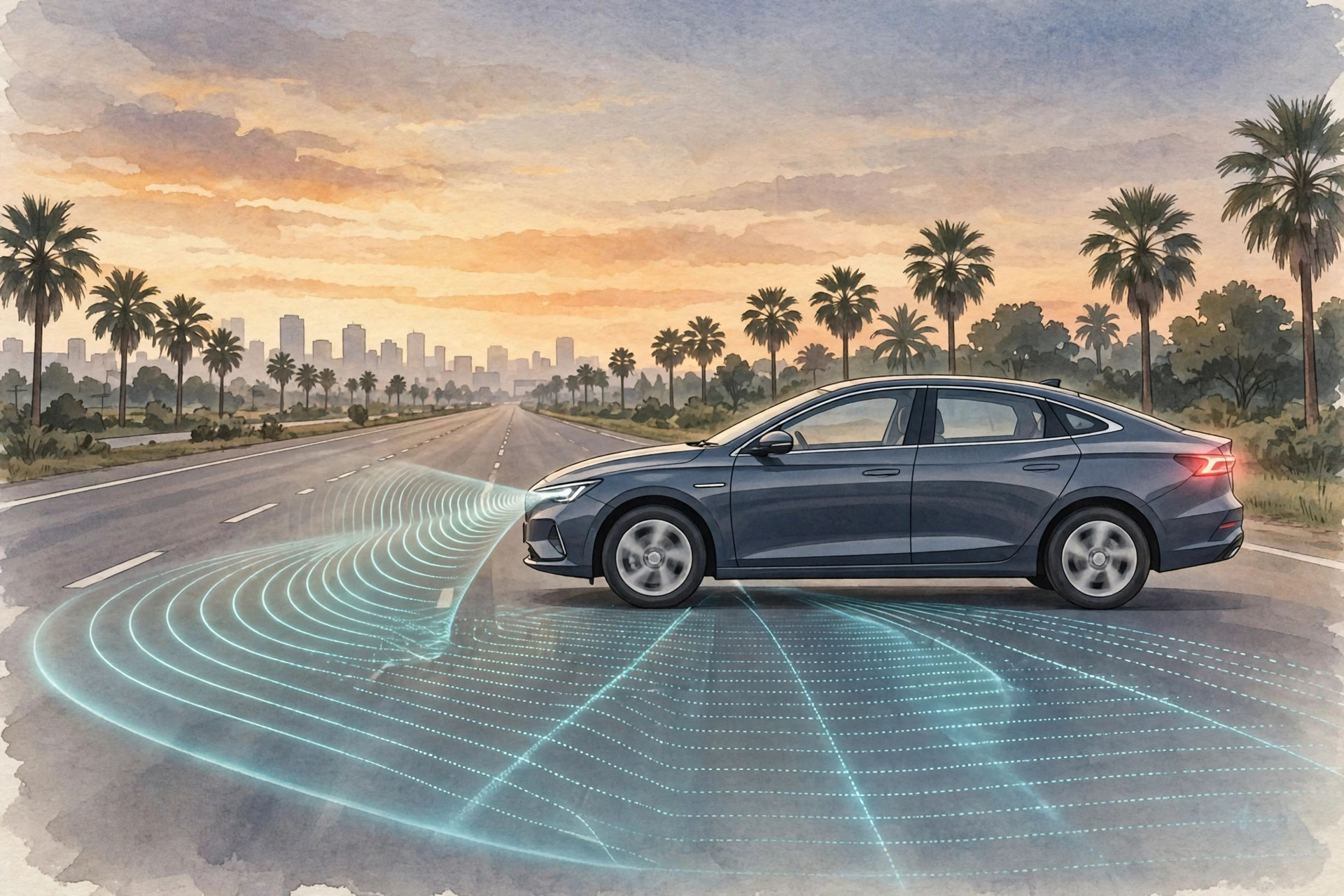
Editorial illustration: a modern passenger car on a highway at dusk, with sensor waves fanning out from the front of the car toward the road ahead.
Key Takeaways
MoRTH has issued a draft notification proposing AEBS as standard on passenger cars, amending the Central Motor Vehicles Rules, 1989; it is a proposal, not yet final law.
New M1 car models will need AEBS conforming to AIS-185 from 1 October 2030, and all M1 models including existing ones from 1 October 2032.
From 1 October 2028, M1 and N1 vehicles already offered with AEBS will have to comply with AIS-185.
The draft also proposes ESC for trucks from 1 October 2027 and mandatory steering and lane-keeping systems for taxis from 1 October 2029.
The push is linked to 5.13 lakh road accidents in 2025 and the goal of halving road accidents and fatalities by 2030.
What has been proposed
The Ministry of Road Transport and Highways (MoRTH) has issued a draft notification proposing that Advanced Emergency Braking Systems (AEBS) become standard on passenger cars in India. The draft, reported as released on 19 October 2026, would amend the Central Motor Vehicles Rules, 1989, and it sets out a phased timetable rather than a single switch-on date.
This is important to state plainly at the start: this is a draft proposal, not yet a final law. The ministry will take objections and suggestions for 30 days from the date the notification is made available to the public through the Gazette of India, and the proposed requirements remain subject to consultation and the rule-making process before they are finalised. Nothing in the reported draft changes what a car buyer must do today, and no existing car owner is being asked to retrofit a system.
What is AEBS, in simple terms
AEBS is an advanced driver assistance feature that uses cameras, radar or other sensors to watch the road ahead. If it detects a possible collision with a vehicle, a pedestrian, a two-wheeler or another obstacle, and the driver does not react in time, it first warns the driver and then applies the brakes automatically. Depending on the situation, that can avoid a crash altogether or reduce how severe the impact is.
It is not self-driving, and it is not a substitute for paying attention. Its performance can vary with road conditions, visibility, sensor limitations and the type of obstacle. A system that is too sensitive can also brake unexpectedly, which is why tuning it for Indian road and traffic conditions matters as much as fitting the hardware.
The timetable: the dates that matter
The draft covers M1-category vehicles, which means passenger vehicles with up to eight seats in addition to the driver. That takes in most cars and SUVs on sale today.
The key dates reported from the draft are:
- From 1 October 2028, M1 passenger vehicles and N1 light goods vehicles (goods vehicles up to 3.5 tonnes) that are already offered with AEBS will have to comply with AIS-185, the Automotive Industry Standard for the system. In other words, cars that already have the feature will first have to meet one common standard, even before fitment becomes compulsory.
- From 1 October 2030, all newly introduced M1 car models will need AEBS conforming to AIS-185 as standard equipment.
- From 1 October 2032, the requirement will extend to every M1 model, including models already in production. Manufacturers therefore get two extra years to bring their existing line-up into line.
That two-step approach is deliberate. It gives carmakers time to redesign models that were planned before the rule, while ensuring that no brand-new model launched after 2030 can skip the technology.
What about trucks, taxis and steering
The draft goes beyond passenger-car braking. Several related proposals were reported alongside it:
- From 1 October 2027, Electronic Stability Control (ESC) systems conforming to AIS-162 will become mandatory for trucks, as part of tighter braking standards for medium and heavy-duty vehicles.
- From 1 October 2027, steering effort on all motor vehicles will have to conform to AIS-193, with motorcycles and three-wheelers without a steering wheel exempted. Cars offered with Automatic Command Steering Functionalities (ACSF) will need to meet the same standard, while cars offered with an Emergency Lane Keeping System (ELKS), commonly known as Lane Keeping Assist, will have to comply with AIS-191 (Part 1).
- From 1 October 2029, both ACSF and ELKS will become mandatory on M1 vehicles registered as transport vehicles, which mainly means taxis. Reports also say taxis will need drowsiness and attention-warning systems from the same date.
Taken together, the draft is not just about one feature. It is a staged move towards a common set of driver-assistance standards across cars, taxis and trucks.
Why the government is pushing this now
Road safety is the stated reason, and the numbers behind it are stark. Government records cited in reporting on the proposal put road accidents in India at 5.13 lakh in 2025. Road Transport and Highways Minister Nitin Gadkari has repeatedly said the government is targeting a 50 percent reduction in road accidents and fatalities by 2030.
AEBS fits that goal directly. A large share of crashes involves a driver reacting too late to something ahead, whether in city traffic, on a highway, or at a junction. A system that brakes a fraction of a second earlier will not prevent every crash, but across millions of vehicles it can reduce both the number of collisions and how serious they are.
There is also a timing logic. Driver-assistance technology is no longer experimental. It is already available in many cars, but in India it is still mainly found in cars above about Rs 9 lakh. Reporting on the draft notes that the Honda Amaze, Maruti Suzuki Baleno and Toyota Glanza are among the most affordable cars that currently offer ADAS features. Making AEBS standard would push the technology down into the mass market, where most buyers actually shop.
Earlier this year, the ministry also proposed making Vehicle-to-Vehicle (V2V) communication systems mandatory on all new vehicles from 1 October 2028. That proposal, like the AEBS draft, points in the same direction: cars that can sense danger and communicate about it, rather than relying on the driver alone.
What this means for car buyers
For someone buying a car today, the draft changes nothing immediately. A car bought in 2026 or 2027 does not suddenly become illegal, and there is no retrofit requirement in the reported draft for cars already on the road.
For someone planning a purchase closer to 2030, the picture is different. Any genuinely new model launched from 1 October 2030 should come with AEBS as standard, and by 2032 every model on sale should have it. That means a buyer in the early 2030s will not need to pay extra for a top variant just to get automatic emergency braking, as is often the case today.
There are still open questions that the final rules will need to answer. The draft summaries published so far do not put a figure on how much AEBS will add to the price of a small car, and manufacturers will have to decide how much of that cost they absorb and how much they pass on. Buyers should also ask how a system behaves in Indian conditions: heavy rain, dust, poorly marked lanes, mixed traffic with pedestrians, cyclists, two-wheelers and stray animals, and stop-start city traffic. A system tuned only for clear highways will be less useful, and potentially more annoying, than one tested for these conditions.
The sensible approach for buyers remains the same. Treat AEBS as a safety net, not as permission to look away from the road. Check whether a car has it, ask what it can and cannot detect, and test how its warnings feel on a test drive. A warning that is too late, too quiet or too frequent will be ignored, which defeats the purpose.
What this means for manufacturers and the industry
For manufacturers, the timetable is the main message. The 2028 AIS-185 compliance step means that even before fitment is compulsory, any car sold with AEBS must meet the national standard. That removes the current situation where different brands can use different definitions of what counts as emergency braking.
The 2030 and 2032 dates then give a clear runway. New platforms can be designed with the sensors, wiring and software from the start, which is cheaper and more reliable than adding them later. Existing models get a two-year grace period, but they cannot stay exempt forever.
Suppliers of cameras, radar, software and testing facilities will also be affected, because demand for AIS-185-compliant systems will rise sharply as the deadlines approach. The taxi and truck provisions add a second wave of demand, for lane-keeping, steering assistance, stability control and driver-monitoring systems.
What happens next
The next step is consultation. Stakeholders, including manufacturers, suppliers, road-safety experts and ordinary citizens, can send objections and suggestions during the 30-day window. The ministry will then decide on the final rules, and it is possible that dates, categories or technical standards change before finalisation.
Until the final notification is published, the correct way to describe this is as a proposal with a clear timetable, not as a settled requirement. Anyone claiming that AEBS is already compulsory for all new cars, or that a particular model is already breaking the law by not having it, is getting ahead of the facts.
Conclusion
India's draft AEBS rules, if finalised as reported, would make automatic emergency braking a standard feature of every new passenger car from 2030, and of every model on sale from 2032, with common standards from 2028 and parallel rules for trucks and taxis. The goal is a measurable one: fewer crashes and fewer deaths on roads that currently see more than five lakh accidents a year.
The proposal will not by itself fix road safety. Driver behaviour, road design, enforcement, vehicle maintenance and emergency care all matter just as much. But a braking system that acts when a human cannot act fast enough is a practical, proven safety net, and making it standard rather than a luxury extra is a significant shift for the Indian car market. The coming consultation period will decide whether the timetable survives intact, and buyers, manufacturers and safety experts will all be watching what the final rules say.
Frequently Asked Questions (FAQ)
From when will automatic emergency braking become mandatory in new cars in India?
Under the draft, all newly introduced M1 passenger car models will need AEBS conforming to AIS-185 from 1 October 2030, and every M1 model, including models already in production, will need it from 1 October 2032. From 1 October 2028, cars already offered with AEBS will first have to comply with AIS-185.
How does an Advanced Emergency Braking System work?
AEBS uses cameras, radar or other sensors to detect a possible collision ahead. If the driver does not react in time, it warns the driver and then applies the brakes automatically, which can avoid a crash or reduce its severity. It is a safety net, not self-driving, and its performance can vary with road conditions, visibility and sensor limits.
Is AEBS already compulsory, and do existing car owners need to retrofit it?
No. The draft is a proposal, not yet a final law. The ministry will take objections and suggestions for 30 days, and the proposed requirements remain subject to consultation and rule-making before finalisation. The reported draft is about new vehicles manufactured from the stated dates, not a retrofit order for cars already on the road.
What else does the draft propose for trucks and taxis?
Alongside AEBS, the draft proposes Electronic Stability Control conforming to AIS-162 for trucks from 1 October 2027, steering standards from 2027, and, for M1 transport vehicles such as taxis, mandatory Automatic Command Steering Functionalities and Emergency Lane Keeping Systems from 1 October 2029, along with drowsiness and attention-warning systems.