Home > Elections & Governance > BJP's Nationwide Protest on 26 October Explained: What Kharge Said in Patna and Why It Sparked a Row
BJP's Nationwide Protest on 26 October Explained: What Kharge Said in Patna and Why It Sparked a Row
By IndiaAsk Editorial Team · 2026-10-26 · 6 min read · Elections & Governance
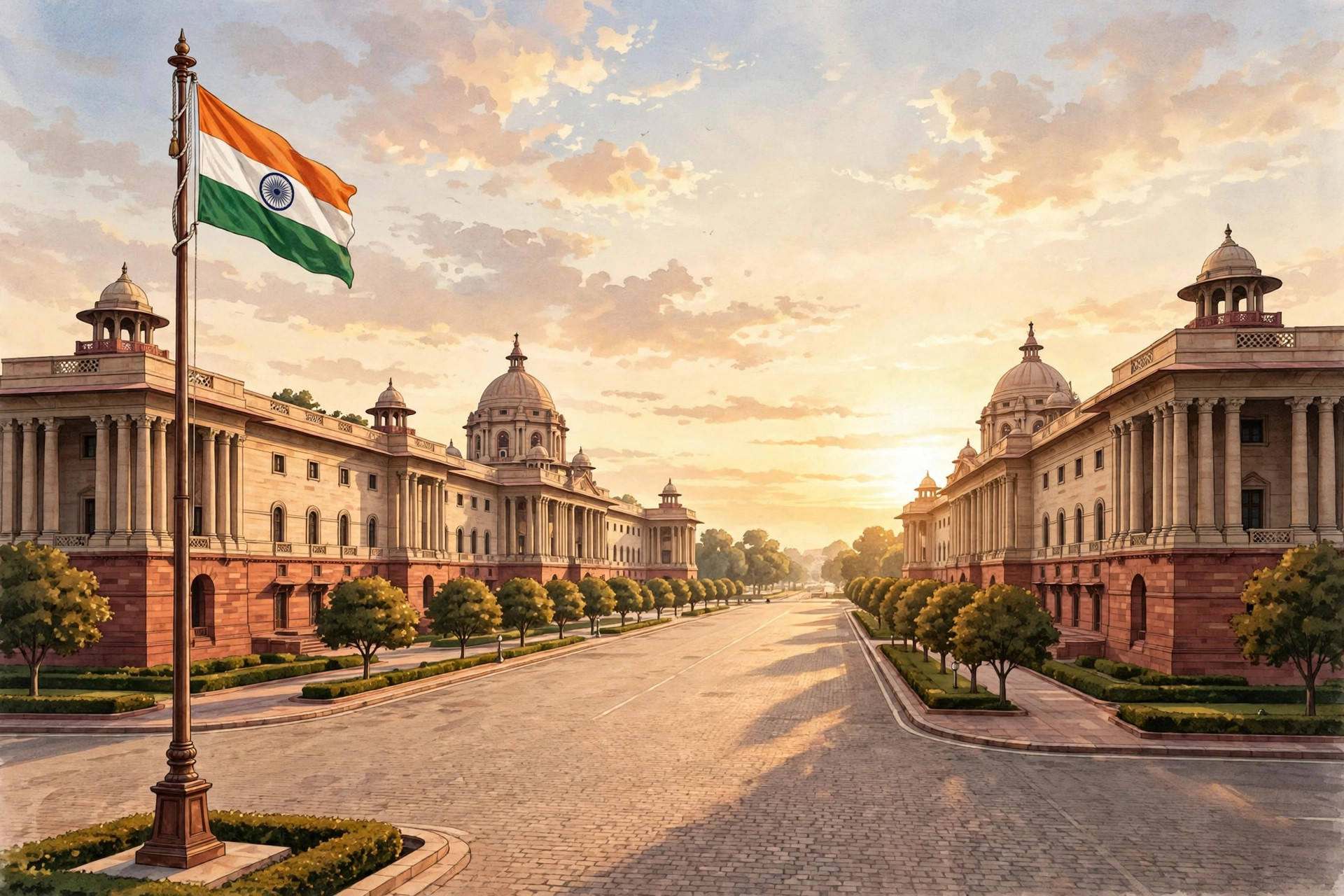
Editorial illustration: a crowd holding plain flags before government buildings in New Delhi, the setting for the BJP's nationwide protests announced on 25 October 2026.
Key Takeaways
The BJP announced nationwide protests for 26 October 2026 after Congress president Mallikarjun Kharge's remark about Prime Minister Narendra Modi's late father at a Patna event on 25 October.
Kharge's 'Modi ka baap bhi jayega' retort came after an audience member shouted that Modi would not go anywhere without a rebellion, during a speech about alleged irregularities in the SIR electoral-roll revision process.
The BJP called the remark insulting, indecent and offensive, with Amit Shah saying Kharge had torn apart all norms of decorum, and announced demonstrations at state headquarters across the country.
The Bihar BJP also planned a protest march and effigy burning in Patna, and the Delhi BJP's demonstration was reported for around noon on Monday.
Congress leaders defended the remark as figurative language; the dispute is over interpretation, while the underlying argument about electoral rolls continues.
The Bharatiya Janata Party (BJP) has announced nationwide protests on Monday, 26 October 2026, against Congress president Mallikarjun Kharge over remarks he made about Prime Minister Narendra Modi during an event in Patna a day earlier. The party said demonstrations would be held at state headquarters across the country, with the Bihar unit also planning a protest march and effigy burning in Patna.
The announcement, reported by PTI and carried by The Hindu, Deccan Herald and ThePrint on the evening of 25 October, turns a single exchange at a public meeting into a national political confrontation. It also shows how quickly a remark made on a stage in Bihar can become the centre of the national news cycle, especially when it touches on the Prime Minister's family.
What exactly was said in Patna
Kharge was speaking in Patna on Sunday, 25 October 2026, at a programme marking the 139th birth anniversary of Shrikrishna Singh, Bihar's first chief minister. During his speech, he raised alleged irregularities in the SIR process — the Special Intensive Revision of electoral rolls — and said the Congress would send those responsible to jail if it returned to power.
At that point, a member of the audience interrupted, shouting that as long as there was no rebellion, Prime Minister Modi would not go anywhere. Kharge retorted from the dais: "Modi ka baap bhi jayega" — rendered in English as "even Modi's father would go".
The remark was aimed, in context, at the heckler's claim that Modi was immovable. But because it named the Prime Minister's late father, it was heard very differently by the BJP, which treated it as a personal attack rather than a political jibe. The exchange was reported in near-identical terms by PTI, The Hindu and Times Now, all of which quoted the remark and the interruption that preceded it.
How the BJP responded
The BJP's reaction was swift and came from the top of the party. Union Home Minister Amit Shah said Kharge had "torn apart all norms of decorum". BJP president Nitin Nabin said the language reflected the Congress's "ideological bankruptcy" and accused the opposition of increasingly resorting to personal attacks against Modi and his family.
In a statement quoted by PTI, the BJP said: "In protest against the insulting, indecent, and offensive remarks made by the Congress national president in Patna regarding Prime Minister Narendra Modi's late father, the BJP will stage strong demonstrations tomorrow (Monday) across all state headquarters in the country."
The party framed the protests as a response to what it called the Congress's "gaali politics" — abusive politics — and said the demonstrations would be aimed at opposing remarks it described as insulting and unparliamentary. The BJP's Delhi unit was reported to be planning its demonstration around noon on Monday.
The protest plan for 26 October
According to the BJP's announcement, the protests on 26 October will be held at state headquarters across India, making this a coordinated national action rather than a local Bihar event. In Patna, the Bihar BJP said it would hold a protest march beginning at the party headquarters, along with effigy burning against Kharge's statement.
Such state-headquarters protests are a standard tool in Indian party politics: they are visible, easy to organise at short notice, and designed to keep an issue in the news for a second day. Whether they draw large crowds or remain symbolic gatherings of party workers will be one measure of how much traction the controversy has beyond the initial headlines.
Why the remark landed so hard
Three factors explain why this particular exchange escalated so fast.
First, Indian political debate has long treated attacks on a leader's family — particularly a deceased parent — as crossing a line, even in an era of otherwise harsh rhetoric. Both major parties have, at different times, accused the other of violating that norm, and both have used such moments to claim the moral high ground.
Second, the underlying argument was not really about one sentence. Kharge's speech was about the SIR process and alleged irregularities in the revision of electoral rolls, an issue on which the Congress has been campaigning hard in Bihar. The BJP, in turn, has dismissed the Congress's charges. The remark therefore became a proxy fight over a much larger argument about elections and their fairness.
Third, timing matters. The exchange happened at a high-profile Bihar event, and the BJP's decision to announce protests within hours — on Sunday evening — ensured the story led into Monday's news cycle rather than fading overnight. By scheduling demonstrations for 26 October itself, the party guaranteed a second day of coverage.
The Congress position
Congress leaders have defended Kharge, arguing that his words were figurative — a retort to the heckler's claim that Modi could not be removed — rather than a literal reference to the Prime Minister's late father. That defence, however, has not blunted the BJP's response, which has insisted that dragging a deceased family member into a public speech is indefensible regardless of context.
The gap between the two readings is the heart of the controversy. One side hears a colloquial, if crude, way of saying "no one is permanent in politics". The other hears a deliberate insult to a dead parent. Neither side has shown any sign of backing down, and the protests are likely to harden both positions rather than resolve them.
What happens next
The immediate question is what the protests on 26 October look like in practice — how widespread they are, whether they pass off peacefully, and whether Kharge or the Congress issues any clarification or apology. The BJP has demanded an unconditional apology, according to reports of the controversy, though no such apology had been issued at the time the protests were announced.
Beyond Monday, the episode is likely to feed into the broader political argument in Bihar, where questions about electoral rolls and the conduct of elections remain live issues. It may also set the tone for the language of the campaign ahead, with each side watching the other's words for the next flashpoint.
For readers, the episode is a useful reminder of how Indian political controversies now work: a few seconds of unscripted exchange, amplified within hours by party statements and television coverage, can produce a nationwide protest call before the day is out. The facts of what was said are not in serious dispute — the argument is entirely about what those words meant and whether they crossed a line.
Conclusion
The BJP's nationwide protest on 26 October 2026 is a direct response to Mallikarjun Kharge's remark in Patna the previous day, in which he retorted to a heckler that even Modi's father would go. The BJP calls the remark indecent and offensive; the Congress defends it as figurative. What began as an interruption at a birth-anniversary event has become a national political row, and Monday's demonstrations will show whether it grows into a longer confrontation or burns out as a one-day protest. Either way, the underlying dispute over electoral rolls that prompted Kharge's speech has not gone away — and it is likely to outlast this particular controversy.
Frequently Asked Questions (FAQ)
What did Mallikarjun Kharge say in Patna that caused the controversy?
On 25 October 2026, Congress president Mallikarjun Kharge was speaking in Patna at an event marking the 139th birth anniversary of Bihar's first chief minister, Shrikrishna Singh. After a member of the audience shouted that Prime Minister Narendra Modi would not go anywhere without a rebellion, Kharge retorted, 'Modi ka baap bhi jayega' (even Modi's father would go).
Where and when are the BJP protests being held?
The BJP announced demonstrations at state headquarters across India on Monday, 26 October 2026, in protest against what it called Kharge's 'insulting, indecent, and offensive' remarks about Prime Minister Modi's late father. The Bihar BJP also planned a protest march and effigy burning in Patna, and the Delhi BJP's demonstration was reported to be planned for around noon.
What was Kharge talking about when the remark was made?
Kharge was speaking about alleged irregularities in the SIR process — the Special Intensive Revision of electoral rolls — and said the Congress would send those responsible to jail if it returned to power. The remark came as a retort to an audience member who interrupted that speech.
How have the BJP and Congress each explained the remark?
The BJP, including Union Home Minister Amit Shah and party president Nitin Nabin, condemned the remark as a breach of decorum and a personal attack on Modi's late father. Congress leaders defended it as figurative language aimed at the heckler's claim that Modi could not be removed. The disagreement is therefore about interpretation: one side hears an insult to a deceased parent, the other hears a colloquial claim that no politician is permanent.
Read Next on IndiaAsk
Protests and parliamentary debate are both part of how Indian democracy works — here is how a bill becomes law in India. How a Bill Becomes Law in India