Home > Government Schemes > Agrivoltaics Under PM-KUSUM Explained: How India Plans to Grow Crops and Generate Solar Power on the Same Land
Agrivoltaics Under PM-KUSUM Explained: How India Plans to Grow Crops and Generate Solar Power on the Same Land
By IndiaAsk Editorial Team · 2026-10-26 · 11 min read · Government Schemes
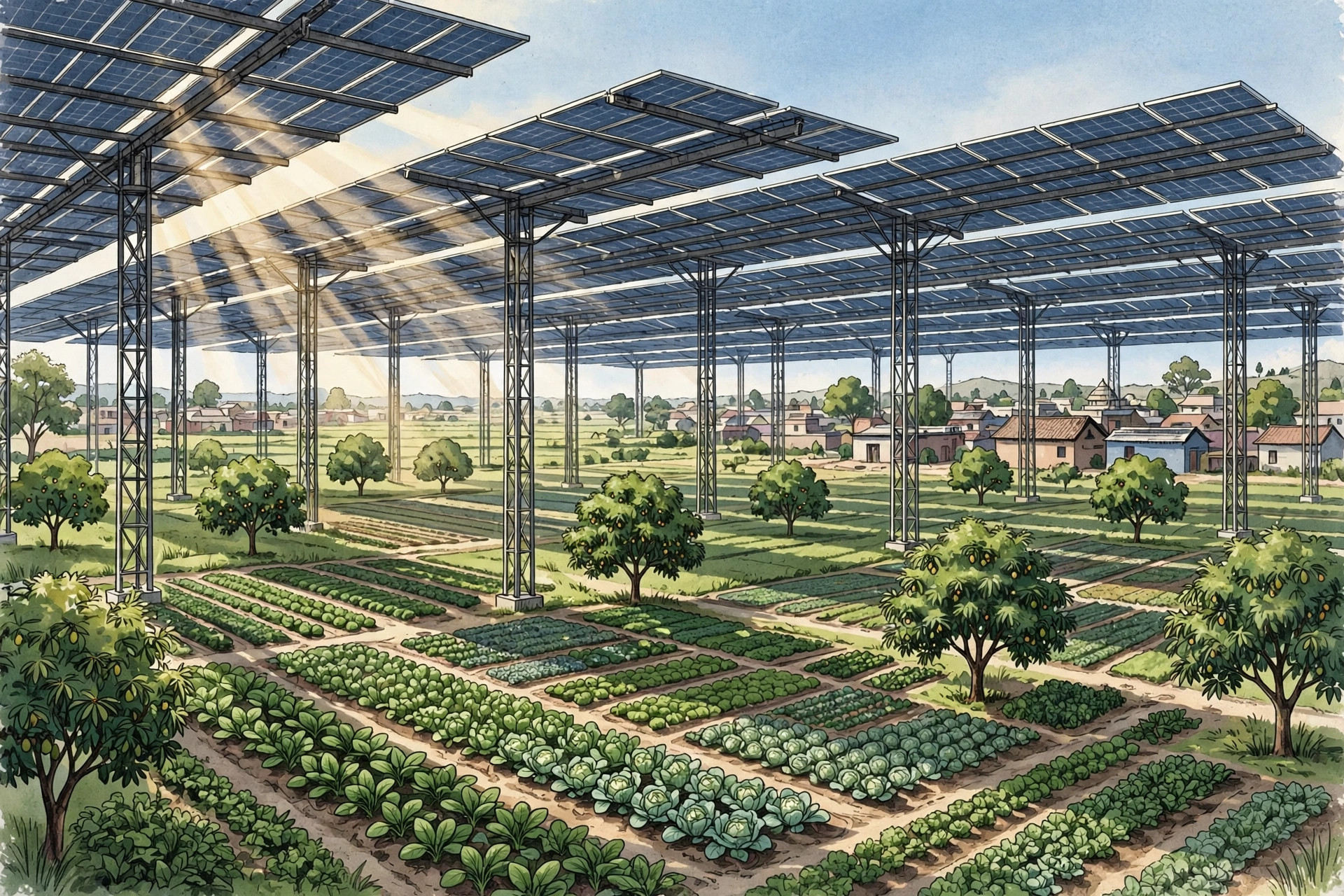
Editorial illustration: elevated solar panels on tall stilts above a green Indian farm field, with leafy vegetable rows and fruit trees growing underneath in sunlight.
Key Takeaways
On 21 October 2026, MNRE Minister Pralhad Joshi announced an agrivoltaics programme under the next phase of PM-KUSUM, at the Agrivoltaics World Conference in New Delhi.
Agrivoltaics puts solar panels on structures 3.5 to 4 metres high so crops can keep growing underneath, addressing the problem that 1 MW of solar takes 4 acres.
The MNRE Secretary described an initial 5 GW target over the next few years, with a draft policy to be published for stakeholder and state suggestions.
Around 47.5 million hectares, nearly 30 percent of India's cropland, is estimated to be technically suitable, with six states holding about half that potential.
Agri-PV costs 25 to 30 percent more than ground-mounted solar and its power could cost Rs 3.20 to 3.30 a unit, so closing the cost gap and protecting small farmers' land and yields are the key tests.
India is preparing to put solar panels above farmland without taking that land away from farming. On 21 October 2026, Union Minister for New and Renewable Energy Pralhad Joshi announced that the government will launch an agrivoltaics programme under the next phase of PM-KUSUM, the Pradhan Mantri Kisan Urja Suraksha evam Utthaan Mahabhiyan. He made the announcement at the seventh Agrivoltaics World Conference 2026, titled "Powering the Global South", held at Bharat Mandapam in New Delhi.
The idea is simple to describe and difficult to get right in practice: raise solar panels on tall structures over a field, grow crops underneath, and let the same plot produce both food and electricity. The government is pitching it as a way to expand solar power without forcing a choice between energy and agriculture, especially in a country where most farmers work small plots and land is under pressure from many directions. The announcement is a beginning, not a finished scheme. The draft policy, the final capacity target and the detailed rules for farmers are still to be published, so this article separates what has actually been announced from what is still expected or estimated.
What happened: the announcement
Joshi said India will launch "one of the world's most ambitious agrivoltaic programs under the next phase of PM Kusum". The programme is meant to let farmers produce solar electricity without giving up cultivation on the same land. The government is looking for ways to grow solar generation without hurting farm output, particularly as demand for land rises across sectors, and Joshi said linking the programme with existing agricultural schemes would open up further room for solar energy in farming.
Separately, Santosh Kumar Sarangi, Secretary in the Ministry of New and Renewable Energy (MNRE), told reporters that a policy to promote agrivoltaics is in the works. The draft would be released publicly so that stakeholders, including state governments, could send in suggestions, and changes would follow from that feedback. Sarangi said the government is targeting a capacity of 5 GW over the next few years to begin with, and will assess the response of states. A dedicated 10-GW agri-photovoltaic component is also expected to be part of the proposed PM-KUSUM 2.0, according to an official cited in the same reporting, along with a central scheme to help states deploy agrivoltaics with panels mounted on stilts above standing crops.
Those two numbers should not be confused. The 5 GW figure is the initial target described by the MNRE Secretary. The 10 GW figure is an expected component of the next phase, not a confirmed final allocation. Until the draft policy and the next phase of PM-KUSUM are formally published, farmers and developers should treat the structure, eligibility rules and subsidy framework as still open.
What agrivoltaics actually means
Agrivoltaics, also called agri-photovoltaics or agri-PV, means installing solar panels on elevated structures over agricultural land. The panels themselves are the same kind used in conventional ground-mounted solar projects. The difference is the structure holding them up: tall, tilted frames that leave enough space below for routine farming, including the movement of machinery.
According to MNRE guidance cited in current-affairs reporting, panels are installed at a height of 3.5 to 4 metres above the ground. That height is meant to allow ploughing, sowing, harvesting and other field work to continue underneath. Union Agriculture Minister Shivraj Singh Chouhan stressed the same point at the conference: agrivoltaic models must let farmers carry on with cultivation instead of replacing farming with solar generation. Panel height, the gap between support structures and room for farm machinery all have to be accounted for in the design, so that farmers can plough their fields and switch crops and cropping patterns as they need.
This is also why the policy debate matters as much as the technology. If the structures are too low, too closely spaced or badly placed, farming becomes impractical even though the land is technically still a farm. Chouhan's message was that agrivoltaic policies must be built around the practical requirements of India's small and marginal farmers, not just around the power output of the panels.
Why the government is pushing this now
The core argument is land. Joshi said installing 1 MW of solar capacity takes 4 acres, and nearly 85 percent of India's farmers are small and marginal farmers, which makes it difficult to set land aside only for power generation. Agrivoltaics lets farming and power generation happen together on the same plot.
Citing estimates, Joshi said around 47.5 million hectares is technically suitable for agrivoltaics. That works out to nearly 30 percent of India's 160 million hectares of cropland. Maharashtra, Rajasthan, Andhra Pradesh, Madhya Pradesh, Karnataka and Uttar Pradesh together hold nearly 50 percent of this estimated potential. A separate current-affairs summary puts the long-term potential at 1 to 2 terawatts, but that is an estimate of what could technically be possible, not a government target and not a forecast of what will actually be built.
PM-KUSUM already forms a large part of India's decentralised solar base. Joshi said decentralised solar capacity additions reached 16.3 GW in the previous year, of which 7.6 GW came under PM-KUSUM. Rooftop solar made up the remaining 8.7 GW, largely through the PM Surya Ghar Muft Bijli Yojana, which had crossed 63 lakh beneficiaries. The new agrivoltaics programme would therefore build on an existing decentralised solar system, rather than starting from scratch, by adding a model in which the panels sit above crops rather than beside them or on rooftops.
There is also a farm-income argument. Field studies cited by Joshi suggest that a suitable agrivoltaic system can improve yields by 10 to 20 percent and cut water use by around 30 percent, partly because partial shade can reduce evaporation and heat stress for some crops. Those figures come from field studies of suitable systems, not a promise for every field or every crop, and they depend heavily on choosing the right crop, the right panel height and the right spacing for local conditions.
Which crops work, and which do not
Not every crop is a good fit under panels. Government assessment studies cited in current-affairs reporting have found agri-PV suitable for fruits and leafy vegetables, while it has not been found suitable for crops such as rice and sugarcane. That limits the immediate range of the model and means the first projects will need careful crop selection rather than a one-size-fits-all design.
Most agri-PV projects in India are still at the pilot stage, and their impact on farming must be properly assessed before the model is scaled up. That is an important caution for farmers who may be approached by developers: a pilot result on one crop in one climate does not automatically transfer to a different crop, soil or rainfall pattern. Soil health, drainage, shade patterns through the day and access for tractors and harvesters all change once a tall structure is built over a field.
The equity question is equally important. With more than 85 percent of Indian farmers being small and marginal, and average landholding around 0.96 hectares according to the same reporting, the policy must be designed so that small farmers benefit and keep control of their land. Chouhan flagged exactly this risk: the model must ensure farmers do not lose control of their agricultural land or suffer a decline in crop production in favour of large-scale solar developers. A scheme that works for a large developer but leaves a small farmer with less usable land, lower yields or a long lease they cannot exit would fail its own purpose.
The cost problem that has to be solved
The biggest practical obstacle is cost. Joshi said agri-PV plants can cost around 25 to 30 percent more than conventional ground-mounted solar, because the panels have to be raised on elevated, tilted structures and the additional infrastructure pushes up project costs.
That difference carries through to the cost of power. Electricity from agrivoltaic systems could cost around Rs 3.20 to 3.30 a unit, Joshi said, against roughly Rs 2.50 to 2.60 a unit from conventional ground-mounted solar. The gap would have to be closed for agrivoltaics to become commercially viable at a larger scale. Joshi indicated that costs could come down with scale, much as conventional solar tariffs have fallen over the years, but that is a hope based on past solar trends, not a guarantee for this newer and more complex design.
This is where the draft policy will matter most. If the policy offers support that closes the cost gap without weakening farming protections, agrivoltaics could attract states and farmers. If it does not, the model may stay limited to pilots and demonstration sites. Questions that remain unanswered include how power from these systems will be bought, what role distribution companies and state energy departments will play, and what financial support, if any, small farmers will receive for the extra structural cost. Those details are expected to be part of the public draft and the next phase of PM-KUSUM, and they should be read carefully when published rather than assumed from the announcement alone.
What other countries are doing
India is not inventing this model from nothing. Joshi said agrivoltaic capacity installed worldwide has crossed 18.4 GW, and India can learn from that experience. He cited Italy's 1.7-billion euro funding programme for farmers, solar developers and research institutions. Japan, he said, has opened every category of farmland to agrivoltaics and supports small-scale systems through preferential tariffs. Germany ties its support to continued farming on the land and minimum crop-yield requirements.
Germany's approach is particularly relevant to India's debate, because it links support to the farming outcome rather than only to the electricity output. If a system stops being a working farm, it stops qualifying as agrivoltaics in that model. Germany's ambassador to India and Bhutan, Jasper Wieck, also offered support for joint research on pilot agrivoltaic sites in India, to test how agriculture and solar power generation can be combined economically and sustainably on the same land.
What this means for farmers right now
For a farmer hearing about this announcement, the practical message is cautious but hopeful. Nothing in the announcement changes land ownership, crop choice or electricity tariffs overnight. The programme is to be launched under the next phase of PM-KUSUM, and a draft policy is to be published for suggestions from stakeholders and states. Until those documents appear, no farmer should sign away land use, accept a structure design or pay for an installation on the basis of the announcement alone.
When the details do appear, the questions worth asking are straightforward. How high will the panels be, and how much space will remain for machinery? Which crops are approved for the local area, and what happens if yields fall? Who owns the structure, who maintains it, and for how long is the land committed? How will the electricity be sold, at what price, and who bears the extra 25 to 30 percent cost? And what protection exists if the developer stops maintaining the system or the farming underneath becomes impractical?
If those answers protect continued cultivation, small-farmer control of land and a fair share of the power income, agrivoltaics could give many farmers a second income from the same field: crops below, electricity above, and less pressure to choose between the two. If they do not, the model risks becoming solar power that happens to sit over a farm, rather than farming and solar power genuinely sharing the land.
Conclusion
The agrivoltaics announcement under PM-KUSUM is best read as a direction of travel, not a finished promise. The government has said it will launch one of the world's most ambitious agrivoltaic programmes, with an initial 5 GW target over the next few years and a draft policy open to public suggestions. The land-use logic is strong: with 1 MW of solar taking 4 acres and most Indian farmers working small plots, growing crops and generating power on the same land is an attractive answer to a real constraint.
But the success of the programme will be decided by details that are not yet published: crop suitability, structure design, the cost gap of Rs 3.20 to 3.30 a unit against Rs 2.50 to 2.60 for ground-mounted solar, power purchase arrangements, and safeguards for small farmers' land and yields. Farmers, states and researchers should use the coming draft policy consultation to press for designs that keep the farm a farm first. If that test is passed, agrivoltaics could become a genuine dual-income model for Indian agriculture. If it is not, it will remain an interesting pilot that never scales.
Frequently Asked Questions (FAQ)
What is agrivoltaics?
Agrivoltaics means installing solar panels on elevated structures over farmland so that crops can keep growing underneath while the panels generate electricity from the same plot. The panels are the same kind used in ground-mounted solar projects; the difference is the tall, tilted frame that leaves room below for farming and machinery.
What has the government announced about agrivoltaics under PM-KUSUM?
On 21 October 2026, Union Minister for New and Renewable Energy Pralhad Joshi announced that the government will launch an agrivoltaics programme under the next phase of PM-KUSUM, the Pradhan Mantri Kisan Urja Suraksha evam Utthaan Mahabhiyan. He announced it at the seventh Agrivoltaics World Conference 2026 at Bharat Mandapam in New Delhi. A draft policy is to be published for suggestions from stakeholders and states.
How high are the panels, and which crops suit agrivoltaics?
According to MNRE guidance cited in current-affairs reporting, panels are installed 3.5 to 4 metres above the ground, enough for routine field work and machinery movement. Government assessments have found the model suitable for fruits and leafy vegetables, but not for crops such as rice and sugarcane, so crop choice matters and most Indian projects are still at the pilot stage.
How much does agrivoltaics cost, and what is still undecided?
Agrivoltaic plants cost around 25 to 30 percent more than conventional ground-mounted solar because of the elevated structures, and the power they produce could cost around Rs 3.20 to 3.30 a unit against roughly Rs 2.50 to 2.60 a unit for ground-mounted solar. The MNRE Secretary described an initial target of 5 GW over the next few years, while a dedicated 10-GW component is expected in the proposed PM-KUSUM 2.0. Final eligibility, subsidy and power-purchase details are still to be published, and farmers should check the draft policy before committing land.