Home > Constitution & Law > Rahul Gandhi Acquitted in Sultanpur Defamation Case Explained: The 2018 Remarks, the Trial, and What the Verdict Means
Rahul Gandhi Acquitted in Sultanpur Defamation Case Explained: The 2018 Remarks, the Trial, and What the Verdict Means
By IndiaAsk Editorial Team · 2026-10-26 · 9 min read · Constitution & Law
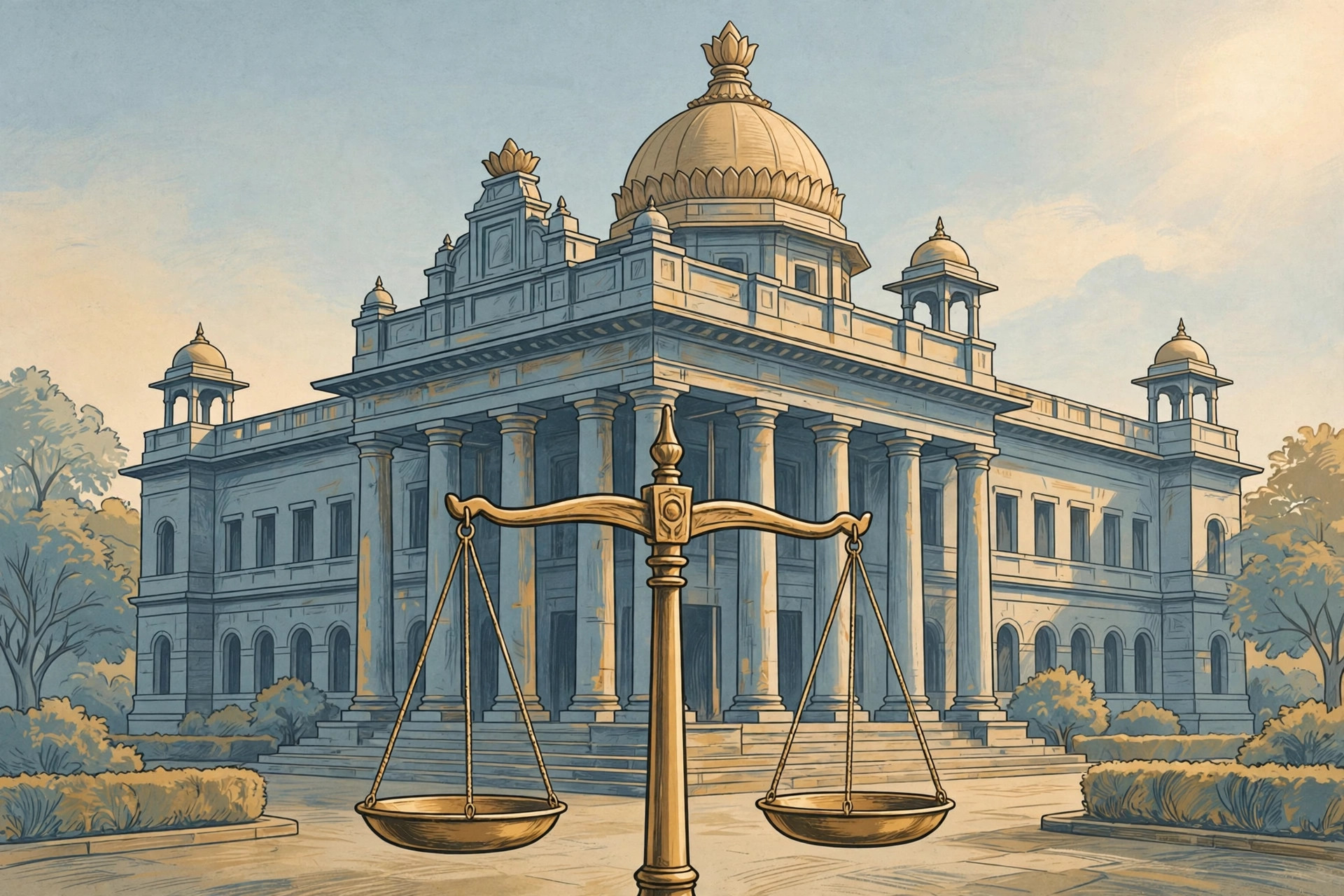
Editorial illustration: a stylised Indian courthouse with tall columns and a large balanced scales of justice in the foreground, representing the Sultanpur court's acquittal in the 2018 defamation case.
Key Takeaways
A special MP/MLA court in Sultanpur acquitted Rahul Gandhi on 26 October 2026 in a 2018 criminal defamation case over his remarks about Amit Shah, then BJP president.
Additional Chief Judicial Magistrate Shubham Verma pronounced the verdict in Gandhi's presence, holding that the remarks were not defamatory.
The complaint, filed by BJP leader Vijay Mishra, concerned Gandhi's 2018 Bengaluru campaign remarks referring to Shah as a murder accused, understood to relate to the Sohrabuddin Sheikh case in which Shah was discharged in 2014.
The case was filed under Sections 499 and 500 of the Indian Penal Code, which provided for up to two years' imprisonment for criminal defamation.
The acquittal ends this case at the trial stage, subject to any appeal, and does not decide Gandhi's other separate defamation cases.
What happened on 26 October 2026
A special MP/MLA court in Sultanpur, Uttar Pradesh, on Monday, 26 October 2026, acquitted Congress leader Rahul Gandhi in a criminal defamation case dating back to 2018. The case concerned remarks Gandhi made about Union Home Minister Amit Shah, who was then the president of the Bharatiya Janata Party (BJP). Gandhi, who is the Leader of the Opposition in the Lok Sabha and the MP from Raebareli, was present in court when the verdict was pronounced.
Additional Chief Judicial Magistrate Shubham Verma delivered the verdict. Reporting by LiveLaw and Bar and Bench, two legal news outlets that covered the hearing, records that the court held Gandhi's remarks were not defamatory in nature. The Press Trust of India also reported the acquittal the same morning. After the verdict, Congress supporters celebrated outside the court, and Gandhi's counsel, Kashi Prasad Shukla, told reporters that the defence respectfully accepted the decision and that, in his words, the truth had ultimately prevailed.
The verdict ends this particular trial, but it is worth stating its limits plainly. An acquittal at the trial court is not the same as a final, unchallengeable finding for all time: the complainant retains the legal option of challenging the verdict before a higher court. What it does mean, for now, is that Gandhi stands acquitted in this case, and the trial-court proceedings that began in 2018 have come to a close.
The remark at the centre of the case
The complaint was filed in 2018 by local BJP leader Vijay Mishra, a former chairman of the Sultanpur District Cooperative Bank. According to the complaint, Gandhi, during campaigning in Bengaluru ahead of the 2018 Karnataka Assembly elections, referred to Shah, then the BJP president, as a murder accused.
The statement attributed to Gandhi, as reported in the court coverage, was: "People in India forget that the president of BJP is a murder accused. That's the truth. The party that talks about honesty, decency, has a person who has been accused of murder as president."
Gandhi's reference was understood to be to the Sohrabuddin Sheikh encounter case, in which Shah had faced allegations and was discharged by a special CBI court in 2014. That discharge is a matter of court record, and it forms the factual background against which the remark was made. The complainant's case was that, even in that context, describing Shah in those terms in a political speech was defamatory. Gandhi disputed the allegation, with the defence arguing that the remarks had been presented out of context.
The case was filed under Sections 499 and 500 of the Indian Penal Code (IPC), the provisions that defined criminal defamation and prescribed its punishment at the time the complaint was made. Because the complaint predates the Bharatiya Nyaya Sanhita, which replaced the IPC in 2024, the case proceeded under the IPC provisions under which it was filed.
How the case travelled through the courts
The case moved slowly, as many criminal defamation trials involving public figures do. The complaint was filed in August 2018. The Sultanpur court summoned Gandhi in November 2023, and he appeared before the court in February 2024, when he was granted bail on personal bonds. Proceedings continued through 2025 and into 2026, including the recording of Gandhi's statement before the court earlier this year.
On 13 October 2026, after the hearing concluded, the court fixed 26 October as the date for the verdict. The complainant's side had also sought, at an earlier stage, a comparison of Gandhi's voice sample, a request the trial court rejected, with later applications to higher courts not changing that outcome. Gandhi travelled to Sultanpur via Lucknow for the verdict hearing, and, according to reports of the day, his convoy was involved in a minor collision on the Purvanchal Expressway on the way, with several people reported injured. That incident was separate from the court proceedings themselves.
Senior Advocate R. S. Cheema appeared for Gandhi, along with advocates Kashi Shukla, Tarannum Cheema, Prasanna S. and Akash Singh, according to Bar and Bench's report of the verdict.
What criminal defamation means in India
Criminal defamation is often confused with civil defamation, and the distinction matters here. A civil defamation suit seeks compensation, usually money, for damage to reputation. A criminal defamation complaint, by contrast, asks the state to punish the speaker, with imprisonment as a possible outcome. Under Section 500 of the IPC, the maximum punishment was simple imprisonment for up to two years, or a fine, or both.
Section 499 set out what counted as defamation, but it also contained exceptions. Truth, for example, was a defence only in limited circumstances: a statement had to be true and made for the public good. Fair comment on a matter of public interest, and statements made in good faith about the conduct of a public servant in the discharge of public functions, were also protected in defined ways. In practice, therefore, a court in a case like this does not simply ask whether words were harsh or politically charged. It asks whether the imputation, in its context, harmed reputation in a way the law treats as defamatory, and whether any exception applies.
That is why the Sultanpur court's short conclusion — that the remarks were not defamatory — matters more than the political reaction to it. The court did not, in the reports of the verdict, declare the underlying political argument right or wrong. It held that the remarks, as made and in their context, did not meet the legal test for defamation. The detailed reasoning in the written order will matter for any appeal, and for how lawyers read the case, but the operative outcome is the acquittal.
It is also important not to confuse this case with other defamation cases involving Gandhi. The best-known is the 2023 case in Surat, Gujarat, in which he was convicted and sentenced to two years' imprisonment over his 2019 remark about the "Modi surname", a conviction that led to his disqualification from Parliament before the Supreme Court stayed the conviction, allowing him to continue as an MP. A separate case in Maharashtra, concerning remarks about Prime Minister Narendra Modi, saw the Supreme Court stay trial-court proceedings in October 2026. Those are different complaints, different remarks, and different courts. The Sultanpur verdict decides only the 2018 complaint about Amit Shah.
Why the verdict matters politically
For Gandhi and the Congress, the immediate effect is straightforward: a long-running case that carried a theoretical risk of conviction and its political consequences is over at the trial stage. A conviction in a criminal case carrying a sentence of two years or more can trigger disqualification of a sitting MP under the Representation of the People Act, 1951, as the Surat case demonstrated in 2023. An acquittal removes that risk in this case entirely, subject only to an appeal.
For the BJP, the verdict is a setback in a case its local leadership pursued for eight years, but it does not change the party's political position in Uttar Pradesh or nationally, and the party has not, in the first reports of the verdict, been reported as announcing an appeal. The complainant's next step, if any, will be a decision for Mishra and his lawyers, and any appeal would be heard on the trial court's record and reasoning.
More broadly, the case is part of a long-running argument in Indian politics about where political speech ends and defamation begins. Election campaigns in India are fought in sharp, personal language, and criminal defamation complaints have become a familiar weapon in that fight, used by politicians of all parties. Courts have repeatedly had to draw the line between robust criticism of a public figure — which the law protects generously — and a false imputation of criminal conduct presented as fact. The Sultanpur verdict falls on the side of protection for political speech in this instance, but it does not create a general rule that any remark about a politician is safe. Each case still turns on its own words, context and evidence.
What happens next
Three things are worth watching. First, whether the complainant files an appeal or revision before a higher court, and on what grounds. An appeal would not automatically suspend the acquittal's effect in the same way a stay operates, but it would keep the legal question alive. Second, whether the detailed written order, when it becomes available, offers reasoning that lawyers in other defamation cases cite — for example, on how much weight a court should give to the political context of a remark, or to the fact that the person referred to had earlier been discharged in the underlying case. Third, whether the verdict affects the tone of the current political argument: the BJP announced nationwide protests on 26 October over a separate remark by Congress president Mallikarjun Kharge in Patna, and the two stories, while legally unrelated, are part of the same heated political week.
For ordinary readers, the practical takeaway is simpler. A court has now examined an eight-year-old complaint, heard both sides, and concluded that the remarks in question were not defamatory. That is the legal fact. The political argument about the remarks will continue, as political arguments do, but it will now continue without this case hanging over it.
Conclusion
The Sultanpur acquittal closes a chapter that began with a single sentence in a Bengaluru campaign speech in 2018. It does not rewrite the history of the Sohrabuddin case, settle every argument about defamation and free speech in India, or decide any of Gandhi's other pending cases. What it does is answer, for this complaint, the question the court was asked: were these remarks defamatory under the law? The court's answer, delivered in Gandhi's presence on 26 October 2026, was no. In a political system where court cases and campaigns now run side by side, that answer matters — not because it ends the political debate, but because it shows the debate, however sharp, still passes through a courtroom that applies a legal test rather than a political one.
Frequently Asked Questions (FAQ)
What did the Sultanpur court decide on 26 October 2026?
A special MP/MLA court in Sultanpur acquitted Congress leader Rahul Gandhi in a 2018 criminal defamation case over his remarks about Amit Shah, then the BJP president. Additional Chief Judicial Magistrate Shubham Verma pronounced the verdict in Gandhi's presence, holding that the remarks were not defamatory in nature.
What remark was the case about?
The complaint concerned remarks Gandhi made in Bengaluru ahead of the 2018 Karnataka Assembly elections, in which he referred to Shah, then BJP president, as a murder accused. Gandhi's reference was understood to relate to the Sohrabuddin Sheikh encounter case, in which Shah was discharged by a special CBI court in 2014. The complaint was filed by local BJP leader Vijay Mishra under Sections 499 and 500 of the Indian Penal Code.
Does this acquittal decide Gandhi's other defamation cases?
No. This verdict decides only the 2018 Sultanpur complaint about Amit Shah. It does not decide the 2023 Surat case over the 'Modi surname' remark, in which Gandhi was convicted and later got a Supreme Court stay on the conviction, or the separate Maharashtra case in which the Supreme Court stayed trial proceedings in October 2026. Each complaint concerns different remarks and is decided on its own record.
Can the verdict be challenged?
Yes, the complainant retains the legal option of challenging the acquittal before a higher court. Until such a challenge is filed and decided, however, the trial-court outcome stands: Gandhi is acquitted in this case, and the proceedings that began in 2018 have concluded at the trial stage.