Home > General Knowledge > Why Did the US Ground All Flights? The FAA Nationwide Ground Stop Explained
Why Did the US Ground All Flights? The FAA Nationwide Ground Stop Explained
By Vijay Pawar · 2026-11-14 · 7 min read · General Knowledge
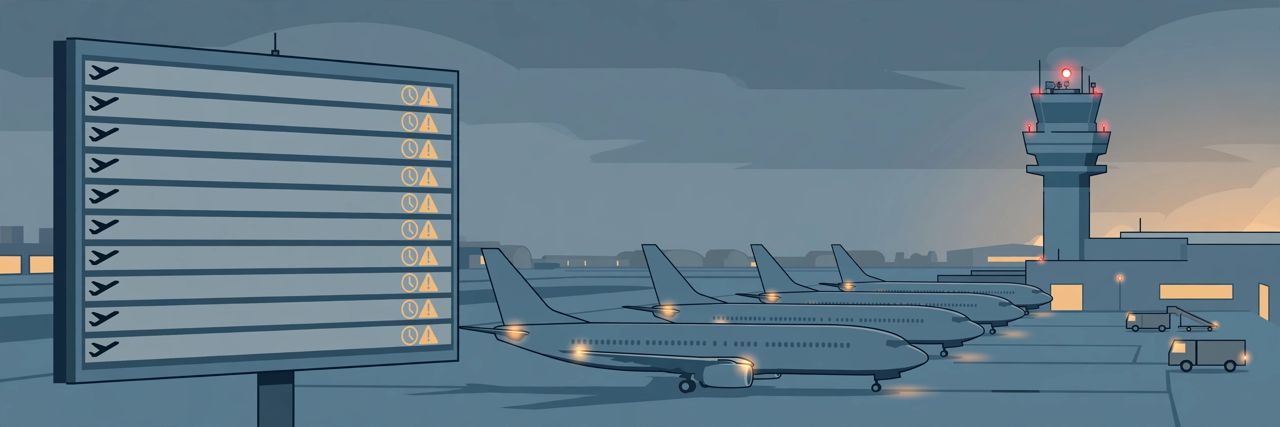
Editorial illustration: the FAA nationwide ground stop on 13 November 2026, with departing flights held on the tarmac at US airports after a communications failure hit air traffic control centres.
Key Takeaways
The FAA ordered a nationwide ground stop at 3:54 pm Eastern Time on Friday, 13 November 2026, after a communications failure hit all 22 Air Route Traffic Control Centers — only the second such stop since the September 11, 2001, attacks.
More than 11,000 flights were delayed or cancelled, including over 1,000 cancellations and nearly 10,000 delays, with at least 600 flights diverted; flights from Canada and Europe were also cancelled.
Planes already airborne were allowed to land — 4,042 flights were in the air when the order was issued — and the FAA later lifted the ground stop.
US officials ruled out a cyberattack: Homeland Security called it a telecommunications outage, the FBI saw no sign of criminality, and President Trump said it did not appear to be a cyberattack or AI.
The episode has renewed scrutiny of the ageing US air traffic control system, which faces equipment and communications failures, controller shortages and old infrastructure; the previous nationwide stop was in January 2023.
Why did the US ground all flights on Friday, 13 November 2026? In an extraordinary move, the Federal Aviation Administration (FAA) ordered every departing flight in the United States to stay on the ground after a communications failure hit air traffic control centres across the country. It was only the second nationwide ground stop since the September 11, 2001, attacks, and it left more than 11,000 flights delayed or cancelled. The FAA later lifted the order, but the disruption has renewed hard questions about the ageing American air traffic control system. Here is what happened, why the FAA grounded all flights, and what it means for travellers, including those flying between India and the United States.
What happened on 13 November 2026
The FAA announced the nationwide ground stop at 3:54 pm Eastern Time on Friday, 13 November 2026 (2:24 am IST on Saturday, 14 November). Its advisory said the stop applied to all US airports and that departing flights should remain grounded until further notice, citing "extraordinary circumstances" and "reasons of safety". Planes already in the air were allowed to continue to their destinations and land — at the moment the order was issued, 4,042 flights were airborne and heading towards US airports, according to flight-tracking service Flightradar24.
The cause, according to the FAA and the US Department of Transportation, was a communications issue affecting all 22 Air Route Traffic Control Centers (ARTCCs) — the regional centres that guide aircraft at high altitudes between airports. US Transportation Secretary Sean Duffy said in a post on X: "The FAA issued a nationwide ground stop for all US airports following a communication issue impacting all Air Route Traffic Control Centers. FAA technicians are investigating the issue. We will provide immediate updates as we have them." The FAA later described the problem as a "temporary telecommunications outage" and said flights had been halted "out of an abundance of caution", adding that "every flight has been accounted for and international flights will be handled on a case by case basis".
Shortly before the nationwide order, the FAA had already halted air traffic in Chicago because of communications problems affecting air traffic control. Within hours the problem had spread across the country, and the nationwide stop followed. The FAA subsequently lifted the ground stop, the Associated Press reported, but the backlog of delayed and cancelled flights took much longer to clear.
How big was the disruption
The scale of the chaos is clear from the flight-tracking numbers. [According to flight-tracking service FlightAware, more than 11,000 flights were delayed or cancelled, including over 1,000 cancellations and nearly 10,000 delays](https://www.businesstoday.in/amp/world/us/story/us-flight-chaos-11000-delays-cancellations-after-faa-grounds-all-departures-over-outage-567441-2026-11-14). At least 600 flights were diverted to other airports as a result of the order. Thousands of stranded passengers endured long waits in crowded terminals across the United States, and the disruption spread beyond American borders, forcing the cancellation of flights from Canada and Europe as airlines struggled to manage their schedules.
The disruption was not limited to leisure travel. Businesses, government offices and cargo operations that depend on American airspace all felt the stoppage, and the knock-on effects rippled through connecting flights around the world. [Aviation disruption is not new for Indian flyers either — international air traffic from India itself fell 7 percent in April-September 2026](https://indiaask.tech/question.php?slug=india-international-air-traffic-falls-7-percent-april-september-2026-explained). For travellers, the practical effect was simple: if a plane was on the ground in the United States, it could not take off, no matter where it was headed.
Was it a cyberattack
No, according to every US official who has spoken about the incident so far. [The Department of Homeland Security said there were no signs the outage was caused by a cyberattack](https://www.gmanetwork.com/news/topstories/world/1009453/us-grounds-flights-nationwide-after-air-traffic-control-communications-outage/story/). Homeland Security Secretary Markwayne Mullin told reporters at the White House: "There is no indication as of yet that this was a nefarious attack against us. It's just a telecommunication outage as of right now." The Federal Bureau of Investigation does not believe the disruption was due to a cyberattack or criminality, a person familiar with the matter said, and US President Donald Trump told Fox News that the flight disruption did not appear to have been caused by a cyberattack or artificial intelligence.
That matters because a nationwide halt of American aviation is exactly the kind of event that invites speculation. Officials have been unusually quick and unusually consistent in ruling out malicious activity, and the working explanation — a failure in the telecommunications links that air traffic controllers depend on — points to infrastructure, not an attacker.
Why the US air traffic control system keeps failing
The ground stop is the latest and most dramatic sign of strain on a US air traffic control system beset by equipment and communications failures, controller shortages and ageing infrastructure. Controllers rely on voice and data links to talk to pilots and to hand aircraft from one centre to another; when those links fail across all 22 regional centres at once, the safe option is to stop departures entirely rather than risk aircraft flying without reliable contact with the ground.
This was the second nationwide ground stop of all departures since the September 11, 2001, attacks, and the first since January 2023, when a key FAA computer system — the NOTAM system that carries safety notices to pilots — malfunctioned and forced a similar halt. The repetition is the worrying part: two nationwide stoppages in less than four years, both caused by failures in the basic systems that keep American aviation running, suggest the problem is not a single faulty component but a system that has been underfunded and patched for years. Successive US administrations have promised to modernise air traffic control, replacing copper-era communications and decades-old radar and computer systems, but the work has moved slowly, and controllers have warned for years that staffing shortages make the system more fragile when something goes wrong.
What it means for Indian travellers
For passengers in India, the direct effect is on travel to and from the United States. Flights departing American airports for India were held on the ground during the stop, and flights from Europe and Canada were cancelled too, which can strand Indian passengers on connecting journeys through those hubs. [The same day also saw Air India suspend its Saudi Arabia flights](https://indiaask.tech/question.php?slug=air-india-saudi-flights-suspended-14-november-2026) — another reminder of how quickly flight schedules can unravel. Even after the ground stop was lifted, the backlog meant delays and cancellations continued as airlines worked to reposition aircraft and crews.
Anyone travelling between India and the US in the days after the disruption should check their flight status with the airline before leaving for the airport, keep an eye on the airline's app or website for rebooking options, and allow extra time for connections through American airports. Airlines are generally required to rebook passengers on cancelled flights, and travel insurance may cover additional costs such as hotel stays, but the exact entitlements depend on the airline and the ticket. The broader lesson for Indian travellers is the same one American passengers learned on Friday: when a country's air traffic control system stops, no airline can fly around the problem, and the only safe response is to wait.
Conclusion
The FAA's decision to ground all departing flights in the United States on 13 November 2026 was drastic, but it was also the textbook response to losing contact with the aircraft controllers are supposed to guide. A telecommunications outage knocked out communications across all 22 regional air traffic control centres, more than 11,000 flights were delayed or cancelled, and officials have ruled out a cyberattack. The stop was lifted the same day, yet the episode has done something no report could: it has shown the world, in a single afternoon, how fragile the infrastructure behind the world's busiest aviation system has become. Until the United States modernises its air traffic control network, travellers should expect that the next failure — not the last — is only a matter of time.
Why did the US ground all flights on 13 November 2026?
The FAA ordered a nationwide ground stop after a communications failure hit air traffic control centres across the United States. A temporary telecommunications outage affected all 22 Air Route Traffic Control Centers, so departing flights were held on the ground from 3:54 pm Eastern Time on Friday, 13 November 2026, until the order was later lifted.
Was the FAA ground stop caused by a cyberattack?
No, according to US officials. The Department of Homeland Security said there were no signs of a cyberattack, Homeland Security Secretary Markwayne Mullin said it was 'just a telecommunication outage as of right now', and the FBI does not believe the disruption was due to a cyberattack or criminality. President Donald Trump also said it did not appear to be caused by a cyberattack or artificial intelligence.
How many flights were affected by the US ground stop?
According to flight-tracking service FlightAware, more than 11,000 flights were delayed or cancelled, including over 1,000 cancellations and nearly 10,000 delays. At least 600 flights were diverted, and flights from Canada and Europe were also cancelled. At the moment the stop was ordered, 4,042 flights were airborne and were allowed to land.
Has the US grounded all flights like this before?
This was only the second nationwide ground stop of all departures since the September 11, 2001, attacks, and the first since January 2023, when a malfunction in the FAA's NOTAM safety-notice system forced a similar halt. The recurrence has renewed scrutiny of the ageing US air traffic control system, which faces equipment and communications failures, controller shortages and ageing infrastructure.