Home > General Knowledge > What Is the Yuge Yugeen Bharat Museum? World's Largest Museum in Delhi's North and South Block Explained
What Is the Yuge Yugeen Bharat Museum? World's Largest Museum in Delhi's North and South Block Explained
By Vijay Pawar · 2026-11-12 · 7 min read · General Knowledge
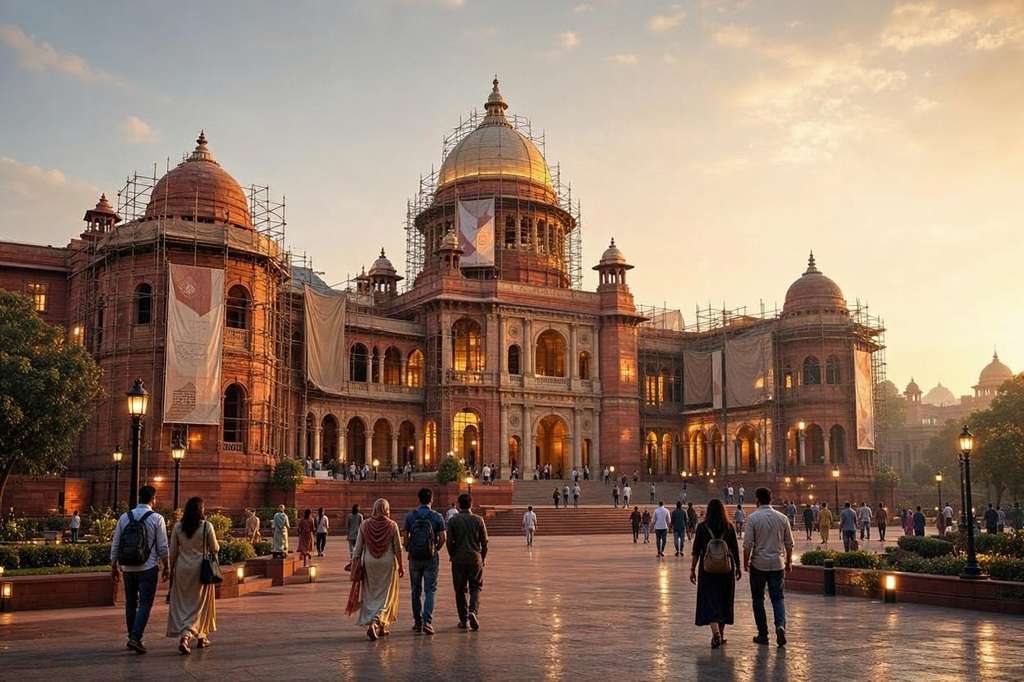
Editorial illustration: the historic North and South Block buildings on Raisina Hill in New Delhi are being transformed into the Yuge Yugeen Bharat Museum, set to have the world's largest museum display area.
Key Takeaways
The Union Cabinet approved the Yuge Yugeen Bharat Museum on 11 November 2026 at an estimated cost of Rs 3,230 crore, in the North and South Block complex in New Delhi.
With a display area of more than one lakh square metres, it will be the world's largest museum by display area, bigger than the Louvre, the British Museum and the Hermitage.
The first gallery, themed 'Adornment', is expected to open in the North Block in the latter part of 2027; the full project runs in phases from FY 2026-27 to FY 2030-31.
Around 1.8 million objects have been identified for possible display, and the museum is designed for up to 30,000 visitors a day and one crore visitors a year.
The proposed ticket price is Rs 100 for Indian visitors and Rs 1,000 for foreign visitors, but final prices are yet to be officially confirmed.
The buildings that once housed the most powerful offices in India are about to welcome a very different kind of visitor. On 11 November 2026, the Union Cabinet approved the development of the Yuge Yugeen Bharat Museum in New Delhi's historic North and South Block complex, at an estimated cost of Rs 3,230 crore. When it is complete, the government says it will have the largest museum display area in the world — bigger than the Louvre in Paris, the British Museum in London and the Hermitage in St Petersburg. So what is the Yuge Yugeen Bharat Museum, and why does this project matter?
What Is the Yuge Yugeen Bharat Museum?
The Yuge Yugeen Bharat Museum — the name roughly means "Everlasting India" or "India through the ages" — is a landmark civilisational museum being developed by the Ministry of Culture through the adaptive reuse of the North and South Block complex on Raisina Hill in New Delhi. It is designed to present the continuity, diversity and richness of India's civilisational heritage, from the Indus Valley Civilisation to modern times, through an integrated narrative of tangible and intangible heritage.
The museum was announced by Prime Minister Narendra Modi on 18 May 2023, during the International Museum Expo, as part of the wider Central Vista redevelopment. The proposal was appraised by the Public Investment Board on 27 July 2026, and on 11 November 2026 the Cabinet Committee on Economic Affairs, chaired by the Prime Minister, formally cleared it, as announced in the [Press Information Bureau's official release](https://www.pib.gov.in/PressReleasePage.aspx?PRID=2334961®=3&lang=1). The project will be implemented in phases from financial year 2026-27 to 2030-31, with the first gallery — themed "Adornment" — expected to open to the public in the North Block in the latter part of 2027.
Why North Block and South Block?
For nearly a century, the North and South Blocks have been the nerve centre of the Indian government. Designed by British architects Edwin Lutyens and Herbert Baker as part of the imperial capital and inaugurated in 1931, the two sandstone buildings housed some of the most powerful ministries of the Union government, including the Home and Finance ministries and the Prime Minister's Office.
That chapter closed in February 2026, when the government formally moved its administrative operations out of the two blocks to the new Seva Teerth and Kartavya Bhavan buildings. The Cabinet decision now gives the vacated buildings a new public purpose. Rather than demolishing or rebuilding them, the project will use adaptive reuse — preserving the facades, architectural character and heritage significance of the complex with minimal intervention, while fitting it out with the infrastructure of a modern museum.
How Big Will It Be?
The scale of the project is what has made headlines around the world. Spread over a proposed built-up area of approximately 1,78,509 square metres — roughly the size of 25 football fields — the museum will have a display area of more than one lakh square metres. That is larger than the Louvre in Paris (about 73,000 square metres), the British Museum in London (about 70,000 square metres) and the Hermitage in St Petersburg (about 66,800 square metres), as [reported by The Indian Express](https://indianexpress.com/article/india/cabinet-approves-rs-3230-crore-yuge-yugeen-bharat-museum-north-south-block-10959239/).
The numbers behind the collection are equally large. Around 1.8 million objects have been identified for possible display, drawn from the National Museum, other museums under the Ministry of Culture, 52 Archaeological Survey of India site museums, state museums and private collections. Reports suggest the museum will eventually hold between 80,000 and one lakh artefacts on display, across nearly 30 thematic galleries in eight zones and around 950 rooms. The museum is being designed to receive up to 30,000 visitors a day and as many as one crore visitors a year, with timed entry and structured crowd management.
The design consultancy is led by Arcop Associates, with Thai-born architect Kulapat Yantrasast — co-founder of the Los Angeles-based WHY Architecture — as principal designer. India is also developing the museum with technical cooperation from France, following an agreement signed in December 2024 between the National Museum and France Muséums Développement, the organisation behind the Louvre Abu Dhabi.
What Will Visitors See?
Unlike a conventional museum that walks visitors through a timeline of dynasties and battles, the Yuge Yugeen Bharat Museum is planned around themes. Its proposed galleries will cover architecture and cityscapes, mathematics and astronomy, languages and scripts, faith and spirituality, and a gallery called Bharat Connects, devoted to trade and the movement of ideas across the world. Exhibits are expected to include ancient manuscripts and inscriptions, coins, sculptures, murals and scrolls, major archaeological finds, and audio-visual and digital installations.
The first gallery to open, in the North Block in late 2027, will be themed "Adornment" — presenting jewellery and decorative traditions from India's cultural history. The museum will also be a national public cultural institution aimed at the general public, students, researchers, scholars and domestic and international tourists, with contemporary museum practices, immersive technologies and visitor-centric interpretation.
What Will It Cost, and What Will It Earn?
The total estimated project cost of Rs 3,230 crore is based on detailed architectural and exhibition design, engineering and museum planning requirements. Reports have noted that this is nearly two-and-a-half times the cost of the new Parliament building, which underlines the scale of the undertaking.
The Culture Ministry has also proposed a revenue model for the museum. According to reports, the proposed ticket price is Rs 100 for Indian visitors and Rs 1,000 for foreign visitors, and the ministry has projected annual revenue of around Rs 163 crore from ticket sales, five auditoriums and event venues, seven food courts, guided tours, retail outlets and digital experiences. These figures are proposals reported in the press; the final ticket prices and facilities will be confirmed by the ministry closer to opening.
Getting there should also become easier over time. A metro station planned near Rakabganj Gurdwara is expected to become operational by June 2029, and reports suggest nearly 70 per cent of visitors are expected to enter from the gate behind the North Block.
Why This Project Matters
The Yuge Yugeen Bharat Museum is more than a building project. It converts the most symbolic address of Indian governance into a public cultural space, and it gives India a national museum on a scale no other country has attempted. For visitors, it promises a single place where 5,000 years of Indian civilisation — its knowledge systems, art, science, faith and trade — can be seen together. For Delhi, it adds a major new cultural destination alongside the city's existing museums and monuments; the capital's riverfront is also getting new attractions, with the [Namo Yamuna River Safari](https://indiaask.tech/question.php?slug=namo-yamuna-river-safari-delhi-explained) offering visitors another way to experience the city.
There are still questions to be answered: the exact opening schedule for the first gallery has been reported differently by different outlets, with the official press release saying the latter part of 2027, and the final ticket prices are yet to be confirmed. But the Cabinet approval removes the biggest uncertainty. After three years as an announcement, the museum now has a sanctioned budget, a timeline and a design team. If the phased plan holds, Delhi will open its first gallery in 2027 and complete the world's largest museum by 2031. International attention has already followed — the project was covered by major global outlets within a day of the decision — and New Delhi's role as a host of major international gatherings, such as the [BRICS Parliamentary Forum held in the capital in October 2026](https://indiaask.tech/question.php?slug=brics-parliamentary-forum-joint-declaration-new-delhi-explained), shows how the city is increasingly positioning itself on the world stage.
Conclusion
The Yuge Yugeen Bharat Museum will turn the North and South Blocks — the seats of power for nearly a century — into the world's largest museum by display area. With a Rs 3,230-crore budget, more than one lakh square metres of exhibition space, around 1.8 million identified objects and a first gallery on "Adornment" planned for late 2027, it is one of the most ambitious cultural projects India has ever undertaken. Whether it lives up to its name — Everlasting India — will be judged when the doors finally open.
The Yuge Yugeen Bharat Museum is a landmark civilisational museum being developed by the Ministry of Culture in New Delhi's historic North and South Block complex. Its name roughly means 'Everlasting India', and it will present 5,000 years of Indian civilisation, from the Indus Valley Civilisation to modern times.
When will the Yuge Yugeen Bharat Museum open?
The first gallery, themed 'Adornment', is expected to open to the public in the North Block in the latter part of 2027, according to the government's official press release. The full project will be implemented in phases from FY 2026-27 to FY 2030-31, with completion targeted by March 2031.
How much does the Yuge Yugeen Bharat Museum cost?
The Union Cabinet approved the project on 11 November 2026 at an estimated total cost of Rs 3,230 crore. The proposal was appraised by the Public Investment Board on 27 July 2026 before Cabinet approval.
Will the Yuge Yugeen Bharat Museum be the world's largest museum?
Yes, by display area. Its display area will be more than one lakh square metres, larger than the Louvre in Paris (about 73,000 sq m), the British Museum in London (about 70,000 sq m) and the Hermitage in St Petersburg (about 66,800 sq m). The built-up area is approximately 1,78,509 square metres.
What is the ticket price of the Yuge Yugeen Bharat Museum?
No final ticket price has been officially confirmed yet. The Culture Ministry has proposed Rs 100 for Indian visitors and Rs 1,000 for foreign visitors, as reported in the press. Final prices will be announced closer to opening.