Home > Science & Environment > What Is the Pralay Missile? DRDO's 5 November 2026 Test, Range, Speed and Why It Matters
What Is the Pralay Missile? DRDO's 5 November 2026 Test, Range, Speed and Why It Matters
By Vijay Pawar · 2026-11-06 · 8 min read · Science & Environment
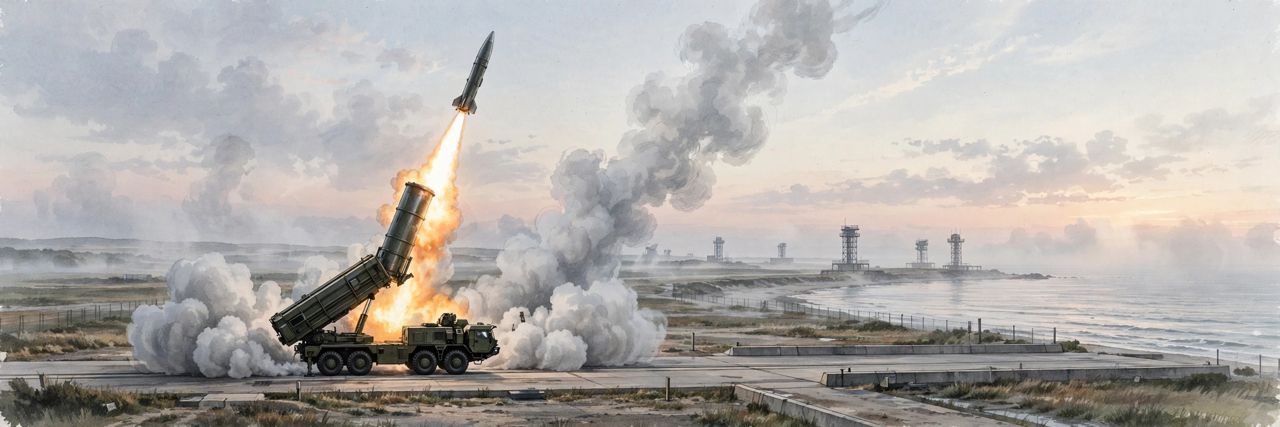
Editorial illustration: a canisterised missile launching from a mobile launcher on a coastal test range at dawn — no text, no logos, no real person.
Key Takeaways
DRDO flight-tested the Pralay quasi-ballistic missile on 5 November 2026 from Dr APJ Abdul Kalam Island off the Odisha coast, at around 11:10 am, as part of user evaluation trials.
All test objectives were fully met, according to the Defence Ministry, and the missile's induction into the armed forces is now imminent, though no date has been announced.
Pralay is a canisterised, solid-propellant, surface-to-surface missile with a reported range of 150 to 500 km, conventional warheads of up to 1,000 kg, and terminal speeds of up to Mach 6.1.
Its quasi-ballistic flight path lets it manoeuvre in flight and in the terminal phase, making it much harder for enemy air defences to intercept than a conventional ballistic missile.
The missile was developed by the Research Centre Imarat in Hyderabad with other DRDO laboratories, and Bharat Dynamics Limited manufactures the system.
On 5 November 2026, India's Defence Research and Development Organisation (DRDO) successfully flight-tested its Pralay missile from Dr APJ Abdul Kalam Island off the Odisha coast. The test, carried out at around 11:10 am as part of user evaluation trials, met all its objectives — and, in the words of the Defence Ministry, has made the missile's induction into the armed forces imminent. But what is the Pralay missile, and why does this test matter? In short, Pralay is an indigenously developed, canisterised, short-range quasi-ballistic missile designed to strike high-value targets 150 to 500 kilometres away with conventional warheads, at terminal speeds of up to Mach 6.1 — more than six times the speed of sound.
This article explains what happened on 5 November, what the Pralay missile can do, why its flight path makes it hard to intercept, and what its induction would mean for India's armed forces.
What happened on 5 November 2026?
DRDO conducted the flight test of the indigenously developed Pralay missile from Dr APJ Abdul Kalam Island at around 11:10 am on Thursday, 5 November 2026. The test was part of user evaluation trials — the stage in which the armed forces themselves assess a weapon before it is formally taken into service. According to the Ministry of Defence, all the test objectives were fully met, as confirmed by data captured by range instruments deployed by the Integrated Test Range at Chandipur.
Defence Minister Rajnath Singh announced the result on X, saying the test had "successfully met all the stipulated objectives, as validated by data captured through various range instruments", and congratulated the scientists, defence personnel and industry partners involved. Senior DRDO officials, industry representatives and members of the armed forces were present for the flight test. The ministry said that with this successful test, "the induction of the system has become imminent" — though it has not announced a date for formal deployment.
The government has not disclosed the exact distance flown or the payload configuration used in this particular test, so the published range and payload figures should be understood as the missile system's reported specifications, not measurements confirmed for this individual flight.
What is the Pralay missile?
Pralay — the name means "apocalypse" — is a canisterised, solid-propellant, surface-to-surface quasi-ballistic missile. It was developed by the Research Centre Imarat in Hyderabad, working with other DRDO laboratories, and Bharat Dynamics Limited, one of the programme's development-cum-production partners, has manufactured the system. It combines technologies developed for the Prahaar tactical missile and the Prithvi Defence Vehicle interceptor programme.
Its headline specifications, as reported by the Defence Ministry and major news organisations, are:
- **Range:** 150 to 500 kilometres
- **Payload:** conventional warheads of up to 1,000 kg, with different warhead types — including high-explosive fragmentation, penetration-cum-blast and runway-denial submunitions — depending on the target
- **Speed:** terminal speeds of up to Mach 6.1, roughly 7,400 km per hour
- **Accuracy:** designed to land within about ten metres of its intended point
Because it is canisterised — sealed in a launch canister on a mobile launcher — Pralay can be stored ready for use, moved quickly and launched with a short preparation time. It is a tactical weapon, meant for conventional strikes against high-value military targets such as airfields, command centres, radar stations and logistics hubs, rather than a strategic nuclear delivery system.
What makes a quasi-ballistic missile hard to stop?
A conventional ballistic missile follows a predictable high arc: it climbs out of the atmosphere, coasts, and falls back onto its target. Air defence systems can calculate that arc and try to meet it. Pralay is called "quasi-ballistic" because it flies a lower, flatter path inside the atmosphere and can manoeuvre during flight, including in the terminal phase as it dives onto its target.
That manoeuvring is the point. By changing course in mid-flight and in the last seconds before impact, Pralay makes it far harder for enemy air defences to predict where it will be and to intercept it. Combined with a terminal speed above Mach 5, the missile covers 500 kilometres in roughly seven to eight minutes, leaving defenders very little time to react. Defence reporting on the programme notes that Pralay was developed with an eye on comparable short-range systems fielded by China and Pakistan, and that it is intended to give India a fast, precise conventional strike option against targets close to the border.
How does Pralay fit into India's missile programme?
Pralay is not a one-off experiment. It was first tested in December 2021, when the missile followed a quasi-ballistic trajectory and hit a designated target 400 kilometres away. In late 2025, DRDO carried out a salvo launch of two Pralay missiles from a single mobile launcher, demonstrating that more than one missile can be fired in quick succession from the same platform.
The missile is reported to be part of plans for an Integrated Rocket Force, alongside the Nirbhay cruise missile, the BrahMos supersonic cruise missile and the Pinaka multi-barrel rocket system — a dedicated force for conventional long-range precision strikes. Pralay's role in that mix is the short-range, high-speed strike: closer and faster than a cruise missile, but far more precise and harder to stop than conventional artillery rockets.
The programme also fits India's wider push to build its own weapons rather than import them. Pralay is entirely indigenous in design, and its production involves Indian public-sector and private industry. That is the same self-reliance drive behind [India's Rs 3 lakh crore defence production target for 2029](https://indiaask.tech/question.php?slug=india-defence-production-3-lakh-crore-2029-explained), which tracks how much of the country's military equipment is now made at home.
Why does the test matter for India?
First, it clears the last major hurdle before induction. User evaluation trials are the final check before a weapon enters service, and the Defence Ministry's statement that induction is now "imminent" signals that the armed forces are satisfied with the system's performance. DRDO chief Dr Samir V Kamat had earlier indicated that user trials would conclude in 2026, paving the way for induction.
Second, it adds a capability India has not had before in this form: a road-mobile, quick-reaction missile that can hit targets up to 500 kilometres away with high precision and is designed to defeat modern air defences. For the Army and the Air Force, which are both reported to be the intended users, that means a credible conventional deterrent against high-value targets without crossing the nuclear threshold.
Third, it strengthens India's defence-industrial base. Every successful indigenous system reduces dependence on imports, keeps production and maintenance jobs in India, and builds the engineering experience needed for the next generation of weapons. The induction process itself runs through the normal procurement system — the same route as the [Rs 2.12 lakh crore defence package approved by the Defence Acquisition Council](https://indiaask.tech/question.php?slug=dac-defence-package-2-12-lakh-crore-explained) — so Pralay's entry into service will also be watched as a test of how quickly indigenous systems move from trial to deployment.
What happens next?
The immediate next step is formal induction into the armed forces, but no date has been announced, and the government has not said how many units will be acquired or which service will receive them first. What is clear is that the user trials are complete and successful, and that production by Bharat Dynamics Limited is already under way as the development-cum-production partner.
Watch for three things: an official induction announcement and the first unit to be equipped; any further tests, including salvo launches that would confirm the system can be fired in numbers; and whether the range is extended, as further work is reported to be in progress to add a few hundred more kilometres to Pralay's reach.
Conclusion
The 5 November 2026 test was a quiet milestone rather than a dramatic one: no new missile was unveiled, and no target was named. Its significance is that a weapon India has been developing since the early 2010s has now passed its final evaluation. Pralay gives the armed forces a fast, precise, hard-to-intercept conventional strike option at ranges of 150 to 500 kilometres, built entirely in India. If induction follows as the Defence Ministry expects, it will be one of the clearest examples yet of an indigenous system moving from the test range to the front line — and a marker of how far India's missile programme has come since the first Pralay test in December 2021.
Sources: the test was announced by Defence Minister Rajnath Singh and reported by [The Hindu](https://www.thehindu.com/news/national/drdo-conducts-flight-test-of-pralay-the-indigenously-developed-quasi-ballistic-missile/article71670670.ece) and the [Times of India](https://timesofindia.indiatimes.com/defence/news/drdo-conducts-successful-test-of-quasi-ballistic-missilepralay-that-can-carry-different-payloads-induction-imminent/articleshow/135580243.cms) on 5 November 2026, with specifications also reported by the Deccan Herald and DD India.
Pralay is an indigenously developed, canisterised, short-range quasi-ballistic missile built by DRDO. It is a surface-to-surface missile designed to strike high-value military targets 150 to 500 kilometres away with conventional warheads, at terminal speeds of up to Mach 6.1. It was developed by the Research Centre Imarat in Hyderabad with other DRDO laboratories, and Bharat Dynamics Limited manufactures the system.
What was tested on 5 November 2026?
On 5 November 2026, DRDO flight-tested the Pralay missile from Dr APJ Abdul Kalam Island off the Odisha coast at around 11:10 am, as part of user evaluation trials. The Defence Ministry said all test objectives were fully met, as confirmed by data from range instruments at the Integrated Test Range, Chandipur, and that the missile's induction into the armed forces is now imminent.
What is the range and speed of the Pralay missile?
The Pralay missile has a reported range of 150 to 500 kilometres and can carry conventional warheads of up to 1,000 kg, with different warhead types depending on the target. It reaches terminal speeds of up to Mach 6.1, more than six times the speed of sound, and is designed to land within about ten metres of its intended point.
When will the Pralay missile join the armed forces?
No date has been announced, but the Defence Ministry said after the 5 November 2026 test that induction has become imminent, because user evaluation trials — the final hurdle before a weapon enters service — were completed successfully. The Army and the Air Force are reported to be the intended users, and Bharat Dynamics Limited is the production partner.