Home > Science & Environment > Japan Earthquake Today: 6.1 Magnitude Quake Strikes Off Tokyo Coast, No Tsunami Alert — What Happened
Japan Earthquake Today: 6.1 Magnitude Quake Strikes Off Tokyo Coast, No Tsunami Alert — What Happened
By Vijay Pawar · 2026-11-06 · 7 min read · Science & Environment
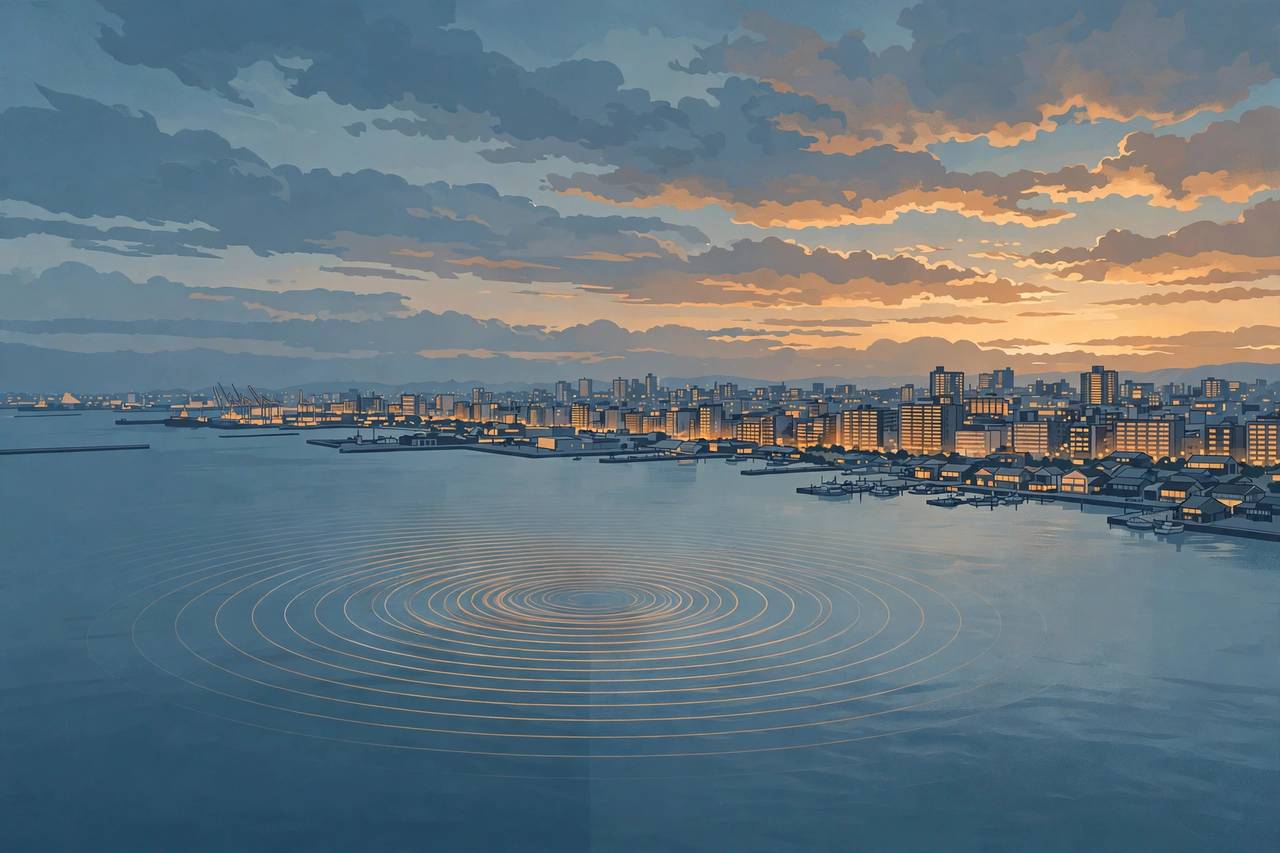
Editorial illustration: a coastal Japanese city skyline at dusk seen across a bay, with stylised seismic ripple waves spreading across the water — no text, no logos, no real person.
Key Takeaways
A magnitude 6.1 earthquake struck the sea off Japan's Kanto region at 7:39 pm local time (4:09 pm IST) on 6 November 2026, with its epicentre about 169 km southeast of Asahi, east of Tokyo.
No tsunami alert was issued: the Japan Meteorological Agency said only slight sea-level changes were possible and there was no concern about damage.
The quake registered a maximum seismic intensity of 3 on Japan's 0-to-7 scale — felt indoors across Miyagi, Fukushima and Ibaraki prefectures, with buildings swaying slightly in Tokyo — and no damage or injuries were reported.
The JMA put the depth at about 10 km, while India's National Centre for Seismology recorded 40 km; such differences between agencies are common in the first hours after a quake.
Japan sits on the Pacific Ring of Fire where four tectonic plates converge, which is why it records more than a thousand noticeable tremors a year and builds its cities and warning systems around that risk.
A Japan earthquake today shook the coast off Tokyo on Friday, 6 November 2026, when a magnitude 6.1 tremor struck the sea off the country's Kanto region in the evening. The Japan Meteorological Agency (JMA) said the shallow quake hit at 7:39 pm local time (4:09 pm IST), and no tsunami alert was issued. There were no immediate reports of damage or injuries, and buildings in Tokyo swayed slightly as the tremor was felt across the region.
This article explains what happened, where exactly the quake struck, why no tsunami warning was issued, and why Japan — and India — watch such tremors so closely.
What happened off Tokyo on 6 November 2026?
The earthquake struck at 7:39 pm Japan Standard Time on Friday, 6 November 2026 — 10:39 GMT and 4:09 pm in India. The Japan Meteorological Agency said the shallow quake occurred in the sea off the coast of the Kanto region, the eastern part of Japan's main island of Honshu that includes Tokyo. Its epicentre was about 169 kilometres (105 miles) southeast of Asahi, a city just east of the capital, according to the United States Geological Survey (USGS). India's National Centre for Seismology (NCS) also reported the tremor, placing it at 4:09:29 pm IST with its epicentre at latitude 35.087° North and longitude 142.254° East.
The JMA put the depth of the quake at about 10 kilometres, which counts as shallow — shallow quakes are usually felt more strongly at the surface than deep ones of the same magnitude. India's NCS recorded the depth differently, at 40 kilometres; such differences between agencies are common in the first hours after a quake, because each agency uses its own network of sensors and calculation methods.
The shaking was measured at a maximum seismic intensity of 3 on Japan's 0-to-7 scale in parts of Miyagi, Fukushima and Ibaraki prefectures. On that scale, intensity 3 means almost everyone indoors feels the shaking and dishes on shelves may rattle. Tremors were felt in central Tokyo, where buildings swayed slightly, and the shaking also reached Urayasu in Chiba prefecture, the city that is home to Tokyo Disneyland, at an intensity of 2. No damage to the theme parks was reported.
Why was there no tsunami warning?
The first question after any offshore quake near Japan is always about a tsunami — and in this case the answer was reassuring. The Japan Meteorological Agency did not issue a tsunami alert, and said that while the quake might cause slight sea-level changes along the Japanese coast, there was no concern about damage.
Whether a quake generates a tsunami depends on more than its magnitude. A tsunami is most likely when a large quake shifts the sea floor vertically by a big amount, usually in a shallow subduction-zone rupture. A magnitude 6.1 quake, even a shallow one, is generally below the size that produces a damaging tsunami, and the JMA's instruments and models evidently showed no significant sea-floor displacement. The agency's call was confirmed by the absence of any tsunami warning from other agencies as well, and no tsunami was observed.
It is worth remembering that "no tsunami alert" does not mean the sea was completely unaffected — the JMA itself noted that slight changes in sea level were possible. But for people on the coast, the official position was clear: no evacuation, no damage expected from the sea.
Why does Japan get so many earthquakes?
Japan sits on the Pacific Ring of Fire, the horseshoe-shaped belt around the Pacific Ocean where several of the Earth's tectonic plates meet and grind against each other. Four plates converge around Japan — the Pacific, Philippine Sea, Eurasian and North American plates — which makes the country one of the most earthquake-prone places on Earth. Japan records more than a thousand noticeable tremors every year, and its buildings, early-warning systems and public drills are designed around that reality.
The Kanto region, where this quake struck, is especially closely watched. It sits near the junction of plates beneath Tokyo Bay, and the region has a long seismic history, including the Great Kanto Earthquake of 1923. That is why even a moderate offshore tremor like this one triggers an immediate assessment from the JMA and wide news coverage.
Japan measures earthquakes in two ways, which often confuses readers abroad. Magnitude — in this case 6.1 — describes the total energy released at the source. The seismic intensity scale, or shindo, describes how strongly the shaking is actually felt at a particular place, from 0 to 7. A magnitude 6.1 quake far offshore can register only intensity 3 on land, which is exactly what happened here: strong enough to feel, not strong enough to damage well-built structures.
What does this mean for India?
For India, a quake off Tokyo matters in three ways. First, the National Centre for Seismology tracks major tremors worldwide, and its reporting of this quake — including its own depth reading of 40 kilometres — is part of the global seismic monitoring network that India contributes to and relies on. Second, a large Indian community lives and works in Tokyo and the wider Kanto region, and families back home look for reliable information within minutes of such news. Third, India and Japan cooperate closely on disaster management, early-warning technology and resilient infrastructure, so Japanese experience with frequent quakes feeds directly into India's own preparedness work in seismic zones such as the Himalayas and the Andaman region.
For readers in India, the practical takeaway is simple: a magnitude 6.1 quake off Tokyo, with no tsunami warning and no reported damage, is a reminder of how the Pacific Ring of Fire behaves — frequent, sometimes strong, but not every tremor becomes a disaster. The systems built around that risk, from the JMA's rapid bulletins to Japan's strict building codes, are what keep a 6.1 offshore quake a news story rather than a tragedy.
What happens next?
The JMA and the USGS will continue to refine the quake's measurements as more sensor data comes in, and the depth and epicentre figures may be adjusted slightly. Aftershocks are possible after a quake of this size, though they are usually smaller than the main shock and fade over days. No tsunami warning is in force, and no damage has been reported, so for now the story ends where it began: a strong shake off the Kanto coast, felt in Tokyo, and a calm official response.
For more on how earthquakes are measured and reported in India, read our explainer on the [5.1 magnitude earthquake in the Andaman Sea in October 2026](https://indiaask.tech/question.php?slug=andaman-sea-earthquake-5-1-magnitude-october-2026-explained). For how India tracks and prepares for natural disasters at home, see our explainer on [Cyclone Murasu's landfall near Ongole](https://indiaask.tech/question.php?slug=cyclone-murasu-landfall-ongole-2-november-2026-explained).
Conclusion
The Japan earthquake today — a magnitude 6.1 tremor off the Tokyo coast at 7:39 pm local time on 6 November 2026 — was felt across the Kanto region, including in the capital, but caused no reported damage or injuries and triggered no tsunami alert. Its epicentre lay about 169 kilometres southeast of Asahi, and it registered a maximum intensity of 3 on Japan's seven-point scale. For a country on the Ring of Fire, it was a familiar event handled by familiar systems: quick detection, a clear public message, and no reason to panic.
Sources: [Channel News Asia](https://www.channelnewsasia.com/east-asia/japan-tokyo-quake-kanto-region-6531296), [The Japan Times](https://www.japantimes.co.jp/news/2026/11/06/japan/tokyo-shallow-quake/), [Moneycontrol](https://www.moneycontrol.com/world/magnitude-6-1-earthquake-strikes-off-tokyo-coast-no-tsunami-alert-issued-article-14073404.html/amp)
A magnitude 6.1 earthquake struck off the coast of Tokyo, in the sea off Japan's Kanto region, at 7:39 pm local time (4:09 pm IST) on Friday, 6 November 2026. Its epicentre was about 169 kilometres southeast of Asahi, east of Tokyo. The Japan Meteorological Agency recorded a maximum seismic intensity of 3 on Japan's 0-to-7 scale, and no tsunami alert was issued.
Was there a tsunami warning after the Tokyo earthquake?
No. The Japan Meteorological Agency did not issue a tsunami alert after the 6.1 magnitude quake off Tokyo on 6 November 2026. The agency said the quake might cause slight sea-level changes along the coast, but there was no concern about damage. A magnitude 6.1 quake is generally below the size that produces a damaging tsunami.
What is the difference between magnitude 6.1 and seismic intensity 3?
Magnitude measures the total energy released at the quake's source — here 6.1. Japan's seismic intensity scale (shindo, 0 to 7) measures how strongly shaking is felt at a particular place. This quake registered intensity 3 at its strongest, meaning almost everyone indoors feels the shaking and dishes on shelves may rattle. A quake far offshore can have a high magnitude but a low intensity on land.
Why does Japan have so many earthquakes?
Japan sits on the Pacific Ring of Fire, where four tectonic plates — the Pacific, Philippine Sea, Eurasian and North American plates — converge. That makes it one of the most earthquake-prone countries in the world, with more than a thousand noticeable tremors every year. Its buildings, early-warning systems and public drills are designed around that reality.