Home > Economy > Why Did India Give a $500 Million Line of Credit to Guyana? Roads, Health and Defence Explained
Why Did India Give a $500 Million Line of Credit to Guyana? Roads, Health and Defence Explained
By Vijay Pawar · 2026-11-06 · 9 min read · Economy
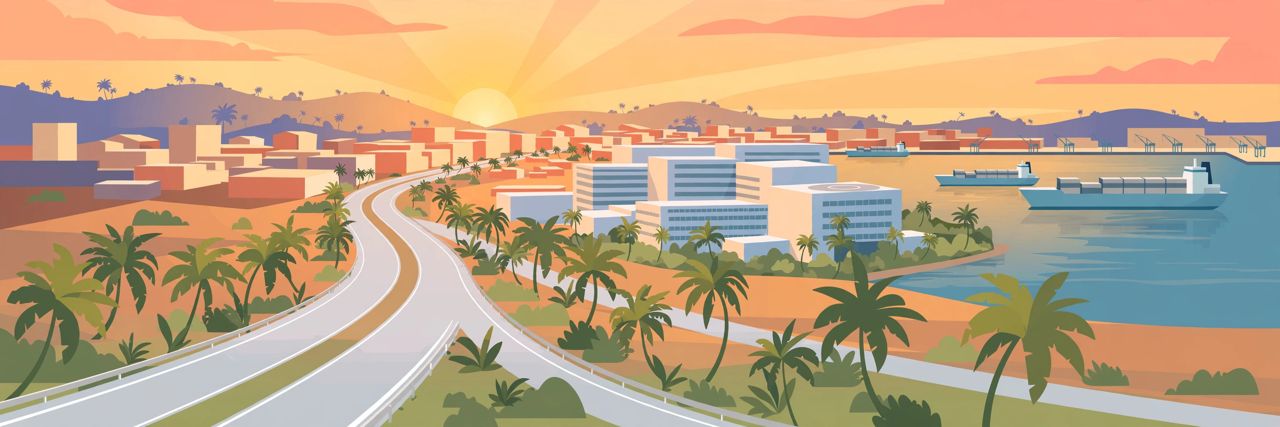
Editorial illustration: a new highway and modern hospital buildings in a tropical Caribbean coastal city at sunset, with cargo ships in the harbour — no text, no logos, no real person.
Key Takeaways
On 5 November 2026, S. Jaishankar announced a $500 million line of credit to Guyana for roads, health and defence after meeting President Mohamed Irfaan Ali at CHOGM in Antigua and Barbuda.
A line of credit is a loan, not a gift: Guyana will draw on the money as projects are approved and repay it over time, on terms that have not been disclosed.
Three agreements were signed alongside: micro and small enterprise manufacturing projects, grant assistance for Quick Impact Projects, and cooperation on digital public infrastructure including a UPI-like payment system.
The package fulfils a commitment from Prime Minister Narendra Modi's November 2024 visit to Guyana and builds on earlier Indian-assisted projects such as a cricket stadium and traffic lights in Georgetown.
The credit line is a commitment, not completed investment: the project list and the terms are yet to be announced, so its real impact will depend on delivery.
Why did India give a $500 million line of credit to Guyana? On 5 November 2026, External Affairs Minister S. Jaishankar announced that India would extend a $500 million (about Rs 4,700 crore) line of credit to Guyana for roads, health and defence projects. He made the announcement after meeting Guyanese President Dr Mohamed Irfaan Ali on the sidelines of the Commonwealth Heads of Government Meeting (CHOGM) in St. John's, Antigua and Barbuda. The two countries also signed three agreements covering small-enterprise manufacturing, community-level grants and digital payments cooperation, including a UPI-like system for Guyana.
This article explains what a line of credit is, what the $500 million will pay for, why Guyana matters to India, and what is still not clear about the deal.
What happened on 5 November 2026?
External Affairs Minister S. Jaishankar met President Dr Mohamed Irfaan Ali on the sidelines of CHOGM 2026 in Antigua and Barbuda on Wednesday, 5 November 2026. After the meeting, Jaishankar announced the extension of a $500 million line of credit for roads, health and defence projects in Guyana, and said the two governments would now work on developing projects under the financing arrangement.
In a post on X after the meeting, Jaishankar wrote that he had reviewed the steady progress in bilateral cooperation, especially after Prime Minister Narendra Modi's visit to Guyana in 2024, and announced the extension of the $500 million line of credit for roads, health and defence projects. A statement from the Ministry of External Affairs said the two leaders discussed ways to strengthen cooperation in trade and investment, energy, agriculture, infrastructure development, digital technology and capacity building.
President Ali welcomed the credit facility and said it would finance transformative investments in Guyana's road infrastructure, healthcare and defence sectors. He said the roads would open up thousands of new homes and house lots, and that improvements to main highways were also planned. According to Guyana's Department of Public Information, the financing marks the next phase of India's investment cooperation with Guyana and fulfils a commitment made by Prime Minister Modi during his visit to the country in November 2024.
Why did India give a $500 million line of credit to Guyana?
The short answer is that the credit line is part of India's development partnership with Guyana, a country with which India shares deep historical and cultural ties and a growing strategic relationship. India has already completed several development projects in Guyana, and the Ministry of External Affairs said the new line of credit will further strengthen the development partnership between the two countries.
Guyana is a resource-rich country on the northern coast of South America and a member of the Caribbean Community. It has a large population of Indian origin, and the relationship between the two countries goes back a long way. In recent years, the partnership has expanded well beyond those traditional ties into trade, investment, energy, agriculture, infrastructure, manufacturing and digital technology.
There is also a wider regional reason. The announcement reflects India's growing engagement with Latin America and the Caribbean, a region where New Delhi has been trying to build deeper economic and development partnerships. The CHOGM meeting itself was a platform for that outreach: Jaishankar also used the summit to call on Commonwealth countries to diversify their supply chains and build stronger economic partnerships. The Guyana package — credit plus manufacturing, grants and digital cooperation — is an example of how India combines development financing with technical cooperation rather than relying on one form of assistance alone.
What is a line of credit?
A line of credit, often shortened to LoC, is a loan arrangement in which one country makes a fixed amount of money available to another country for agreed purposes, and the borrowing country draws on it as specific projects are approved. It is not a gift or a grant: the money has to be repaid, usually over a long period and on concessional terms. The exact terms, such as the interest rate and repayment period, are agreed between the two governments and the Export-Import Bank of India, which typically administers India's lines of credit.
For the borrowing country, a line of credit is useful because it provides assured, long-term financing for large projects that might otherwise be hard to fund. For the lending country, it supports its own companies and expertise: projects financed by Indian lines of credit often involve Indian goods, services and technology. In Guyana's case, the money is earmarked for roads, health and defence, and the two governments will now decide which specific projects it will fund.
What will the $500 million pay for?
The credit line is meant for three broad areas: roads, health and defence. President Ali said the road projects would include main highways and roads that open up thousands of new homes and house lots. On health, he said the support would help Guyana embrace Prime Minister Modi's health initiative, including affordable medication, the transfer of technology and the integration of healthcare services. Defence and security projects are also covered, though no specific projects have been named yet.
It is important to be clear about what has not been announced. The terms of the credit line, its repayment period and the list of projects to be financed have not been disclosed. The announcement is a commitment to extend the facility; the money will flow as projects are identified and approved. That is normal for a line of credit, but it means readers should not treat the $500 million as money already spent or as completed investment.
The three agreements signed alongside the credit line
Alongside the credit announcement, India and Guyana signed three agreements, each covering a different part of the development partnership:
First, an agreement on the supply and installation of micro and small enterprise (MSE) manufacturing projects. This is aimed at building small-scale industrial and manufacturing capacity in Guyana, so that the country can produce more goods locally instead of importing them.
Second, an agreement on grant assistance for the implementation of Quick Impact Projects. Unlike the line of credit, these are grants — money that does not have to be repaid — meant for small, community-level projects that deliver visible benefits quickly.
Third, an agreement on cooperation in Digital Public Infrastructure, including the functioning of a UPI-like payment system in Guyana. This is one of the most closely watched parts of the package. India's Unified Payments Interface (UPI) has become a model for low-cost digital payments, and several countries have shown interest in building similar systems with Indian help. The agreement will explore how a UPI-style system can work in Guyana.
Together, the credit line and the three agreements show India using a mix of tools — loans, grants, manufacturing support and digital cooperation — to deepen its partnership with Guyana.
What has India built in Guyana before?
The new credit line builds on earlier Indian-assisted projects in Guyana. Over the years, Guyana has benefited from Indian loans and lines of credit for infrastructure, healthcare and education, including a cricket stadium, traffic lights in Georgetown and the supply of 14 irrigation and drainage pumps. The Ministry of External Affairs has said India has already completed several development projects in the country, and the latest commitment is expected to add momentum to that cooperation.
The relationship also has a strong people-to-people dimension. Guyana has one of the largest Indian-origin populations in the Caribbean, and cultural and family ties between the two countries run deep. That shared history is part of why the partnership has been able to grow from cultural links into trade, energy, digital technology and defence cooperation.
What does the Guyana credit line mean for India?
For India, the $500 million line of credit is a statement of intent in the Caribbean and Latin America. It strengthens New Delhi's role as a development partner in a region where countries are looking for financing and technology that comes without heavy political conditions. It also supports Indian companies and expertise in areas such as roads, healthcare and digital payments, and it gives India a closer partner in a resource-rich country whose economy has been growing fast on the back of its oil discoveries.
There are limits to what one announcement can do. The credit line is a commitment, not completed investment, and its real impact will depend on which projects are chosen, how quickly they are executed and whether Guyana can absorb the financing well. The UPI-like payments system is also at the cooperation stage, not yet operational. Even so, the package announced on 5 November 2026 is the largest single element of the India-Guyana engagement so far, and it signals that both countries want the relationship to keep growing.
For more on how India conducts its diplomacy at major summits, read our explainer on [Jaishankar's recent G20, Quad and CHOGM engagements](https://indiaask.tech/question.php?slug=jaishankar-atlanta-g20-quad-chogm-visit-explained). For how India structures its economic partnerships with other countries, see our explainer on the [India-Mexico preferential trade agreement](https://indiaask.tech/question.php?slug=india-mexico-preferential-trade-agreement-explained).
Conclusion
India's $500 million line of credit to Guyana, announced on 5 November 2026, is a development partnership package: money for roads, health and defence, plus three agreements on small-enterprise manufacturing, community grants and a UPI-like digital payments system. It fulfils a commitment from Prime Minister Modi's 2024 visit and builds on projects India has already completed in Guyana. The terms and the project list are yet to be disclosed, so the real test will be in the delivery — which roads get built, which health projects get funded and whether the digital payments cooperation turns into a working system. For now, the announcement marks a clear step up in India's engagement with Guyana and the wider Caribbean.
Sources: [The Hindu](https://www.thehindu.com/news/national/india-announces-extension-of-500-million-line-of-credit-for-guyana/article71668982.ece), [DD India](https://ddindia.co.in/2026/11/jaishankar-meets-guyana-president-announces-extension-of-new-500-million-line-of-credit/), [Guyana Department of Public Information](https://dpi.gov.gy/india-extends-us500m-line-of-credit-to-guyana/).
Why did India give a $500 million line of credit to Guyana?
On 5 November 2026, External Affairs Minister S. Jaishankar announced a $500 million line of credit to Guyana for roads, health and defence projects after meeting President Dr Mohamed Irfaan Ali on the sidelines of the Commonwealth Heads of Government Meeting in Antigua and Barbuda. It is part of India's development partnership with Guyana and fulfils a commitment made during Prime Minister Narendra Modi's visit to Guyana in November 2024.
What is a line of credit, and is the $500 million a gift?
A line of credit is a loan arrangement: one country makes a fixed sum available to another for agreed purposes, and the borrowing country draws on it as specific projects are approved. It is not a gift or a grant — the money has to be repaid, usually over a long period and on concessional terms. The exact terms of the Guyana credit line have not been disclosed.
What are the three agreements India and Guyana signed?
Three agreements were signed: one on the supply and installation of micro and small enterprise manufacturing projects, one on grant assistance for Quick Impact Projects in communities, and one on cooperation in Digital Public Infrastructure, including a UPI-like payment system in Guyana.
What will the $500 million be used for, and what is still unclear?
The money is earmarked for roads, health and defence. President Ali said the roads would open up thousands of new homes and house lots and improve main highways, while the health support covers affordable medication, technology transfer and integration of healthcare services. The specific project list, the terms and the repayment period have not been disclosed, and the money will flow as projects are approved.