Home > Economy > Karnataka Bus Fare Hike: What Are the New BMTC and KSRTC Rates From 5 November?
Karnataka Bus Fare Hike: What Are the New BMTC and KSRTC Rates From 5 November?
By Vijay Pawar · 2026-11-05 · 7 min read · Economy
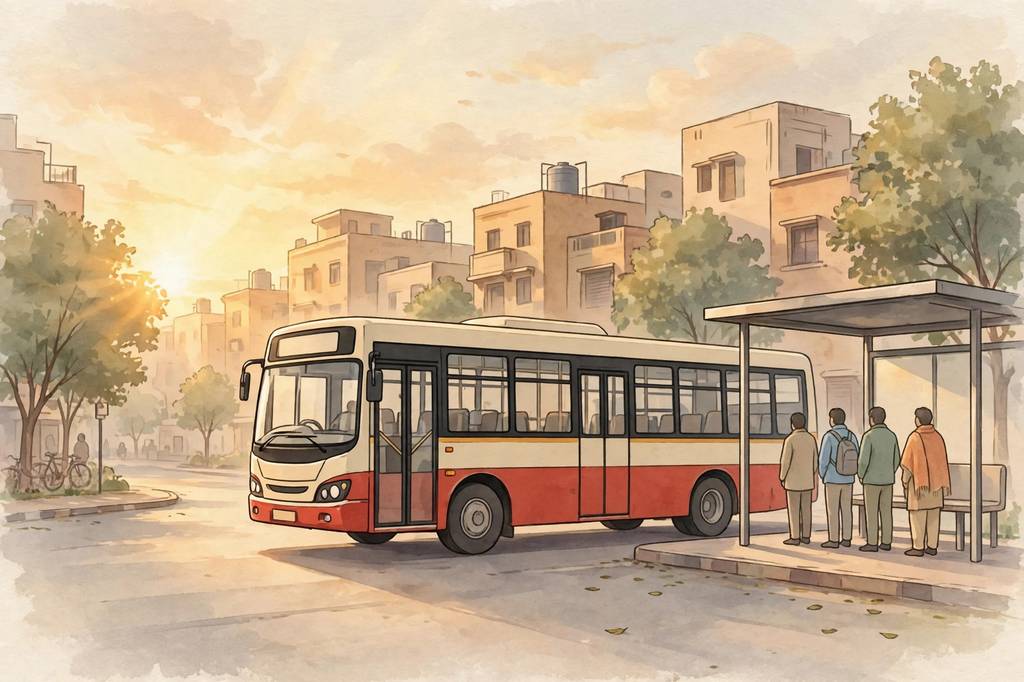
Editorial illustration: a generic red-and-cream city bus at a bus stop on an Indian city street at dawn, passengers waiting in soft morning light — no text, no logos, no real person.
Key Takeaways
Karnataka has raised bus fares across all four state-run transport corporations from 5 November 2026, announced on 4 November by Transport Minister Byrathi Suresh.
BMTC fares rise 32–35% on average: the minimum city fare goes from Rs 6 to Rs 10 and the maximum from Rs 35 to Rs 45.
KSRTC, NWKRTC and KKRTC fares rise about 23% on average, with KSRTC ordinary fares up by up to Rs 9 and Express fares rising from Rs 81 to Rs 100.
The government cites rising diesel prices, salaries, dearness allowance and maintenance costs, and says the hike is to reduce losses, not to earn a profit.
The Shakti free-travel scheme for women is unaffected, while the opposition has called the hike illegal and announced statewide protests.
Bus travel across Karnataka is set to cost more from 5 November 2026, after the state government announced a fare hike across all four state-run transport corporations. The Karnataka bus fare hike raises average fares by about 23 percent for the Karnataka State Road Transport Corporation (KSRTC) and by 32 to 35 percent for Bengaluru's city buses run by the Bengaluru Metropolitan Transport Corporation (BMTC). For daily commuters, the change is immediate and visible: the minimum BMTC fare rises from Rs 6 to Rs 10, while the maximum city fare goes up from Rs 35 to Rs 45.
The announcement was made in Bengaluru on Wednesday, 4 November 2026, by Transport Minister Byrathi Suresh. The revised fares come into effect from the midnight between 4 and 5 November, covering KSRTC, BMTC, the North Western Karnataka Road Transport Corporation (NWKRTC) and the Kalyana Karnataka Road Transport Corporation (KKRTC).
What has changed in the new fares
The hike is not a flat percentage applied evenly to every ticket. Transport Minister Byrathi Suresh said the revision was calculated stage-wise, so the actual increase depends on the distance travelled and the type of service.
For BMTC city buses in Bengaluru, the minimum fare for short journeys of up to 2 km has jumped from Rs 6 to Rs 10, and the maximum fare has risen from Rs 35 to Rs 45. On average, BMTC fares are up by 33 to 35 percent, with some reports putting the range at 32 to 35 percent.
For KSRTC and the other two corporations, the average increase is around 23 percent. KSRTC ordinary bus fares have gone up by up to Rs 9 depending on distance, with reports indicating an increase of Rs 9 for the first five stages and Rs 18 for journeys covering up to ten stages. KSRTC Express fares rise from Rs 81 to Rs 100, while long-distance fares increase from Rs 75 to Rs 90. On routes near Bengaluru, the fare from Bengaluru to Nelamangala and Hoskote rises from Rs 35 to Rs 44, while journeys to Doddaballapura and Anekal will cost Rs 47 instead of Rs 38.
Why the government says the hike was needed
The government has blamed rising operating costs. According to the Transport Minister, diesel prices, employee salaries, dearness allowance and vehicle maintenance expenses have all gone up, while the four corporations have been running mounting losses. The minister said the fare revision was made not to earn a profit but to reduce losses and keep corporations such as KSRTC and BMTC running.
The final hike is lower than what the corporations themselves asked for. The boards of the four transport corporations had sought a fare increase of up to 90 percent, while the Public Transport Fare Regulatory Committee, chaired by retired IAS officer Atul Kumar Tiwari, had recommended a 45 percent increase. The government settled for roughly half of the committee's recommendation for KSRTC and a somewhat higher band for BMTC, where officials said financial losses were considerably higher.
How big is this hike compared to the past
By Karnataka's own recent history, this is a large revision. Between 2009 and 2025, fare revisions by the four corporations ranged from a modest 3.56 percent to a maximum of 15 percent. The latest increase is therefore more than double the highest revision seen in the previous 16 years, which is one reason it has drawn so much attention.
The timing has also added to the debate. The bus fare hike comes about a week after the state raised Nandini milk prices by Rs 8 per litre, so households in Karnataka are facing back-to-back increases in everyday costs. For a family that depends on buses for work, school and hospital visits, the combined effect of higher milk prices and higher bus fares is felt in the monthly budget, not just in a single ticket.
What stays unchanged: the Shakti scheme
One important part of the announcement is what has not changed. The minister said the fare increase has nothing to do with the Congress government's flagship Shakti guarantee scheme, under which women travel free on state-run buses. That scheme remains unaffected, so women passengers travelling under Shakti will not pay the revised fares.
This matters because Shakti is one of the most widely used welfare schemes in the state, and any suggestion that free travel would be rolled back would have caused far greater concern. The government has been clear that the hike applies to fare-paying passengers, while the free-travel benefit continues as before.
The political reaction
The decision has already triggered a political row. Leader of the Opposition R Ashok criticised the hike, calling it illegal and alleging that the government had failed to clear dues worth over Rs 5,800 crore to the Transport Department. He announced statewide protests against the increase, arguing that passengers were being made to pay for the government's failure to support the corporations.
The government, for its part, has defended the move as unavoidable. The minister pointed to other states that have also raised bus fares, including Tamil Nadu and Maharashtra, and argued that Karnataka's corporations could not continue absorbing rising diesel and salary costs without a revision.
What this means for commuters
For daily passengers, the practical impact depends on how far and how often they travel. A short BMTC ride that cost Rs 6 will now cost Rs 10, a jump of about two-thirds on the minimum fare, even though the average BMTC increase is around a third. Regular commuters who buy passes or travel long distances every day will feel the increase most in absolute rupees, while occasional travellers will notice it mainly on longer inter-city routes.
Passengers travelling ahead of Diwali should also note that private bus operators have been reported to be charging two to three times the usual rates during the festival rush. The state-run fare revision is separate from that, but together they mean that travelling in and around Karnataka in the festive week will cost noticeably more than usual.
Commuters can check the revised stage-wise fares at bus stations and on the corporations' official channels before travelling, since the increase varies by route and service type rather than applying as one uniform percentage.
Conclusion
The Karnataka bus fare hike is the state's biggest bus fare revision in over a decade and a half, driven by rising diesel prices, salary costs and accumulated losses at the four transport corporations. BMTC passengers face a 32 to 35 percent average increase, with the minimum fare rising to Rs 10, while KSRTC, NWKRTC and KKRTC passengers face an average increase of about 23 percent. The Shakti free-travel scheme for women remains untouched, but the opposition has promised protests, and the debate over whether the corporations should be supported through fares or through government funding is likely to continue. For now, passengers should plan for higher ticket prices from 5 November and check the new fare for their specific route before they travel.
Read more on related topics: [Pune Metro's Pink Line opening and what its Rs 21,800 crore expansion means for commuters](https://indiaask.tech/question.php?slug=pune-metro-pink-line-opening-rs-21800-crore-expansion-explained) and [why commercial LPG cylinder prices rose again in November 2026](https://indiaask.tech/question.php?slug=commercial-lpg-cylinder-price-rise-november-2026-explained). For the original reporting, see The Hindu's coverage of the fare revision (https://www.thehindu.com/news/national/karnataka/karnataka-hikes-bus-fares-in-bmtc-ksrtc-nwkrtc-and-kkrtc/article71664586.ece) and The Hindu BusinessLine's report (https://www.thehindubusinessline.com/news/after-milk-price-hike-karnataka-raises-bus-fares-by-up-to-35/article71665170.ece).
When do the new Karnataka bus fares come into effect?
The revised fares come into effect from the midnight between 4 and 5 November 2026, across all four state-run transport corporations: KSRTC, BMTC, NWKRTC and KKRTC.
How much have BMTC fares increased?
BMTC fares have increased by 32 to 35 percent on average. The minimum city fare has risen from Rs 6 to Rs 10, and the maximum fare from Rs 35 to Rs 45.
How much have KSRTC fares increased?
KSRTC fares, along with NWKRTC and KKRTC, have increased by about 23 percent on average. KSRTC ordinary fares are up by up to Rs 9 depending on distance, and Express fares rise from Rs 81 to Rs 100.
Is the Shakti free bus travel scheme for women affected by the hike?
No. The government has said the Shakti scheme remains unaffected, so women travelling free under Shakti will not pay the revised fares.