Home > Economy > How Much Tax Devolution Did States Get on 31 October 2026? Rs 1.09 Lakh Crore State-Wise Share Explained
How Much Tax Devolution Did States Get on 31 October 2026? Rs 1.09 Lakh Crore State-Wise Share Explained
By Vijay Pawar · 2026-11-01 · 9 min read · Economy
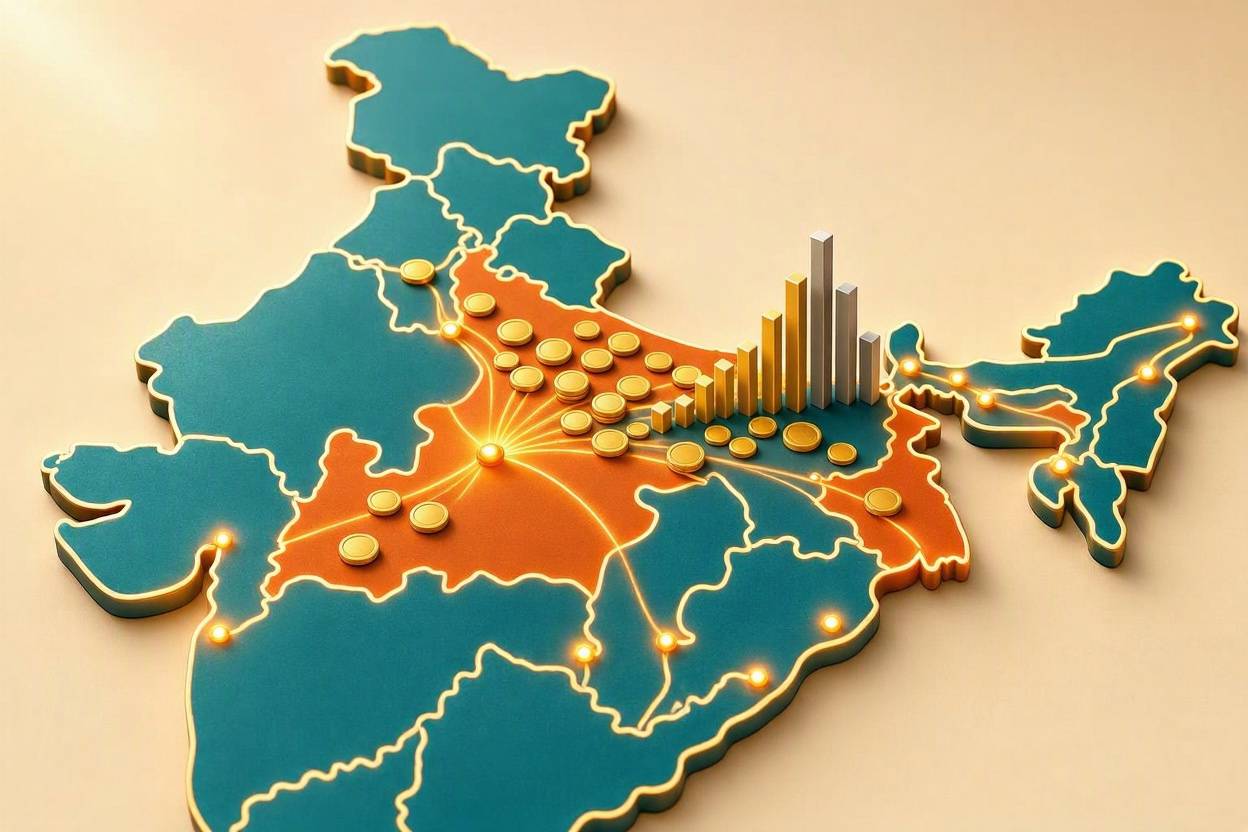
Editorial illustration: a stylised map of India with golden coins and rising bar charts flowing from New Delhi toward the states, representing the additional tax devolution release. This is an illustration, not a photograph.
Key Takeaways
The Centre released an additional Rs 1,09,019 crore in tax devolution to states on 31 October 2026, over and above regular monthly devolution — the second additional instalment of FY 2026-27.
Uttar Pradesh got the largest share at Rs 19,208 crore, followed by Bihar (Rs 10,845 crore), Madhya Pradesh (Rs 8,010 crore), West Bengal (Rs 7,866 crore) and Maharashtra (Rs 7,022 crore).
Under the current arrangement 41% of central taxes is devolved to states in 14 instalments a year; each state's share follows the Finance Commission formula.
The stated purpose is festive-season capital spending and development/welfare expenditure, giving states liquidity without changing their total annual entitlement.
The release was linked by the Finance Minister to stronger economic activity and buoyant tax collections.
How much tax devolution did states get on 31 October 2026?
The question of how much tax devolution to states was released this festive season now has a clear answer: on 31 October 2026, the Union government released an additional instalment of Rs 1,09,019 crore in tax devolution to state governments. The amount is over and above the regular monthly devolution that states receive, and it is the second additional instalment of the current financial year, 2026-27. The Finance Ministry said the release was made keeping the festive season in view, so that states can accelerate capital spending and finance development and welfare expenditure.
Uttar Pradesh received the largest share at Rs 19,208 crore, followed by Bihar at Rs 10,845 crore and Madhya Pradesh at Rs 8,010 crore. West Bengal received Rs 7,866 crore and Maharashtra Rs 7,022 crore. Every state received a share, with the smallest allocations going to Sikkim (Rs 365 crore) and Goa (Rs 398 crore). For ordinary citizens, the release matters because state governments fund a large part of everyday public services — roads, schools, hospitals, water supply and welfare schemes — and an advance instalment gives them more room to spend on these without waiting for the next monthly cycle.
What happened on 31 October 2026
According to the Finance Ministry statement reported by Business Today, CNBC-TV18 and the Press Trust of India, the Centre released Rs 1,09,019 crore as an additional instalment of tax devolution on Saturday, 31 October 2026. Finance Minister Nirmala Sitharaman announced the release on social media, describing it as the second additional instalment this financial year, supported by stronger economic activity and buoyant tax collections.
The ministry's stated reason was specific: "This release is in view of the upcoming festive season and to enable states to accelerate capital spending, and also to finance their development/welfare related expenditure." In other words, this is not a new scheme or a special grant for one state. It is an advance of money that belongs to the states under the existing tax-sharing arrangement, paid ahead of schedule so that spending is not held up during the festival period.
It is worth noting what this release is not. It does not change any state's total entitlement for the year, and it does not come from a separate fund. It is part of the same divisible pool of central taxes, released early as an additional instalment. The regular monthly devolution continues separately.
State-wise share: who got how much
The shares follow the formula recommended by the Finance Commission, which weighs factors such as population, area, income distance and demographic performance. That is why larger and lower-income states receive bigger amounts, while smaller states receive less in absolute terms.
Other significant shares included Gujarat (Rs 4,094 crore), Chhattisgarh (Rs 3,602 crore), Jharkhand (Rs 3,600 crore), Assam (Rs 3,552 crore), Kerala (Rs 2,597 crore), Telangana (Rs 2,370 crore) and Punjab (Rs 2,176 crore). Haryana received Rs 1,484 crore, Arunachal Pradesh Rs 1,476 crore, Uttarakhand Rs 1,244 crore and Himachal Pradesh Rs 996 crore. Among the smaller states, Tripura received Rs 699 crore, Meghalaya Rs 688 crore, Manipur Rs 682 crore, Mizoram Rs 615 crore, Nagaland Rs 524 crore, Goa Rs 398 crore and Sikkim Rs 365 crore.
The pattern is consistent with earlier releases: the same formula, applied to a larger-than-usual single instalment, produces the same ranking. Uttar Pradesh's share alone is larger than the combined share of all eight northeastern states in this instalment, which reflects its population weight in the formula rather than any special treatment.
What is tax devolution to states and how is it calculated?
Tax devolution is the transfer of a share of the Centre's tax revenue to state governments. Under the current arrangement, 41% of the taxes collected by the Centre — the divisible pool — is shared with states. This 41% figure comes from the 15th Finance Commission's recommendations, which apply for the 2021-26 period and continue to govern the current sharing pattern.
The money is normally released in 14 instalments during a financial year: 12 monthly instalments plus two additional ones. The additional instalments are typically released when tax collections are strong enough to allow an advance, which is exactly what happened on 31 October. The share of each state is fixed by the Finance Commission's formula and does not change from instalment to instalment; only the size of each instalment varies with collections.
It helps to distinguish tax devolution from other central transfers. Grants-in-aid, centrally sponsored schemes and Finance Commission grants for specific purposes (such as local bodies or disaster management) are separate. Devolution is untied money: once transferred, a state government can spend it according to its own budget priorities, whether that means capital works, salaries, subsidies or welfare programmes. That freedom is precisely why an advance instalment is useful — it gives states flexibility at a time when festival-season spending and year-end project deadlines pile up.
Two related points are worth understanding. First, GST is part of the tax system whose revenues feed into Centre-state finances, and changes in GST rules affect the revenues both levels of government ultimately share — our separate explainer on [GST changes from 1 November 2026](https://indiaask.tech/question.php?slug=gst-changes-november-2026-explained) covers the November amendments. Second, this devolution release sits alongside the other money changes of the season, including pensions, tax deadlines and banking charges covered in our [money rules explainer for November 2026](https://indiaask.tech/question.php?slug=money-rules-change-1-november-2026-explained).
Why an additional instalment now
Three reasons explain the timing. The first is the festive season itself. Diwali, Chhath and Bhai Dooj fall in this period, and state spending — on procurement, welfare payments, transport and public works — typically rises. An advance payment avoids a cash squeeze at exactly the moment demands peak.
The second reason is the state of tax collections. The Finance Minister linked the release to stronger economic activity and buoyant collections, and the fact that this is the second additional instalment of the year (after an identical Rs 1,09,019 crore additional release in August, as reported) suggests collections have stayed ahead of the monthly schedule. When collections run ahead, the Centre can release the additional instalments without borrowing extra.
The third reason is capital spending. The ministry explicitly tied the release to accelerating capital expenditure — roads, bridges, irrigation, urban infrastructure and other assets that create long-term value. Capital spending by states has a multiplier effect: it supports construction jobs, material suppliers and local businesses, and it is often the first item to be cut when states face a cash crunch. An advance instalment protects it.
What this means for states and citizens
For state governments, the immediate effect is liquidity. A state like Bihar, receiving Rs 10,845 crore in one instalment, can clear pending contractor bills, release welfare payments on time and keep infrastructure projects moving without resorting to short-term borrowing. For smaller states, even a few hundred crore matters: Meghalaya's Rs 688 crore or Tripura's Rs 699 crore can cover a significant part of a month's development spending.
For citizens, the effects are indirect but real. Better state liquidity means fewer delays in payments that people depend on — pensions, scholarships, subsidies and wages for scheme workers — and steadier progress on public works. It does not mean new schemes are announced with this money; the money funds the budgets states have already passed.
There is also a fiscal context worth keeping in mind. India's fiscal deficit for the first six months of 2026-27 (April-September) stood at Rs 7.14 lakh crore, about 42.1% of the full-year budget estimate of Rs 16.96 lakh crore, with revenue receipts budgeted at Rs 17.57 lakh crore. Releasing devolution early does not worsen the Centre's deficit — it is a transfer of revenue, not new spending — but it does show that the Centre is comfortable with the pace of collections so far this year.
What to watch next
Two things will show whether this release delivers its intended effect. The first is state capital spending in the October-December quarter: if utilisation rises, the advance will have done its job. The second is the next regular instalment cycle and any further additional release before the end of the financial year in March 2027. If collections remain strong, another additional instalment is possible; if they weaken, states will have to manage with the regular schedule.
Readers should also watch for the 16th Finance Commission's recommendations, which will set the sharing formula for the next five-year period. Any change in the 41% vertical share or in the horizontal formula between states would reshape every figure in the table above — which is why this instalment, large as it is, is still only one chapter in a longer fiscal story.
Conclusion
The Rs 1,09,019 crore additional tax devolution released on 31 October 2026 is a straightforward but significant fiscal event: money that belongs to the states, paid early, to support festive-season spending and capital works. Uttar Pradesh, Bihar and Madhya Pradesh received the largest shares, every state received something, and the release is the second such advance this financial year. For citizens, its value will be judged not by the headline figure but by whether roads get built, bills get paid and welfare reaches people on time in the months that follow.
Sources: Finance Ministry statement as reported by Business Today (https://www.businesstoday.in/latest/economy/story/centre-releases-rs1-09-lakh-crore-additional-tax-devolution-to-states-ahead-of-festive-season-up-gets-largest-share-564962-2026-10-31) and ET Now (https://www.etnownews.com/news/centre-releases-additional-rs-1-09-lakh-crore-to-states-ahead-of-festive-season-check-state-wise-allocation-article-156443161), with state-wise figures cross-checked against Deccan Herald and CNBC-TV18/PTI reports.
How much additional tax devolution did states get on 31 October 2026?
On 31 October 2026, the Union government released an additional instalment of Rs 1,09,019 crore in tax devolution to state governments, over and above the regular monthly devolution. It is the second additional instalment of financial year 2026-27.
What is tax devolution and how is a state's share decided?
Tax devolution is the transfer of a share of the Centre's tax revenue to states. Under the current arrangement, 41% of central taxes (the divisible pool) is shared with states, normally in 14 instalments a year. The share of each state is fixed by the Finance Commission's formula, which weighs population, area, income distance and demographic performance.
Which state received the largest share of the tax devolution?
Uttar Pradesh received the largest share at Rs 19,208 crore, followed by Bihar (Rs 10,845 crore), Madhya Pradesh (Rs 8,010 crore), West Bengal (Rs 7,866 crore) and Maharashtra (Rs 7,022 crore). The smallest shares went to Sikkim (Rs 365 crore) and Goa (Rs 398 crore).
Why did the Centre release an additional instalment now?
The Finance Ministry said the release was made in view of the festive season, to enable states to accelerate capital spending and finance development and welfare expenditure. It is an advance of money states are already entitled to, not a new scheme or special grant, and it gives states flexibility when festival-season spending peaks.