Home > General Knowledge > What Is FSSAI's Nationwide Food Safety Crackdown? 56,000 Inspections, 1,133 Licences Suspended and 3,280 Tonnes Seized Explained
What Is FSSAI's Nationwide Food Safety Crackdown? 56,000 Inspections, 1,133 Licences Suspended and 3,280 Tonnes Seized Explained
By Vijay Pawar · 2026-11-08 · 7 min read · General Knowledge
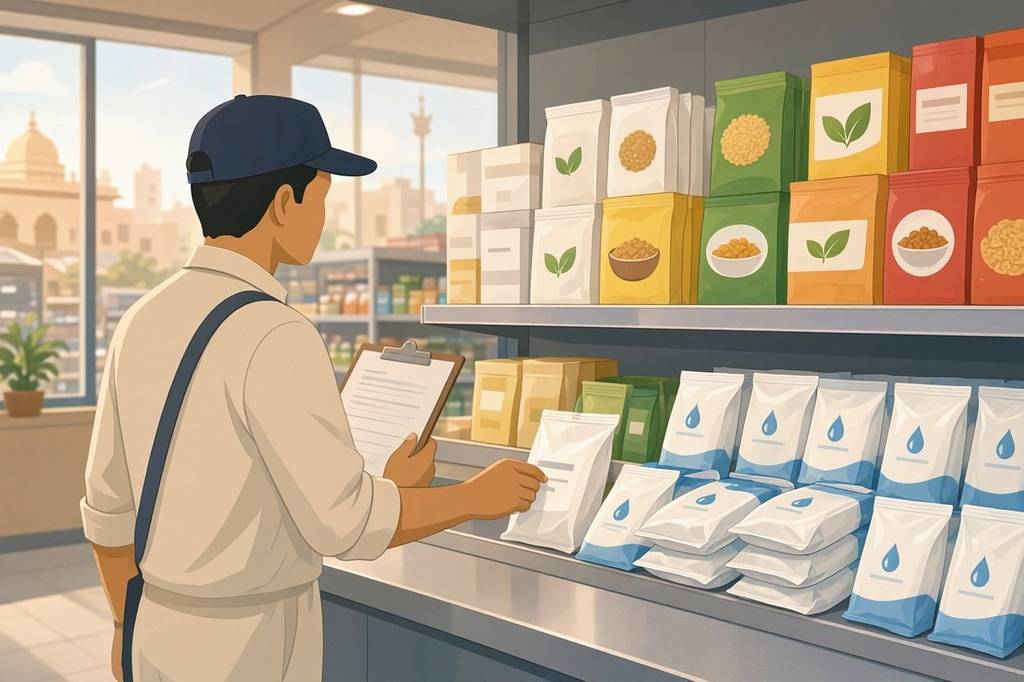
Editorial illustration: a food safety inspector with a clipboard checking packaged food items and milk packets on a market shelf — no text, no logos, no real person.
Key Takeaways
FSSAI's 65-day nationwide crackdown (1 September to 5 November 2026) inspected 56,431 food establishments across states and Union Territories.
About 3,280 tonnes of food worth Rs 81.8 crore were seized, 1,133 licences were suspended, 52 cancelled, 312 establishments sealed and 410 prosecutions started.
Of 43,939 samples collected, 23,648 were analysed and 2,273 were found non-compliant with safety standards.
Seized items included edible oils, milk products such as paneer, khoya and ghee, bakery items, chocolates, ice creams, namkeen, gift hampers and packaged foods.
Consumers should check the FSSAI logo and 14-digit licence number on packaged food and report suspected adulteration to the state food safety department.
On 7 November 2026, the Food Safety and Standards Authority of India (FSSAI) announced the results of a 65-day nationwide FSSAI crackdown on adulterated and substandard food — and the numbers are striking. In a drive that ran from 1 September to 5 November 2026 across states and Union Territories, food safety teams inspected 56,431 establishments, seized about 3,280 tonnes of food products worth Rs 81.8 crore, suspended 1,133 food business licences and started 410 prosecutions. The timing was deliberate: the drive was organised to protect consumers during the festive season, when demand for sweets, snacks, milk products and gift hampers peaks — and when adulteration is at its worst.
What Happened in the FSSAI Crackdown
FSSAI, the central food regulator, carried out the drive together with state food safety departments. Over the 65 days, inspection squads visited food manufacturing units, processing plants, wholesalers, retailers and eateries, checking hygiene, labelling, storage and whether the food being sold met safety standards.
The action taken was wide-ranging. Alongside the 1,133 licence suspensions, the regulator issued 10,047 improvement notices — formal warnings telling businesses to fix specific problems within a set time — cancelled 52 licences outright and sealed 312 establishments where serious violations were found. In parallel, officials collected 43,939 food samples; of these, 23,648 were analysed in laboratories and 2,273 were found non-compliant, meaning they failed to meet the required safety or quality standards. The 410 prosecutions that followed are now working their way through the legal process.
FSSAI announced the results in social media posts on Saturday, saying the checks were carried out "through rigorous checks on over 56,000 food establishments" and that the action was taken "to maintain uncompromising safety standards". The scale of the drive — more than 56,000 inspections in just over two months — makes it one of the largest food safety enforcement operations the country has seen in a single festive season.
What Was Seized: Milk, Oil, Sweets and Packaged Food
The food seized in the drive reads like a list of everyday Indian shopping. Edible oils were among the biggest categories, along with milk and milk products such as paneer, khoya and ghee — items that see heavy demand during Diwali and the wedding season. Bakery products and chocolates, ice creams and namkeen were also seized in large quantities, as were gift hampers and packaged foods.
These are exactly the categories where adulteration is most common and most profitable. Milk products can be bulked up with cheaper substitutes, edible oil can be mixed with inferior oils, and sweets and namkeen made in unlicensed units often use substandard ingredients, synthetic colours or stale raw material. Because these foods are bought in bulk during festivals and often gifted, a single bad batch can reach hundreds of homes — which is why the regulator targeted them before the festive rush rather than after it.
Milk is among the most commonly adulterated items in India, and it is also one of the most widely consumed. [Nandini milk prices recently rose by Rs 8 a litre in Karnataka](https://indiaask.tech/question.php?slug=karnataka-nandini-milk-price-hike-rs8-explained), a reminder of how closely milk touches household budgets — and why keeping it safe matters so much.
How the Drive Worked: Inspections, Samples and Prosecutions
FSSAI does not inspect shops itself in most cases. The Food Safety and Standards Act, 2006 gives the regulator the power to set standards, but the ground work — inspections, sampling and immediate action — is largely carried out by state food safety departments and FSSAI's regional offices, working in coordination.
The process follows a fixed sequence. Food safety officers visit an establishment and check its licence, hygiene, storage, labelling and records. If they find a problem, they can collect samples and send them to notified food testing laboratories. If a sample fails, the business may get an improvement notice for minor issues, a licence suspension for serious ones, or a licence cancellation and prosecution for the worst cases. Establishments can also be sealed on the spot when inspectors find conditions that pose a direct risk to consumers.
FSSAI also runs a risk-based inspection system, under which high-risk food businesses — such as dairy units, meat processors and large manufacturers — are inspected more often than low-risk ones. The regulator has notified 252 food testing laboratories and 24 referral laboratories for testing appellate samples, giving the enforcement system a scientific backbone.
Why This Crackdown Happened Before Diwali
Festive seasons are the peak period for food adulteration in India. Demand for sweets, ghee, khoya, paneer, edible oil and dry fruits surges, prices rise, and unscrupulous operators rush to meet the demand with cheap substitutes. Gift hampers — a festive staple — are a particular risk, because the buyer rarely checks what is inside and the recipient rarely complains.
This is not a new pattern. In the financial year 2025-26, FSSAI and state departments together carried out more than 5.2 lakh food inspections. And in a written reply in the Rajya Sabha in March 2026, the government said that between 2022-23 and 2024-25, surveillance drives and random sampling led to over 5.18 lakh samples being analysed, 88,192 cases decided with penalties and 3,614 convictions, while 1,161 licences were cancelled. The November 2026 drive fits into that continuing enforcement effort — but its festive-season timing and its sheer size set it apart.
What FSSAI Is and What Powers It Has
The Food Safety and Standards Authority of India was set up under the Food Safety and Standards Act, 2006. It is the country's apex food regulator: it lays down science-based standards for food articles, regulates the manufacture, storage, distribution, sale and import of food, and runs the licensing and registration system for food businesses.
Every food business in India — from a street vendor to a large manufacturer — needs an FSSAI registration or licence, and packaged food must carry a 14-digit FSSAI licence number. That number is the consumer's simplest check: it shows the product comes from a registered business that the regulator can trace and hold accountable.
FSSAI's powers have also been tested in court. [In Maharashtra, a dispute over the regulator's authority reached the Bombay High Court](https://indiaask.tech/question.php?slug=maharashtra-vs-fssai-bombay-high-court-food-safety-dispute), showing how the balance between the central regulator and state authorities continues to be worked out in practice.
What It Means for You as a Consumer
For ordinary shoppers, the crackdown carries three practical lessons. First, check the pack: look for the FSSAI logo and the 14-digit licence number on packaged food, and check the manufacturing and expiry dates — especially on sweets, ghee, paneer and edible oil bought during festivals. Second, buy from licensed, known sellers rather than unlabelled loose products from unknown sources, because loose and unlabelled food is the hardest to trace when something goes wrong. Third, if you suspect adulteration or find food that looks, smells or tastes wrong, report it to your state food safety department — complaints are what trigger many inspections in the first place.
The crackdown also shows that enforcement is tightening. A licence suspension is not a warning: it stops a business from operating until it proves it has fixed the problem, and a cancelled licence ends it altogether. For the thousands of businesses that received improvement notices, the message is that the next inspection will check whether the problems were actually fixed.
Conclusion
The FSSAI crackdown of September–November 2026 was a large, deliberate operation: 56,431 establishments inspected, 3,280 tonnes of food worth Rs 81.8 crore seized, 1,133 licences suspended and 410 prosecutions started, all timed to protect consumers during the festive season. It shows both the scale of India's food adulteration problem and the scale of the enforcement response. But a crackdown is only as good as its follow-through — the samples still being analysed, the prosecutions still to be decided, and the next round of inspections will determine whether the festive season stays safer next year. For consumers, the simplest protection remains the same: check the licence number, buy from trusted sellers, and report what looks wrong.
Between 1 September and 5 November 2026, FSSAI and state food safety departments inspected 56,431 food establishments across India, seized about 3,280 tonnes of food worth Rs 81.8 crore, suspended 1,133 licences, cancelled 52 licences, sealed 312 establishments and started 410 prosecutions. The drive was timed to protect consumers during the festive season.
How much food was seized and how many licences were suspended in the FSSAI crackdown?
About 3,280 tonnes of food products worth Rs 818 million (Rs 81.8 crore) were seized. Alongside that, 1,133 food business licences were suspended, 52 were cancelled, 312 establishments were sealed and 10,047 improvement notices were issued.
Which food items were seized in the FSSAI crackdown?
Edible oils, milk and milk products such as paneer, khoya and ghee, bakery items and chocolates, ice creams and namkeen, gift hampers and packaged foods. Of 43,939 samples collected, 23,648 were analysed and 2,273 were found non-compliant with safety standards.
How can consumers check if packaged food is safe and FSSAI-approved?
Check for the FSSAI logo and the 14-digit FSSAI licence number on packaged food, along with manufacturing and expiry dates. Buy from licensed, known sellers rather than unlabelled loose products, and report suspected adulteration to your state food safety department.