Home > General Knowledge > What Happened to IndiGo Flight 6E 451? The Bengaluru–Lucknow Hijack Threat Note Explained
What Happened to IndiGo Flight 6E 451? The Bengaluru–Lucknow Hijack Threat Note Explained
By Vijay Pawar · 2026-11-08 · 7 min read · General Knowledge
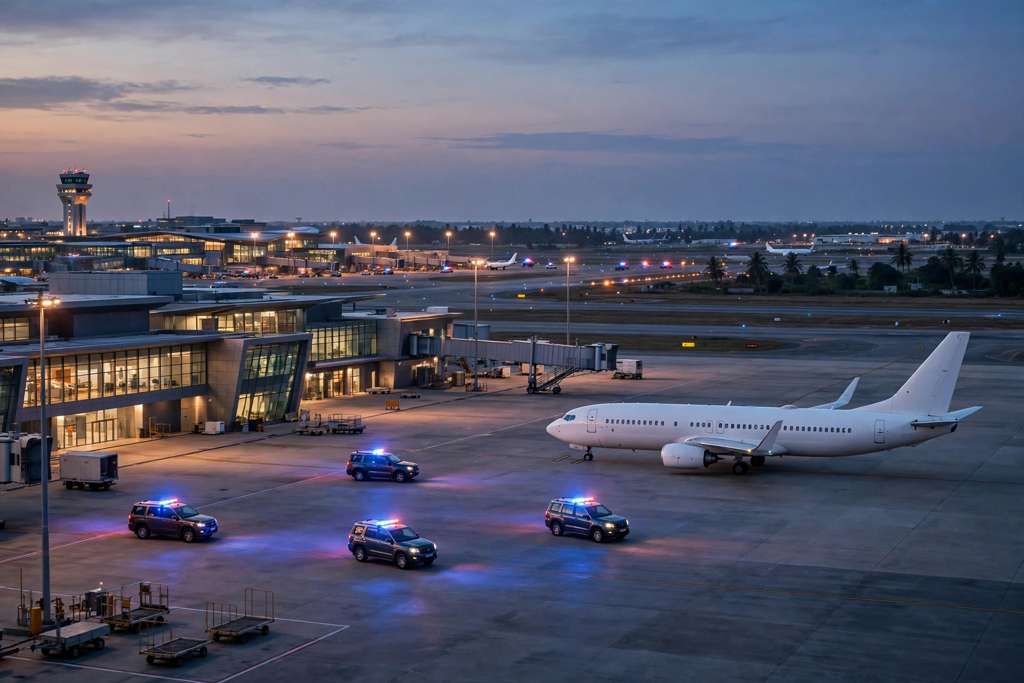
Editorial illustration: a passenger aircraft parked at an isolated bay of an Indian airport at dusk, with security vehicles nearby — no text, no logos, no real person.
Key Takeaways
IndiGo flight 6E 451, Bengaluru to Lucknow, departed at about 5.50 pm on 7 November 2026 with 178 passengers; a handwritten hijack threat note was found in the lavatory about 30 minutes later.
The note threatened a hijack at 6.30 pm and warned of consequences if ignored; the crew alerted the pilot, who informed ATC and returned to Bengaluru.
A full emergency was declared at Kempegowda International Airport, the aircraft was moved to an isolated bay, and CISF and Bengaluru police cordoned off the area.
Checks found nothing suspicious, the threat was declared a hoax, the emergency was lifted, and the flight resumed to Lucknow later that night; an investigation is on to find who left the note.
Hoax aviation threats are serious offences in India: up to Rs 1 lakh penalty under the Aircraft (Security) Rules and possible life imprisonment under the 1982 civil aviation safety Act.
A handwritten note found in the toilet of a Lucknow-bound IndiGo flight on Saturday evening, 7 November 2026, forced the aircraft to turn back to Bengaluru and triggered a full emergency at Kempegowda International Airport. So what happened to IndiGo flight 6E 451, and why did a single piece of paper cause such a serious response? The threat turned out to be a hoax, but the way the crew, the pilot and the airport handled it shows how aviation security works when a threat cannot be ignored.
What Happened to IndiGo Flight 6E 451?
IndiGo flight 6E 451 was operating from Bengaluru to Lucknow on Saturday, 7 November 2026. The aircraft departed from Terminal 1 of Kempegowda International Airport (KIA) at around 5.50 pm with 178 passengers on board. About 30 minutes into the journey, a passenger who entered the aircraft lavatory spotted a handwritten note containing a hijack threat and alerted the cabin crew.
The crew immediately informed the pilot-in-command, who alerted Air Traffic Control (ATC) and sought priority clearance to return to Bengaluru. According to flight-tracking website Flightradar24, the aircraft remained airborne for 51 minutes before landing back at KIA. Airport authorities declared a full emergency as a precautionary measure, and the aircraft was moved to an isolated bay after landing safely.
Security agencies, including the Central Industrial Security Force (CISF) and the Bengaluru police, cordoned off the area. Thorough checks of the aircraft, the baggage and the passengers found nothing suspicious, and the threat was declared a hoax. The emergency was then lifted, and the flight resumed its journey to Lucknow later in the night after receiving the necessary security clearances, according to reports.
What Did the Threat Note Say?
The handwritten note reportedly read: "This flight is going to be hijacked exactly at 6.30. Ignore this and see the consequences." Reports differ slightly on the exact wording — some versions say "this plane is going to get hijacked" — but all accounts agree on the core message: a hijack at 6.30 pm, with a warning of consequences if the note was ignored.
The note gave no name, no demand and no other detail. That is part of what made it so disruptive. A threat with a specific time attached cannot simply be dismissed in the air, even if it looks like a prank. The crew had to treat it as real until security agencies on the ground could prove otherwise.
How the Crew and the Airport Responded
Every step that followed was standard aviation security procedure. The passenger who found the note did the right thing by telling the cabin crew at once instead of keeping quiet or causing panic among fellow passengers. The crew passed the information to the pilot without delay, and the pilot's decision to return to the airport of origin rather than continue to Lucknow is exactly what the protocol requires when a security threat is reported mid-flight.
On the ground, the response was equally methodical. A full emergency was declared at the airport, which puts fire services, medical teams and security personnel on standby. The aircraft was parked in an isolated bay, away from the terminal and other aircraft, so that any risk could be contained. The CISF and the Bengaluru police secured the area while security personnel inspected the aircraft and screened the passengers and baggage.
IndiGo said in a statement: "A security threat was reported onboard IndiGo flight 6E 451, operating from Bengaluru to Lucknow on November 7, 2026. In line with Standard Operating Procedure, the relevant authorities were informed immediately, and the pilots decided to return to the origin to carry out the necessary security checks, as per protocol." The airline added that it regretted the inconvenience to customers and was making efforts to minimise it, including offering refreshments and sharing regular updates.
The Threat Turned Out to Be a Hoax
After the checks were completed, sources in Bangalore International Airport Ltd (BIAL) confirmed that no suspicious object was found and the threat was declared a hoax. The emergency was lifted only after the aircraft was formally declared safe.
An investigation has been initiated to find out who left the handwritten note inside the aircraft lavatory. That question matters, because a note left on board could only have been written by someone who was on the flight — a passenger or a member of the crew — and identifying the person is now the job of the police and the security agencies.
Why Hoax Threats Are Taken So Seriously
This was not an isolated scare. Indian aviation has faced a flood of hoax threats in recent years. According to government data cited by News18, 728 hoax bomb threats were reported in 2024, and 24 more were reported in the first months of 2025, targeting airlines including IndiGo and Air India. Each one forces the same expensive, disruptive response: diversions, emergency declarations, security sweeps, delays and frightened passengers.
The law treats such acts as grave offences, not pranks. Under the Aircraft (Security) Rules, a rule added in December 2024 — Rule 30A — prohibits communicating false information that could jeopardise the safety of an aircraft or airport, cause panic, or disrupt civil aviation operations. An individual who violates it can face a penalty of up to Rs 1 lakh, apart from other criminal charges. The Suppression of Unlawful Acts against the Safety of Civil Aviation Act, 1982, goes further: a person who communicates information they know to be false so as to endanger the safety of an aircraft in flight can face life imprisonment and a fine.
The Bureau of Civil Aviation Security (BCAS), the regulator for civil aviation security in India, has pushed for these provisions to be invoked in hoax cases. A person found responsible can also be placed on the no-fly list and barred from flying for up to two years, and can be asked to bear the cost of the disruption caused.
What This Means for Passengers
For the 178 passengers on 6E 451, the evening meant hours of delay, a return to Bengaluru, security screening and a late departure for Lucknow. For passengers more generally, the incident is a reminder of two things. First, any threat found on board — however unlikely it seems — will be treated as real until proven otherwise, and that will always mean delays. Second, passengers who spot something suspicious should do exactly what the passenger on this flight did: inform the cabin crew calmly and immediately, without spreading alarm.
Airlines and airports also pay a price. A single hoax can disrupt schedules across the network, since the aircraft, the crew and the passengers are all out of position for their next flights. That is why the authorities are keen to trace and prosecute the people behind such threats rather than treating them as harmless mischief.
For IndiGo, the country's largest airline, the incident comes in a difficult period. The airline has also been in the news for its financial results — [IndiGo reported a quarterly loss](https://indiaask.tech/question.php?slug=indigo-q2-loss-fuel-costs-rupee-explained) — and for the wider pressures on aviation, from fuel costs to a weaker rupee. A security scare of this kind adds operational disruption to those commercial pressures, even when it ends as a hoax.
Conclusion
What happened to IndiGo flight 6E 451 was a scare that ended without harm: a handwritten hijack threat found in the lavatory forced a Bengaluru–Lucknow flight carrying 178 passengers to return to Bengaluru, a full emergency was declared, and hours of checks found nothing. The threat was a hoax, the aircraft was declared safe, and the flight resumed later that night.
But the incident is a serious reminder that hoax threats are not victimless jokes. They terrify passengers, ground aircraft, cost airlines and airports heavily, and can land the person responsible in prison for years. The investigation into who left the note will now decide whether this particular prank ends with a prosecution — and a message to anyone tempted to try the same thing.
*Sources: [The Hindu](https://www.thehindu.com/news/national/karnataka/lucknow-bound-indigo-flight-emergency-returns-to-bengaluru-after-hijack-threat-note-found-onboard/article71679041.ece), [NDTV](https://www.ndtv.com/india-news/hijack-threat-note-in-toilet-bengaluru-lucknow-flight-makes-u-turn-ignore-and-see-consequences-12298199/amp/1), [Deccan Herald](https://www.deccanherald.com/india/karnataka/bengaluru/handwritten-hijack-threat-forces-lucknow-bound-indigo-flight-to-return-to-bengalurus-kia-4211575), [News18](https://www.news18.com/explainers/bengaluru-delhi-schools-to-flights-stadium-what-is-the-punishment-for-bomb-hoax-callers-ws-kl-9448182.html). Flight disruptions have affected other carriers too — [Air India suspended some Saudi Arabia flights](https://indiaask.tech/question.php?slug=air-india-saudi-flights-suspended-14-november-2026-explained) — showing how quickly one incident can ripple through schedules.*
On 7 November 2026, IndiGo flight 6E 451 from Bengaluru to Lucknow returned to Kempegowda International Airport after a passenger found a handwritten hijack threat note in the lavatory about 30 minutes after take-off. The aircraft, carrying 178 passengers, landed back safely, a full emergency was declared, and after checks found nothing suspicious the threat was declared a hoax. The flight resumed its journey to Lucknow later that night.
What did the hijack threat note on IndiGo flight 6E 451 say?
The note reportedly read: "This flight is going to be hijacked exactly at 6.30. Ignore this and see the consequences." Reports differ slightly on the exact wording, but all agree it threatened a hijack at 6.30 pm. The note gave no name and no demand.
Why did the flight return to Bengaluru instead of continuing to Lucknow?
Aviation security protocol requires a threat reported mid-flight to be treated as real until proven otherwise. The pilot informed Air Traffic Control, sought priority clearance and returned to the airport of origin so security agencies could inspect the aircraft in an isolated bay. Continuing to Lucknow would have meant landing at an airport that was not prepared for the emergency.
What punishment can a person face for a hoax hijack or bomb threat on a flight?
Under the Aircraft (Security) Rules, communicating false information that endangers an aircraft or causes panic can attract a penalty of up to Rs 1 lakh for an individual, apart from other criminal charges. Under the Suppression of Unlawful Acts against the Safety of Civil Aviation Act, 1982, communicating information known to be false so as to endanger an aircraft in flight can lead to life imprisonment and a fine. The person can also be placed on the no-fly list and barred from flying for up to two years.