Home > Elections & Governance > Why Was Paraguay President Santiago Peña Impeached? Ueno Bank Collapse, House Arrest and Pedro Alliana Explained
Why Was Paraguay President Santiago Peña Impeached? Ueno Bank Collapse, House Arrest and Pedro Alliana Explained
By Vijay Pawar · 2026-11-07 · 8 min read · Elections & Governance
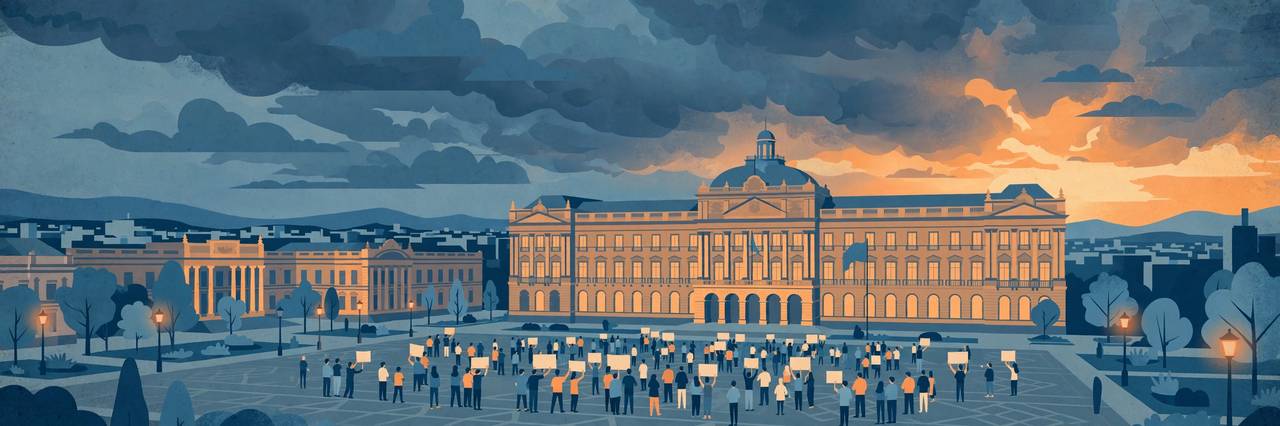
Editorial illustration: a South American presidential palace at dusk with a crowd gathered peacefully in the plaza below — no text, no logos, no real person.
Key Takeaways
Paraguay's Senate voted unanimously on 6 November 2026 to remove President Santiago Peña for misconduct in office, over his links to the collapse of digital bank Ueno.
Ueno held accounts for nearly half of Paraguay's roughly six million people; regulators seized it three days before the impeachment, leaving depositors locked out of their savings.
Prosecutors placed Peña under house arrest on suspicion of breach of trust and ordered him to appear before their economic crimes unit on Saturday morning, 7 November.
Vice President Pedro Alliana, 52, was sworn in as Paraguay's 53rd president the same day and serves out the term ending in August 2028, though he is also under investigation over Ueno.
Peña is the second Paraguayan president ousted by impeachment since the country returned to democracy in 1989.
Paraguay has a new president after one of the fastest political falls in South American history. On Friday, 6 November 2026, Pedro Alliana was sworn in as the country's 53rd president, hours after the Senate voted unanimously to remove Santiago Peña from office over his links to the collapse of Ueno, a digital bank that held accounts for nearly half of Paraguay's roughly six million people. Prosecutors then placed Peña under house arrest on suspicion of breach of trust and other crimes, and ordered him to appear before their economic crimes unit on Saturday morning. This article explains why Paraguay president Santiago Peña was impeached, what the Ueno bank collapse has to do with it, who Pedro Alliana is, and what happens next for the country's depositors.
What happened in Paraguay on 6 November 2026?
The day moved with remarkable speed. All 44 senators present voted to remove Peña from the presidency for misconduct in office, making him the second Paraguayan president ousted by impeachment since the country returned to democracy in 1989. The Senate acted a day after the Chamber of Deputies had voted 78 to zero to impeach him, and about an hour after the Senate vote, Vice President Pedro Alliana, 52, took the oath of office to serve out the presidential term, which ends in August 2028. [Al Jazeera reported](https://www.aljazeera.com/news/2026/11/7/paraguays-santiago-pena-under-arrest-new-president-pedro-alliana-sworn-in) that Alliana became the South American country's 53rd president on Friday.
Peña had offered his resignation a day earlier, on 5 November, but the Senate chose to finalise the impeachment process rather than accept it. That distinction matters: a resignation would have let Peña leave office on his own terms, while impeachment is a formal finding of misconduct, and it leaves him exposed to criminal proceedings. Prosecutors speaking outside Peña's house in Asunción said the exact charges were still being determined but could include influence peddling, and ordered him to remain at one of his homes until he appears before prosecutors on Saturday morning. Breach of trust, the central suspicion, carries a sentence of up to five years in prison, or up to 10 years in serious cases.
Prosecutors also issued an arrest warrant for Carlos Carvallo, who ran the finance company that became Ueno until Peña named him central bank chief in 2023. The central bank has been accused of failing in its oversight duties as Ueno slid towards collapse.
What is the Ueno bank collapse behind the impeachment?
Ueno was a digital bank that had grown to serve nearly half of Paraguay's population, and its collapse is the crisis at the heart of this story. Regulators seized Ueno just three days before the impeachment vote, after the bank's troubles left depositors unable to access their savings. [NDTV reported](https://www.ndtv.com/world-news/paraguay-president-santiago-pena-impeached-placed-under-house-arrest-over-bank-scandal-pedro-alliana-sworn-in-as-new-president-12295240) that the bank's collapse locked nearly half of the country's six million people out of their savings, and the takeover set off what news agencies have called the country's worst political crisis in more than a decade.
The impeachment charges against Peña alleged that he had conflicts of interest, manipulated regulatory oversight, diverted pension funds, and participated in an institutional cover-up involving the central bank. In plain terms, lawmakers accused the president of using his office to protect a bank he was connected to, of weakening the regulators who should have supervised it, and of helping to hide what was going wrong. Peña's past links to Ueno were the specific issue senators cited when they voted to remove him.
For ordinary Paraguayans, the political drama is secondary to a practical question: when will they get their money back? Depositors have been demanding access to their frozen savings since regulators took over the bank, and the new government inherits that pressure from day one. How the state handles Ueno's depositors — whether savings are protected, how quickly accounts are unfrozen, and who ultimately bears the losses — will shape public judgement of Alliana's presidency far more than the ceremony of his swearing-in.
Who is Pedro Alliana, the new president of Paraguay?
Pedro Alliana, 52, is a conservative politician from the long-governing Colorado Party, the same party as Peña. He served as vice president under Peña since the start of the latter's term in 2023, and as vice president he was the constitutional successor when the presidency fell vacant. His swearing-in was carried out by the president of the Senate, Basilio Núñez.
Alliana takes over in difficult circumstances. He serves out a term that runs until August 2028, but he inherits a government under pressure on two fronts at once: returning depositors' money and punishing those behind Ueno's collapse. Complicating matters further, Alliana himself is also under investigation in connection with Ueno's collapse, according to reporting on the case. That means the man now leading the response to the banking scandal is himself under scrutiny over it — a fact that opposition lawmakers and depositors are certain to keep raising.
The speed of the transition is also notable. In many countries, an impeachment takes weeks or months; in Paraguay, the lower house voted on Thursday, the Senate removed the president on Friday, and a new president was sworn in the same day. The rapidity reflects how acute the crisis had become once regulators seized Ueno: with nearly half the population's accounts affected, lawmakers moved before public anger could grow further. Democratic processes elsewhere can also move quickly when institutions are tested — as our explainer on [what happens when elections are decided and power changes hands](https://indiaask.tech/question.php?slug=us-midterm-elections-2026-results-democrats-win-explained) shows, the rules for removing or replacing a leader matter most in a crisis.
Why did the Senate impeach Peña instead of accepting his resignation?
Peña offered to resign on 5 November, the day before his removal. Accepting the resignation would have been the quieter exit, but the Senate chose to complete the impeachment instead. There are two reasons this mattered to lawmakers. First, impeachment is a public verdict: it records that the Senate found misconduct in office, rather than allowing the departure to be framed as a voluntary decision. Second, it preserves the political consequences — a president who resigns can sometimes claim he left for other reasons, while an impeached president carries the finding with him into the criminal process that follows.
The unanimous nature of the Senate vote is also significant. All 44 senators present voted for removal, including members of Peña's own Colorado Party. That suggests the evidence linking Peña to Ueno's collapse, and the scale of the depositor crisis, had made his position untenable across party lines. Impeachment is designed for exactly this situation: when a leader is accused of using public office for private gain, the legislature, not the courts alone, decides whether he can stay. The [rules that govern how voters and institutions hold leaders to account](https://indiaask.tech/question.php?slug=electoral-roll-revision-2026-special-summary-revision-explained) are what keep that process democratic rather than a power grab.
What happens next in Paraguay?
The immediate next step is legal. Peña must appear before prosecutors' economic crimes unit on Saturday morning, 7 November, where the formal charges against him are expected to be set out. Prosecutors have said the charges could include breach of trust and influence peddling, and the investigation is also pursuing Carvallo, the former central bank chief, under an arrest warrant.
The second question is financial. Regulators now control Ueno, and the Alliana government must decide how depositors are treated — whether savings are guaranteed, how the bank is wound down or restructured, and what happens to the pension funds the impeachment charges say were diverted. With accounts belonging to nearly half the population frozen, every delay adds to public frustration, and the government's credibility depends on showing depositors a credible plan quickly.
The third question is political. Alliana leads a Colorado Party government that has just removed its own president, and he does so while under investigation himself over the same scandal. Whether he can present himself as a clean break from Peña, or whether the Ueno investigation reaches further into the party, will determine whether Paraguay's crisis ends with this impeachment or deepens into a wider reckoning. For now, the country has a new president, a former president under house arrest, and millions of savers waiting to learn what happens to their money.
Conclusion
Santiago Peña was impeached because Paraguay's Senate held him responsible for misconduct linked to the collapse of Ueno bank — a digital lender used by nearly half the country, seized by regulators three days before his removal. The unanimous Senate vote, the house arrest order, and the arrest warrant for the former central bank chief show how seriously the country's institutions are treating the scandal. Pedro Alliana now serves out the term until August 2028, but he inherits both the depositor crisis and an investigation that touches him as well. The impeachment answers who leads Paraguay; it does not yet answer when depositors get their savings back, and that is the question the new president will be judged on.
Why was Paraguay president Santiago Peña impeached?
Paraguay's Senate voted unanimously on 6 November 2026 to remove Santiago Peña from the presidency for misconduct in office, over his past links to the collapse of Ueno, a digital bank that held accounts for nearly half of the country's population. The impeachment charges alleged conflicts of interest, manipulated regulatory oversight, diverted pension funds and an institutional cover-up involving the central bank.
What is the Ueno bank collapse behind Peña's impeachment?
Ueno was a digital bank used by nearly half of Paraguay's roughly six million people. Regulators seized it on 3 November 2026, three days before the impeachment, after its troubles left depositors unable to access their savings. The collapse triggered Paraguay's worst political crisis in more than a decade.
Who is Pedro Alliana, the new president of Paraguay?
Pedro Alliana, 52, was Peña's vice president since 2023 and a member of the same Colorado Party. He was sworn in as Paraguay's 53rd president on 6 November 2026, about an hour after the Senate removed Peña, and will serve out the term ending in August 2028. He is also under investigation in connection with Ueno's collapse.
What happens to Santiago Peña now that he has been impeached?
Prosecutors placed Peña under house arrest on suspicion of breach of trust and other crimes, including possible influence peddling, and ordered him to appear before their economic crimes unit on Saturday morning, 7 November. Breach of trust carries up to five years in prison, or up to 10 years in serious cases. An arrest warrant was also issued for Carlos Carvallo, the former central bank chief.