Home > Economy > Why Is Gold Price Falling in India? 9% Weekly Drop, Strong Dollar and Fed Rate Hike Fears, Explained
Why Is Gold Price Falling in India? 9% Weekly Drop, Strong Dollar and Fed Rate Hike Fears, Explained
By Vijay Pawar · 2026-11-21 · 8 min read · Economy
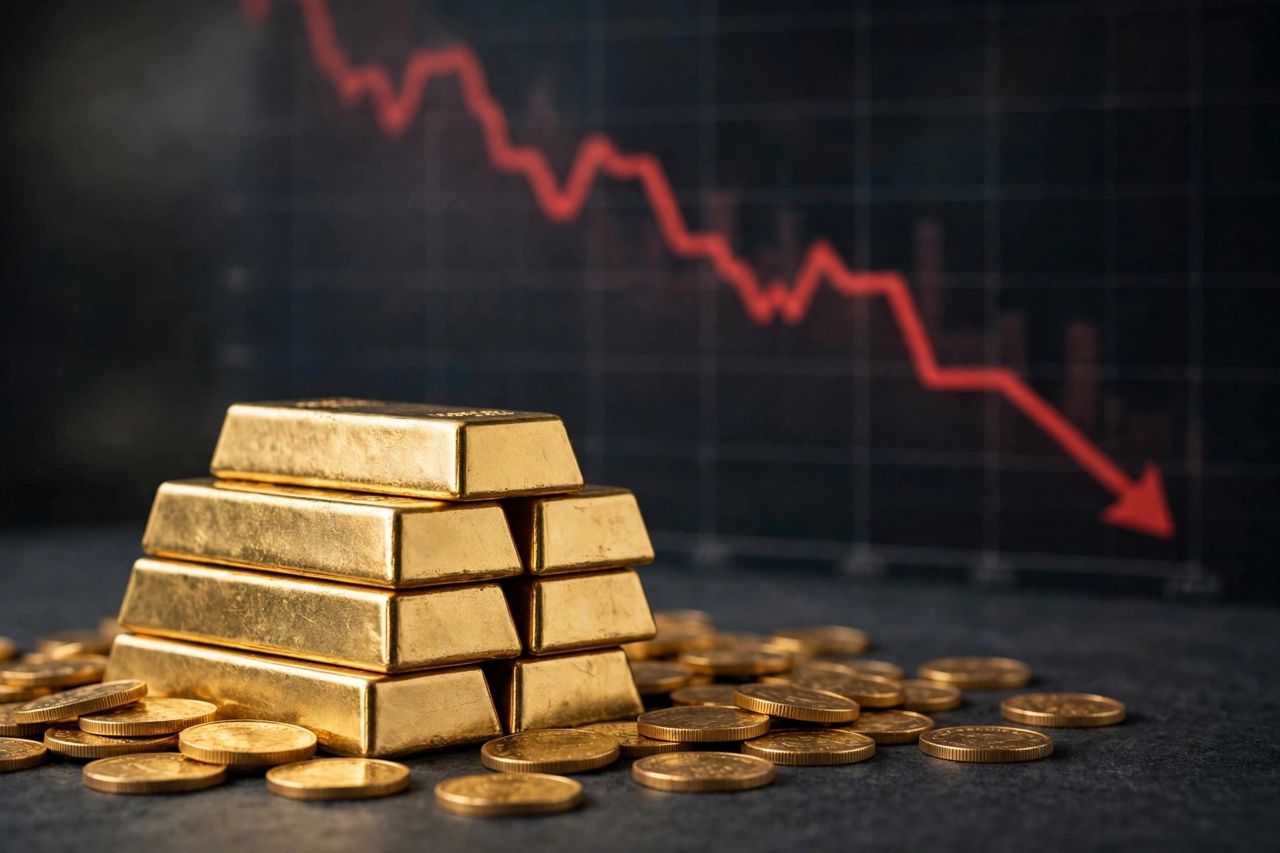
Editorial illustration: stacked gold bars and coins with a falling red chart line behind them, symbolising the sharp fall in gold prices on 20 November 2026.
Key Takeaways
In Delhi, 99.9 per cent pure gold fell Rs 5,200 in a single day to Rs 1,29,300 per 10 grams on 20 November 2026, the ninth consecutive session of losses.
International spot gold was near $3,546 an ounce and down about 8.9 per cent for the week — its steepest weekly decline in eight months — while MCX December futures fell 3.67 per cent to Rs 1,22,769 per 10 grams.
The fall is driven by a stronger US dollar (dollar index near 104, a 19-month high), expectations of a US Federal Reserve rate hike in December, profit-booking after a sharp 2026 rally, forced selling to raise cash, and weak physical demand.
Silver fell even harder, dropping about 6 per cent to Rs 1,48,034 per kilogram, and 18-karat gold fell below Rs 1 lakh per 10 grams on the IBJA benchmark.
UBS projects gold could reach $4,600 an ounce by June 2027 and $5,000 by December 2027, suggesting many professionals see this as a correction within a longer uptrend — but the Fed's December decision will set the short-term direction.
Gold, the metal Indian households trust most in uncertain times, has just suffered one of its sharpest falls of the year. If you have been wondering why is gold price falling in India, the short answer is that a stronger US dollar, expectations of another interest rate hike by the US Federal Reserve, and heavy profit-booking after a long rally have all hit at once. On Friday, 20 November 2026, gold fell for the ninth straight session in Delhi, and international prices were heading for their steepest weekly decline in eight months. Here is what happened, why it happened, and what it means for buyers.
How Much Has Gold Fallen?
The scale of the fall is striking. In Delhi, 99.9 per cent pure gold fell by Rs 5,200 in a single day to Rs 1,29,300 per 10 grams on 20 November, compared with Rs 1,34,500 the previous day, according to local traders quoted by ANI. It was the ninth consecutive session of losses for the yellow metal in the capital.
The picture is similar across benchmarks. On the Multi Commodity Exchange (MCX), December gold futures fell Rs 4,683, or 3.67 per cent, to Rs 1,22,769 per 10 grams on Friday amid weak spot demand. Data from the India Bullion and Jewellers Association (IBJA) shows that 18-karat gold, which had been priced at Rs 1,00,814 per 10 grams on 17 November, had fallen to Rs 92,688 by 20 November — a drop of 8.06 per cent in just three trading sessions. On the same day, the IBJA benchmark for 24-karat gold stood at Rs 1,23,584 per 10 grams and 22-karat gold at Rs 1,13,203, according to CNBC-TV18.
Internationally, spot gold was trading near $3,546 an ounce on 20 November, and Reuters reported that it was down approximately 8.9 per cent for the week — its steepest weekly decline in eight months. Retail rates for buyers tell the same story: on 20 November, 24-karat gold was priced at Rs 12,557 per gram, 22-karat at Rs 11,510 per gram and 18-karat at Rs 9,418 per gram, according to GoodReturns data. Silver has fallen even harder, dropping about 6 per cent to Rs 1,48,034 per kilogram.
Why Is Gold Price Falling in India?
Five forces are pushing prices down at the same time, and they are all connected.
**1. The US dollar has become much stronger.** International gold is priced in dollars. When the dollar rises, gold becomes more expensive for buyers using other currencies, and demand falls. The dollar index was near 104, around a 19-month high, as investors moved towards the dollar to secure liquidity, according to Anindya Banerjee, Head of Commodity and Currency Research at Kotak NEO. For Indian buyers there is a second twist: the rupee-dollar exchange rate also affects the landed cost of imported gold, so a strong dollar hits Indian prices twice over.
**2. The US Federal Reserve may raise interest rates again.** This is the biggest single reason behind the sell-off. Several US Federal Reserve officials have argued for increasing interest rates to bring inflation closer to the 2 per cent target, and Governor Christopher Waller noted that a 50-basis-point hike could be considered in December. Gold pays no interest, so when rates rise — or are expected to rise — government bonds become more attractive and gold loses some of its shine. Markets have now almost fully priced in a December hike.
**3. Investors are booking profits after a huge rally.** Gold had risen sharply through much of 2026 before this correction. Investors who bought at lower prices are now selling part of their holdings to lock in profits, and that selling has gathered pace as prices started sliding. Once a fall begins, it can feed on itself: traders sell to protect gains, and the selling pushes prices lower still.
**4. A wider market sell-off is forcing investors to raise cash.** The gold correction is part of a broader sell-off across global financial markets, not an isolated fall in bullion. An AI-driven sell-off in global equities prompted investors to liquidate bullion holdings to cover losses elsewhere, according to Kedia Advisory. Speculative investors are cutting exposure, some inventory holders are raising cash, and producers have an incentive to hedge against further declines — flows that reinforce one another.
**5. Physical demand in India has been weak.** Despite the wedding season, spot demand has been soft, which has added to the pressure on domestic prices. Jewellers report that many buyers are waiting on the sidelines, hoping prices fall further before they buy.
The Dollar and the Fed: The Two Forces Behind the Fall
To understand why is gold price falling in India right now, it helps to see how the two main forces work together. A stronger dollar makes gold costlier in rupees and other currencies, which weakens demand. At the same time, expectations of higher US interest rates push up bond yields, giving investors an income-paying alternative to gold. Higher rates also tend to strengthen the dollar further, so the two effects compound each other.
That is why gold, traditionally a safe haven in uncertain times, is falling even while global markets are nervous. As one market report put it, expectations of tighter monetary policy have overshadowed gold's traditional appeal as a safe-haven asset. The same forces are visible in Indian markets more broadly: the week that gold crashed was also the week foreign investors poured record money into Indian shares, with the [Sensex jumping nearly 898 points on 20 November](https://indiaask.tech/question.php?slug=why-did-sensex-rise-today-898-point-rally-fii-buying-explained) itself — money is rotating, not disappearing.
What About Silver?
Silver has fallen even more sharply than gold. Silver prices tanked about 6 per cent to Rs 1,48,034 per kilogram on 20 November, and in Delhi silver slipped to Rs 1.58 lakh per kilogram. Silver is more volatile than gold because it is both a precious metal and an industrial metal, so it suffers both from the same dollar and rate pressures and from worries about industrial demand. The same IBJA data that showed 18-karat gold falling below Rs 1 lakh per 10 grams also showed silver under steady pressure all week.
What Does This Mean for Buyers in India?
For ordinary buyers, the fall is both good news and a warning. Gold jewellery is cheaper than it was a week ago, but the retail bill does not fall by the same percentage as the international price. Making charges and taxes — GST on jewellery — stay the same, so a 9 per cent fall in bullion does not mean a 9 per cent fall at the jeweller's counter. Buyers should also note that different sources quote different rates: the IBJA benchmark, MCX futures and city retail rates all measure slightly different things, so comparing like with like matters.
The practical question many buyers are asking is whether to buy now or wait. There is no reliable answer — nobody can predict the next move in gold with certainty. What is known is that physical demand in India has remained firm despite the weakness, according to an Augmont report, and some long-term investors are using the decline to accumulate gold. Others are waiting for the US Federal Reserve's December decision before committing, because that decision is likely to set the direction for the dollar and for gold. This article is information, not investment advice.
Will Gold Recover? What Experts Expect
Views differ, but the longer-term outlook from major brokerages remains positive. UBS has projected that gold could reach $4,600 an ounce by June 2027 and $5,000 by December 2027, supported by central bank purchases, Chinese demand, ETF holdings and rising government debt concerns. That suggests the current fall is being seen by many professionals as a correction within a longer uptrend rather than the end of it.
In the short term, though, the direction depends on two things: whether the US Federal Reserve does raise rates in December, and whether the dollar keeps strengthening. If the Fed surprises markets by holding rates, gold could recover quickly. If the hike goes ahead as expected, prices could stay under pressure for longer. The [sticky inflation that is shaping the Fed's thinking](https://indiaask.tech/question.php?slug=why-retail-inflation-rose-6-09-percent-october-2026-explained) is the same force that has pushed India's own retail inflation higher, which shows how connected these markets have become.
Conclusion
Gold is falling in India because the US dollar is at a 19-month high, the Federal Reserve is expected to raise rates in December, investors are booking profits after a strong 2026 rally, a wider market sell-off is forcing sales to raise cash, and physical demand is weak. The fall — about 9 per cent in a week internationally, and Rs 5,200 in a day in Delhi — is the steepest in months, and silver has fallen harder still. For buyers, it is a cheaper entry point than a week ago, but with the Fed's December decision still ahead, the metal's next move is far from settled. The sensible approach is to watch the Fed, check the IBJA benchmark rate before buying, and remember that a fall in the international price never translates one-for-one into a cheaper jewellery bill.
Sources: [CNBC-TV18](https://www.cnbctv18.com/personal-finance/gold-prices-take-a-sharp-hit-as-18k-slips-below-rs1-lakh-is-it-time-to-buy-the-dip-20038769.htm) and [Mathrubhumi English](https://english.mathrubhumi.com/amp/news/money/why-gold-prices-are-falling-november-2026-reasons-uil7col9).
Gold is falling in India because the US dollar is near a 19-month high, the US Federal Reserve is expected to raise interest rates in December 2026, investors are booking profits after a sharp rally in 2026, a wider market sell-off is forcing investors to sell gold to raise cash, and physical demand in India has been weak. International gold fell about 9 per cent in the week to 20 November 2026.
How much has gold fallen in India in November 2026?
In Delhi, 99.9 per cent pure gold fell Rs 5,200 in a single day to Rs 1,29,300 per 10 grams on 20 November 2026, the ninth straight session of losses. The IBJA benchmark for 18-karat gold fell from Rs 1,00,814 per 10 grams on 17 November to Rs 92,688 on 20 November, and MCX December futures fell 3.67 per cent to Rs 1,22,769 per 10 grams.
Why does a strong US dollar push gold prices down?
International gold is priced in dollars, so when the dollar strengthens, gold becomes more expensive for buyers using other currencies and demand falls. A strong dollar also tends to go with higher US interest rates, which make income-paying government bonds more attractive than gold, which pays no interest.
Should I buy gold now that prices have fallen?
There is no reliable answer — nobody can predict gold's next move with certainty. The fall makes jewellery cheaper than a week ago, but making charges and taxes do not fall, so the retail bill does not drop by the same percentage. Some long-term investors are using the decline to accumulate gold, while others are waiting for the US Federal Reserve's December rate decision. This is information, not investment advice.