Home > Economy > Why Is Retail Inflation Rising in India? October 2026 CPI at 6.09% Explained
Why Is Retail Inflation Rising in India? October 2026 CPI at 6.09% Explained
By Vijay Pawar · 2026-11-12 · 8 min read · Economy
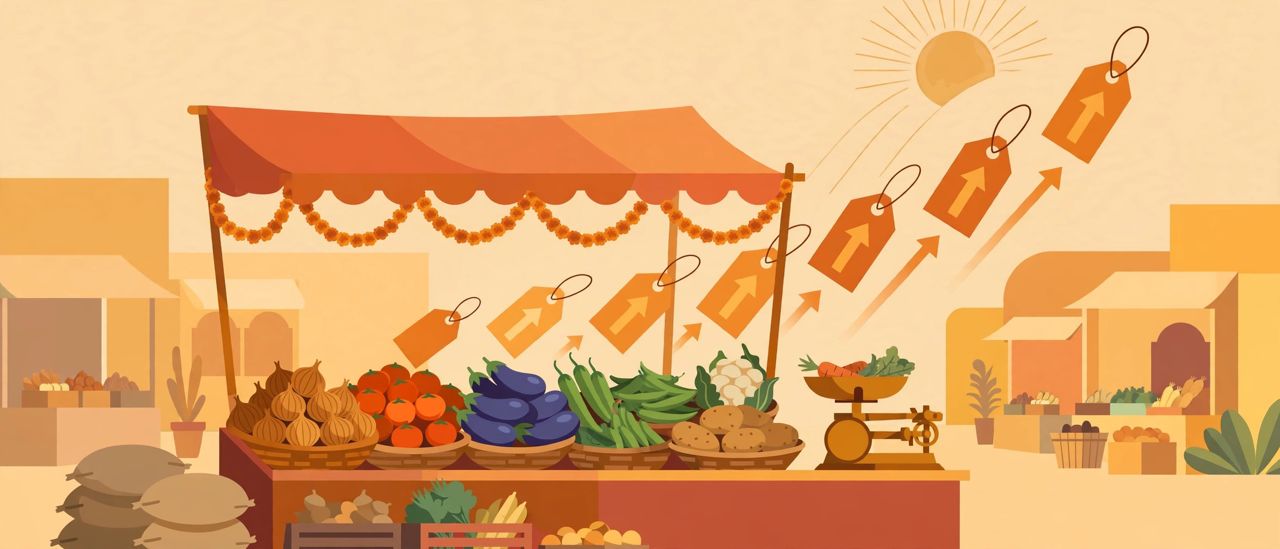
Editorial illustration: food prices have pushed India's retail inflation to 6.09% in October 2026, breaching the RBI's 6% upper tolerance limit for the first time in two years.
Key Takeaways
Retail inflation rose to 6.09% in October 2026 from 5.54% in September, a two-year high and the first breach of the RBI's 6% upper limit since October 2024.
Food inflation accelerated to 8.94% in October from 7.74% in September; rural food inflation was 9.09% and urban 8.68%.
Inflation has risen every month in 2026, from 2.74% in January to 6.09% in October, a ninth straight monthly increase.
The RBI targets 4% inflation within a 2-6% band until March 2031, and already raised the repo rate to 5.50% in October, its first hike in nearly four years.
Economists expect another rate hike when the RBI's Monetary Policy Committee announces its decision on 4 December 2026.
India's retail inflation has jumped to a two-year high, and the question everyone is asking is simple: why is retail inflation rising in India when the economy is otherwise growing at a healthy pace? The answer lies mostly in the food basket. Data released by the Ministry of Statistics and Programme Implementation (MoSPI) on 12 November 2026 shows retail inflation, measured by the Consumer Price Index (CPI), rose to 6.09% in October 2026, up from 5.54% in September. That single number matters because it has pushed inflation above the Reserve Bank of India's (RBI) upper tolerance limit of 6% for the first time in two years.
For households, this is not an abstract statistic. It means the monthly grocery bill, the cost of eating out and the price of everyday essentials are all climbing faster than they were a few months ago. For the RBI, it means the central bank's inflation-targeting framework is now under strain, and for borrowers, it raises the chances of another interest rate hike when the Monetary Policy Committee (MPC) meets in December.
What Happened: October CPI at 6.09%
The headline numbers from the October 2026 CPI release tell the story clearly. Retail inflation rose to 6.09% in October from 5.54% in September, a jump of 55 basis points in a single month. It is the highest reading in about two years and the first time the headline number has crossed the RBI's 6% comfort band since October 2024. It is also the highest print under the new CPI series, which uses 2024 as the base year and was introduced in January 2026.
The rise has been steady rather than sudden. Inflation has now increased every single month in 2026, climbing from 2.74% in January to 6.09% in October — a ninth straight monthly increase under the new series. In other words, price pressures have been building all year, and October was the month they finally crossed the RBI's red line.
The split between rural and urban India is also revealing. Rural inflation stood at 6.63% in October, noticeably higher than urban inflation at 5.41%. That gap matters because rural households spend a larger share of their income on food, and food is exactly where prices have risen fastest.
Why Is Retail Inflation Rising in India?
Food prices are the main driver behind the uptick. Food inflation, measured by the Consumer Food Price Index (CFPI), accelerated to 8.94% in October from 7.74% in September. That is a sharp move in one month, and it came in above market expectations of around 8.5%. Rural food inflation was even higher at 9.09%, while urban food inflation stood at 8.68%.
Economists also point to two supporting factors. First, adverse base effects: prices are being compared with a relatively low base from a year ago, which makes the year-on-year increase look larger. Second, there are signs that price pressures are broadening beyond food. As Radhika Rao, senior economist at DBS Bank, put it, the October data showed "a sharp food-driven upmove accompanied by signs of broadening out of price pressures on a sequential basis." When inflation spreads from one category to others, it becomes harder to bring down quickly.
The data itself is comprehensive. MoSPI said real-time price data were collected from 1,407 urban markets, including online markets, and 1,465 villages across all states and Union Territories, with a 100% response rate in both rural and urban markets during October 2026. The numbers are provisional, but the trend they show is consistent across every major news report of the release.
What Is the RBI's 2-6% Band and Why Does Breaching It Matter?
Under India's inflation-targeting framework, the government has mandated the RBI to keep retail inflation at 4%, within a tolerance band of 2% to 6%. That mandate runs until March 2031. The 4% figure is the target; 6% is the ceiling. Staying below 6% is therefore not just a preference — it is the legal boundary of the RBI's mandate.
The last time inflation crossed 6% was in October 2024. Since then, the RBI had managed to keep the headline number inside the band. The October 2026 breach ends that run and puts the central bank in a difficult position, because its own projections had already pointed to pressure ahead: the RBI has projected inflation at 6% for the third quarter of FY27, and ICRA chief economist Aditi Nayar expects CPI inflation to average around 6.2% in that quarter, slightly higher than the MPC's projection.
There is also a connection with the rupee. A weaker currency makes imports, including crude oil and other inputs, more expensive in rupee terms, and that feeds into domestic prices over time. The rupee has been under pressure this year, which adds another layer to the inflation story. For the full picture on the currency side, see our explainer on [why the Indian rupee is falling against the US dollar](https://indiaask.tech/question.php?slug=why-indian-rupee-falling-against-us-dollar-explained).
What Does This Mean for Interest Rates and Your Loans?
The October inflation data is the final CPI reading available to the RBI before its next monetary policy decision on 4 December 2026, when the MPC meets from 2 to 4 December. With inflation above the 6% ceiling, economists increasingly expect the central bank to raise interest rates again in December.
That expectation is strengthened by what the RBI has already done. In October, the central bank raised its benchmark repo rate by 0.25 percentage points to 5.50%, its first hike in nearly four years. A second successive hike in December now looks likely, according to economists quoted across major business publications. SBI Mutual Fund warned a day before the data release that price pressures could persist, saying in its November 2026 Market Outlook that headline CPI is expected to average almost 5.8% over the next three quarters and could remain near 6% with "a material risk of breaching the 6% threshold."
For borrowers, a rate hike means home loans, car loans and personal loans could get more expensive, since banks pass higher policy rates through to lending rates. For savers, it could mean slightly better returns on fixed deposits. For the broader economy, higher rates are the RBI's main tool to cool demand and bring inflation back inside the band — but they also slow growth, which is why the December decision is being watched so closely.
What Does It Mean for Households and the Economy?
For households, the immediate impact is on the monthly budget. With food inflation near 9%, the grocery bill is where the pressure is felt first, and rural families are feeling it more than urban ones. When food takes a bigger share of spending, families cut back on other things — clothing, eating out, travel and discretionary purchases — and that softer demand eventually shows up in the wider economy.
For the economy as a whole, the picture is mixed rather than bleak. Growth remains strong: Moody's recently raised India's GDP growth forecast to 7% for FY27, and the RBI's own estimate is 7.1%. The challenge is that strong growth alongside rising inflation narrows the RBI's room to support the economy with lower rates. Read our explainer on [why Moody's raised India's GDP growth forecast to 7% for FY27](https://indiaask.tech/question.php?slug=why-moodys-raised-india-gdp-growth-forecast-7-percent-fy27-explained) for the growth side of the story. The good news is that inflation at 6.09% is only just above the ceiling, not a runaway double-digit spiral, and the RBI still has the tools and the time to respond.
What Happens Next?
Three dates matter from here. The RBI's Monetary Policy Committee announces its decision on 4 December 2026, and markets will watch whether the repo rate goes up again. The November CPI data is scheduled for release on 14 December 2026, which will show whether October was a peak or the start of a longer stay above 6%. And over the next few months, the trend in food prices — especially vegetables and cereals — will decide how quickly inflation can come back inside the band.
If food prices cool and the base effect turns favourable, inflation could ease back below 6% without much damage. If food prices stay high, the RBI may have to hike rates further, which would raise borrowing costs for everyone. Either way, the October print has changed the conversation: inflation is no longer a background number, it is now the central question for India's economy heading into December.
For the detailed official reporting behind these numbers, see the coverage in [The Times of India](https://timesofindia.indiatimes.com/business/india-business/cpi-inflation-soars-to-2-year-high-of-6-09-crosses-rbis-upper-limit-raises-chances-of-another-rate-hike/articleshow/135766377.cms) and [CNBC-TV18](https://www.cnbctv18.com/economy/india-october-cpi-inflation-breaches-rbi-upper-limit-rises-to-6-09-pc-food-inflation-20032597.htm), both based on the MoSPI data released on 12 November 2026.
Conclusion
Retail inflation rising to 6.09% in October 2026 is significant not because of the number alone, but because of what it crosses: the RBI's 6% upper tolerance limit, breached for the first time in two years after nine straight months of increases. Food inflation at 8.94% is the main culprit, with rural households hit hardest. The RBI has already raised rates once, in October, and another hike in December now looks likely. For households, the months ahead will depend on food prices; for the RBI, they will depend on whether it can bring inflation back inside the band without hurting growth. The December policy meeting and the November CPI release will give the first answers.
India's retail inflation, measured by the Consumer Price Index (CPI), rose to 6.09% in October 2026, up from 5.54% in September, according to provisional data released by the Ministry of Statistics and Programme Implementation on 12 November 2026. It is a two-year high.
Why is retail inflation rising in India?
Food prices are the main driver. Food inflation measured by the Consumer Food Price Index rose to 8.94% in October from 7.74% in September, with rural food inflation at 9.09%. Adverse base effects and signs of price pressures broadening beyond food are also contributing.
What is the RBI's inflation target and why does 6.09% matter?
The government has mandated the RBI to keep retail inflation at 4%, within a tolerance band of 2% to 6%, until March 2031. At 6.09%, inflation has breached the 6% upper limit for the first time in two years, since October 2024.
Will the RBI raise interest rates in December 2026?
Economists increasingly expect another rate hike when the RBI's Monetary Policy Committee announces its decision on 4 December 2026. The RBI already raised the repo rate by 0.25 percentage points to 5.50% in October, its first hike in nearly four years, and the October CPI print is the last inflation data available before the December meeting.