Home > Economy > Why Did the US Buy Japanese Yen for the First Time Since 1998? The $500 Million Intervention, Explained
Why Did the US Buy Japanese Yen for the First Time Since 1998? The $500 Million Intervention, Explained
By Vijay Pawar · 2026-11-13 · 9 min read · Economy
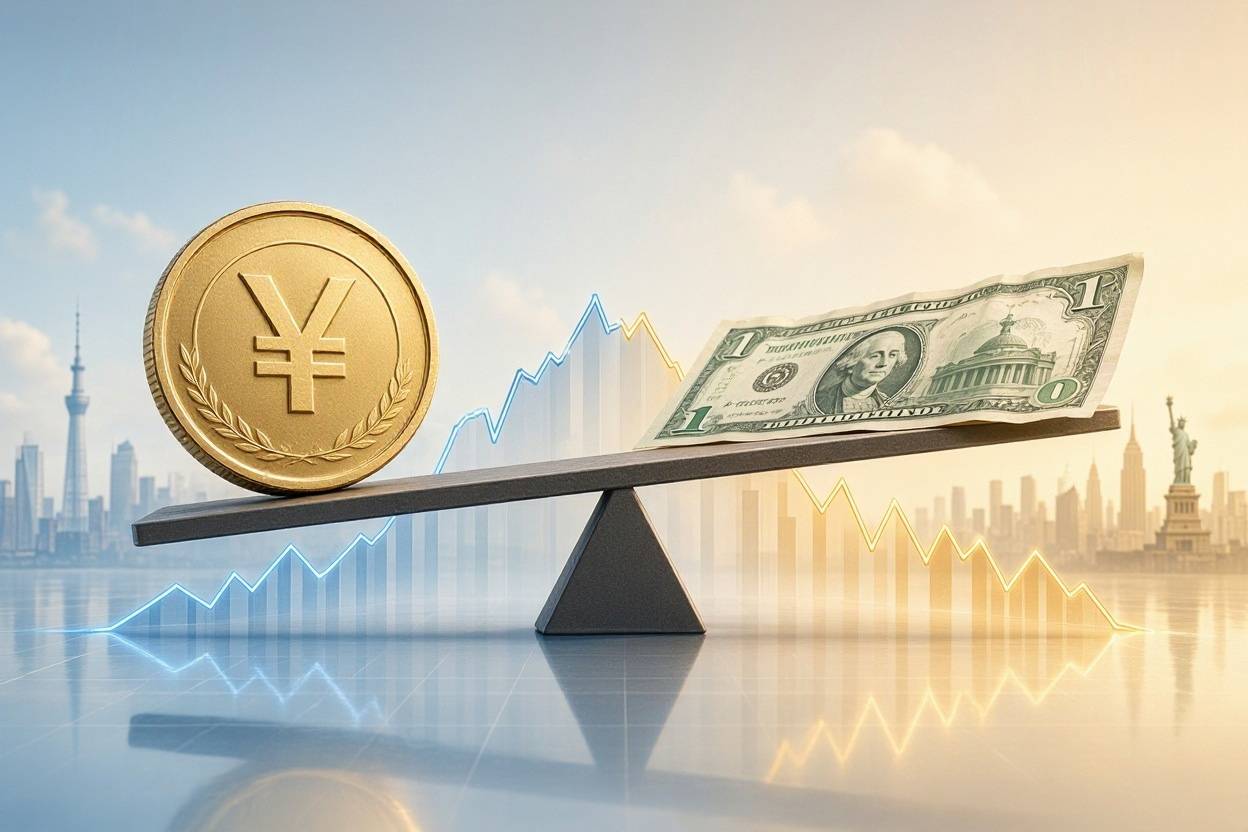
Editorial illustration: the US Treasury's first yen-buying intervention since 1998, buying 79.4 billion yen on 31 July 2026 alongside Japan's intervention to steady the currency.
Key Takeaways
The US Treasury bought yen in the July–September 2026 quarter — its first yen-buying intervention since 1998 — confirmed by the New York Fed's quarterly report on 12 November 2026.
The New York Fed bought 79.4 billion yen (about $500 million) in the spot market on 31 July 2026, selling euros from the Exchange Stabilization Fund, to counter what the Treasury called disorderly moves in the yen.
Japan's Ministry of Finance intervened at the same time, spending about 15 trillion yen, and the dollar-yen rate fell from around 164 to around 155 within a few days.
The Federal Reserve made no foreign exchange interventions on its own account in the quarter — the purchase was a Treasury decision, executed by the New York Fed as its fiscal agent.
With the yen weakening again towards 160, the lasting fix depends on the Bank of Japan, which most economists expect to raise rates to 1.5% in December 2026.
Why did the US buy Japanese yen in July 2026? That is the question markets have been asking since the Federal Reserve Bank of New York confirmed on 12 November 2026 that the US Treasury bought yen this summer — its first yen-buying intervention since 1998. The confirmation came in [the New York Fed's quarterly report on foreign exchange operations](https://www.thestandard.com.hk/finance/article/348397/US-Treasury-bought-yen-in-July-Fed-made-no-solo-FX-interventions-in-Q3), and it ended months of speculation about whether Washington had quietly joined Tokyo in defending the Japanese currency.
The numbers are small by the standards of global currency markets, but the signal is large. According to the report, the New York Fed bought 79.4 billion yen — roughly $500 million — in the spot market on 31 July 2026. It paid for the yen by selling euros held in the Exchange Stabilization Fund, the US Treasury's account for currency operations. The stated purpose, in the report's own words, was "to counter what the US Treasury viewed as disorderly moves in the Japanese yen."
What happened in July 2026
The intervention did not come out of nowhere. Through July 2026, the yen had been sliding sharply against the dollar, at one point approaching 164 yen to the dollar. A fall that fast worries policymakers for a simple reason: when a currency moves in a disorderly rush, it stops reflecting economic fundamentals and starts feeding on itself, as traders pile into the same direction.
On 30 July, press reports emerged that the New York Fed had asked banks for "rate checks" on the dollar-yen rate — a standard early step in which a central bank asks dealers to quote prices, partly to test the market and partly to signal that the authorities are watching. The New York Fed's report later confirmed that those checks were made "solely on behalf of the US Treasury," with the New York Fed acting as the government's fiscal agent. The yen rose more than 2% that day.
The next day, 31 July, the actual purchase followed: 79.4 billion yen bought in the spot market. Crucially, Washington was not acting alone. [Japan's own Ministry of Finance intervened at the same time](https://investinglive.com/central-banks/us-treasury-bought-yen-in-july-its-first-intervention-since-1998-as-yen-nears-160-again/), spending about 15 trillion yen during the quarter. The combined action worked, at least in the short term: the dollar-yen rate fell from around 164 to around 155 within a few days, meaning the yen strengthened.
Why did the US buy Japanese yen?
Governments rarely explain currency intervention in detail, and the US Treasury's explanation was deliberately narrow: it viewed the yen's moves as "disorderly." That word matters. Under the norms agreed by the G7 group of advanced economies, intervention is supposed to be reserved for excessive volatility and disorderly movements, not for steering a currency to a level a government happens to prefer. By framing the action that way, Washington signalled that it was calming a market, not starting a currency war.
There is also a coordination story here. Japan had been intervening on its own to support the yen, but a move carries far more weight when the world's largest economy joins in. The New York Fed's report shows that Washington acted alongside Tokyo — the US purchase was small next to Japan's 15 trillion yen, yet the message it sent was that the slide had become a shared concern rather than Japan's problem alone.
It is equally important to note what did not happen. The Federal Reserve itself made no foreign exchange interventions on its own account in the July-to-September quarter. The distinction matters: the Fed conducts monetary policy, while the Treasury is responsible for the dollar's exchange-rate policy. The yen purchase was a Treasury decision, executed by the New York Fed as the Treasury's agent — not a change in US interest-rate policy.
Why a weak yen worries Japan
To understand why the yen's slide needed a response, it helps to see what a weak currency does. Japan imports almost all of its oil and gas and much of its food, and it pays for those imports in dollars. When the yen weakens, every barrel of oil and every shipment of wheat costs more yen, pushing up prices for households and businesses. A gradual fall can be absorbed; a sharp, disorderly one feeds inflation quickly and squeezes living standards.
A weak yen also has a flip side that complicates the picture: it makes Japanese exports cheaper abroad, which helps exporters. That is one reason Japan has often tolerated a soft yen. But when the currency falls too far, too fast, the import-cost pain outweighs the export gain, and the risk grows that speculators will push it further purely because it is falling. Intervention is designed to break that momentum.
The yen's weakness also matters beyond Japan because of the so-called carry trade. For years, investors have borrowed cheaply in yen — where interest rates have been very low — and invested the money in higher-yielding assets elsewhere. When the yen suddenly strengthens, those borrowers rush to repay their yen loans, which can send shockwaves through global bond and stock markets. That is one reason a disorderly yen move is treated as a global concern, not just a Japanese one.
What is a currency intervention, and how does it work?
A currency intervention is when a government or central bank buys or sells its own currency in the foreign exchange market to influence its value. To support the yen, the US Treasury sold euros from the Exchange Stabilization Fund and bought yen. Buying yen increases demand for it, which pushes its price up against the dollar.
Interventions come in two broad types. A "sterilised" intervention is offset by other operations so that it does not change the domestic money supply; an "unsterilised" one lets the money supply move too. The New York Fed's report does not dwell on those mechanics — the point it makes is simpler: the operation was targeted, limited in size and aimed at disorderly conditions.
History also explains why the 1998 comparison drew so much attention. The last time the United States bought yen was in 1998, during the Asian financial crisis, when Washington joined Tokyo in a coordinated intervention to support the Japanese currency. That a similar step was needed again, 28 years later, tells its own story about how severe the yen's slide had become by July 2026.
Why the yen is under pressure again
The confirmation of the July intervention arrived at an awkward moment: the yen has been weakening again and was nearing 160 to the dollar at the time of the report's release. The market is now watching the Bank of Japan, which sets Japan's interest rates. Most economists expect the Bank of Japan to raise its policy rate to 1.5% in December 2026, a step that would narrow the gap between Japanese and US interest rates and, in theory, make the yen more attractive to hold.
That expectation is not a certainty, and the Bank of Japan has moved cautiously in the past. But the logic is straightforward: when US rates are much higher than Japanese rates, investors prefer to hold dollars; as the gap closes, the yen becomes more competitive. Until that happens, traders will keep testing whether Tokyo — and now Washington — will step in again if the yen slides too fast.
For India, the episode is a useful reminder of how connected currency markets are. A strong dollar has already been pressing on the Indian rupee, which has been falling against the US dollar — a trend explained in detail in our article on [why the Indian rupee is falling against the US dollar](https://indiaask.tech/question.php?slug=why-indian-rupee-falling-against-us-dollar-explained). When the dollar surges against one major currency, it tends to rise against others too, and when the US intervenes to weaken the dollar against the yen, some of that pressure eases elsewhere as well. Currency moves also feed into inflation through import prices, which is why the Reserve Bank of India watches both the rupee and global rates closely — the same forces behind [retail inflation rising to 6.09% in October 2026](https://indiaask.tech/question.php?slug=why-retail-inflation-rose-6-09-percent-october-2026-explained).
What happens next
Three things will decide whether the July intervention is remembered as a turning point or a footnote. The first is the Bank of Japan's December decision: a rate rise to 1.5% would do more for the yen over time than any single day of buying. The second is the dollar-yen level itself — if the rate pushes well past 160, markets will assume another round of coordinated intervention is on the table. The third is whether Washington's involvement was a one-off or the start of a more active US stance on the yen.
What is already clear is that the intervention broke a 28-year silence. The US had not bought yen since 1998, and it chose to do so alongside Japan, in modest size, with a carefully worded justification. That combination — small money, big message — is often how currency intervention works best: the aim is not to outspend the market, which no government can do for long, but to convince it that the authorities are united and watching. Whether the market believes that will be tested in the weeks ahead, starting with the Bank of Japan's next move.
Conclusion
The US bought Japanese yen in July 2026 because the Treasury judged the yen's slide to be disorderly, and it did so in coordination with Japan's far larger intervention. The New York Fed's purchase of 79.4 billion yen on 31 July — the first US yen-buying since 1998 — helped push the dollar-yen rate down from around 164 to around 155 within days. But with the yen weakening again towards 160, the lasting fix depends less on intervention and more on the Bank of Japan's interest-rate decisions. The July episode showed that Washington is willing to act; the December rate decision will show whether the yen's underlying weakness is finally being addressed.
The US Treasury viewed the yen's sharp slide as a disorderly move. The New York Fed bought 79.4 billion yen (about $500 million) on 31 July 2026 to counter that disorder, acting alongside Japan's own much larger intervention.
When was the last time the US bought yen before 2026?
In 1998, during the Asian financial crisis, when Washington joined Tokyo in a coordinated intervention to support the Japanese currency. The July 2026 purchase was the first US yen-buying intervention in 28 years.
How much yen did the US buy, and how was it paid for?
The New York Fed bought 79.4 billion yen, worth about $497 million, in the spot market on 31 July 2026, selling euros from the Treasury's Exchange Stabilization Fund. Japan's Ministry of Finance intervened at the same time, spending about 15 trillion yen.
Did the intervention work, and what happens next?
In the short term, yes: the dollar-yen rate fell from around 164 to around 155 within a few days. But the yen has weakened again towards 160, so the lasting fix depends on the Bank of Japan — most economists expect it to raise rates to 1.5% in December 2026.