Home > Constitution & Law > What Is a Digital Arrest Scam? Supreme Court's WhatsApp Order and How to Stay Safe Explained
What Is a Digital Arrest Scam? Supreme Court's WhatsApp Order and How to Stay Safe Explained
By Vijay Pawar · 2026-11-11 · 9 min read · Constitution & Law
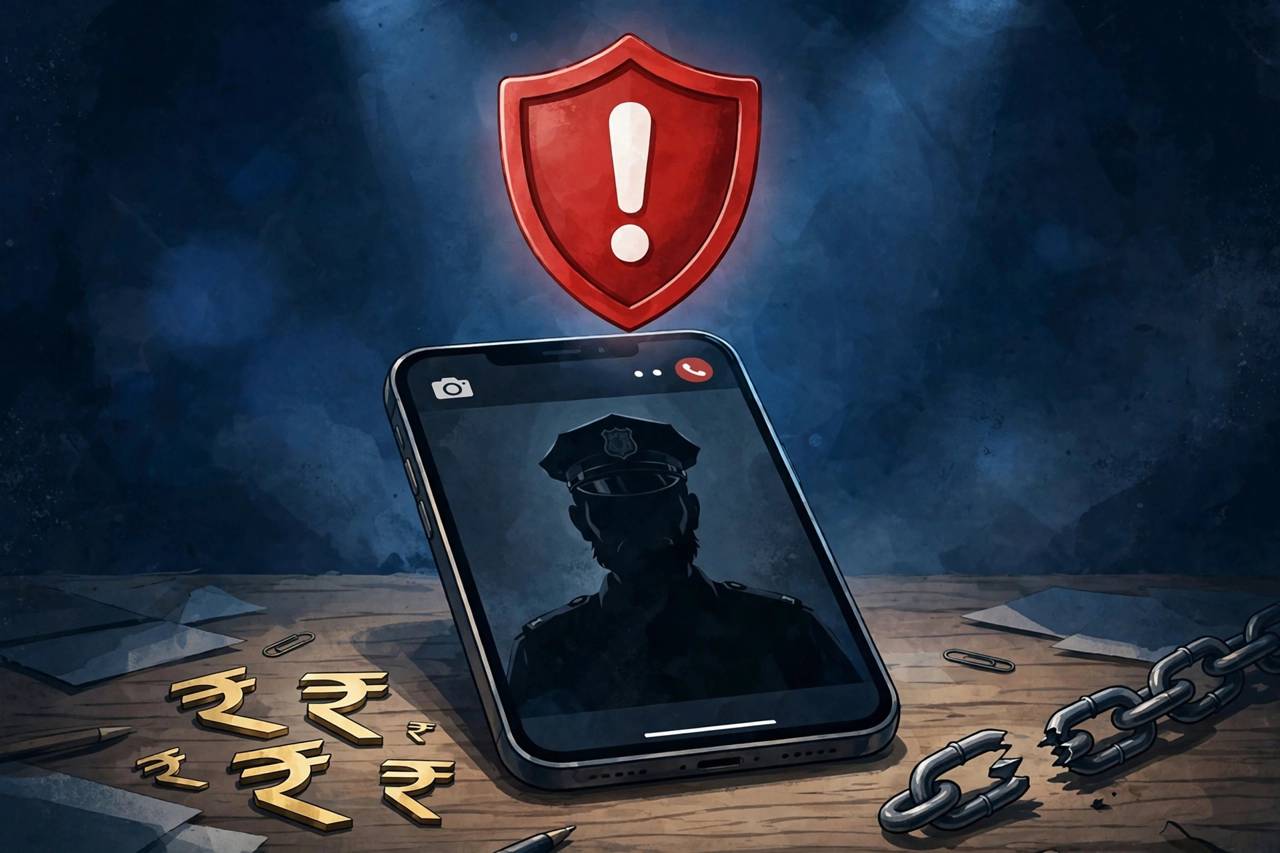
Editorial illustration: a smartphone showing a video call with a shadowy fake officer, a red warning shield above it, and rupee symbols nearby — no text, no real person, no logos.
Key Takeaways
There is no legal concept of digital arrest in India — no agency arrests anyone on a video call or asks for money to clear a name.
On 10 November 2026 the Supreme Court directed WhatsApp and other intermediaries to submit cybercrime prevention plans to the court and to the I4C.
WhatsApp told the court it had acted against 9,400 accounts and is building software to spot suspicious accounts and warn users.
Banks must compensate victims where fraud occurred due to their failure of due diligence; RBI KYC directions are due by 30 November and in force by 31 December 2026.
Victims lost around Rs 800 crore this year; if you get such a call, hang up and report it on helpline 1930 or cybercrime.gov.in.
A phone call arrives, the caller says he is a police officer, and within minutes you are told you are under "digital arrest". You must stay on a video call, keep your camera on, tell nobody, and transfer your savings to an account the caller names for "verification". It sounds official, it feels terrifying, and it is a complete fraud. So what is a digital arrest scam, and why has the Supreme Court of India now stepped in? On 10 November 2026, the court directed WhatsApp and other online platforms to tell it what they plan to do to stop these scams, and asked banks to be ready to compensate victims when their own checks fail. This article explains what happened, how the scam works, and what you should do if such a call ever reaches you.
What Is a Digital Arrest Scam?
A digital arrest scam is a fraud in which criminals pretend to be police officers, CBI or Enforcement Directorate officials, customs or narcotics officers, or even bank and telecom officials. They tell the victim that their name has appeared in a serious case — often money laundering, a parcel containing drugs, or misuse of their Aadhaar or bank account — and that they are now under "digital arrest". The victim is ordered to stay on a phone or video call, keep the camera switched on, not leave the room, and not tell family members. Then comes the demand: transfer money to a so-called safe account for verification, or pay a fine, bond or security deposit to avoid arrest.
There is no such thing as a digital arrest in Indian law. No police force, court or investigating agency arrests anyone over a video call, and no agency asks a citizen to transfer money to prove innocence. The Indian Cyber Crime Coordination Centre (I4C), which works under the Ministry of Home Affairs, said this clearly in an advisory in October 2024: the CBI, police, customs, ED and judges do not arrest people on video calls. The Rajasthan High Court, taking suo motu notice of the growing menace in January 2025, also observed that digital arrest has no legal standing in India. Under Article 22 of the Constitution, a person who is actually arrested must be told the grounds of arrest and produced before a magistrate within 24 hours — something no video call can ever do.
What Did the Supreme Court Order on 10 November 2026?
The Supreme Court is hearing a suo motu case titled "In Re: Victims of Digital Arrest Related to Forged Documents". A bench headed by Chief Justice of India Surya Kant, along with Justices Joymalya Bagchi and V Mohana, heard the matter on 29 October 2026, and its order was uploaded on the court's website on 10 November 2026.
The court directed WhatsApp and other intermediaries to inform it about the measures they propose to take to prevent digital arrest scams and related cybercrimes, and to submit those proposals simultaneously to the I4C. Senior advocate Kapil Sibal, appearing for WhatsApp, told the court that the platform had already taken action against 9,400 accounts and was developing software to identify suspicious accounts and warn users. WhatsApp is to file an affidavit setting out the steps it has taken.
The court also turned its attention to banks. On 29 October, it had said financial institutions must be held accountable, and that banks should compensate victims where an investigation establishes that the fraud happened because the institution failed to exercise due diligence. The court said the proposed Reserve Bank of India (Know Your Customer) Amendment Directions, 2026, must include provisions requiring financial institutions to indemnify victims and pay compensation of not less than the amount lost. Those directions are proposed to be notified by 30 November 2026 and operationalised by 31 December 2026. The court said it would first examine the draft KYC directions before allowing the regulatory process to proceed.
All law enforcement agencies in the states and Union Territories have also been directed to submit the status of FIRs registered so far in digital arrest cases, along with suggestions for prevention, detection and prosecution. The Directors General of Police of all states and Union Territories have been told to ensure compliance. The matter will be heard next on 23 November 2026.
How Big Is the Problem?
The scale of the problem is what pushed the country's highest court to act on its own. According to figures reported from I4C's status reports, complaints of digital arrest fell from 1,23,672 in 2024 to 58,239 in 2025, and stood at 16,377 for the period up to 30 June 2026. Yet the money lost remains enormous: the court was told that despite a decline of about 50 per cent in cybercrimes, victims had lost around Rs 800 crore so far this year. The numbers show that while awareness may be improving, the gangs behind these calls are still reaching — and robbing — thousands of people, including elderly citizens, professionals and students.
The scam is described by the government as an organised, cross-border economic crime. It does not depend on hacking or malware. It depends on fear, authority and speed. The fraudsters build a theatre of authority: fake identity cards, forged notices, police uniforms, official logos, simulated offices, and sometimes extra callers posing as senior officers. The victim is isolated and kept continuously connected so that fear prevents independent checking. Read our earlier report on [the Supreme Court's direction that banks must compensate digital arrest victims](https://indiaask.tech/question.php?slug=sc-digital-arrest-bank-compensation-explained) for the background to the compensation question.
How the Scam Usually Unfolds
The call typically begins with an alarming claim: a parcel in your name contains illegal goods, your bank account is linked to money laundering, or your Aadhaar number has been misused. A fake case number and forged documents are shown on screen. The caller warns that an arrest warrant has been issued and that you must cooperate at once.
Next comes the isolation. You are told the matter is confidential, that family members may be involved, and that you must not disconnect the call or tell anyone. The camera must stay on so the "officers" can watch you. Then the demand arrives: transfer your money to a "safe account" for verification, pay a "security deposit", or move funds through UPI, bank transfer or even cryptocurrency. The pressure is deliberate — every minute you are given to think is a minute the scam can fail, so the caller creates urgency and panic.
The red flags are always the same. You are told you are under "digital arrest" or "digital custody". You are asked to transfer money to any account to "verify", "secure" or "release" it. You are asked for OTPs, PINs or passwords, or told to install an app or share your screen. Any one of these is proof that the call is a fraud.
What This Means for You
The Supreme Court's order matters for ordinary people in three ways. First, it puts the platforms on notice: WhatsApp and other intermediaries must show concrete plans, not just general assurances, and share them with the I4C. Second, it moves the responsibility onto banks as well: if a bank's failure of due diligence allowed the fraud, the victim may have to be compensated in full. Third, it creates a timeline — the RBI's KYC directions by 30 November and in force by 31 December — so the changes are not left open-ended.
None of this, however, replaces personal caution. The strongest protection remains knowing one fact: no genuine authority will ever arrest you on a video call or ask you to move your money to a safe account. A real arrest is a physical act, and a real investigation does not happen on WhatsApp. The Supreme Court has separately explained [when the 24-hour deadline to produce an arrested person before a magistrate begins](https://indiaask.tech/question.php?slug=supreme-court-24-hour-deadline-detention-not-formal-arrest-explained), which underlines why a "digital arrest" cannot be a lawful arrest at all.
What to Do If You Get Such a Call
If a threatening call is happening right now, the safest response is simple. Stay calm and do not argue. Disconnect the call — you do not need the caller's permission to end it, and hanging up is not an offence. Do not transfer money, share an OTP or PIN, or install any app. Contact someone you trust immediately, because the scam depends on keeping you alone. Then verify independently: if you are worried about a real case, contact your nearest police station or the agency concerned using a number from its official website, never a number given by the caller. Preserve evidence — the caller's number, screenshots, messages and payment details.
If money has already been transferred, act at once. Call the national cybercrime helpline 1930 immediately, so banks can be alerted to hold the funds. File a complaint on the National Cyber Crime Reporting Portal at [cybercrime.gov.in](https://cybercrime.gov.in), and inform your bank without delay. You can also report the number through Chakshu on the Sanchar Saathi portal. Speed improves the chance of tracing the funds, though recovery can never be guaranteed.
The Supreme Court's intervention, reported by [PTI via Rediff](https://www.rediff.com/news/report/sc-directs-whatsapp-banks-on-digital-arrest-cybercrime-prevention/20261110.htm) and [The Hindu BusinessLine](https://www.thehindubusinessline.com/info-tech/sc-asks-whatsapp-others-to-list-measures-to-prevent-digital-arrest-related-cyber-crimes/article71685754.ece/amp/), shows that digital arrest is now treated as a national problem requiring action from platforms, banks and police together. The next hearing on 23 November will show whether those plans are concrete. Until then, the simplest rule protects everyone: a call that demands money under threat of arrest is a scam — hang up, tell someone, and report it on 1930.
Conclusion
A digital arrest scam is not a legal procedure but a script built on fear, isolation and speed, and it has already cost victims around Rs 800 crore this year alone. The Supreme Court's order of 10 November 2026 asks WhatsApp and other platforms to submit prevention plans to the I4C, holds banks accountable for compensating victims when their due diligence fails, and sets a firm timeline for the RBI's new KYC directions. If you ever receive such a call, remember the one fact that defeats the whole trick: no one is ever arrested on a video call in India. Hang up, speak to someone you trust, and report the call on 1930 or cybercrime.gov.in.
A digital arrest scam is a fraud in which criminals posing as police, CBI, ED, customs or bank officials keep a victim on a phone or video call, claim the victim is under investigation, and pressure them into transferring money to a so-called safe account. There is no such thing as a digital arrest in Indian law — no agency arrests anyone over a video call or asks for money to clear a name.
What did the Supreme Court order about digital arrest scams on 10 November 2026?
In the suo motu case 'In Re: Victims of Digital Arrest Related to Forged Documents', a bench headed by Chief Justice Surya Kant directed WhatsApp and other intermediaries to submit their proposed prevention measures to the court and simultaneously to the Indian Cyber Crime Coordination Centre (I4C). The court also said banks must compensate victims where fraud occurred due to the bank's failure of due diligence, and asked law enforcement agencies to report the status of FIRs. The next hearing is on 23 November 2026.
What should I do if I receive a digital arrest call?
Hang up immediately — ending the call is not an offence. Do not transfer money, share OTPs or PINs, or install any app. Tell a family member or friend, and verify any claim independently through the official website of the agency concerned. If money has been transferred, call the national cybercrime helpline 1930 at once and file a complaint on cybercrime.gov.in.
Will banks compensate digital arrest victims?
The Supreme Court has said financial institutions must indemnify victims and pay compensation of not less than the amount lost, where it is established that the fraud happened because the institution failed to exercise due diligence. The proposed RBI (Know Your Customer) Amendment Directions, 2026, which are to be notified by 30 November 2026 and operationalised by 31 December 2026, are expected to carry these provisions.